资讯 / 正文
2027届模拟试卷速递41:较简单! 20261112湖丽衢三地市高三英语 +答案+听力文本(word版本下载)
开学了,推荐高中英语学习必备书:最新2026版应用文写作和读后续写:
2026年7月第10版《新高考英语应用文写作+读后续写+人教版单元词块整理三驾马车》来啦!
我用夸克网盘给你分享了「20261112湖丽衢.docx」,点击链接或复制整段内容,打开「夸克APP」即可获取。
链接:https://pan.quark.cn/s/74002ebb08e1
音频下载:
我用夸克网盘给你分享了「衢丽湖高三英语听力.mp3」,点击链接或复制整段内容,打开「夸克APP」即可获取。
链接:https://pan.quark.cn/s/6c911e5bdba8
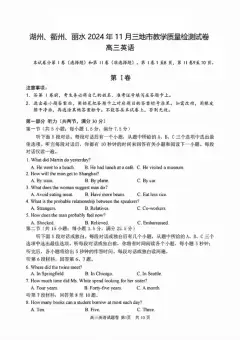
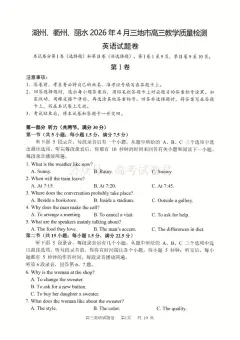
衢州、丽水、湖州2026年11月三地市高三教学质量检测 英语试题卷
第一部分听力 (共两节,满分 30 分)
第一节 (共 5 小题;每小题 1.5 分,满分 7.5 分)
听下面 5 段录音。每段录音后有一个小题,从题中所给的 A、B、C 三个选项中选出最佳选项。听完每段录音后,你都有 10 秒钟的时间来回答有关小题和阅读下一小题。每段录音播放两遍。
1.What will the woman do first?
A. Finish her project. B. Design a water system. C. Go over the instructions.
2.When does the man plan to reach the station?
A. At 3:50. B. At 4:30. C.At 5:10.
3.Where does the conversation probably take place?
A. In an art store. B. At an art show. C. In an art classroom.
4.What are the speakers mainly talking about?
A. The homeless victims. B. The strong winds. C. A natural disaster.
5.What is the probable relationship between the speakers?
A. They are gym partners. B. They are neighbors. C. They are colleagues.
第二节 (共 15 小题;每小题 1.5 分,满分 22.5 分)
听下面五段录音。每段录音后有几个小题,从题中所给的 A、B、C 三个选项中选出最佳选项。听每段录音前,你将有时间阅读各个小题,每小题 5 秒钟,听完后,每小题都有 5 秒钟的作答时间。每段录音播放两遍。
听第 6 段录音,回答第 6、7 题。
6. What do we know about Kate's father?
A. He is learning to fly a plane.
B. He is qualified to pilot a plane.
C. He will retire after finishing the plane.
7.What will happen once the plane is completed?
A. Kate will take the first flight in it.
B. Experts will make a trial flight first.
C. Kate's father will test the plane right away.
听第 7 段录音,回答第 8 至 10 题。
8. What can we learn about Lily?
A. She is a student. B. She hates her job. C. She earns much money.
9.What is Peter going to do this year?
A. Find a good job. B. Give up smoking. C. Join a photography club.
10.What is Judy's New Year's resolution this year?
A. Taking a holiday. B. Going on a diet. C. Visiting her grandparents.
听第 8 段录音,回答第 11 至 13 题。
11. What is Sirmon's main job responsibility?
A. Selling software. B. Developing software. C. Providing customer service.
12.What is the function of the software?
A. To analyze market trends.
B. To work out the costs of production.
C. To manage relations with customers.
13.What is the biggest problem Simon faces at work?
A. Tight working time.
B. Unpredictable market trends.
C. Difficult relations with customers.
听第 9 段录音,回答第 14 至 17 题。
14. What is the man doing?
A. Discussing current affairs. B. Conducting a survey. C. Writing a class report.
15.What does the man want to find out?
A. Why people watch news on TV.
B. How young people get their news.
C. How often people read newspapers.
16.What does the woman occasionally do in English class?
A. Visit news sites. B. Watch the news on TV. C. Read English newspapers.
17.Where does the woman usually get her news?
A. From the Internet and TV.
B. From newspapers and the Internet.
C. From mobile phone and the Internet.
听第 10 段录音,回答第 18 至 20 题。
18. What does the speaker mainly talk about?
A. Advertising benefits. B. Unnecessary spend. C. Consumer habits.
19.Why are related items recommended?
A. For lower price. B. For better service. C. For more purchase.
20.What is the last reason for people often overspending?
A. Digital currency. B. Fancy advertising. C. Accessory products.
第二部分阅读 (共两节,满分 50 分)
第一节 (共 15 小题;每小题 2.5 分,满分 37.5 分)
阅读下列短文,从每题所给的 A、B、C 和 D 四个选项中,选出最佳答案。
A
Unplanned travel is easier than ever. A groupchat message, a cheap train ticket or a lastminute flight deal can have you leaving the next morning. It doesn't require perfect planning, but keeping a few basics ready makes it easier to leave with confidence and stay flexible. Here are five items worth keeping on hand.
Passport Bag & Card Holder
For international travel, few things matter more than your passport. Keep it and your cards in the same holder — a permanent home that can prevent lastminute panic.
Sunscreen
People often think sunscreen is only for beach vacations, but that's far from true. Whether you're hiking in the mountains, exploring a city, or even visiting snowy destinations, UV rays are still there. Applying it each morning helps reduce longterm sun damage.
Chargers (and a Portable Charger)
A dead phone while traveling is surprisingly stressful. Always pack your charging cable, and if possible, carry a portable charger. Extra power can be invaluable during a long day of travel.
BandAids
If you get a small cut, or you scrape your knee while exploring somewhere new, you'll be glad you packed a few. They're tiny, inexpensive, and one of those things easy to forget until the exact moment you need them.
One Small Thing That Makes You Feel Like Yourself
Travel can be exciting, but it can also be exhausting. Having one familiar item — whether it's your favorite lipstick, perfume, notebook, or headphones — can make even a hotel room feel a little more like home.
The beauty of unplanned travel isn't that everything goes perfectly, but that you're willing to go. Pack light, stay flexible, and embrace the unexpected — those unplanned adventures often become your best life stories.
21.What is emphasized about sunscreen?
A. Its small size. B. Its practical use. C. Its seasonal limits. D. Its special value on beaches.
22.Which two practices are recommended?
A. Having a lipstick and packing light clothes.
B. Booking flights weeks ahead and carrying a charger.
C. Leaving notebooks behind and taking a few BandAids.
D. Keeping passports with cards and bringing familiar items.
23.Who is the text mainly intended for?
A. People traveling with little planning. B. Students studying tourism.
C. Travelers shopping for luxury goods. D. Families moving to new places.
B
When Ulunda Baker was eight, her mother put her and her six younger siblings on a bus to Florida with only the clothes they were wearing. It was one of many moves during a childhood in which the family sometimes stayed with relatives and sometimes had no home at all. Depending on food banks, charities and neighbors, they managed to get by, though poverty affected them "mentally, physically, and emotionally," Baker later recalled.
By sixteen, Baker was close to dropping out of high school, which might have narrowed an already limited future. Then a teacher offered her an internship (实习) at an insurance company, where she would learn about contracts and business. There was, however, one condition: "You have to stay in school." Committed to recovering the credits she had missed, Baker attended classes during the day and at night until she earned her diploma. What began as a reason to remain in school opened up a world she had never imagined entering. The internship led to a career lasting more than twenty years at a Fortune 500 company that helps people plan for their futures, where she led teams and helped support small businesses.
Success did not separate Baker from her past, instead, it gave that past a new purpose. Drawing on her experience, she prepared tax returns for families in need, tutored students and served organizations supporting schools, shelters and lowincome communities. She also encouraged young people to improve their financial lives through small choices, believing that even saving fifty cents could begin a new habit.
Not until Baker looked back did she recognize how much had begun with one teacher's decision to notice her potential. The internship did not remove every obstacle or fear, but it gave her direction when she needed it most. Baker now tries to offer others the same combination of practical help and belief. "The life you were born into," she says, "is not the life you're required to live."
24.What mainly characterized Baker's childhood?
A. Frequent travels and adventures. B. Unsettled life and hardship.
C. Growing independence from others. D. Consistent support from relatives.
25.Why was the internship important to Baker?
A. It enabled her to recover missed credits. B. It helped her start an insurance company.
C. It guaranteed her permanent employment. D. It kept her in school and launched her career.
26.Which of the following best describes Baker?
A. Caring and determined. B. Practical and cautious.
C. Confident and competitive. D. Ambitious and independent.
27.What does Baker's experience show?
A. Giving back is the highest goal of life. B. A good opportunity ensures career success.
C. One's origin does not define one's future. D. Practical skills outweigh academic learning.
C
Seeking out a peaceful spot and writing a few words with a favourite pen can be more than a pleasant way to pass the time. From helping us cope with difficulties to improving memory, handwriting may benefit our wellbeing.
Many of us once kept diaries as children or wrote letters to distant family and friends before digital communication became part of everyday life. Yet handwriting is an easy habit to lose. According to recent YouGov research, only one in six of us updates a journal or diary by hand at least a few times a month, as digital devices have largely replaced traditional writing.
However, choosing a pen over a keyboard is not just a stylistic choice; it is a workout for the brain. Norwegian researchers collected data from 36 university students who either wrote with a pen or typed on a keyboard. The findings were striking: brain connectivity jumped when participants wrote by hand, but showed no such change when they typed. Audrey van der Meer, a professor from the Norwegian University of Science and Technology, notes that the precise movements involved in forming letters support brain activity linked to learning and memory. This may help explain why children who learn mainly on screens sometimes struggle to distinguish between visually similar letters.
Beyond cognitive (认知的) enhancement, handwriting works as a powerful tool for emotional management. Psychologist James Pennebaker, in his book Opening Up By Writing It Down, explores how expressive writing can ease emotional pain. He recommends writing continuously by hand for 1520 minutes daily over several days about a difficult experience. "Expressive writing is not a form of journaling or diary writing, nor is it a practice that will help you become a novelist or writer. Rather, it is a brief writing technique that helps people understand and manage emotional upheavals in their lives," he says.
In a world overloaded with digital information, handwriting offers an ideal antidote (解药) to mental exhaustion. It requires neither beautiful script nor artistic talent — only a willingness to begin. A few honest lines may be enough to bring scattered thoughts into focus and create a quiet space away from the speed and noise of the screen.
28.Why does the author mention diaries and letters in paragraph 2?
A. To explain children's interest in writing. B. To introduce ways of staying connected.
C. To show handwriting's former popularity. D. To stress the value of personal communication.
29.How was handwriting different from typing in the Norwegian study?
A. It produced better learning results. B. It helped students write much faster.
C. It required less effort from the students. D. It created more connections in the brain.
30.What does the underlined word "upheavals" in paragraph 4 probably mean?
A. Struggles. B. Needs. C. Responses. D. Expressions.
31.What is the main purpose of the text?
A. To compare different writing habits. B. To examine the decline of handwriting.
C. To highlight handwriting's value today. D. To confirm handwriting's effects on learning.
D
Even as global warming causes sea levels to rise worldwide, sea levels around Greenland will likely drop. According to a new study published in Nature Communications, local sea levels could fall by roughly 0.9 meters under a lowemissions scenario (预测) and 2.5 meters under a highemissions scenario by 2100.
This contradictory outcome is driven primarily by the rise of the land beneath Greenland's ice sheet. The ice sheet loses about 200 billion tons of ice each year. As this huge weight disappears, the land beneath rises. This uplift lowers the relative sea level — the height of the sea in relation to the land — along the coast. Meanwhile, as the ice sheet becomes smaller, its pull on the surrounding ocean becomes weaker, causing some seawater to move away.
In their study, the lead author Lauren Lewright and her team combined sealevel records covering thousands of years with more than two decades of height measurements from a network of satellitemonitoring stations across Greenland. By comparing their models with these realworld observations, they found that the solid Earth beneath Greenland is responding to ice loss much faster than older models predicted. This quicker response suggests that local sealevel falls may be greater than earlier estimates.
However, a lower sea level does not mean that Greenland will escape the effects of climate change. "The biggest impact is on local communities and the effects on shipping routes, fishing and infrastructure (基础设施)," says study coauthor Austermann. Ports, roads, and other infrastructure built for presentday sea levels may be left high and dry. At the same time, some glaciers that reach the ocean might become more stable if the water level falls enough, although scientists are still uncertain whether this effect would be strong enough to slow ice loss.
Sealevel change is often discussed in terms of global averages. In reality, different regions are shaped by different combinations of global and local forces. As Austermann puts it, "Any sea level prediction or consideration needs to be done on a local or regional scale."
32.What explains the possible sealevel fall around Greenland?
A. Lower emissions slow global warming.
B. Melting ice pushes nearby seawater away.
C. Ice sheet loss causes rising land and weaker pull.
D. Rising land blocks meltwater from entering the sea.
33.What can we learn about the study from paragraph 3?
A. Future ice loss can now be measured directly.
B. The land is rising faster than previously expected.
C. Ancient records work better than modern measurements.
D. Sea levels have already fallen considerably in Greenland.
34.What might a lower sea level bring about?
A. No further glacier loss.B. Safer coastal communities.
C. More shipping routes and fishing grounds. D. Worse infrastructure but more stable glaciers.
35.Which of the following is the best title for the text?
A. Global Warming: A Threat to Greenland
B. Falling Sea: A Different Story in Greenland
C. Melting Ice: Changes Along Greenland's Coast
D. Changing Coasts: Effects of Greenland's Ice Loss
第二节 (共 5 小题;每小题 2.5 分,满分 12.5 分)
阅读下面短文,从短文后的选项中选出能填入空白处的最佳选项。选项中有两项为多余选项。
Generative AI can now produce polished writing in seconds. This has made a familiar question harder to answer: Who is really the author? In the past, a finished essay was often treated as evidence of a student's thinking and writing ability. 36 A strong product may show what is on the page, but not how it got there.
One way to look beyond the final product is to focus on the process. 37 What matters, then, is not only the result but the learning that produced it. Teachers can ask students to provide reflections or other evidence showing how they developed their work. Such evidence may make students' thinking more visible, although it cannot fully prove what actually happened during the writing process.
38 This includes the capacity to evaluate, judge, make decisions, take a position and defend it, and to recognize good reasoning from bad reasoning. Thoughtful use of AI may actually require these abilities: students must read its output critically, spot errors or weak reasoning, and decide what to keep, cut or rewrite. However, assessing such abilities requires a different approach — one that makes the student's reasoning process clear enough to evaluate. 39 The product, process and student's reasoning should therefore be considered together.
This leads to a broader view of authorship. Traditionally, an author combines three roles: thinker, drafter and authority — the person responsible for the words. AI may assist with the first two. 40 In the age of AI, authenticity may therefore mean understanding the work, making key decisions and being prepared to stand behind them.
A. But now it is no longer the whole story.
B. Processbased assessments are not AIproof.
C. Reading, thinking, drafting and revising are all part of it.
D. It cannot account for the final work as a human author can.
E. Attention should also turn to what the student brings to the work.
F. No single piece of evidence can establish authorship with certainty.
G. The process is less important when only the quality of the final product matters.
第三部分语言运用 (共两节,满分 30 分)
第一节 (共 15 小题;每小题 1 分,满分 15 分)
阅读下面短文,从短文后各题所给的 A、B、C 和 D 四个选项中,选出可以填入空白处的最佳选项。
Beside a soccer field near my home lies a small garden planted with flowers for monarch butterflies (帝王蝶). Small signs explain the plants, and a wooden box offers free seeds. At first, I41 it was a project for the nearby school.
I understood its purpose: monarch butterflies were in trouble and depended on certain plants to lay their eggs. Yet, I had42 about whether such a tiny garden could really help. Our valley is outside their main route, so the chance of them finding it seemed43 .
One morning I met Ida, the woman behind the garden, as she was44 the seed box with fresh packets. She had planted the area years earlier and it had recently begun to45 a few monarchs. Even so, their numbers worldwide had fallen46 — by 99 percent over the past years. It would have been easy to feel sorry and move on; the story might have ended there — 47 the person involved was Ida.
Last year, she handharvested 17 pounds of seeds and48 a second butterfly garden. She also gives talks to schools and49 groups. Soon, the packets began disappearing faster than she could replace them. To meet the growing50 , she rises before dawn to prepare more packets. "I can barely keep up," she says. Word is51 , and so are those seeds. In the process of creating52 , she is building a community of people who care.
Now I cannot help but53 whenever I pass the garden. This is art. This is love. This is54 in the soil and stones. Ida may be a volunteer, but she is55 in butterflies — one fine currency around here.
41.A. admitted B. assumed C. proved D. remembered
42.A. doubts B. expectations C. memories D. decisions
43.A. certain B. equal C. slim D. valuable
44.A. repairing B. decorating C. moving D. refilling
45.A. track B. attract C. release D. transport
46.A. sharply B. immediately C. slightly D. gradually
47.A. unless B. because C. although D. since
48.A. visited B. examined C. established D. discovered
49.A. experienced B.interested C. professional D. political
50.A. concern B. pressure C. cost D. demand
51.A. breaking off B. dying down C. getting around D.coming back
52.A. farmland B. landscape C. habitat D. society
53.A. sigh B. smile C. wait D. wave
54.A. hope B. courage C. success D. peace
55.A. lost B. covered C. wrapped D. paid
第二节 (共 10 小题;每小题 1.5 分,满分 15 分)
阅读下面短文,在空白处填入 1 个适当的单词或括号内单词的正确形式。
Young Chinese people are finding new ways to connect with historical figures. In recent years, a playful trend has become 56._______(increasing) popular among them: visiting tombs and memorial sites of people from the past. Instead of bringing only flowers and fruit, visitors sometimes leave medicine, train tickets or postcards — modern objects carefully 57._______(choose) to reflect the figures' experiences. At the tomb of Cao Cao, some visitors leave medicine because he is believed to have suffered from severe headaches throughout his life.
By 58._______(link) ancient lives with presentday objects, these gifts make historical figures feel human and familiar. Online culture reinforces this sense of closeness: historical figures are no longer distant textbook characters, 59._______ people to chat and sympathize with.
More importantly, many admired icons led imperfect lives. Some died young and others 60._______ (fail) to fulfil their ambitions. Their stories never reached 61._______ satisfying conclusion. Such experiences mirror modern life, 62._______ is similarly marked by limited choices and an uncertain future. Young people therefore see something of 63._______(they) in these figures and find emotional comfort in their destinies.
In this way, visitors keep their stories alive and find comfort and 64._______(strong). These historical figures serve 65._______ modern emotional anchors (精神支柱). For young visitors, remembering them becomes a quiet dialogue with history.
第四部分写作 (共两节,满分 40 分)
第一节 (满分 15 分)
你校英文报“Morals and Virtues” 栏目正在征稿,请同学们分享自己经历的一次道德困境。请你写一篇短文向该栏目投稿,内容包括: 1. 简述困境与抉择; 2. 分享你的感悟。
注意: 1. 写作词数应为 80 个左右; 2. 请按如下格式在答题纸的相应位置作答。
A Moral Dilemma
第二节 (满分 25 分)
阅读下面材料,根据其内容和所给段落开头语续写两段,使之构成一篇完整的短文。
Last summer, I decided to spend 30 days getting rejected (拒绝) on purpose.
At first, it sounded ridiculous. After all, most people spend their lives actively trying to avoid rejection — and I was deciding to walk towards it. But it had become obvious that my terror of being rejected was holding me back.
For years, I often felt absent on social occasions, focusing on not seeming odd or doing anything that might make others laugh at me. I also lost many opportunities because of my fear of rejection. So I promised myself that for one month I would stop hiding from rejection. After a lifetime of worrying what people thought about me, I knew that only bold action would work.
Later that week, on a sunny August afternoon, I found myself walking into a small independent coffee shop in my hometown of Warrington in Cheshire, preparing for my first rejection challenge. I hesitated by the door for what felt like forever, giving myself a pep talk before finally plucking up the courage to walk to the counter.
There, a barista (咖啡师) was grinding fresh coffee beans. Then he pressed the powder into the machine and pulled a rich espresso (浓缩咖啡) shot. After he poured steamed milk carefully, a beautiful art pattern was created. After standing there for a while, I forced myself to say the words: "I was wondering, if you showed me, could I make my own coffee please?" I had no reason for asking; I wasn't especially particular about how my drink was made. I just wanted to see what would happen if I asked — and how I'd feel if they said no.
I fully expected the staff to laugh at me or get annoyed for wasting their time, and I had a backup plan in place: I'd apologize, let them make my drink, apologize again and leave. But there was no anger, no questioning. I explained my "rejection challenge" and the barista seemed to see the funny side of it all.
注意: 1. 续写词数应为 150 个左右; 2. 请按如下格式在答题卡的相应位置作答。
"Why not?" he said with a broad smile, handing me some coffee beans.
As I took more challenges, I continued to be met with patience and generosity.
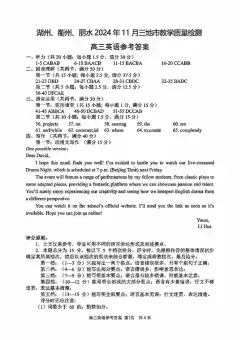
衢州、丽水、湖州 2026 年 11 月三地市高三教学质量检测 英语参考答案
第一部分听力 (共两节,每小题 1.5 分,满分 30 分)
15 CABCC 610 BBACA 1115 ABABB 1620 CCBCA
第二部分阅读 (共两节,满分 50 分)
第一节 (共 15 小题;每小题 2.5 分,满分 37.5 分)
2123 BDA 2427 BDAC 2831 CDAC 3235 CBDB
第二节 (共 5 小题;每小题 2.5 分,满分 12.5 分)
3640 ACEFD
第三部分语言运用 (共两节,满分 30 分)
第一节 (共 15 小题;每小题 1 分,满分 15 分)
4145 BACDB 4650 AACBD 5155 CCBAD
第二节 (共 10 小题;每小题 1.5 分,满分 15 分)
56.increasingly57.chosen58.linking59.but60.failed61.a
62.which63.themselves64.strength65.as
第四部分写作 (共两节,满分 40 分)
第一节应用文写作 (满分 15 分)
Possible version:
A Moral Dilemma
Last month, I faced a real dilemma in an 800meter race. With only 100 meters to go, I was running second, desperately chasing the leader. Suddenly, he stumbled and fell heavily. My heart raced — I could easily overtake him and win the gold, but I felt it wrong to leave a fallen competitor behind. After a splitsecond hesitation, I stopped and helped him up. We crossed the line together, and he finished just inches ahead of me.
I lost the gold medal that day, but I gained something far more valuable. It taught me that true victory isn’t about winning at all costs, but about competing with integrity. A medal can discolour, but the honor of doing the right thing never fades.
第二节读后续写 (满分 25 分)
Possible version:
“Why not?” he said with a broad smile, handing me some coffee beans. Less than five minutes later, I was behind the counter. The barista showed me how to grind coffee beans, how to steam milk without burning it, how to pull the perfect coffee shot, and reassured me every step of the way. We chatted about coffee, work, life — and I soon felt like I’d known him for a lot longer than just the few minutes it took to make my drink. He’d shown me nothing but patience and generosity. I began to suspect that my fear of rejection might actually be rooted in my own prejudice: the assumption that others were always judging me.
As I took more challenges, I continued to be met with patience and generosity. I would approach people with unusual requests: asking strangers if I could join in their group photo, if they would film me singing or if I could sit with them in my local cafe. And time after time, I was exposed not to rejection, but the heartening kindness of humans who owed me nothing. Even when my strange requests were declined, the interactions were overwhelmingly positive. They laughed with me, but never at me. Through the challenge, I’ve found courage isn’t something that’s always rewarded with success — but it nearly always leads to connection.
听力原文
Text 1
W: I’m struggling with my project. I have to come up with a design for a water treatment system... but I don’t know where to start.
M: Well, why not look closely at the task instructions first?
W: Good idea.
Text 2
W: When will you leave for the station?
M: The train leaves at 4:30. I plan to arrive there forty minutes before it leaves. So, I’ll have enough time to have my ticket checked.
Text 3
W: Thanks so much for coming to my painting exhibition.
M: My pleasure! Your work is so great. It makes me want to have a painting class!
W: I’d love to teach you some basic art skills!
Text 4
M: Have you heard about the wildfires near Los Angeles?
W: Yes. I read an article about them in the news this morning. They’re spreading very fast due to strong winds. Many people have been forced to leave their homes.
Text 5
W: Hello there. I didn’t expect to see you at the gym.
M: Oh, I come here quite a lot. I never see anyone else from work, though. Do you come here often?
W: Every Tuesday evening, after I’ve been to the shop.
Text 6
M: Kate, can you tell me something about your father?
W: Sure. My dad is an interesting person. He has retired and he’s building a plane.
M: Can he fly a plane?
W: Yes, he has got a license.
M: So when is he going to finish it?
W: I don’t know. I got an email from him last week. He said the plane would be finished soon.
M: Are you going to fly in this plane with your father as soon as it’s finished?
W: No. He will ask some professional people to try it first. After that, he will be ready to fly it.
M: Sounds fun.
Text 7
M: Have you made any New Year’s resolutions, Lily?
W: Well, I’d like to go on a diet and save some money.
M: Come on! Everybody makes those resolutions.
W: I know, Peter. Well, I hope I’ll get a good job after I graduate this summer. How about you?
M: Hmm, I stopped smoking last June. That was last year’s resolution.
W: So what do you want to do this year?
M: My father bought me a camera, so I’d like to join a photography club.
W: Sounds great. Judy told me she’d like to have a long vacation.
M: Oh? Where will she go?
W: She might go to Xizang, or visit her friends in Chongqing. She hasn’t made up her mind yet.
Text 8
W: What do you do, Simon?
M: I work for a company that produces software. And I’m a sales representative.
W: Who do you work with?
M: I work with a small team of representatives.
W: So who are your customers?
M: International companies that work with producers and suppliers abroad. They use our software to figure out the cost of making a product in different countries.
W: How does this help your customers?
M: Well, they know the production cost in each country. Then they choose the supplier with the best price.
W: OK, I see. What sort of problems do you deal with in your work?
M: The biggest problem is time — my company only hires 12 people. I primarily sell software at work, but I also need to train our customers to use it and that’s a lot of work.
Text 9
M: How often do you watch the news?
W: Why do you want to know that?
M: I’m collecting data for my Current Affairs class report. I decided to find out how people our age get their news.
W: Oh. Actually I watch the news on TV only about once a month.
M: Hmm. So, how and where do you get the news? Do you read the newspaper?
W: Not really. Well, once a month I read the China Daily in my English class, but it’s no longer news by the time I read it.
M: If you don’t watch the news or read the newspaper, how do you get your news, then?
W: Usually, I get news reports sent to me on my mobile phone. I also visit some news sites and blogs on the web.
M: Do you feel like you are really up to date on what’s happening in the news?
W: Yes, I think so.
M: Okay, well, thank you. Those are all questions I have for you.
Text 10
M: Do you always buy things you don’t really need? And why? First, when we buy something new, it causes us to buy more things to go with our new item. For example, if we buy a new sofa, this may cause us to buy a matching coffee table. Whenever I shop online, the site always suggests related items. As a result, we end up buying things we previously didn’t think we needed in order to feel happy or satisfied. Another reason is advertising. Take cellphones for example. You can buy a phone for 1000 yuan that will do everything you need, but all my friends and I constantly pay five times amount for a new phone. It’s partly because these constant ads plant messages in our brains, convincing us that certain things are cool and musthave items. Finally, the reason we tend to overspend is because we use credit cards and digital wallets. These are convenient methods of payment, but they make it challenging to monitor our spending habits. Handing over physical cash can make the cost of a purchase more obvious and lead people to think twice before spending.
相关文档
- 浙江省湖丽衢2025年11月三地市高三教学质量检测(湖丽衢一模)技术试题+答案
- 浙江省湖丽衢2025年11月三地市高三教学质量检测(湖丽衢一模)物理试题+答案
- 浙江省湖丽衢2025年11月三地市高三教学质量检测(湖丽衢一模)政治试题+答案
- 浙江省湖丽衢2025年11月三地市高三教学质量检测(湖丽衢一模)化学试题+答案
- 湖衢丽三地市高三教学质量检测化学卷
- 语文答案-2604湖衢丽三地市
- 2026年4月全国各地高考模拟卷
- 数学答案-2604湖衢丽三地市
- 技术答案-2604湖衢丽三地市
- 技术卷-2604湖衢丽三地市
- 数学卷-2604湖衢丽三地市
- 浙江省湖州市衢州市丽水市2024-2025学年高三上学期11月教学质量检测英语试卷
- 浙江省湖州市衢州市丽水市2024-2025学年高三上学期11月教学质量检测英语答案
- 浙江省湖州衢州丽水2026年4月三地市高三教学质量检测语文答案
- 浙江省湖州衢州丽水2026年4月三地市高三教学质量检测语文卷
- 浙江省湖州衢州丽水2026年4月三地市高三教学质量检测数学答案
- 浙江省湖州衢州丽水2026年4月三地市高三教学质量检测数学卷
- 浙江省湖州衢州丽水2026年4月三地市高三教学质量检测技术答案
- 浙江省湖州衢州丽水2026年4月三地市高三教学质量检测技术卷
- 浙江省湖州衢州丽水2026年4月三地市高三教学质量检测化学卷
- 浙江省丽水湖州衢州2024届高三下学期4月二模英语试题含答案含听力
- 浙江省湖丽衢三地市2024-2025学年高三上学期11月教学质量检测语文试卷
- 浙江省湖州市衢州市丽水市2024-2025学年高三上学期11月教学质量检测生物试卷
- 浙江省湖州市衢州市丽水市2024-2025学年高三上学期11月教学质量检测物理试卷
- 浙江省湖州市衢州市丽水市2024-2025学年高三上学期11月教学质量检测数学试卷
- 浙江省湖州市衢州市丽水市2024-2025学年高三上学期11月教学质量检测技术试卷
- 浙江省湖州市衢州市丽水市2024-2025学年高三上学期11月教学质量检测地理试卷
- 浙江省湖州市衢州市丽水市2024-2025学年高三上学期11月教学质量检测历史试卷
- 浙江省湖州市衢州市丽水市2024-2025学年高三上学期11月教学质量检测化学试卷
- 浙江省湖丽衢三地市2024-2025学年高三上学期11月教学质量检测语文答案
- 浙江省湖州市衢州市丽水市2024-2025学年高三上学期11月教学质量检测生物答案
- 浙江省湖州市衢州市丽水市2024-2025学年高三上学期11月教学质量检测物理答案
- 浙江省湖州市衢州市丽水市2024-2025学年高三上学期11月教学质量检测数学答案
- 浙江省湖州市衢州市丽水市2024-2025学年高三上学期11月教学质量检测技术答案
- 浙江省湖州市衢州市丽水市2024-2025学年高三上学期11月教学质量检测地理答案
- 浙江省湖州市衢州市丽水市2024-2025学年高三上学期11月教学质量检测历史答案
- 浙江省湖州市衢州市丽水市2024-2025学年高三上学期11月教学质量检测化学答案
- 2026年4月全国各地高考模拟卷之27
- 浙江省金丽衢十二校2025学年高三第一次联考英语答案含听力
- 浙江省金丽衢十二校2025学年高三第二次联考英语卷
- 日语教学资料
- 政治教学资料
- 政治教学资料
- 浙江省金丽衢十二校2025学年高三第二次联考英语答案
- 浙江省金丽衢十二校2024届高三第二次联考英语试卷
- 浙江省金丽衢十二校2025学年高三第二次联考生物答题卷
- 浙江省金丽衢十二校2025学年高三第二次联考政治卷
- 浙江省金丽衢十二校2025学年高三第二次联考技术卷
- 浙江省金丽衢十二校2025学年高三第二次联考地理卷
- 浙江省金丽衢十二校2025学年高三第二次联考历史卷
- 浙江省金丽衢十二校2025学年高三第二次联考化学答案
- 浙江省丽水湖州衢州2024届高三下学期4月二模参考答案
- 浙江省金丽衢十二校2024-2025学年高三上学期第一次联考英语试题(Word版无答案)
- 浙江省金丽衢十二校2024-2025学年高三上学期第一次联考英语试题(Word版含解析)
- 浙江省金丽衢十二校2025学年高三第一次联考英语试题
- 浙江省金丽衢十二校2024-2025学年高三上学期第一次联考英语
- 浙江省金丽衢十二校2025学年高三第一次联考生物试题含答案
- 浙江省金丽衢十二校2025学年高三第二次联考生物试卷
- 浙江省金丽衢十二校2025学年高三第二次联考参考答案及评分标准
- 浙江省金丽衢十二校2025届高三第二次联考英语试卷
- 浙江省金丽衢十二校2025学年高三第二次联考物理答案
- 浙江省金丽衢十二校2025学年高三第二次联考技术答案
- 浙江省金丽衢十二校2025学年高三第二次联考政治试卷
- 浙江省金丽衢十二校2024-2025学年高三上学期第一次联考历史答案
- 浙江省金丽衢十二校2024-2025学年高三上学期第一次联考历史试卷
- 浙江省金华市金丽衢十二校高三上学期第一次联考物理试卷无答案
- 浙江省金丽衢十二校2024-2025学年高三上学期第一次联考生物Word版含答案
- 浙江省金华市金丽衢十二校2024-2025学年高三上学期第一次联考物理试卷(含解析)
- 浙江省金丽衢十二校2024-2025学年高三上学期第一次联考语文答案
- 浙江省金丽衢十二校2024-2025学年高三上学期第一次联考语文卷
- 浙江省金丽衢十二校2025学年高三第二次联考物理试题
- 浙江省金丽衢十二校2025学年高三第二次联考化学试题含答案
- 浙江省金丽衢十二校2025学年高三第二次联考生物答案
- 浙江省金丽衢十二校2025学年高三第二次联考政治官方答案
- 浙江省金丽衢十二校2025学年高三第二次联考地理官方答案
- 浙江省金丽衢十二校2025学年高三第二次联考历史答案
- 浙江省金丽衢十二校2025学年高三第一次联考物理答案
- 浙江省金丽衢十二校2025学年高三第一次联考政治答案
- 浙江省金丽衢十二校2025学年高三第一次联考历史答案
- 浙江省金丽衢十二校2025学年高三第一次联考化学答案
- 浙江省金丽衢十二校2025学年高三第一次联考物理试题
- 浙江省金丽衢十二校2025学年高三第一次联考政治试题(2025年12月)
- 浙江省金丽衢十二校2025学年高三第一次联考历史试题
- 浙江省金丽衢十二校2025学年高三第一次联考化学试题
- 浙江省金丽衢十二校高三第二次联考生物卷
- 浙江省金丽衢十二校2024届高三第二次联考技术卷
- 浙江省金丽衢十二校高三第二次联考地理卷
- 2024届浙江金丽衢十二校高三第二次联考历史卷
- 浙江省金丽衢十二校七彩阳光等校2023届高三下学期3月联考英语试卷
- 四川省南充市嘉陵一中2024-2025学年高二下学期5月月考历史试题另一份
- 2024届浙江金丽衢十二校高三第二次联考化学卷
- 浙江省金丽衢十二校2025学年高三第一次联考技术试题含答案
- 浙江省金丽衢十二校2024-2025学年高三上学期第一次联考生物答案
- 浙江省金丽衢十二校2024-2025学年高三上学期第一次联考政治试题(无答案)
- 浙江省金丽衢十二校2024-2025学年高三上学期第一次联考政治试题(含解析)
- 浙江省金丽衢十二校2024-2025学年高三上学期第一次联考地理试题(无答案)
- 浙江省金丽衢十二校2024-2025学年高三上学期第一次联考地理试题(含解析)
- 浙江省金丽衢十二校2024-2025学年高三上学期第一次联考化学试题(无答案)
- 浙江省金丽衢十二校2024-2025学年高三上学期第一次联考化学试题(含解析)
- 浙江省金丽衢十二校2025届高三第二次联考英语答案