
点击下方“RE精读备考FCE备考CAE”,
关注公众号,和1.6万+家长
一起成长、思考、育娃 。
Hi,大家好,我是Tracy。
这是我的第293 篇原创分享。
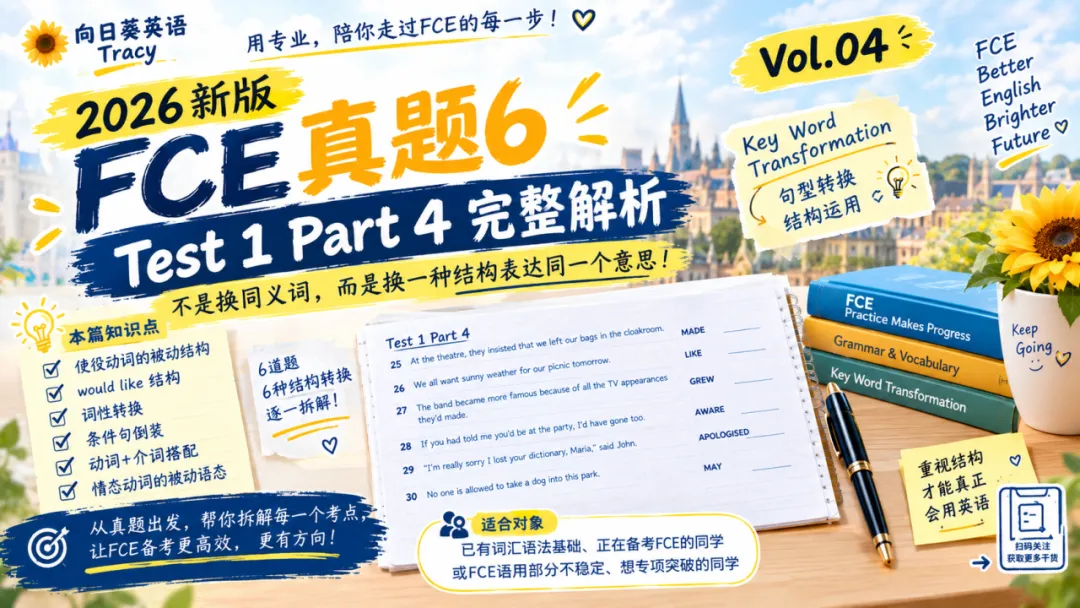

前面三篇,我们已经完成了:
Vol.01|Test 1 Part 1Multiple Choice Cloze
2026新版FCE真题6来了!Test 1 Part 1:看懂文章,却不一定能做对完型填空题
Vol.02|Test 1 Part 2Open Cloze
2026新版FCE校园版真题6来了!Test 1 Part 2:没有选项以后,FCE语用到底在考什么?
Vol.03|Test 1 Part 3Word Formation
2026新版校园版FCE真题6来了!Test 1 Part 3:给你一个词,为什么还是不会变?
今天来到Test 1的最后一个Use of English部分:
Part 4|Key Word Transformation
Part 4很多学生会把它理解成:
“同义句转换。”
这个理解不能算错,但如果真的只把它当成“找同义词”,很容易做不出来。
因为Part 4真正考的是:
如何用不同的英语结构,表达基本相同的意思。
所以今天我们不只是看答案,而是把每一道题拆成:
原句的哪个部分 → 转换成了什么结构
这才是Part 4真正值得学习的地方。

1
Q25|insisted that we left → were made to leave
原句
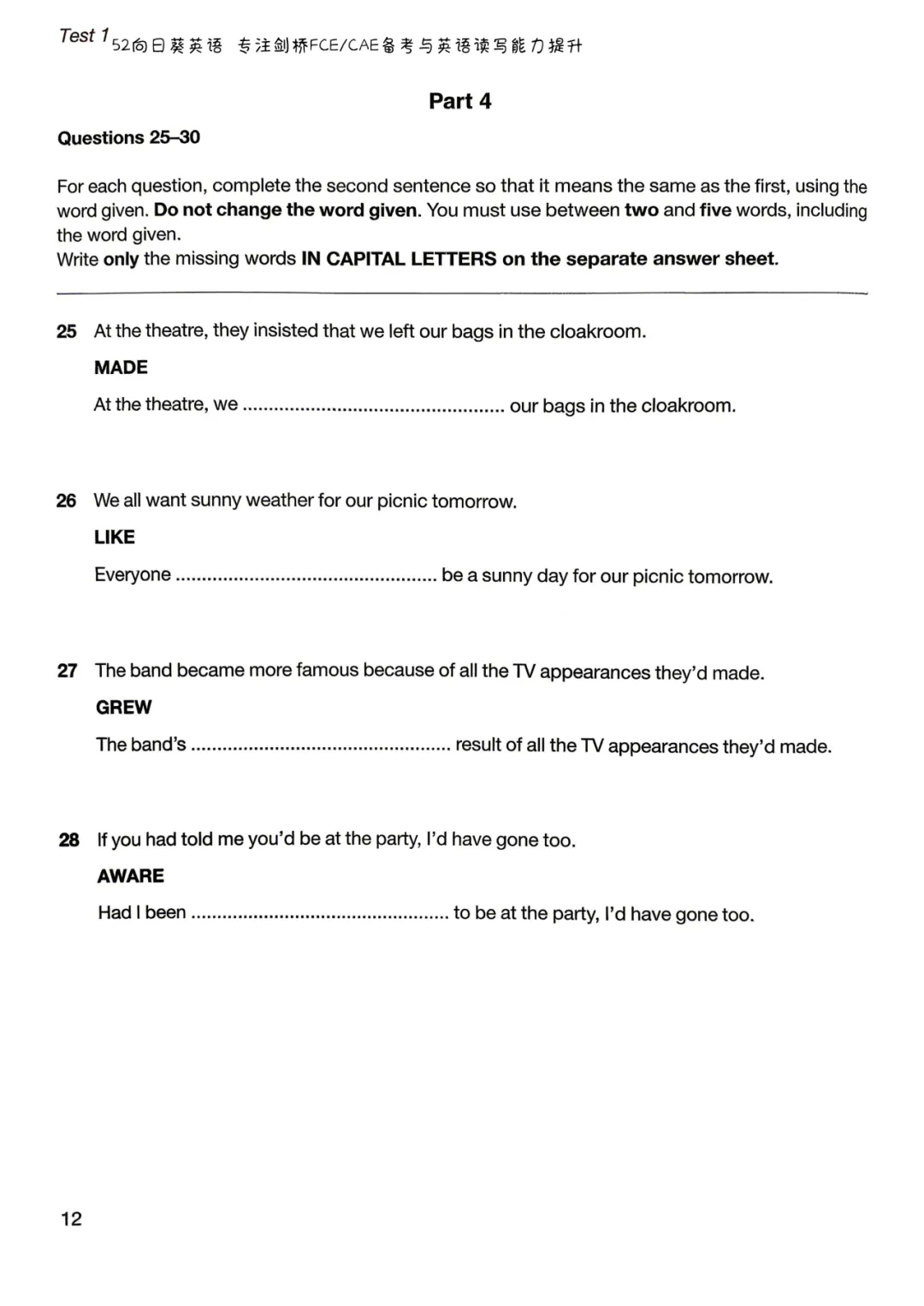
At the theatre, they insisted that we left our bags in the cloakroom.
关键词:
MADE
改写:
At the theatre, we were made to leave our bags in the cloakroom.
答案:
✅ WERE MADE TO LEAVE
🔍 先看:什么和什么进行了同义转换?
原句:
they insisted that we left our bags...
这里表达的是:
他们坚持要求我们把包留在衣帽间。
改写成:
we were made to leave our bags...
表达的是:
我们被要求把包留在衣帽间。
所以这里发生的是:
they insisted that we left...
↓
we were made to leave...
也就是:
主动表达 → 被动表达
原句强调:
他们要求我们做某事
改写后强调:
我们被要求做某事
🌟 核心结构
make sb do sth
让/迫使某人做某事
变成被动以后:
sb be made to do sth
某人被要求/被迫做某事
注意:
make + sb + do
但是被动:
be made + to do
to会回来!
补充例子
The teacher made us stay after class.
老师让我们课后留下。
↓
We were made to stay after class.
我们被要求课后留下。
🎯 这题真正要记住:
make sb do → sb be made to do
而不是只记:
make = insist

2
Q26|want → would like;sunny weather → it to be a sunny day
原句
We all want sunny weather for our picnic tomorrow.
关键词:
LIKE
改写:
Everyonewould like it to be a sunny day for our picnic tomorrow.
答案:
✅ WOULD LIKE IT TO
🔍 什么和什么进行了转换?
原句:
We all want sunny weather
改写:
Everyone would like it to be a sunny day
这里其实发生了两层转换。
第一层:
want → would like
都是表达:
想要 / 希望
但:
would like
是更加委婉、正式的表达。
第二层:
sunny weather
↓
it to be a sunny day
也就是把原来的:
“想要晴朗的天气”
转换成:
“希望天气是晴天。”
这里的:
it
用来指代天气情况。
🌟 核心结构
would like to do
I would like to go.
我想去。
如果希望某人/某物做某事:
would like + object + to do
I would like you to come.
我希望你来。
本题:
would like it to be a sunny day
这里:
it = the weather / weather conditions
补充例子
We'd like it to be warmer tomorrow.
我们希望明天天气暖和一点。
She'd like it to stop raining.
她希望雨停下来。
🎯 这题真正要记住:
would like + 宾语 + to do
以及:
it可以用来指代天气情况。

3
Q27|became more famous → fame grew;because of → as a result of
原句
The band became more famous because of all the TV appearances they'd made.
关键词:
GREW
改写:
The band's fame grew as a result of all the TV appearances they'd made.
答案:
✅ FAME GREW AS A RESULT OF
🔍 这一题其实有两组转换
第一组:
原句:
became more famous
改写:
fame grew
意思都是:
名气变得更大了。
也就是:
famous → fame
同时:
became more → grew
第二组:
原句:
because of
改写:
as a result of
两者都可以表达:
因为 / 由于
后面都可以接:
名词或名词短语
所以:
because of all the TV appearances
↓
as a result of all the TV appearances
🌟 一个非常值得积累的词性转换
famous → fame
The actor became famous.
↓
The actor gained fame.
类似的还有:
happy → happiness
popular → popularity
important → importance
different → difference
所以Part 4有时候看起来是在考句型,其实也会考:
词性转换能力。
🌟 as a result of
as a result of + 名词
The match was cancelled as a result of the rain.
比赛由于下雨而取消。
而:
as a result + 句子
It rained heavily. As a result, the match was cancelled.
注意不要混淆。
🎯 这题可以记成:
become more famous → fame grow
because of → as a result of

4
Q28|If you had told me... → Had I been aware...
原句
If you had told me you'd be at the party, I'd have gone too.
关键词:
AWARE
改写:
Had I been aware that you were going to be at the party, I'd have gone too.
答案:
✅ AWARE (THAT) YOU WERE GOING
🔍 这题到底转换了什么?
原句:
If you had told me you'd be at the party
核心意思是:
如果你告诉我你会参加聚会……
改写:
Had I been aware that you were going to be at the party
核心意思是:
如果我知道你会参加聚会……
所以这里不是简单地把:
tell
换成:
aware
而是整个条件句结构发生了变化。
原句:
If + 主语 + had done
If you had told me...
↓
改写:
Had + 主语 + done
Had I been aware...
这就是:
条件句的倒装
🌟 普通形式
If I had known, I would have gone.
如果我知道,我就会去了。
倒装形式
Had I known, I would have gone.
意思完全相同。
补充例子
If I had known about the problem, I would have helped.
↓
Had I known about the problem, I would have helped.
🌟 另外一个重点:be aware
be aware of + 名词
I am aware of the problem.
我知道这个问题。
be aware that + 从句
I am aware that he is busy.
我知道他很忙。
所以本题:
be aware that you were going...
🎯 这题真正要记住:
If + had... → Had + 主语...
以及:
be aware of + 名词
be aware that + 从句

5
Q29|I'm really sorry I lost... → apologised to... for losing...
原句
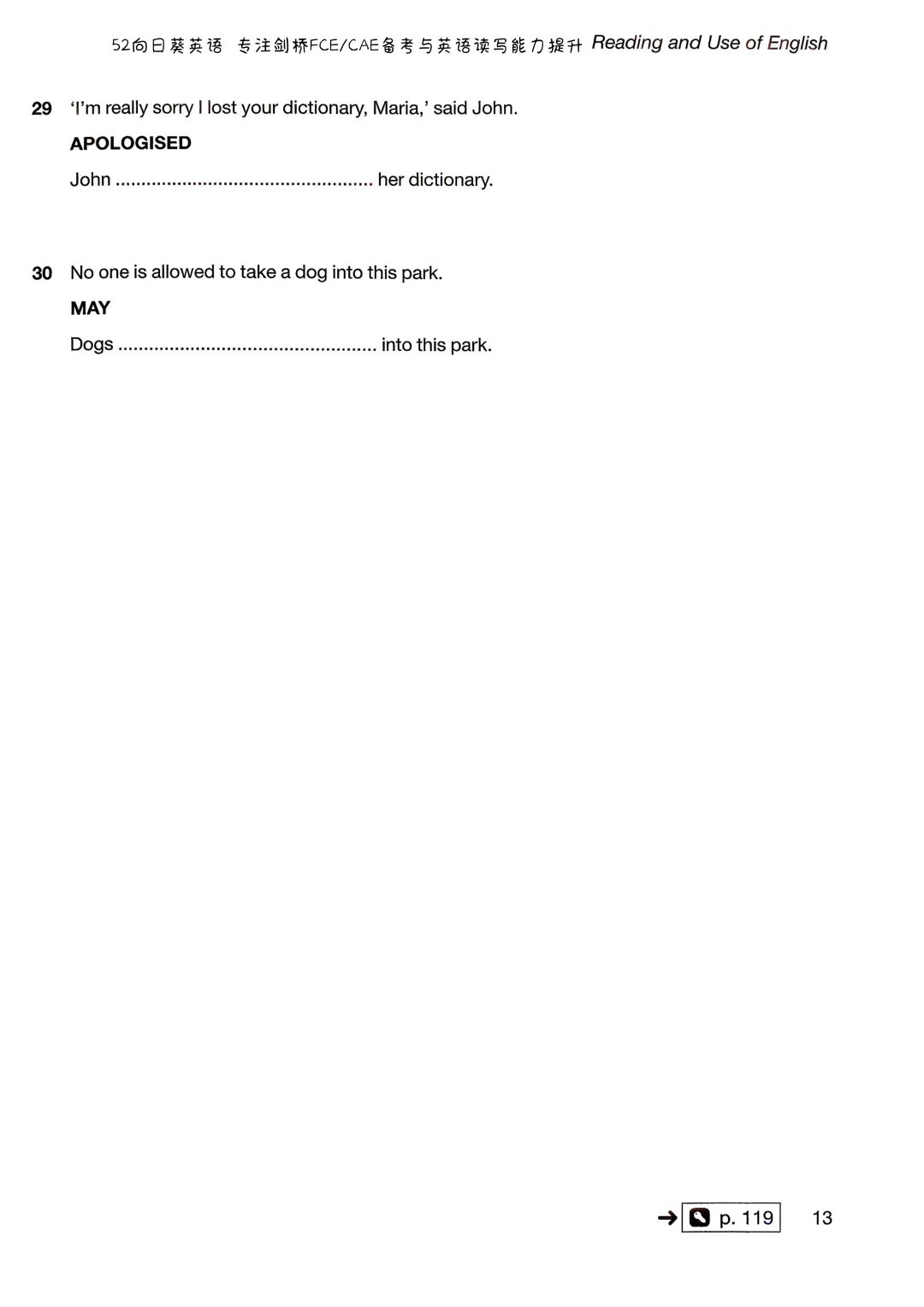
“I'm really sorry I lost your dictionary, Maria,” said John.
关键词:
APOLOGISED
改写:
John apologised to Maria for losing her dictionary.
答案:
✅ APOLOGISED TO MARIA FOR LOSING
🔍 什么和什么进行了转换?
原句:
I'm really sorry I lost your dictionary
表达:
对丢了你的词典这件事表示道歉。
改写:
apologised to Maria for losing her dictionary
把:
I'm really sorry...
转换成了:
apologised... for...
所以这里考的是:
say sorry → apologise
以及:
sorry for doing → apologise for doing
🌟 最重要的结构
apologise to sb for sth
向某人因为某事道歉
如果后面是动作:
apologise to sb for doing sth
例如:
I apologised to my teacher for being late.
我因为迟到向老师道歉。
补充例子
She apologised to her friend for forgetting her birthday.
她因为忘记朋友的生日而道歉。
He apologised to me for breaking the cup.
他因为打破杯子向我道歉。
⚠️ 两个介词不要弄反
apologise TO somebody
apologise to Maria
向Maria道歉
apologise FOR something
apologise for losing the dictionary
为丢词典这件事道歉
所以完整结构:
apologise to sb for doing sth
🎯 这题真正要记住:
I'm sorry... → apologise to sb for doing...

6
Q30|No one is allowed to take... → Dogs may not be taken...
原句
No one is allowed to take a dog into this park.
关键词:
MAY
改写:
Dogs may not be taken into this park.
答案:
✅ MAY NOT BE TAKEN
🔍 什么和什么进行了转换?
原句:
No one is allowed to take a dog into this park.
意思:
没有人被允许把狗带进这个公园。
改写:
Dogs may not be taken into this park.
意思:
狗不得被带进这个公园。
这里同时发生了两个转换:
① no one is allowed to
↓
may not
表达:
不被允许
② 主动
take a dog into...
↓
被动
a dog be taken into...
🌟 情态动词的被动语态
基本结构:
modal + be + 过去分词
例如:
must be completed
必须被完成
can be used
可以被使用
should be checked
应该被检查
may be taken
可以被带走
否定:
may not be taken
不得被带走
为什么这里用Dogs?
原句:
take a dog into this park
改成被动以后:
Dogs may not be taken into this park.
这里把原来的宾语:
a dog
转换成了被动句的主语。
补充例子
主动:
You may not use mobile phones here.
↓
被动:
Mobile phones may not be used here.
主动:
Visitors are not allowed to take photographs.
↓
Photographs may not be taken.
🎯 这题真正要记住:
be allowed to do → may
以及:
主动 → 被动

6道题放在一起,你会发现Part 4真正考的是“结构转换”
把今天的6道题重新放在一起:
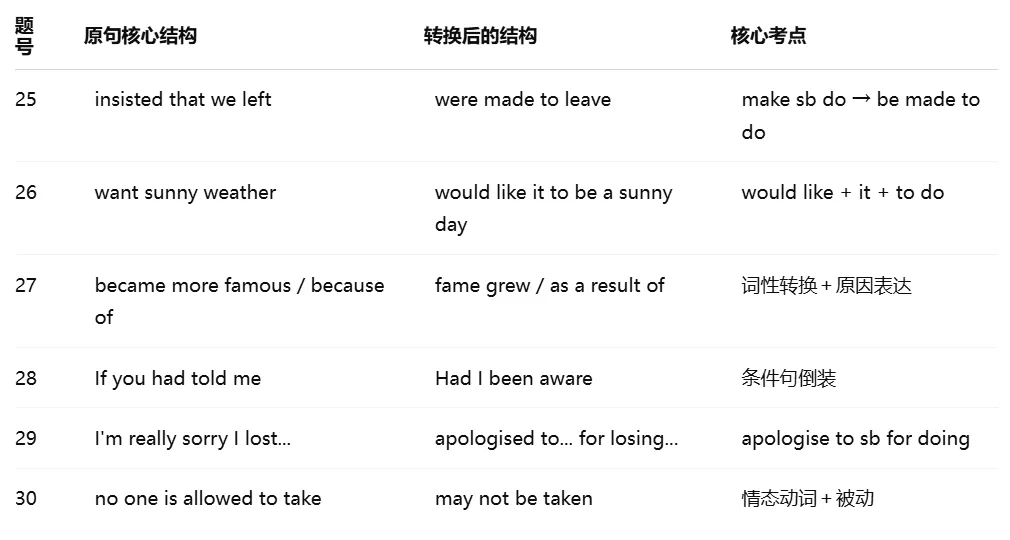
所以做Part 4,不要只问“同义词是什么”
这是我特别想提醒FCE考生的一点。
比如25题。
如果你只是想:
insist = ?
你可能会想到:
demand
require
request
但是这些都不是这道题真正考的。
真正需要转换的是:
they insisted that we left...
↓
we were made to leave...
28题也是一样。
你不需要去找:
told = ?
真正要转换的是:
If you had told me...
↓
Had I been aware...
30题也是:
allowed = ?
不是简单找一个同义词。
而是:
No one is allowed to take...
↓
Dogs may not be taken...

Part 4的核心能力:
看到“意思”,想到“结构”。
这也是Part 4和Part 1、2、3非常不一样的地方。
Part 1
看到语境:
选择最合适的词
Part 2
看到句子:
判断这里缺什么
Part 3
看到词根:
判断应该变成什么词形
Part 4
看到原句:
重新组织成另一个结构
所以Part 4实际上是在测试:
你有没有足够的英语结构库。
⭐ 把这6道题变成你的“结构库”
今天这6道题,如果只记答案,其实很容易忘。
但如果记成下面这6个结构,就完全不一样了:
① make sb do
→ sb be made to do
② would like
→ would like sb/it to do
③ famous
→ fame
④ If I had...
→ Had I...
⑤ apologise
→ apologise to sb for doing sth
⑥ may
→ may be done / may not be done
这才是做完一道Part 4题之后真正应该留下来的东西。

7
Test 1 Part 1–4,到这里完整结束
到这里,我们已经把Test 1的Reading & Use of English Part 1–4全部拆完了。
Part 1|Multiple Choice Cloze
词义 × 搭配 × 语境
↓
Part 2|Open Cloze
语法结构 × 固定搭配 × 逻辑
↓
Part 3|Word Formation
词性 × 单复数 × 肯定/否定 × 词形
↓
Part 4|Key Word Transformation
句型转换 × 搭配 × 结构运用
所以FCE语用真正需要训练的,并不是:
“我做过多少套题?”
而是:
“我做过的题,有多少真正变成了自己的语言结构?”
一道题做完,如果只知道:
答案是A。
过几天可能就忘了。
但如果知道:
为什么?
什么结构?
以后还能怎么用?
那么这道题才真正留下来了。

🌻 下一期继续
2026新版FCE校园版真题6
Test 1:
Part 1 ✅
Part 2 ✅
Part 3 ✅
Part 4 ✅
接下来继续往后拆。
如果你正在备考FCE,可以把这个系列收藏起来。
后面我会继续用同样的方式:
真题 → 找结构 → 拆规律 → 补例句
而不是只给一个答案。

8
📚 如果你也在系统复习整理FCE语用
我自己整理的两份资料,也比较适合配合真题使用:
📕《FCE词转讲义》
专门整理Word Formation中的词性变化、常见词根词缀和高频考法。
📘《FCE语用错题集》
把容易反复出错的Part 1–4知识点、结构和易错点重新归纳,适合用来做二次巩固。
如果你正在刷FCE真题,可以把它们当作:
真题训练 → 发现问题 → 回到讲义整理 → 错题再次巩固
的一套配套资料。
不追求“资料越多越好”,而是希望:
每做一道题,都能真正弄懂一个语言结构。
向日葵英语 Tracy

链接Tracy


真题不是做完就结束。
真正有价值的是:
做一道题,弄懂一道题背后的语言规律。
🌻 向日葵英语 Tracy