每一天学习一篇高考阅读 Day 10|青岛淄博二模阅读 C 篇:森林被切成“拼图”,物种真的会更多吗?
这篇生态类说明文先呈现一场长期争论,再用跨六大洲的数据检验“碎片化可能增加多样性”的假设。真正的考点不是记住12%,而是看懂“观点—验证—结果—机制—行动”的完整证据链。
一、试题来源与内容概览
- 资料来源
:山东省青岛市、淄博市2025年高三年级第二次适应性检测(二模) - 题型
:高考英语阅读理解C篇,第28—31题 - 体裁
:生态研究报道/说明文 - 主题
:连续栖息地与碎片化栖息地的生物多样性比较 - 答案页核对
:28.D;29.C;30.D;31.B
研究汇总37项研究、覆盖六大洲和4000多个物种,发现碎片化区域平均少12%的物种。作者随后解释三个原因:迁移受阻、边缘受入侵者和气候影响、小种群因近亲繁殖而衰弱。结尾没有主张放弃小型碎片,而是把重点转向植树和恢复退化栖息地。
二、真题原文与全部题目
Reading C
For decades, scientists have debated whether protecting large, continuous habitats or fragmented areas better addresses the biodiversity crisis. Recently, a new study in Nature has delivered a potentially decisive answer to the debate.
“The heart of the debate,” explained lead author Thiago Gonçalves-Souza, a postdoctoral researcher at the University of Michigan, “is that supporters of fragmentation compare it to puzzle pieces–arguing that if we assume disconnected habitats develop unique species compositions, the total biodiversity across the entire landscape could increase, like grouping distinct patterns together into a more complex whole.”
To test whether that assumption holds up in practice, a group of 28 scientists, people in Europe, South and Central America and Australia, gathered data from 37 studies of biodiversity covering six continents and more than 4,000 species. That data enabled them to check the number and kinds of species found in large sections of land against the same measurements from a collection of smaller fragments from similar ecosystems nearby.
On a broad landscape level, the scientists found that fragmented areas had, on average, 12% fewer species than continuous areas, with a shortage ranging from 10.7% to 18%. Even when accounting for differences in the amount of habitat, the shortage remained significant. This makes sense due to three key issues: disconnected areas prevent movement, exposed edges attract invaders and climate damage, and small populations weaken due to reproduction among relatives.
These findings suggest that fragmented areas have lower ecological value. But does it mean conservation efforts should abandon small fragments? “Not necessarily,” said Gonçalves-Souza. “In many countries, there aren’t large, undamaged forests remaining. Therefore, our focus should be on planting new forests and recovering increasingly degraded habitats, which is crucial for the future, more so than debating whether it’s better to have one large forest or many smaller fragments.”
Questions 28—31
28.The comparison of puzzle pieces in paragraph 2 is used to show ______.
A.how humans break apart nature
B.why fragmented habitats need protection
C.why species composition varies by habitat
D.how habitat differences increase total biodiversity
29.What did the gathered data serve as?
A.A method for risk assessment.
B.A guide for resource distribution.
C.The foundation for comparative analysis.
D.The evidence for further assumptions.
30.What can we learn about fragmentation in paragraph 4?
A.It results in habitat connectivity.
B.It weakens the growth of invasive species.
C.It releases the potential of habitat recovery.
D.It leads to a range of ecological disturbances.
31.What does Gonçalves-Souza suggest in the last paragraph?
A.Abandoning small fragments.
B.Advancing nature restoration.
C.Protecting existing large forests.
D.Exploring fragmentation impacts.
三、全文分段翻译
第1段:提出长期争论
几十年来,科学家一直争论:保护大面积连续栖息地,还是保护碎片化区域,更能应对生物多样性危机。最近,《自然》杂志刊登的一项新研究可能为这场争论给出决定性答案。
第2段:解释“拼图”一方的假设
主要作者Gonçalves-Souza解释,碎片化的支持者把分散栖息地比作拼图:如果不相连的栖息地各自发展出独特的物种组成,那么整个景观的总生物多样性可能增加,就像把不同图案组合成更复杂的整体。
第3段:用跨区域数据检验假设
为了检验该假设是否经得起实践验证,28名科学家汇集了37项生物多样性研究的数据,覆盖六大洲和4000多个物种。这些数据让他们能够把大片土地中的物种数量和种类,与附近相似生态系统中的多个小型碎片进行比较。
第4段:结果与三个生态机制
在广阔景观尺度上,碎片化区域的物种数量平均比连续区域少12%,短缺幅度为10.7%至18%。即使把栖息地面积差异计算在内,差距仍然显著。原因有三点:不连续区域阻碍迁移;暴露边缘吸引入侵者并受到气候破坏;小种群因近亲繁殖而衰弱。
第5段:从争论转向恢复行动
研究说明碎片化区域生态价值较低,但这不意味着保护工作应该放弃小型碎片。许多国家已没有大型完整森林,因此重点应放在种植新森林、恢复日益退化的栖息地,而不是继续争论“一大片还是多个小碎片”。

四、语篇逻辑:争论—假设—验证—结果—行动
- P1提出问题
:连续栖息地与碎片化栖息地孰优。 - P2呈现假设
:不同碎片像拼图,或能增加总多样性。 - P3说明方法
:汇总大样本,进行同类生态系统比较。 - P4给出反证
:碎片化区域物种更少,并解释三个机制。 - P5转向行动
:不放弃小碎片,但优先推进生态恢复。
碎片可能“各有特色” ≠ 整体物种一定更多;真正的数据结果是连续区域平均保留更多物种。

五、段落功能与关键衔接
puzzle pieces:比喻服务于对方观点
拼图比喻不是作者的最终结论,而是解释碎片化支持者的逻辑:不同碎片形成不同物种组合,合在一起或能增加总多样性。第28题问的是比喻“说明什么”,答案必须回到这一完整推理。
To test whether:从观点进入证据
第3段开头标志研究开始检验假设。后面的37项研究、六大洲和4000多个物种,构成比较分析的基础,而不是新的假设。
Even when accounting for:排除面积干扰
即使考虑栖息地数量差异,物种短缺仍显著,说明结果并非单纯由面积不同造成。
But—Not necessarily—Therefore:结论并非“一刀切”
末段先承认碎片化生态价值较低,再否定“放弃小碎片”,最后提出恢复行动。作者把讨论从二选一争论推进到现实解决方案。
六、逐题精讲与选项翻译
第28题:比喻作用题
题干翻译:第2段把栖息地比作拼图,是为了说明什么?
正确答案:D
证据:disconnected habitats develop unique species compositions → total biodiversity ... could increase。
A:人类如何分割自然——原文不是说明分割过程。 B:为什么碎片需要保护——比喻讨论的是多样性假设。 C:为什么不同栖息地物种不同——只截取推理中间一步。 D:栖息地差异如何提高总多样性——完整还原比喻逻辑。
第29题:数据作用题
题干翻译:收集的数据起到了什么作用?
正确答案:C
证据:enabled them to check ... against the same measurements。check A against B表示把A与B进行比较,因此数据是比较分析的基础。
A风险评估:未提及。 B资源分配指南:未提及。 C比较分析基础:与原文方法完全对应。 D进一步假设的证据:研究是在检验已有假设,不是制造新假设。
第30题:机制概括题
题干翻译:关于碎片化,第4段告诉我们什么?
正确答案:D
证据:迁移受阻、边缘入侵与气候损害、小种群近亲繁殖,三项共同概括为 a range of ecological disturbances。
A与原文prevent movement相反。 B与exposed edges attract invaders相反。 C文章没有说碎片化释放恢复潜力。 D概括三个并列生态问题。
第31题:建议推断题
题干翻译:Gonçalves-Souza在最后一段提出什么建议?
正确答案:B
证据:planting new forests and recovering increasingly degraded habitats,即推进自然恢复。
A被Not necessarily直接否定。 B准确概括种植与恢复。 C只说保护现有大森林,范围不符。 D继续探索影响不是末段行动重点。

七、答案的底层判断逻辑
- 28题
:比喻题要还原完整论证,不能只选其中一步。 - 29题
:方法题抓动词结构,check A against B=比较。 - 30题
:三个并列细节要上位概括为“生态干扰”。 - 31题
:建议题抓行动动词planting和recovering。
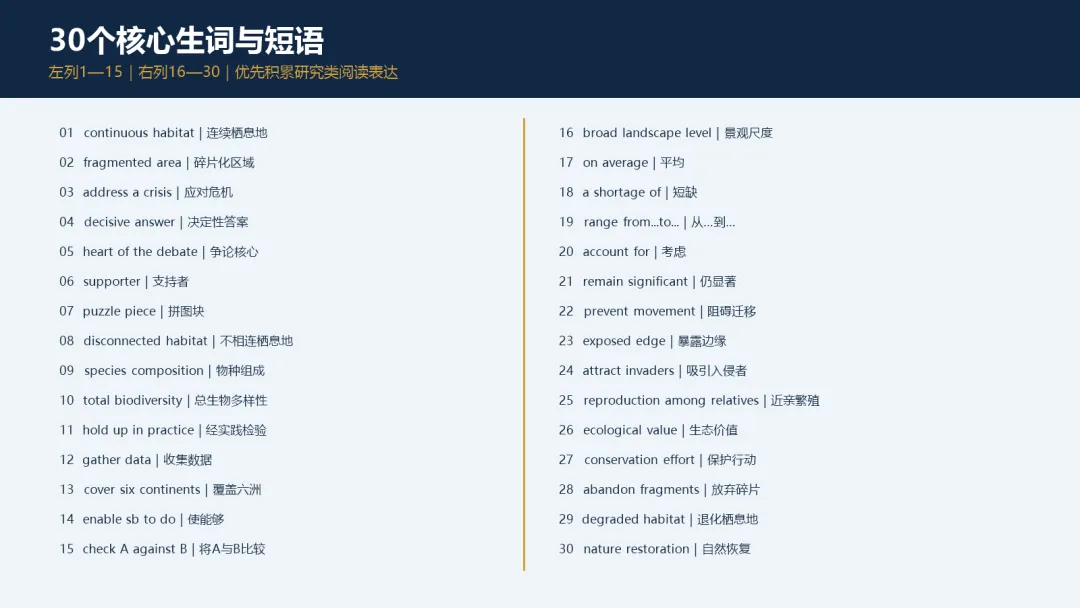
八、30个核心生词与短语
九、学生复习笔记
一句话主旨
跨研究数据表明,连续栖息地通常比碎片化区域保留更多物种;现实保护应超越“一个大还是多个小”的争论,推进森林种植与退化栖息地恢复。
每段一句话
P1提出争论;P2解释拼图假设;P3说明比较方法;P4给出12%差距与三个原因;P5转向恢复行动。
易错点
拼图比喻代表待检验观点,不是研究最终结论;“碎片化价值较低”也不等于“放弃所有小碎片”。
可复用句型
Even when accounting for differences in the amount of habitat, the shortage remained significant.
写作迁移:即使考虑某项干扰因素,差异仍然显著。
二次训练
用五个词复述全文:debate—assumption—comparison—disturbance—restoration;再不看原文说出碎片化造成的三个生态机制。
十、阅读技巧与同类迁移
研究报道先区分“被检验的观点”和“研究得到的结论”。 数据后找比较对象和控制因素,不只记百分比。 多个并列原因要提炼上位概念。 末段遇到But、Not necessarily、Therefore,注意作者往往在修正极端结论。
遇到同类环境文章,可画出:争议观点 → 数据方法 → 结果 → 机制 → 政策或行动建议。
结尾总结
本篇四题都围绕同一条证据链:拼图比喻提出假设,跨地区数据建立比较,12%的差距否定乐观预期,三个机制解释结果,末段则把答案落到生态恢复。读研究类文章时,真正重要的是看清每一段在“提出、验证、解释还是行动”。