 ◎加入胡师姐新传考研25级、26级群聊,你想要的都在群里!😊
(English Question) How has Artificial Intelligence (AI) transformed the meaning and form of international/intercultural communication? Please analyze with one specific example. (20 points)
Artificial Intelligence has fundamentally reshaped international and intercultural communication by altering not only how communication is conducted, but also what communication means in a global context. Traditionally, international communication was understood as the transmission of messages across national or cultural boundaries, largely mediated by human actors such as journalists, diplomats, or translators. With the rise of AI, communication increasingly involves algorithmic systems that mediate, translate, recommend, and even generate content. This transformation has redefined both the form and the meaning of intercultural communication.
人工智能从根本上重塑了国际与跨文化交流,不仅改变了沟通方式,更重塑了全球语境下的交流内涵。传统国际传播被理解为跨越国界或文化藩篱传递信息的过程,主要由记者、外交官、翻译等人类中介完成。随着人工智能的兴起,传播领域日益融入算法系统——这些系统不仅承担着内容中介、翻译、推荐等职能,甚至能自主生成内容。这种变革既重构了跨文化交流的形式,也重塑了其深层意义。
First, AI has transformed the form of intercultural communication by making it more automated, real-time, and scalable.
AI-powered technologies such as machine translation, speech recognition, and recommendation algorithms enable individuals from different linguistic and cultural backgrounds to interact instantly and continuously. Language barriers, which once constituted a major obstacle in intercultural communication, are increasingly reduced through AI-driven translation systems. As a result, communication shifts from delayed, institutionally mediated exchanges to immediate, platform-based interactions among ordinary users.
Moreover, AI changes the structure of communication flows. Instead of linear sender–receiver models, communication now occurs within algorithmically curated environments, where AI systems decide what content is visible, prioritized, or suppressed. This means that intercultural encounters are no longer neutral exchanges but are shaped by algorithmic logic.
首先,人工智能通过提升跨文化交流的自动化程度、实时性及可扩展性,彻底改变了其形式。
人工智能驱动的机器翻译、语音识别和推荐算法等技术,让不同语言文化背景的人们能够即时持续地交流。曾经阻碍跨文化交流的语言障碍,如今正通过AI翻译系统逐步消除。这种转变使得沟通方式从机构主导的延迟性交流,转变为普通用户基于平台的即时互动。
此外,人工智能重塑了信息传播的结构。传统线性发送-接收模式已不复存在,取而代之的是算法精心设计的传播环境——人工智能系统决定内容的可见性、优先级及屏蔽规则。这意味着跨文化互动已不再是中立的交流,而是被算法逻辑所主导。
Second, AI has reshaped the meaning of international communication by redefining who participates and how cultural understanding is produced.
Traditionally, international communication emphasized representation at the national or institutional level, focusing on official narratives and elite voices. Under AI-mediated conditions, however, intercultural communication increasingly takes place through everyday interactions, emotional expressions, and informal content produced by ordinary users. AI thus shifts the meaning of international communication from a state-centered process to a networked, bottom-up practice.
At the same time, AI introduces new forms of power and asymmetry. Algorithms embed cultural assumptions, biases, and values, which influence how cultures are represented and interpreted. Therefore, intercultural understanding is no longer shaped solely by human intention, but also by technological mediation, raising questions about algorithmic bias, cultural homogenization, and uneven visibility.
其次,人工智能通过重新定义参与主体及文化理解的生成方式,重塑了国际交流的内涵。
传统国际传播往往聚焦国家或机构层面的官方叙事与精英声音,而人工智能主导的传播环境则截然不同。如今,跨文化沟通日益通过日常互动、情感表达以及普通用户生成的非正式内容展开。人工智能正将国际传播的重心从国家主导的模式,转向网络化、自下而上的实践范式。
与此同时,人工智能催生了新的权力结构与不对称现象。算法内嵌的文化预设、偏见与价值观,深刻影响着文化表征与解读方式。因此,跨文化理解不再仅由人类主观意图决定,更受技术中介作用影响,由此引发算法偏见、文化同质化及可见性差异等议题。
A concrete example can be found in AI-powered automatic translation on global social media platforms.
On platforms such as social networking or content-sharing apps, users from different countries can directly interact through AI-generated translations of posts and comments. This allows intercultural communication to occur at an unprecedented scale and frequency, enabling users to share daily experiences, humor, and emotions across cultural boundaries.
However, these AI translations often prioritize efficiency over cultural nuance. Idioms, cultural references, and emotional subtleties may be simplified or distorted, leading to partial understanding or misinterpretation. This example illustrates how AI both enables intercultural connection and reshapes cultural meaning, transforming communication into a technologically mediated process rather than a purely human one.
其次,人工智能通过重新定义参与主体及文化理解的生成方式,重塑了国际交流的内涵。
传统国际传播往往聚焦国家或机构层面的官方叙事与精英声音,而人工智能主导的传播环境则截然不同。如今,跨文化沟通日益通过日常互动、情感表达以及普通用户生成的非正式内容展开。人工智能正将国际传播的重心从国家主导的模式,转向网络化、自下而上的实践范式。
与此同时,人工智能催生了新的权力结构与不对称现象。算法内嵌的文化预设、偏见与价值观,深刻影响着文化表征与解读方式。因此,跨文化理解不再仅由人类主观意图决定,更受技术中介作用影响,由此引发算法偏见、文化同质化及可见性差异等议题。
In conclusion, Artificial Intelligence has transformed international and intercultural communication in both form and meaning. In terms of form, communication has become faster, automated, and algorithmically structured. In terms of meaning, communication has shifted from elite, state-centered exchanges to everyday, platform-based interactions shaped by AI systems. While AI lowers barriers and expands participation, it also introduces new challenges related to cultural representation and algorithmic power. Understanding international communication today therefore requires not only cultural analysis, but also critical reflection on the role of AI as an active mediator in global communication.
总而言之,人工智能在形式和内涵上彻底改变了国际与跨文化交流。在形式层面,沟通变得更快捷、自动化且算法化。在内涵层面,交流模式已从精英阶层的国家主导型对话,转变为由AI系统塑造的日常平台互动。虽然人工智能降低了参与门槛并扩大了参与范围,但也带来了文化表征与算法权力的新挑战。因此,理解当今国际交流不仅需要文化分析,更需对AI作为全球传播主动中介者的角色进行批判性反思。
26级清华新传考研复试班,就是为你在最后冲刺期,提供高效MAX的上岸攻略。我们的课程,不教你泛泛而谈,而是精准狙击清华复试的每一个“考评维度”
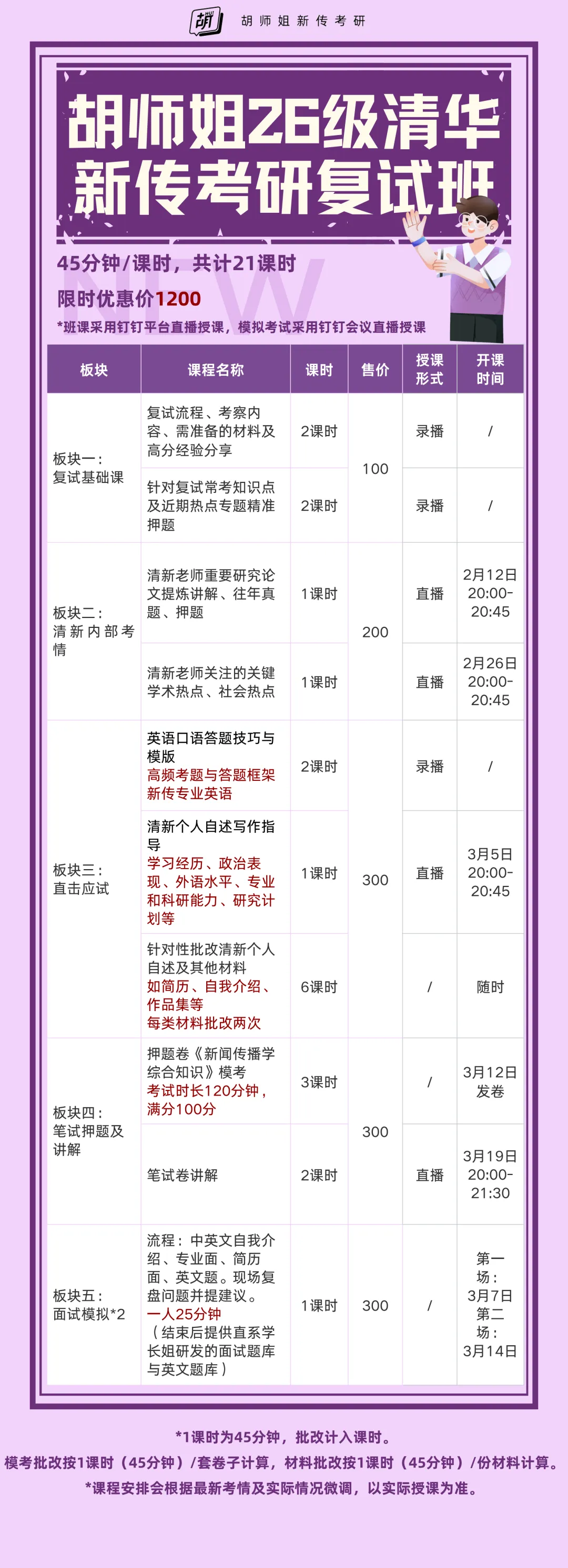
胡师姐辅导班的状元学员包括
24级北大新传国新总分状元
24级北大新媒体总分状元(港澳台)
24级清华大学新传数双初试状元
24级清华新传国新初试状元
24级清华新传国新复试状元
24级清华新传学硕总分状元
23级北大新传总分状元 23级北大新传初试状元 23级北大mjc专业课总分状元 23级清华新传普新初试状元 23级清华新传国新初试状元
23级清华新传国新总分状元
23级清华健康传播总分状元
23级清华健康传播复试状元
23级清华普新学硕复试状元
23级清华学硕专业课总分状元 23级北师大新传专硕复试状元
23级北语新传学硕初试状元
23级北语新传学硕总分状元
23级深圳大学新传学硕复试状元
23级黑龙江大学新传专硕复试状元
22级北大新传专硕复试状元
22级清华数据传播初试状元
22级清华数据传播总分状元
22级清华传媒实务与创新总分状元
22级中大新传专硕小方向初试状元
22级中大新传专硕小方向复试状元
22级中大新传专硕小方向总分状元
22级华南师范大学新传学硕初试状元
22级厦大港澳台新传专硕总分状元
21级北大新传专硕复试状元
21级清华新传专硕小方向总分状元
21级北京交通大学新传学硕总分状元
21级北京邮电大学新传专硕专业课总分状元
(两门专业课260分)
21级北京印刷学院新传专硕复试状元
20级北大新传专硕总分状元
20级北大新闻学学硕总分状元
20级北大传播学学硕专业课总分状元
(两门专业课244分)
20级北大新媒体专业课总分状元
(两门专业课246分)
20级北大新媒体专硕复试状元
20级北大港澳台传播学硕总分状元
20级北大港澳台新传专硕总分状元
20级清华新传专硕初试状元
20级北师大新传专硕专业课总分状元
(两门专业课263分)
20级中山大学传播学硕总分状元
19级北大新媒体专硕总分状元
19级北大新传专硕初试总分状元
19级北师大新传专硕专业课总分状元
(两门专业课247分)
18级北大健康传播总分状元
14级北大新传专硕总分状元
(以上仅呈现状元学员,其余未展示)
更详细的课程介绍可以戳下方图片
跟着清华北大硕博学长学姐
科学备考高效复习吧!
👇