

听力材料
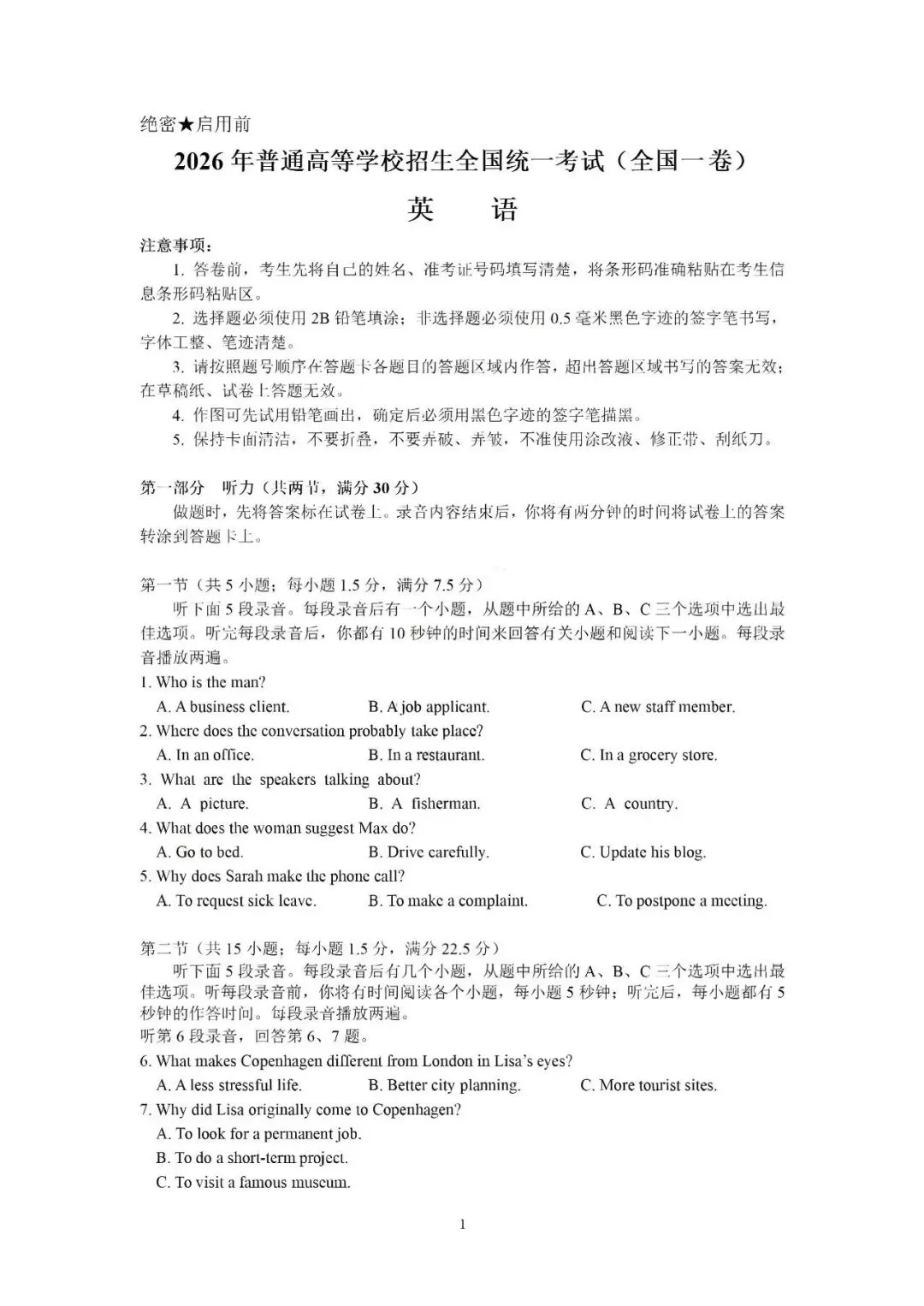
Text 1 员工入职(01:05-01:20)M: Do I need a card to enter the building?W: Yes, you’ll get your card this afternoon. Now let me show you around and say hello to everyone, and then we’ll talk about your job duties.
Text 2 餐桌闲聊(01: 55-02: 04)W: Would you like some more roast beef? It’s the chef’s signature dish. M: No thanks. It’s really good, but I can’t manage any more.
Text 3 探讨摄影作品(02:35-02:48)W: Hey! Look at this one in the newspaper. Fishermen fishing in Lake Victoria in Tanzania. M: Wow, that’s awesome! I like the unique atmosphere caught by the photographer.
Text 4 劝其休息(03:22-03:33)W: It’s almost midnight, Max. You’ve got a long drive tomorrow. M: Okay, another 15 minutes from my travel blog and I’ll be done.
Text 5 改约见面(04:02-04:20)W: Hello Mr. Waterman. This is Sarah Jones. I’m stuck on the highway. There’s a serious accident. I’m afraid I can’t arrive before noon. Could we meet this afternoon?M: Okay, I’ll see my doctor at one and will be available after two.
Text 6 城市对比(05:50-06:25)M: Lisa, you’re English, but you live here. What do you love about Copenhagen?
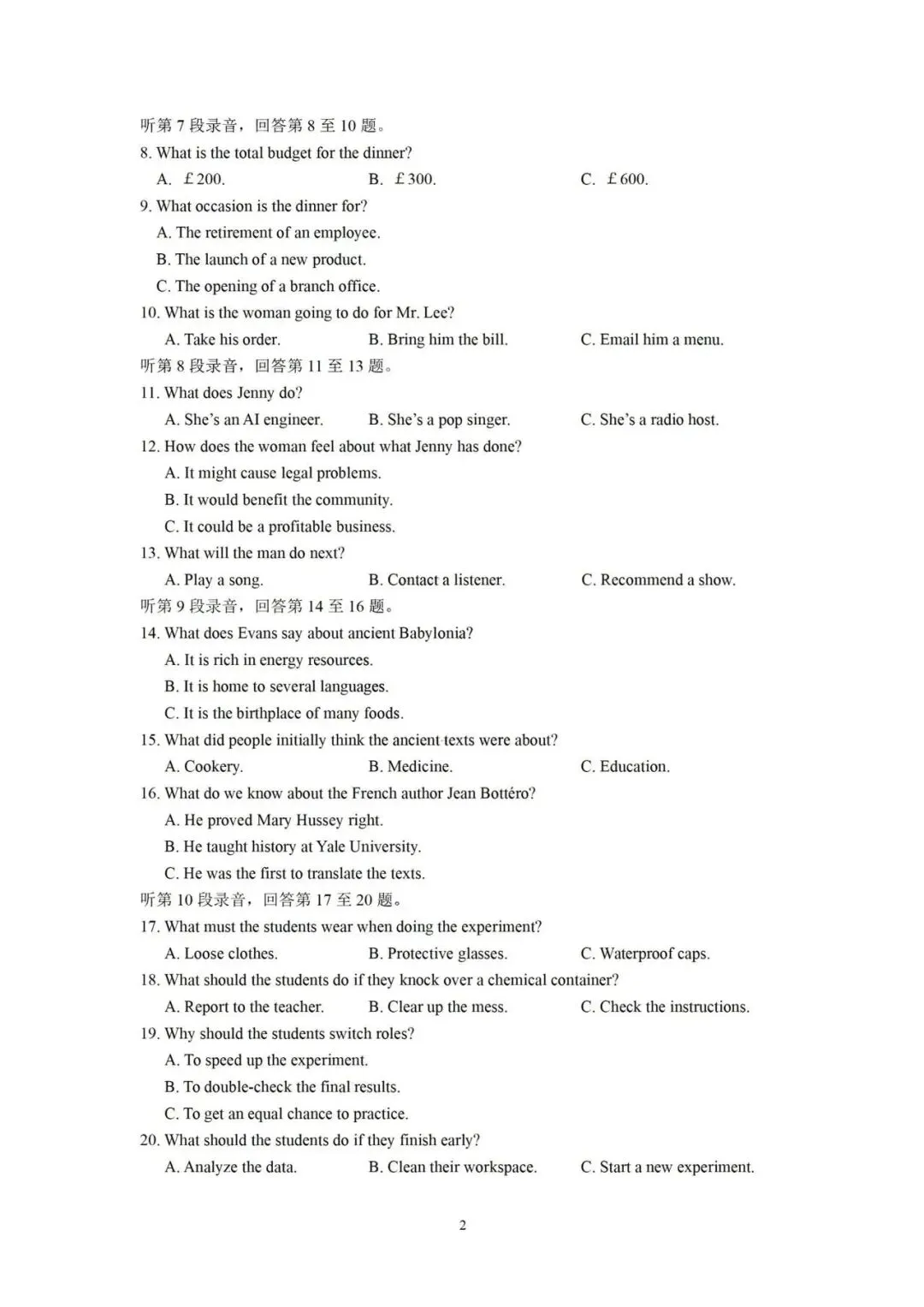
W: It has everything big cities offer. Cafes, Theaters, Museums, but it is still relaxing and manageable. Unlike London, you don’t feel constant pressure here. M: Was this lifestyle why you first came?W: No, I originally came for a three-month project at a law firm. After finishing it, they offered me a permanent job. I took it and stayed.
Text 7 预定晚宴(07:44-08:38)W: The Garden Hotel. May I help you?M: Hello, this is Mike Lee from Gilbert Company. We’d like to book a dinner for next Tuesday. W: Certainly, Mr. Lee. Could you let me know how many guests you’re expecting, and if you have a specific budget in mind?M: Yes, we’re expecting 20 people, and we’re aiming for 30 pounds per person. W: Understood. Is this for a special occasion?M: Yes, it’s to honor a staff member who is retiring next month. W: That sounds lovely. What time would you like the dinner to start?M: At 6:30 PM. W: Okay, would you like a detailed menu with prices?M: Yes, could you email it to mikelee@gilbert. com. W: No problem, I’m on it.
Text 8 讨论 AI 商业创作(10:20-11:15)W: Dear listeners, the song we’ve just heard was made with an AI version of Jenny’s singing voice. M: Yeah, earlier this year Jenny announced that she'd let anybody make a song using her AI voice, as long as they were entitled and shared their profits with her, and in just a few weeks, more than 300 new songs were created using her AI voice. W: Incredible! Just imagine, Jenny may have been at home drinking a glass of wine while her AI clone voice worked hard to sing her songs. This could be an attractive new business model for a pop star. M: Indeed. But some of our listeners called to say they want to hear Jenny’s real voice. Now let’s play one of her greatest hits. Show me your love.
Text 9 古巴比伦食谱文本(12:57-14:02)M: Dr. Evans, you just said that these ancient texts are actually the recipes from ancient Babylonia. Can you tell us more?W: Ancient Babylonia is home to many of the things that we use in our cooking today. I bet about 50% of the energy you need every day comes from vegetables or animals that originated in this area. M: Why have these texts taken so long to come to light?W: These ancient texts have been known since the 1920s but were thought to be medical texts. In the 1940s, Mary Hussey, an American scholar, suggested that they might be about food, but people didn’t believe her until French author Jean Poteau. In the 1980s, was asked to write an article about cooking in the past. He had heard about the texts, so he went to Yale University and found out that they were indeed about food.
Text 10 实验规则注意事项(16:00-17:13)Before we begin today’s experiment, let’s review the lab rules. First, safety glasses must be worn at all times, even if you’re only watching. Second, never mix chemicals unless the instructions tell you to do so. Today we’re using a strong acid, which can cause serious burns if it touches your skin. If any chemical container is knocked over, DON’T PANIC! Tell me immediately, and I’ll handle the cleanup. Also, keep your hair tied back and avoid wearing loose clothes. We will work in pairs. One person will handle the tools while the other records the data. Switch roles after every three trials to ensure everyone gets practice. Remember, the goal is accurate data, not speed. If you finish early, do not start a new experiment. Instead, clean your workspace thoroughly. Any questions? No? Alright, let’s have a safe and productive class!
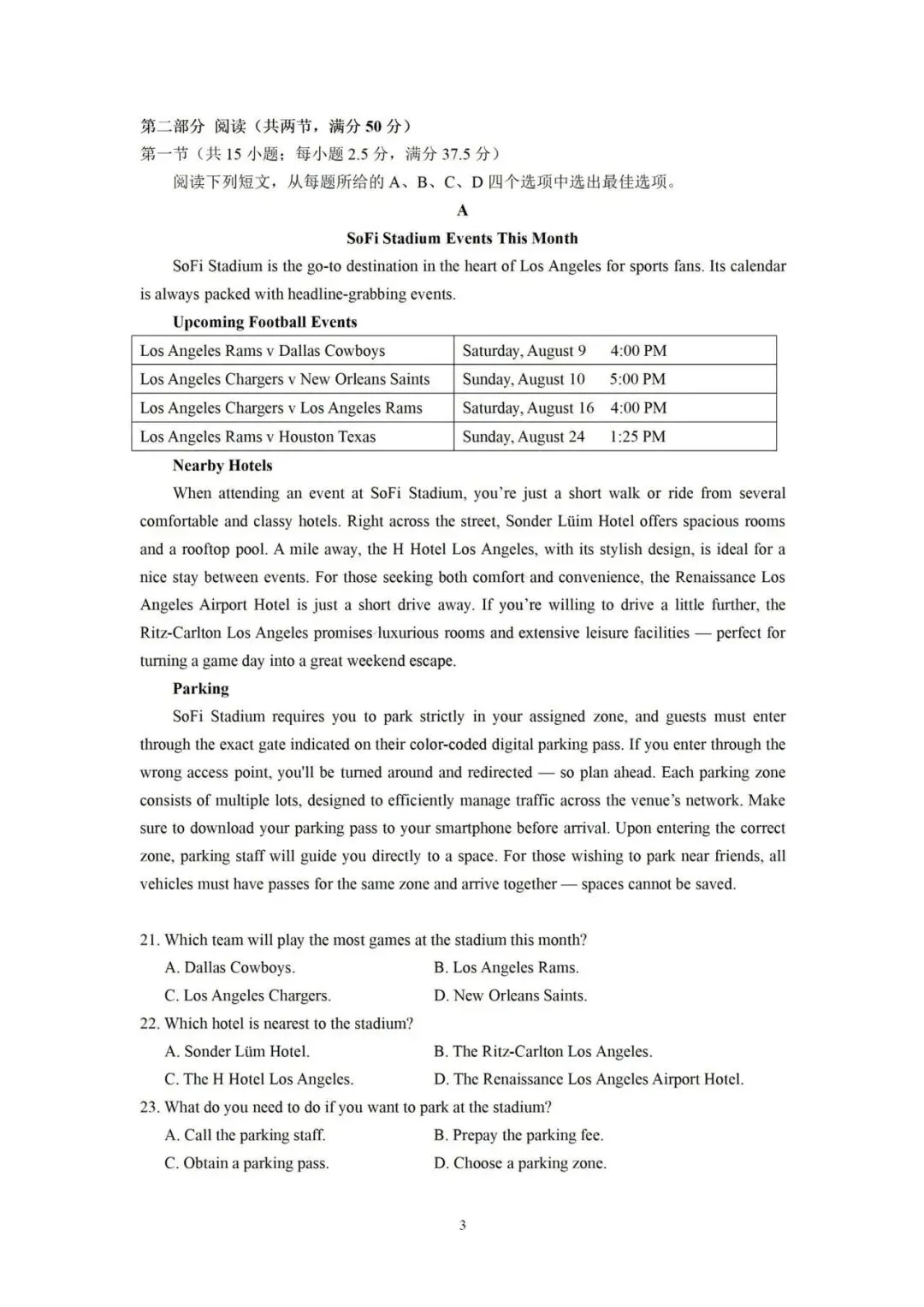
【答案解析】A篇主题语境:人与社会——社会服务与文化场馆【语篇导读】本文是一篇应用文。文章主要介绍了SoFi体育场本月的橄榄球赛事安排、周边酒店推荐以及停车须知等实用信息。
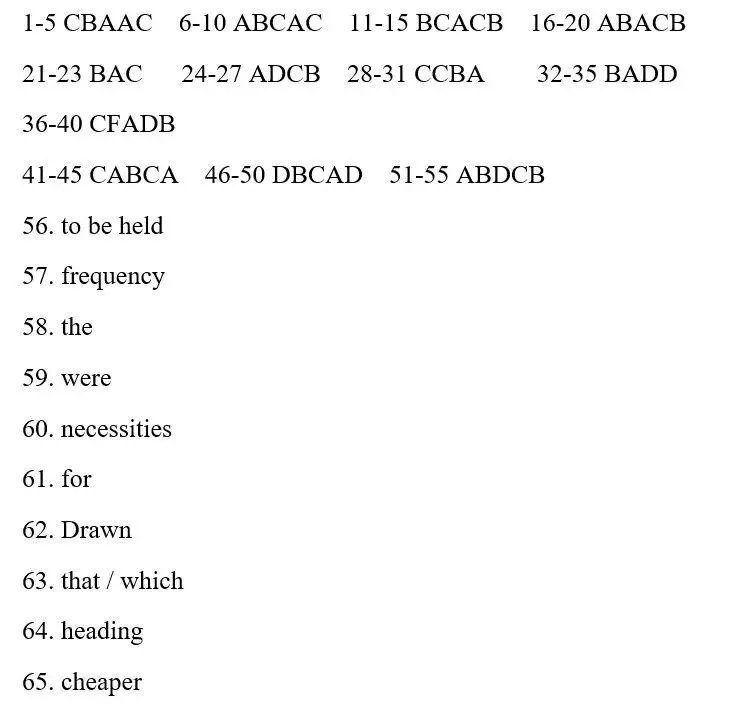
第21题.B 细节理解。解析:根据“Upcoming Football Events”部分列出的比赛:8月9日洛杉矶公羊队对达拉斯牛仔队、8月10日洛杉矶闪电队对新奥尔良圣徒队、8月16日洛杉矶闪电队对洛杉矶公羊队、8月24日洛杉矶公羊队对休斯顿德州人队。统计可得,洛杉矶公羊队出场3次(8月9日、16日、24日),洛杉矶闪电队出场2次(8月10日、16日),其余两队各出场1次。因此本月比赛场次最多的球队是洛杉矶公羊队。故选B。
第22题.A 细节理解。解析:酒店介绍中提到,“Right across the street, Sonder Lütm Hotel...”(街对面就是Sonder Lütm酒店),说明该酒店紧邻体育场。而H Hotel在一英里外,Renaissance需短途开车,Ritz-Carlton则更远。因此,距离最近的是Sonder Lütm Hotel。故选A。
第23题.C 细节理解。解析:根据“Parking”部分,“SoFi Stadium requires you to park strictly in your assigned zone, and guests must enter through the exact gate indicated on their color-coded digital parking pass.”以及“Make sure to download your parking pass to your smartphone before arrival.”可知,进入停车场必须持有并出示颜色编码的数字停车证,且需提前下载,因此你需要获得一个停车证。故选C。
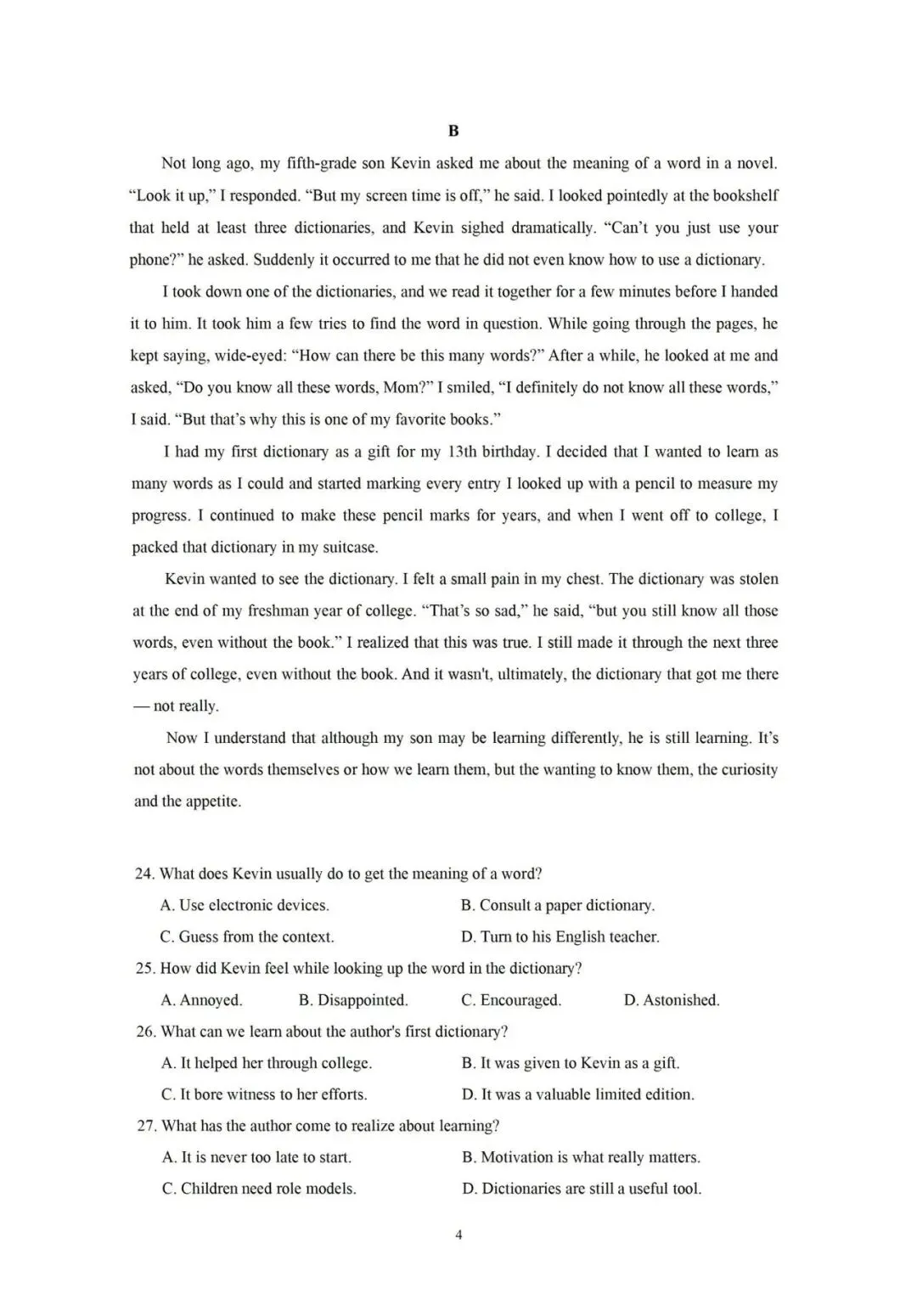
B篇主题语境:人与自我——生活与学习【语篇导读】本文是一篇记叙文。文章主要讲述了作者引导儿子使用纸质词典查单词,并由此回忆自己第一本词典的学习经历,最终感悟到学习的真谛在于好奇心和求知欲,而非工具本身。
第24题.A 细节理解。解析:根据第一段中Kevin说的“But my screen time is off”以及“Can’t you just use your phone?”可知,他平时习惯用手机等电子设备查单词,因此他通常通过电子设备获取词义。故选A。
第25题.D 观点态度推断。解析:根据第二段中“While going through the pages, he kept saying, wide-eyed: ‘How can there be this many words?’”可知,Kevin在翻字典时睁大眼睛,惊叹于单词的数量之多,表现出非常惊讶的情绪(astonished)。故选D。
第26题.C 细节理解。解析:根据第三段中“I decided that I wanted to learn as many words as I could and started marking every entry I looked up with a pencil... I continued to make these pencil marks for years”可知,作者在字典上用铅笔标记每一个查阅过的单词,这本字典见证了她多年的努力。故选C。
第27题.B 推理判断。解析:根据最后一段中“It’s not about the words themselves or how we learn them, but the wanting to know them, the curiosity and the appetite.”可知,作者认识到学习的关键不在于单词本身或学习方式,而在于求知的渴望、好奇心和欲望,即动机才是真正重要的。故选B。
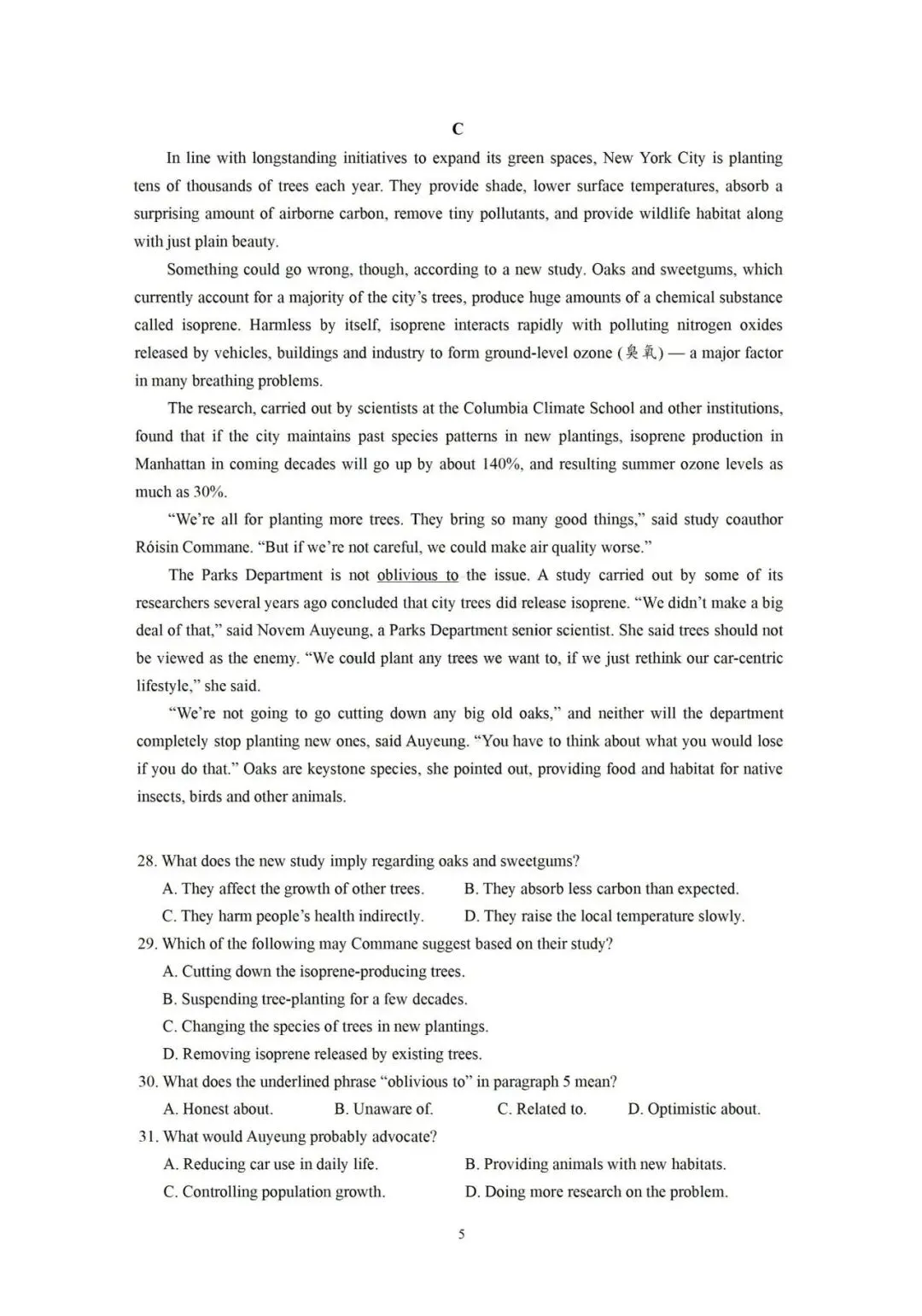
C篇主题语境:人与自然——环境保护与生态平衡【语篇导读】本文是一篇说明文。文章主要讲的是纽约市大规模植树虽益处众多,但新研究发现橡树和枫香树等主要树种会释放异戊二烯,与汽车尾气等污染物反应生成危害健康的臭氧,从而引发对树种选择与生活方式的重新思考。
第28题.C 细节理解。解析:根据第二段,橡树和枫香树本身无害,但它们释放的异戊二烯会与车辆等排放的氮氧化物快速反应,生成地面臭氧,而臭氧是引发诸多呼吸问题的主要因素。可见,这些树种通过化学反应的间接方式危害人体健康,而非直接影响温度或吸收碳的能力。故选C。
第29题.C 推理判断。解析:Commane认为植树是好事,但“如果我们不小心,可能会使空气质量变差”。结合研究发现(若维持现有树种模式,异戊二烯排放和臭氧水平将大幅上升),合理推断其建议应为在新植树时更换排放异戊二烯较少的树种,而非采取砍树、暂停植树或直接清除异戊二烯等极端做法。故选C。
第30题.B 词义猜测。解析:画线部分所在句为“The Parks Department is not oblivious to the issue.”,下文提到其研究人员几年前就研究过并得出城市树木释放异戊二烯的结论,说明公园部门对该问题是知晓的、并非浑然不觉。由此可猜测“oblivious to”意为“没意识到”,与unaware of同义。故选B。
第31题.A 推理判断。解析:根据最后两段,Auyeung表示只要重新思考以汽车为中心的生活方式,就可以种任何我们想要的树,且不主张砍掉老橡树或停止种植新橡树。这说明她倡导的解决方案是从源头减少汽车尾气等氮氧化物排放,即减少日常生活中的汽车使用,而不是停止植树或单纯为动物提供新栖息地等。故选A。
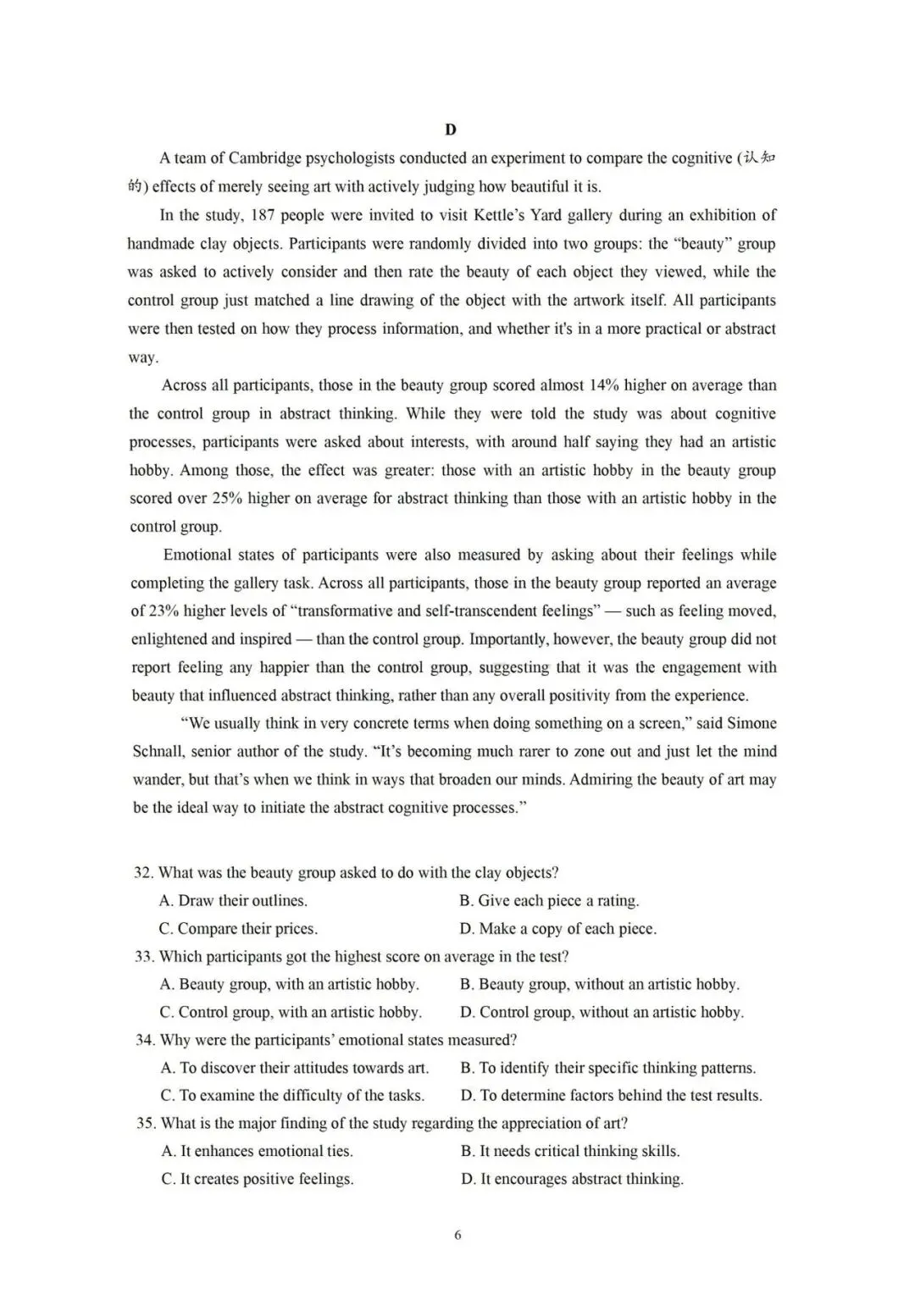
D篇主题语境:人与社会——文学、艺术与体育【语篇导读】本文是一篇说明文。文章主要讲的是剑桥大学心理学家通过实验发现,主动评判艺术品的美感能显著提升抽象思维能力,且这种效果在有艺术爱好的人群中更为明显,而非由积极情绪驱动。
第32题.B 细节理解。解析:根据第二段“the ‘beauty’ group was asked to actively consider and then rate the beauty of each object they viewed”可知,美组被要求积极思考并给每件作品的美观度打分,“rate”与选项B中的“Give each piece a rating”同义。故选B。
第33题.A 细节理解。解析:根据第三段“those with an artistic hobby in the beauty group scored over 25% higher on average for abstract thinking than those with an artistic hobby in the control group”可知,美组中有艺术爱好的人抽象思维得分最高,超越其他所有组别。故选A。
第34题.D 推理判断。解析:根据第四段,研究者测量情绪状态后发现美组虽然“超越性情感”更强,但并未比对照组更快乐,由此排除了整体积极情绪的影响,从而确定是“对美的投入”这一因素导致抽象思维提升。这说明测量情绪是为了弄清测试结果背后的真正原因。故选D。
第35题.D 主旨大意。解析:全文围绕“评判艺术之美促进抽象思维”展开,最后一段也明确指出“Admiring the beauty of art may be the ideal way to initiate the abstract cognitive processes”,与此直接对应。故选D。
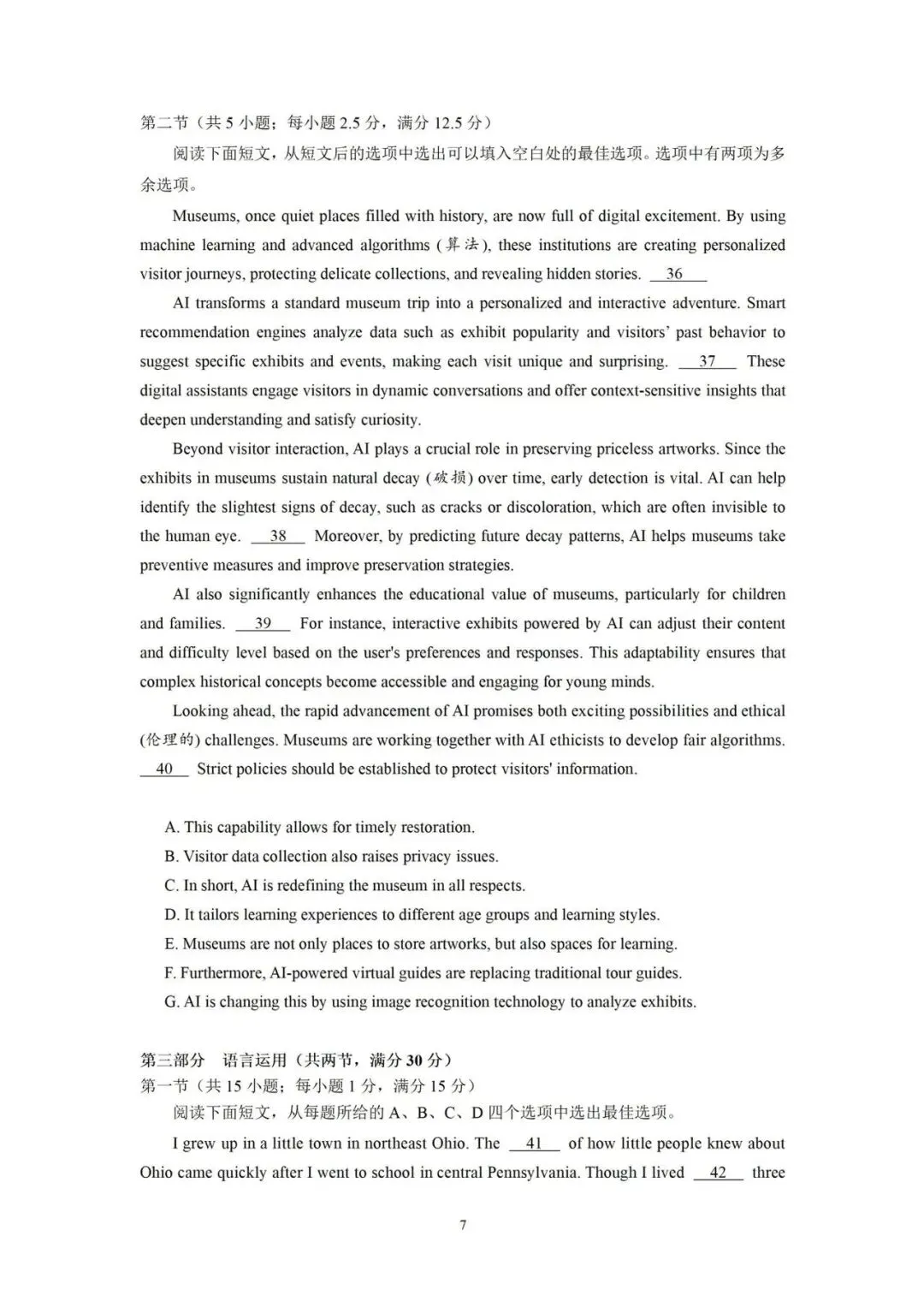
七选五主题语境:人与社会——科学与技术【语篇导读】本文是一篇说明文。文章主要讲的是人工智能通过个性化参观、文物保护、教育提升等方式重新定义博物馆,并带来隐私等伦理挑战。
第36题.C 总结概括与承上启下。解析:空前概述了博物馆借助机器学习等创造个性化旅程、保护藏品、揭示隐藏故事,空后开始具体阐述AI如何改变博物馆参观,C项“总之,AI正在全面重新定义博物馆”既对上文进行总结,又自然引出下文,起到过渡作用。故选C。
第37题.F 上下文衔接与指代关系。解析:空后“These digital assistants”表明前文需出现可被指代的“数字助手”,F项中的“AI-powered virtual guides”恰与“digital assistants”对应,且Further more表示对上文推荐引擎的递进补充,介绍虚拟导游如何与游客对话。故选F。第38题.A 因果逻辑与句间连贯。解析:空前说AI能识别人眼无法察觉的破损迹象,A项“This capability allows for timely restoration”指这一识别能力让及时修复成为可能,与空前内容形成因果关系;空后“Moreover”引出预测破损模式的更进一步作用,逻辑通顺。故选A。
第39题.D 主题句与举例说明。解析:本段主题为AI提升博物馆的教育价值,尤其对儿童和家庭。D项“It tailors learning experiences to different age groups and learning styles”说明AI可定制学习体验,空后的例子“根据用户偏好和反应调整内容和难度”恰好是对这一定制功能的具体说明。故选D。
第40题.B 承上启下与话题一致。解析:前文提到博物馆与伦理学家合作开发公平算法,属伦理挑战;B项“游客数据收集也引发隐私问题”延续伦理话题,空后“应制定严格政策保护访客信息”正是对隐私问题的应对,衔接紧密。故选B。
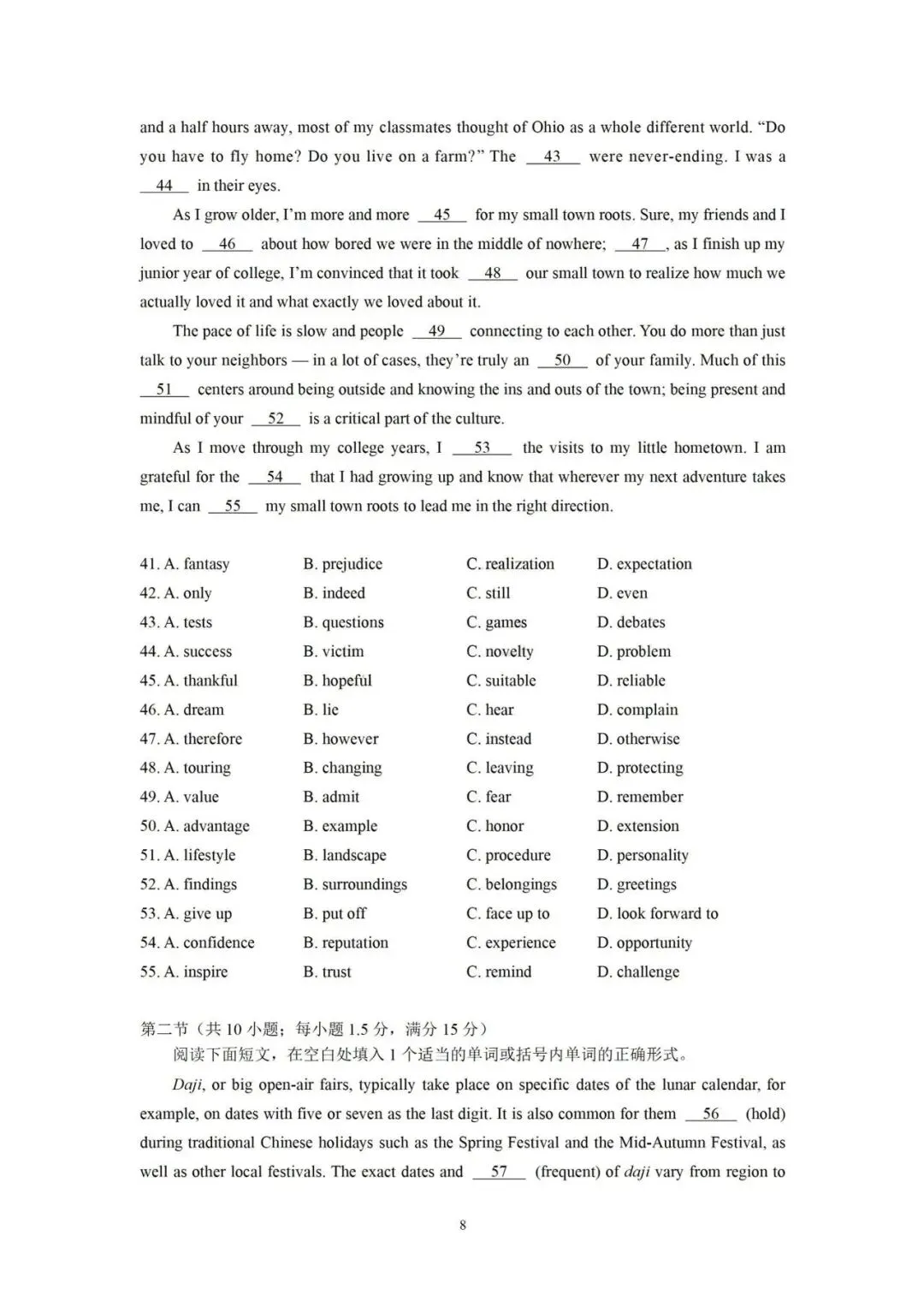
完形填空主题语境:人与社会——社会交往与人际沟通、家乡情感与文化认同【语篇导读】本文是一篇记叙文。文章主要讲的是作者离开家乡俄亥俄州小镇后,逐渐意识到并感激故乡慢节奏的生活方式、紧密的邻里关系,以及这些根源如何持续给予自己归属感和方向感的个人成长感悟。第41题.C 名词词义辨析与上下文逻辑。解析:A.fantasy幻想;B.prejudice偏见;C.realization认识,意识到;D.expectation期待。上文提到作者在俄亥俄州东北部小镇长大,下文紧接着说同学们对俄亥俄知之甚少,这让作者很快“意识到”这一点,强调一种逐渐清晰的认识过程。故选C。
第42题.A 副词辨析与逻辑强调。解析:A.only仅仅;B.indeed确实;C.still仍然;D.even甚至。作者离开家乡到宾州中部上学,虽然车程“仅仅”三个半小时,同学们却觉得俄亥俄是另一个世界,用only强调这种地理距离近、心理距离远的反差。故选A。
第43题.B 名词词义辨析与语境对应。解析:A.tests测试;B. questions问题;C.games游戏;D.debates辩论。前文引号里“Do you have to fly home? Do you live on a farm?”都是同学们提出的“问题”,且下文never-ending显示问题接连不断。故选B。
第44题.C 名词词义辨析与情感色彩。解析:A.success成功;B.victim受害者;C.novelty新奇事物,与众不同的人;D.problem问题。同学们对作者来自俄亥俄州小镇这件事感到无比好奇,频频发问,说明在他们眼里,作者是一个“新奇的人”。故选C。
第45题.A 形容词词义辨析与情感态度。解析:A.thankful感激的,欣慰的;B.hopeful有希望的;C.suitable合适的;D.reliable可靠的。下文详细列举了作者对故乡生活的怀念和肯定,表明随着年龄增长,他对小镇根源越来越“心存感激”。故选A。
第46题.D 动词词义辨析与搭配。解析:A.dream梦想;B.lie说谎;C.hear听见;D.complain抱怨。complain about为固定搭配,意为“抱怨”。此处指作者和朋友过去常“抱怨”乡下生活无聊。故选D。
第47题.B 逻辑连接副词辨析。解析:A.therefore因此;B.however然而;C.instead反而;D.otherwise否则。前句讲过去常抱怨无聊,后句讲现在却发现其实很爱故乡,前后构成明显的转折关系。故选B。
第48题.C 动词词义辨析与深层含义。解析:A.touring游览;B.changing改变;C.leaving离开;D.protecting保护。句意表达的是“离开小镇之后才意识到自己有多爱它”,这是对成长过程中远离家乡才能理解故乡这一普遍体验的诠释。故选C。
第49题.A 动词词义辨析与价值观。解析:A.value重视,珍视;B.admit承认;C.fear害怕;D.remember记住。在小镇里生活节奏慢,人们“重视”彼此间的联结,这体现了小镇文化的核心特征。故选A。
第50题.D 名词词义辨析与比喻义。解析:A.advantage优势;B.example例子;C.honor荣誉;D.extension延伸,扩展部分。此处意指邻居不仅仅是可以交谈的对象,很多时候他们真正是家庭的“延伸”,说明关系极其亲密,如同一家人。故选D。
第51题.A 名词词义辨析与概括能力。解析:A.lifestyle生活方式;B.landscape风景;C.procedure步骤,程序;D.personality性格。后文描述的多在户外、熟知小镇的一切、关注当下和环境等,都是对一种慢节奏“生活方式”的具体说明。故选A。
第52题.B 名词词义辨析与语境对应。解析:A.findings发现;B.surroundings周围环境;C.belongings财产,所有物;D.greetings问候。be mindful of your surroundings意为了解并关注自己的“周围环境”,这与前文knowing the ins and outs of the town相呼应,是小城镇文化的核心部分。故选B。
第53题.D 动词短语辨析与情感倾向。解析:A.give up放弃;B.put off推迟;C.face up to勇敢面对;D.look forward to期待。结合全文对故乡的依恋与感激,作者在大学期间应是“期待”回到故乡的每一次探访。故选D。
第54题.C 名词词义辨析与总结。解析:A.confidence信心;B.reputation名声;C.experience经历,体验;D.opportunity机会。作者感激的是成长过程中在小镇拥有的宝贵“经历”,这些经历塑造了自己。故选C。
第55题.B 动词词义辨析与核心理念。解析:A.inspire激励;B.trust信任,信赖;C.remind提醒;D.challenge挑战。作者相信无论未来去哪里冒险,都可以“信赖”自己的小镇根源为自己指明正确的方向。trust表达一种内心的依靠和信念。故选B。
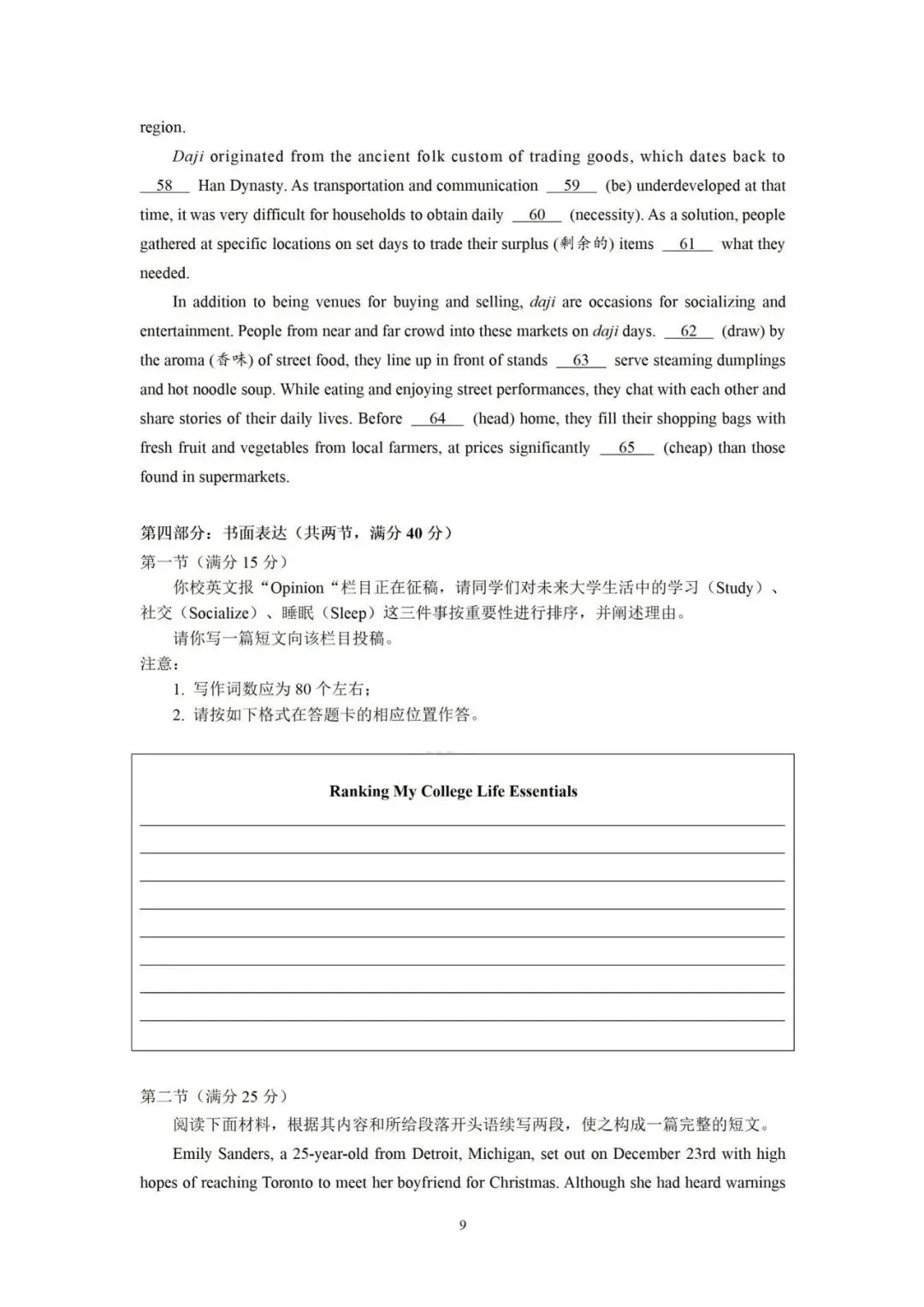
语法填空主题语境:人与社会——历史、社会与文化【语篇导读】本文是一篇说明文。文章主要介绍了中国民间传统集市“大集”的时间安排、历史渊源,以及其兼具商品交易和社交娱乐功能的特点。
第56题.to be held 非谓语动词(不定式的被动式)。解析:此处为“It is+adj.+for sb./sth. to do sth.”句型,其中动词hold与逻辑主语them(指代daji)之间是被动关系,大集是被举办,故用不定式的被动形式to be held。
第57题.frequency 词性转换(形容词变名词)。解析:and连接两个并列主语,前面为名词dates,故此处应填入frequent的名词形式frequency,表示“频率”。
第58题.the 定冠词。解析:Han Dynasty是专有名词“汉朝”,由普通名词构成的朝代名称前通常要加定冠词the。
第59题.were 时态与主谓一致。解析:描述过去的情况,应用一般过去时;主语是“transportation and communication”,为复数概念,故be动词用were。
第60题.necessities 名词单复数。解析:necessity意为“必需品”,为可数名词,日常必需品是多种物品,需用复数形式necessities。
第61题.for 介词。解析:trade...for...为固定搭配,意为“用……交换……”,此处表示用多余物品交换所需要的东西。
第62题.Drawn 非谓语动词(过去分词作状语)。解析:句首单词注意大写。主语they与draw之间是被动关系,即“人们被街头小吃的香味所吸引”,故用过去分词Drawn作原因状语。
第63题.that/which 定语从句关系代词。解析:先行词是stands(摊位),指物,关系词在定语从句中作主语,故用that或which引导。
第64题.heading 非谓语动词(动名词)。解析:介词before后需接动词-ing形式作宾语,head home表示“动身回家”,故用heading。
第65题.cheaper 形容词比较级。解析:由空后than可知此处是把大集上的价格和超市价格进行比较,应用cheap的比较级形式cheaper。
一、应用文(15分,约80词)(AI参考)
题目:校英文报“Campus Life”征文,讨论大学生活中学习(Study)、睡眠(Sleep)、社交(Socializing)的重要性排序,说明理由。
范文(Study>Sleep>Socializing)
Dear editor,
As I prepare for college life, I firmly rank study first, sleep second, and socializing third.
Study is the core task, equipping me with knowledge and skills for my future career. Good sleep ensures health and energy to support efficient study. Socializing enriches life, but it should not distract me from my main goals.
Balancing the three well will make my college life rewarding.
Yours,
Li Hua
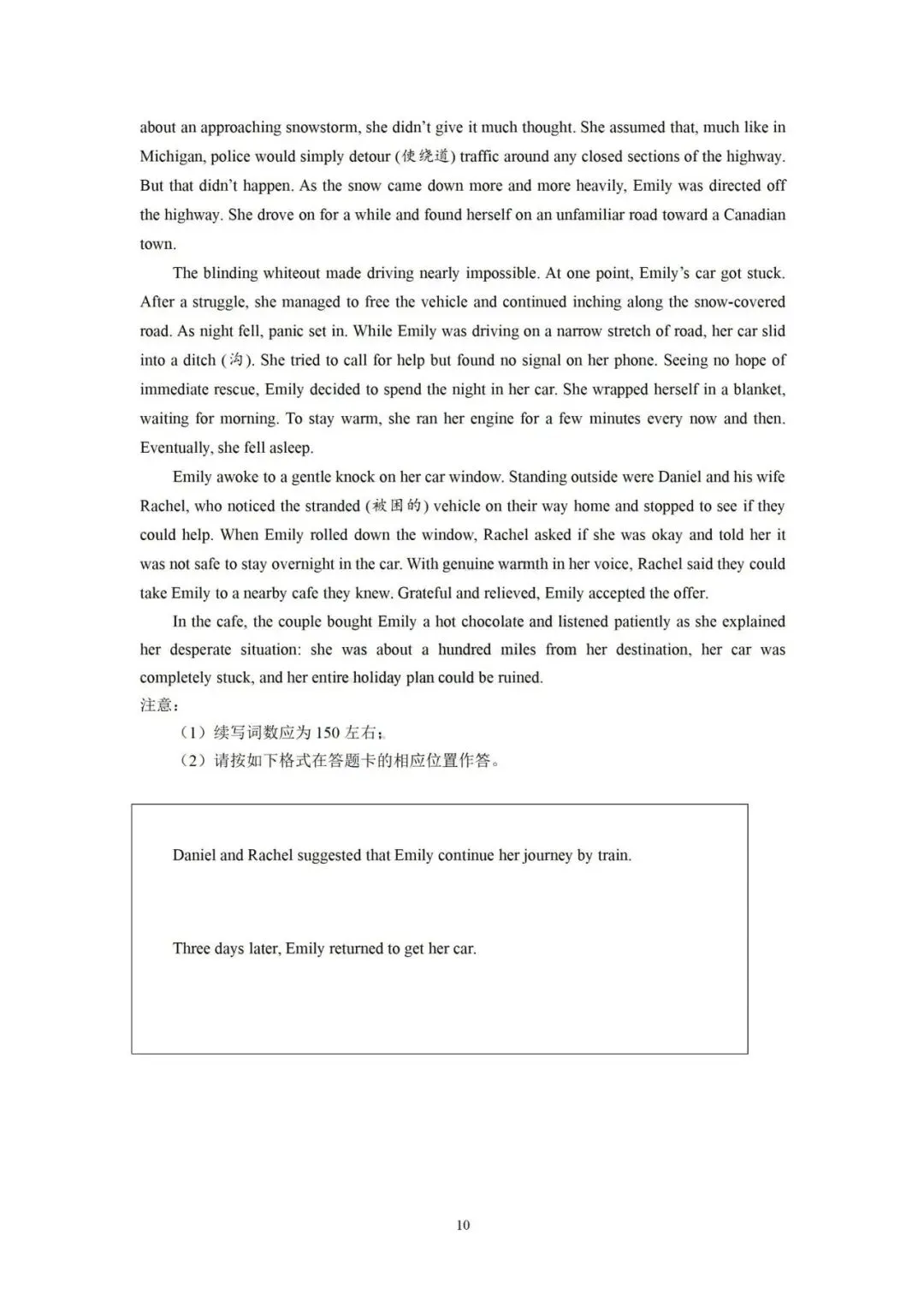
二、读后续写(25分)
原文梗概:Emily圣诞节前夕独自开车去多伦多见男友,遇暴风雪被困,被一对夫妇救助。
段首句:
1. The couple suggested Emily take a train to meet her boyfriend.
2. Three days later, Emily came back to get her car.
范文(AI参考)
Para 1: The couple suggested Emily take a train to meet her boyfriend.
Emily hesitated but finally accepted their kind advice. The couple drove her to the nearby station and helped her buy a ticket. On the train, she watched the snow-covered scenery, feeling grateful for their timely help. She texted her boyfriend to update her plan, relieved to continue her journey safely.
Para 2: Three days later, Emily came back to get her car.
The snow had cleared, and the road was smooth again. She thanked the couple repeatedly for rescuing her from the blizzard. This experience taught her to respect weather warnings and cherish the kindness of strangers. It was a Christmas she would never forget.


