


往期链接
外刊真题题源泛读1:交通工具绿色化(A篇题源 2025全国一卷 )
外刊真题题源泛读2:居家绿植治愈风潮(A篇题源 2025 全国二卷 )
外刊真题题源泛读3:专职宠物运输师Merebeth的暖心公路之旅(A篇题源 2022年1月浙江首考全卷)
外刊真题题源泛读4:纸质阅读与数字阅读的学习效果差异(A篇题源 2024年新高考一卷)
外刊真题题源泛读5:永不言弃的人生一课(A篇题源 2021年6月浙江高考 )
酌情取舍,仅供参考
外刊真题题源泛读7:纸质词典与语音查词(B篇题源 2026年高考)
私家英语
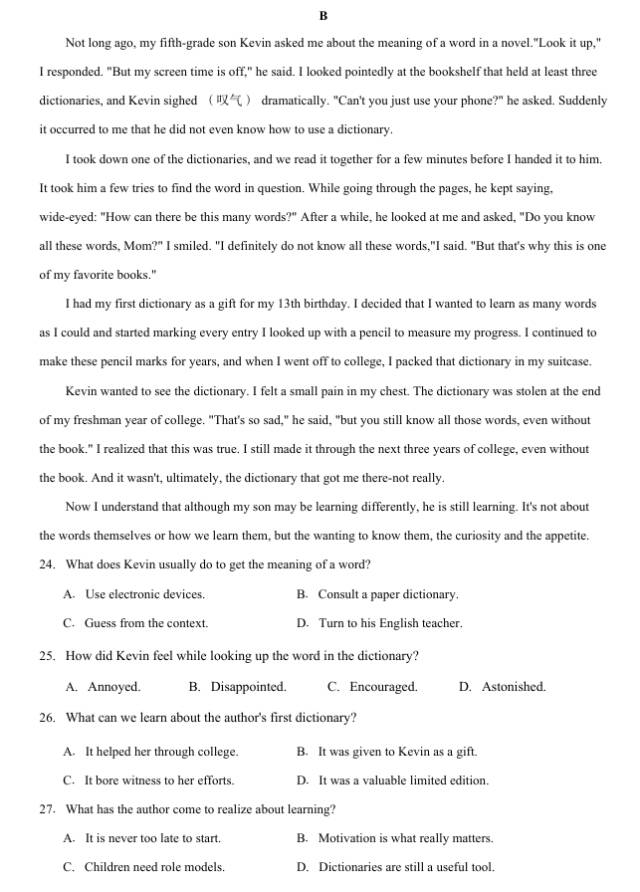
一、基础信息
项目 | 详情 |
文章标题 | Hey Siri, Call Webster |
话题 | 纸质词典与智能语音查词的对比,作者少年标记词典的成长回忆,探讨求知欲比查词工具更重要 |
体裁 | 叙事抒情散文(高考记叙文标准题型) |
词数 | 约 830 词(高考中等偏上难度) |
二、主要内容
本文以母子对话开篇,儿子遇到生词第一反应喊 Siri,完全不会使用书架上的纸质词典,引发作者感慨。作者回忆自己 13 岁收到厚本词典作为生日礼物,当年坚持用铅笔点标记每一个查阅的单词,依靠纸质词典积累词汇;文中引用《坚毅》一书观点,自我挑战的毅力比天赋更重要。后来这本承载回忆的词典在大学宿舍被偷走,作者一度惋惜。如今孩子习惯语音一键查词,无需翻书查找,作者担忧便捷工具弱化思维,但最后释然:真正的学习核心不是词典工具,而是内心主动求知的好奇心与求知欲。
三、英文原文(830 词)
Hey Siri, Call Webster When it comes to learning new words, it’s not where you look them up that’s important Not long ago, my son asked me about the meaning of a word in a novel he was reading for his fifth-grade book club. “Look it up,” I responded, my automatic rejoinder when my children ask me the meaning of a word, which is often. “But my screen time is off,” he whined. We were sitting next to a bookshelf that held at least three dictionaries, plus a thesaurus. I looked pointedly at the shelf, and my son sighed dramatically. “Can’t you just use your phone?” he asked. A terrifying thought occurred to me. “Do you even know how to use a dictionary?” This was my second son, and it turned out that my sureness of having taught him something was often a transplanted memory of having taught that very thing to my firstborn. “Of course,” he scoffed. “Every chapter is a different letter.” I laughed out loud at this idea. I’d never thought of the dictionary as having chapters, as something that might be read sequentially from beginning to end. We pored over a paperback dictionary together for a few minutes before I handed it to my son. It took him a few tries to find the word in question (peripheral), and he was overwhelmed by the idea that there could be an entire page—pages!—devoted to words that share the same three beginning letters. He kept saying: “How can there be this many words?” He asked this with alternating horror and awe. I wanted him to land squarely in the awe category. But I knew from experience that if I pushed too hard, he’d just shut the book. So I concentrated on my own work as he continued to browse. After a few frustrated minutes, he looked at me with surprise. “Do you know all these words, Mom?” I am an English professor, and he often assigns strange functions to my job, imagining the classes I teach to be a mix of book club, Scratch class, and the soul-numbing five-paragraph essay. I rarely explain that these things don’t really exist in college. “I definitely do not know all these words,” I said. “But that’s why this is one of my favorite books.” I was just a bit older than my son is now when I decided that I wanted to learn as many words as I could and started marking every entry I looked up in the dictionary with a small penciled dot. I don’t know where I got this idea. I remember feeling stolen from, my face burning in the dark, while watching the scene in Say Anything when Diane Court tells Lloyd Dobler that she used a pen to mark the words she looked up in her obscenely huge dictionary. My dictionary was also obscenely huge, the kind with onionskin paper and gold leaf on the cutaway thumb tab for each letter. Diane’s dictionary was covered in Xs; mine was filled with graphite—a strange, silvery Morse code dotting its pages. The dictionary was a gift for my 13th birthday. Books, especially new books, were hallowed in my house. Although neither of my parents was able to go to college, they both made clear that my education was a family priority. This dictionary seemed like an embodiment of what I’d need to know to get into college one day. And so I took to measuring my progress. In her book Grit: The Power of Passion and Perseverance, the psychologist Angela Duckworth argues that this inclination toward self-challenge is far more important as a measure of success than talent or intelligence. I agree that my impulse to set goals and my tendency to work harder than the next person have been more helpful in my life than any score I ever received on an IQ test or the SAT. But mostly, I marked up my dictionary because I enjoyed the process, took pleasure in the visual tabulation. I didn’t set out to learn every word. I did it for the experience, for the pleasure of participation, not the result, a rare thing in those days. I continued to make these pencil marks for years, and when I did finally go off to college, I packed that dictionary in my suitcase. After my son finished his homework that evening, I reshelved the paperback dictionary. He did not place a dot by his word, and since that day, I haven’t seen him take the dictionary down once. I have, however, heard him ask Siri to define many more words. I try not to let this scare me, and yet, I worry that things are too easy for my children, that asking Siri to define words instead of hunting for them on their own in a paper dictionary will soften and ultimately dull their brains. I want to keep them sharp, but I don’t know how to do this in today’s world, where every single definition of every single word is only a voice query away. A few days later, my son asked me about my dictionary, the one I marked up. He wanted to see it. A small pain gripped my chest at the memory. “The book is gone,” I said. The dictionary was stolen at the end of my freshman year of college. I had used the book to prop open my old double-hung dorm window, and someone walking by just plucked it from the sill when I wasn’t looking. “That’s so sad,” he said. “I wish I could see all the words you know.” I thought about this. When they were toddlers, I used to write the words my children could say in chalk on our bluestone patio. I loved seeing the list grow, extend to more and more of the pavers until we couldn’t squeeze any more words in. I thought about all of my own dictionary words climbing out of my childhood bedroom and down to the street, extending into the distance, making a bridge of letters to my college dorm room. My son paused, thinking, then said, “But you still know all those words, even without the book.” I realized that this was true. I imagined my dictionary with its little dots, moldering in a secondhand bookshop or turning to mulch at the dump. I still made it through the next three years of college, even without my book. And it wasn’t, ultimately, the dictionary that got me there—not really. I remembered that although my children loved to watch me chalk out their words, what they loved even more was helping spray down the stones with the hose afterward, watching the color disappear until our patio resembled a computer screen gone blank. And I understood that although my son may be learning differently, he is still learning. It’s not about the words themselves or how we learn them, but the wanting to know them, the curiosity and the appetite.
四、生词中英文梳理
1.rejoinder /rɪˈdʒɔɪndə(r)/n. 脱口而出的答复
2.thesaurus /θɪˈsɔːrəs/n. 同义词词典
3.pointedly /ˈpɔɪntɪdli/adv. 刻意地,直指地
4.scoff /skɒf/v. 嗤之以鼻,嘲笑
5.sequentially /sɪˈkwenʃəli/adv. 按顺序地
6.peripheral /pəˈrɪfərəl/adj. 周边的,外围的
7.awe /ɔː/n. 惊叹,敬畏
8.obscenely /əbˈsiːnli/adv. 过分地,惊人地
9.onionskin paper 薄如洋葱皮的字典纸
10.graphite /ˈɡræfaɪt/n. 石墨(铅笔芯)
11.hallow /ˈhæləʊ/v. 珍视,奉若珍宝
12.embodiment /ɪmˈbɒdɪmənt/n. 化身,具象体现
13.inclination /ˌɪŋklɪˈneɪʃn/n. 倾向,本能冲动
14.tabulation /ˌtæbjuˈleɪʃn/n. 罗列,记录
15.mulch /mʌltʃ/n. 腐殖土,碎料
16.appetite /ˈæpətaɪt/n. 求知欲,渴望
五、全文中文翻译
嗨,Siri,呼叫韦氏词典 学新词时,查词的工具从来都不是关键 不久前,儿子在读五年级读书会指定小说,遇到一个生词跑来问我。 “自己查字典。” 只要孩子问单词,我总会脱口而出这句。 “屏幕使用时间被锁了。” 他委屈嘟囔。我们身旁书架摆着至少三本词典,还有一本同义词辞典。我刻意朝书架扬了扬视线,他长长叹了口气:“你直接用手机查不行吗?” 一个令人不安的念头涌上心头:“你连纸质词典都不会用?” 这是我的二儿子,我总以为自己教过他查词,后来才发现,这份记忆其实是我教大儿子时的画面混淆了。 “我当然会,” 他嗤笑一声,“每个章节对应一个字母呗。” 我听完忍不住大笑。我从来没想过词典还能分章节,像小说一样从头读到尾。 我和他一起翻了会儿平装词典,再把书递给他。他试了好几次才找到那个单词 peripheral。看到整整好几页全是以这三个字母开头的词,他无比震惊,反复念叨:“怎么会有这么多单词?语气里又害怕又惊叹。” 我希望他能发自内心敬畏词汇的浩瀚,但我清楚,逼太紧他只会合上书放弃。于是他慢慢翻阅,我转头忙自己的事。 几分钟后,他一脸惊奇看向我:“妈妈,这些单词你全都认识吗?” 我是一名英语教授,他总对我的工作充满奇特想象,以为我上课就是读书会、编程课加枯燥五段式作文的结合。我很少和他解释大学课堂根本不是这样。“我肯定认不全,可这却是我最爱的一本书。” 我当时比现在的儿子大不了几岁,下定决心要尽可能多积累单词,每次查到新词,都会用铅笔在词条旁点一个小点。我也说不清这个灵感从哪来。某天夜里看电影《情到深处》,戴安告诉劳埃德,她在那本巨厚词典上用叉标记查过的词,看到这一幕我心里深受触动。我那本词典同样厚重,纸张轻薄如洋葱皮,每个字母分区都有烫金拇指分页。戴安画叉,我的书页则布满银灰色铅笔点,像一串奇特摩斯密码。 这本词典是我 13 岁的生日礼物。在我家,书籍尤其是新书格外珍贵。父母都没能读完大学,但他们明确告诉我,我的学业是全家头等大事。这本词典仿佛承载着我考上大学需要掌握的一切知识,我开始用铅笔标记衡量自己的进步。心理学家安吉拉・达克沃思在《坚毅:激情与坚持的力量》中写道,主动自我挑战的特质,比天赋、智商更能决定一个人的成败。我十分认同,比起智商测试、SAT 分数,设立目标、比旁人更努力的本能,对我的人生帮助更大。但我标记词典主要是享受过程,享受这种可视化的积累,我并非立志学完所有单词,只是单纯享受参与其中的乐趣,在那个年代,这份心态十分难得。我坚持标记了很多年,上大学时,我把这本词典塞进了行李箱。 那天儿子写完作业,我把平装词典放回书架。他没有在查到的单词旁做任何标记,自那以后,我再也没见他碰过这本词典,倒是无数次听见他喊 Siri 查词义。我努力不让自己焦虑,可总会担心:现在的孩子获取知识太容易,张口语音查询,不用亲手翻书搜寻,长期下来思维会变得迟钝。我想让他保持思考力,可如今每个单词释义只需要一句语音指令,我不知道该如何引导。 几天后,儿子问起我当年那本标记满的词典,他很想看一看。回忆涌上心头,一阵酸涩:“那本书不在了。” 大一期末,我拿词典抵住老式推拉宿舍窗户,路过的路人趁我不在,直接从窗台拿走了它。 “太可惜了,” 他说,“我真想看看你记下的所有单词。”我想起孩子们小时候,我会用粉笔在青石庭院写下他们会说的词,看着石板上的词汇越写越多,直到再也挤不下。我幻想我少年时标记的所有单词,走出卧室、铺满庭院,一路延伸到大学宿舍,搭起一座由字母构成的长桥。 儿子低头思索片刻,开口道:“可就算书不见了,那些单词你还是记得啊。” 我恍然大悟,确实如此。我想象那本布满铅笔小点的词典,或许闲置在二手书店,或许被当成垃圾化作腐殖土。即便没有它,我依然读完了后三年大学。说到底,真正成就我的从来不是一本词典。 我记得孩子们小时候,很爱看我在石板写词,但更爱拿水管冲掉粉笔痕迹,看着石板变得空白,像黑屏的电脑。那一刻我释怀:儿子学习的方式虽和我截然不同,但他依然在汲取知识。真正重要的从来不是单词本身,也不是查词工具,而是内心求知的渴望、与生俱来的好奇与探索欲。
六、语法填空
阅读下面短文,在空白处填入 1 个适当的单词或括号内单词的正确形式。 Sonja ____56 (seek) to run a plant store, launched her website in the pandemic. Her ____57 (guide) for new growers is widely shared online. Over the past year, thousands of green plants ____58 (deliver) to buyers. Her TikTok channel ____59 (attract) a huge group of plant lovers so far. Many notes ____60 (send) by customers talk about comfort brought ____61 plants. The ____62 (care) selection of pots matters a lot. We can enjoy ____63 (true) relaxing time with houseplants, ____64 the small greens brighten every room. It is ____65 simple joy of growing things that lifts our low spirits.
【标准答案】
- to seek
- guidance
- have been delivered
- has attracted
- sent
- by
- careful
- truly
- and
- that
短文导语
本篇语法填空严格匹配指定 8 道有提示词、4 类无提示词考点,贴合全国一卷命题规则,依托外刊原文改编设空。
逐题详细解析
- to seek
【考点:有提示词・不定式(非谓语)】 句意:一心想开绿植店的索尼娅在疫情期间上线网站。 解析:不定式作后置定语修饰主语,匹配指定不定式考点。 - guidance
【考点:有提示词・动词变名词 guide→guidance】 句意:她给绿植新手的养护指南在网上广为流传。 解析:形容词性物主代词后需名词,动词 guide 转化名词 guidance。 - have been delivered
【考点:有提示词・动词时态 + 被动语态】 句意:过去一年,数千盆绿植被配送至买家手中。 解析:Over the past year 为现在完成时标志,plants 与 deliver 被动关系。 - has attracted
【考点:有提示词・时态 + 主谓一致】 句意:迄今为止,她的抖音账号吸引了大批绿植爱好者。 解析:so far 现在完成时标志,主语单数,谓语三单。 - sent
【考点:有提示词・过去分词(动词类补充)】 句意:许多顾客寄来的留言诉说绿植带来慰藉。 解析:notes 与 send 被动,过去分词后置定语,补足 8 道有提示词。 - by
【考点:无提示词・介词】 句意:许多顾客寄来的留言诉说绿植带来慰藉。 解析:被动结构引出动作主体,匹配指定介词 by 考点。 - careful
【考点:有提示词・名词变形容词 care→careful】 句意:花盆的精心挑选十分关键。 解析:修饰名词 selection,名词转换形容词。 - truly
【考点:有提示词・形容词变副词 true→truly】 句意:养护绿植能收获真正放松的时光。 解析:修饰形容词 relaxing,形容词转副词。 - and
【考点:无提示词・并列连词】 句意:我们能享受放松时光,小小的绿植点亮每一间屋子。 解析:前后分句顺承并列,用 and 连接。 - that
【考点:无提示词・定冠词 the】 句意:养护植物这份简单的快乐治愈低落情绪。 解析:特指这份快乐,用定冠词 the。
温馨提示:独家首发,版权所有。
独家首发,版权所有。如需引用,请标注出处。
欢迎各位有志之士投稿,共建优质交流平台。
投稿邮箱:carries4182925@126.com
视频音频请在此处下载。
本系列仅供个人参考学习,请勿挪作他用。
如需完整版请前往小程序(第一个二维码),搜索关键词下载。
下载 课件
课件


读后续写系列书籍
你点的在看,是对我们持续分享最大的支持!


