
READING PASSAGE 1
You should spend about 20 minutes on Questions 1-13, which are based on Reading Passage 1.
Jewels from the sea
Indigenous necklaces in Tasmania
A Necklace-making is the most significant cultural tradition of Tasmania Aboriginal women. It is also one of the few traditions that have continued without interruption since before the Europeans settled in Tasmania, the island to the south of the mainland of Australia, in 1803. Whereas colonisation disrupted or destroyed so much of Tasmanian Aboriginal life and heritage, necklace-making has not only continued but also evolved in various ways.
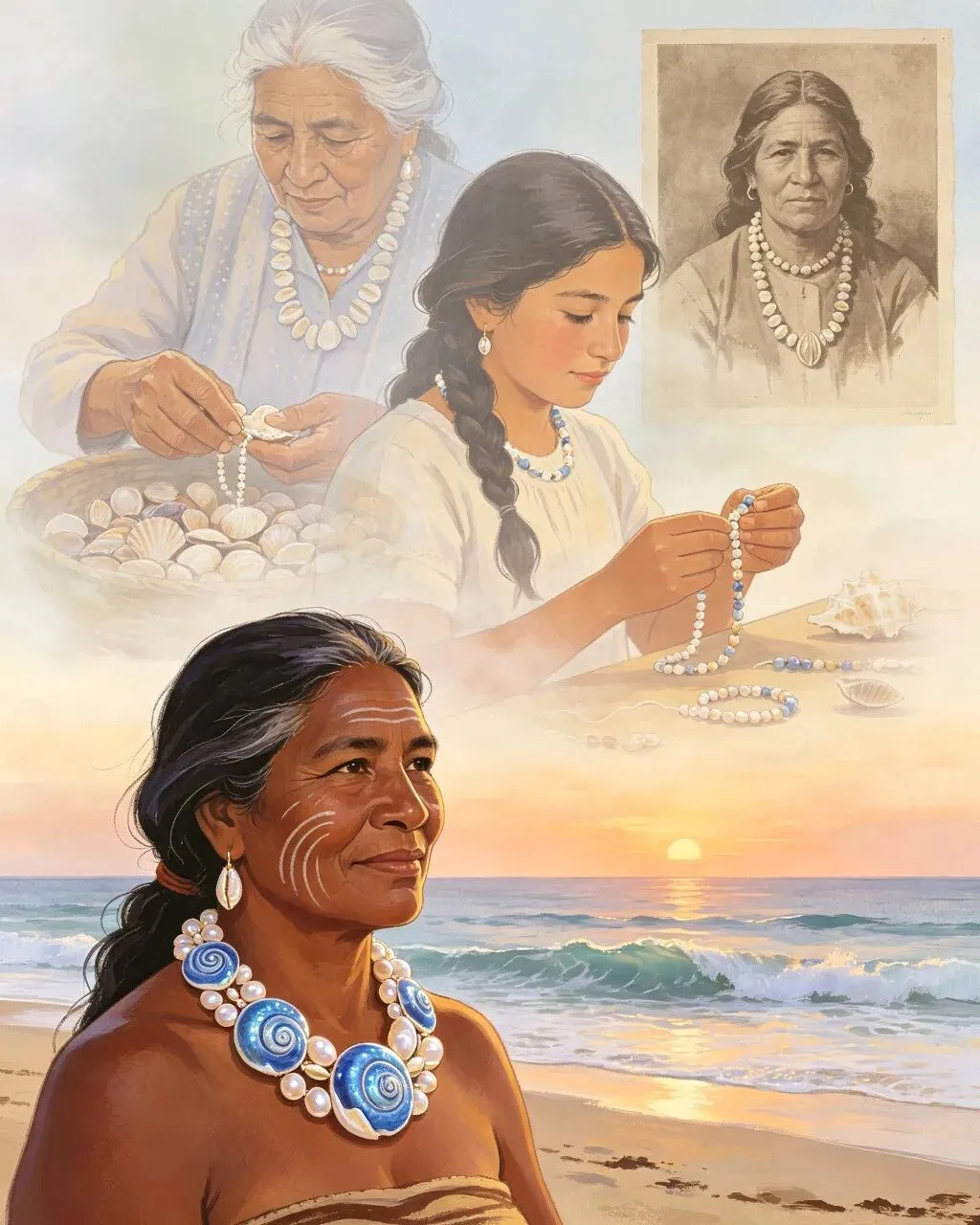
B The knowledge and skills of shell processing and stringing have been passed down through generations of women, particularly the women of the Furneaux Island, off Tasmania’s north-east coast. Necklace-making is an opportunity for women of all ages to get together and share stories, pass knowledge to younger generations and continue to affirm their culture. Aunty Dulcie Greeno, an elder of the Tasmanian Aboriginal community, has been, making necklaces for more than 40 years, but first began practising as a child. ‘My grandmother used to do shell necklaces and a couple of my aunties did too,’ she said in an interview for Australian Museums and Galleries Online. ‘We’d go round with them on the beach and collect shells with them.’ Now her sister (Corrie Fullard), daughter (Betty Grace), daughter-in-law (Lola Greeno), and niece (Jeanette James) – all celebrated artists in their own right-make necklaces.
C Shell necklaces were originally made as an adornment, as gifts, and tokens of honour, and as objects to be exchanged with other groups for tools or for ochre, which could be used in important ceremonies. Archaeologist Rhys Jones found shells that had been pierced for a necklace dating back at least 2,000 years. After European colonisation, necklaces were also sold or exchanged for food, clothing, and other essential supplies. Now, the artists are often commissioned to create necklaces for museums, galleries, and private collectors.
D Early European explorers remarked on the beauty of these treasures, and held them in high esteem. The French naturalist Jacques Labillardière, traveling with the d’Entrecasteaux expedition of 1791-94, observed women wearing ‘strings of brilliant pearly blue spiral shells upon their bare heads’. 18th- and 19th-century images show Tasmanian Aboriginal people wearing necklaces, including a photograph taken around 1866 of the leader and spokeswoman Truganini.
Questions 1-6
Do the following statements agree with the information given in Reading Passage1?In boxes 1-6 on your answer sheet, write TRUE if the statement agrees with the informationFALSE if the statement contradicts the information NOT GIVEN if there is no information on this
1 After European settlement, Tasmanian Aboriginals stopped making necklaces for a short time. ............
2 Aboriginal women on the Furneaux Islands made the most beautiful necklaces. ............
3 An 1866 photograph of the leader Truganini shows her wearing a necklace she had made herself. ............
4 Men assist in gathering shells growing on sea plants. ............
5 Tasmanian Aboriginal men wore long necklaces when hunting. ............
6 Tasmanian Aboriginal necklaces are appreciated outside Australia. ............
私信up主免费领取完整原文,答案,解析,机考刷题账号!