READING PASSAGE 1
You should spend about 20 minutes on Question 1-13 which are based on Reading Passage 1 below.
Jethro Tull (1674–1741) – Inventor of the Seed Drill
The English gentleman farmer who revolutionized the practice of agriculture
A Jethro Tull was a major pioneer in the modernizing of agriculture. He was born in 1674 in Berkshire, southern England, into a family of land-owning gentry. He studied first at Oxford University and then at the Inns of Court, London, in preparation for a legal or political career. However, his health issues forced him to postpone these plans, and after qualifying as a barrister in 1699, he made a tour of Europe, in the hope that the milder climates of France and Italy would alleviate his breathing problems. In every country through which he passed, he made careful observations of the soil and agricultural production, and on his return to England, the young Tull married, then began farming with his father at Howberry farm in Oxfordshire.
B Tull was determined to improve farming methods and increase crop yield on the family land, and pursued a number of agricultural experiments. He particularly wanted to increase efficiency in the sowing of seeds. At that time, seeds were still thrown by hand across the field in a haphazard manner, in a traditional method known as broadcasting. Tull soon realized this method of random distribution was inefficient, being wasteful of both seed and labor, so he instructed his staff to sow seeds at very precise, low densities. But by 1701, his frustration with their lack of co-operation prompted him to invent a machine to do the work for him.
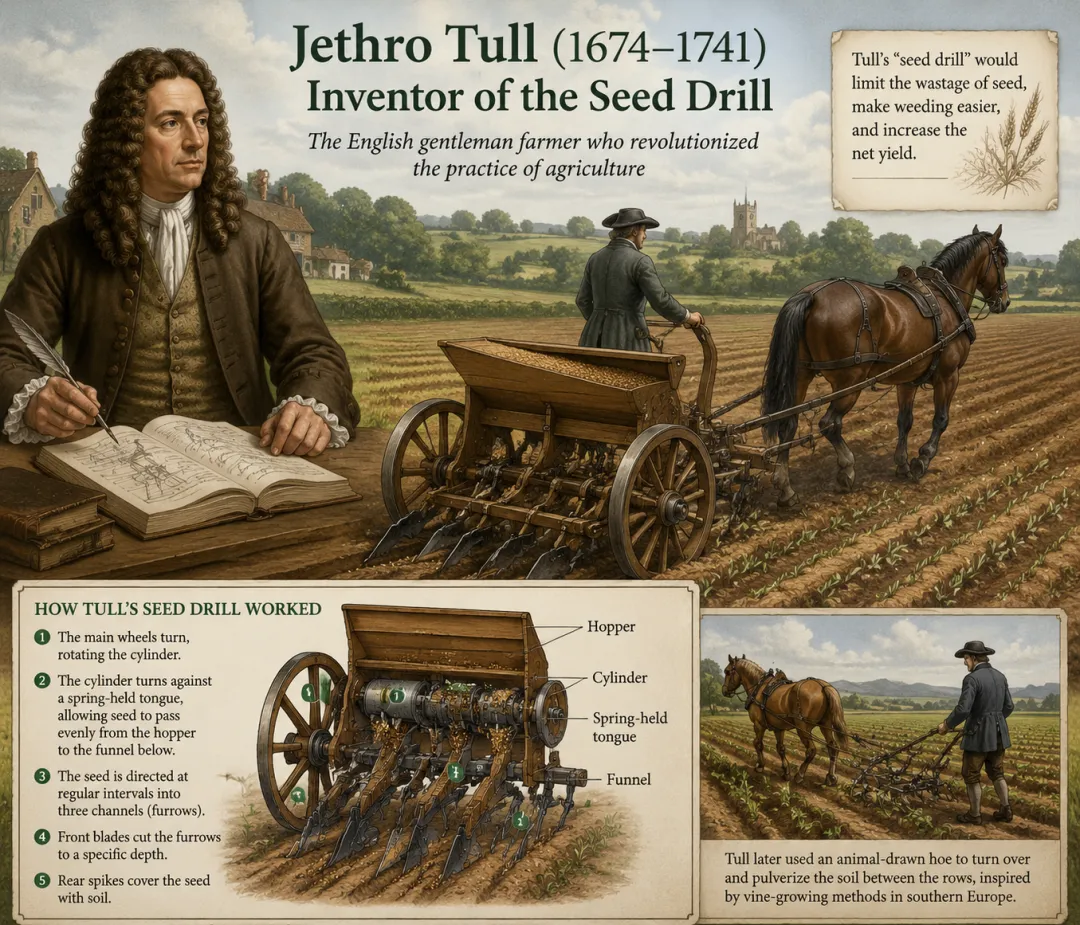
C Earlier in his life, Tull had once dismantled a pipe-organ, and the application of the technology behind this musical instrument inspired him to devise a drill that would distribute precise amounts of seed into pre-cut channels. Basic seeding devices had been known for almost 2000 years, but Tull took the concept a stage further. In his device, as the main wheels of the drill turned, the cylinder rotated against a spring-held tongue. This allowed seed to pass evenly from the hopper above to a funnel below. From here, the seed was directed at regular intervals into three channels, or furrows, in the earth. These were dug to a specific depth by the blades at the front of the machine. Spikes at the back of the machine then turned the soil over to immediately cover the seeds. Tull’s ‘seed drill’ would limit the wastage of seed, and as the seedlings grew in uniform rows, it would also make it easier to remove any unwanted weeds growing among the crop. Accordingly, each plant would have more space to grow, and although there would be fewer plants, the net yield would be greater.
D Initially the machine was only a limited success, and in 1711 Tull decided to travel around Europe again, both to improve his health and to study agricultural techniques there. Upon his return in 1714, he perfected both his system and machinery. Following practices he had observed in the vine-growing methods of southern Europe, he used an animal-drawn hoe to turn over and pulverize the earth between the rows. He wrongly believed this practice would release enough nutrients in the soil to nourish the crop, and so eliminate the need for manure to be used to fertilize the soil. His experiments were apparently successful, as he did manage to grow wheat in the same field for 13 successive years without the use of manure. However, it is more likely that it was the turning over and pulverization of the soil that cut down on the volume of weeds competing with the seed.
Questions 1-4
Label the diagram below.
Choose ONE WORD ONLY from the passage for each answer.
Write your answers in boxes 1–4 on your answer sheet.
1 _____ containing seeds
2 _____ which turns as wheel move
3 _____ through which seed passes into channels
4 _____ to distribute earth over seeds
Questions 5-8
Answer the questions below.
Choose NO MORE THAN TWO WORDS from the passage for each answer.
5 What name was given to the traditional technique of seed-sowing?
........................
6 What type of agriculture gave Tull inspiration on his second tour of Europe?
........................
7 What traditional addition to soil did Tull believe to be unnecessary?
........................
8 What animals did Tull recommend farmers should use to pull their machinery?
........................
私信up主免费领取完整原文,答案,解析,机考刷题账号!