

高考寄语
高考还有20多天,现在大家应该逐渐回到自己做过的错题和原题中。再做题,应该不以对喜,不以错悲,保持心态的稳定。
下面是2022年全国乙卷英语真题和2025年全国高考二卷英语听力和阅读C篇的真题,大家对比着去做,去感觉!
文后有答案,但不要听完就去对答案,听好多遍,直到听懂为止。大家可以按照此法有计划的听,细心地体会。
阅读还是要紧扣提干,阅读第一段抓住主旨,结合提干,合理推理!
双语桥是学习英语和汉语的公众号,有高考英语合集(#高考英语解析),有四、六级英语学习合集(四级写作与翻译)。有小说阅读(哈利波特原著导读),有英语散文解读(美文欣赏),有《论语》英译的评析(《论语·为政》英译评析(34):谨言慎行),有英文歌曲(英文歌曲)!前后原创180余篇,近40多万字!

2022年全国乙卷英语真题(含听力)
学校:___________姓名:___________班级:___________考号:___________
一、听力选择题
1.What does the man want to do?
A.Have breakfast.
B.Take a walk.
C.Call his office.
2.What was George doing last night?
A.Having a meeting.
B.Flying home.
C.Working on a project.
3.Why does the man suggest going to the park?
A.It’s big.
B.It’s quiet.
C.It’s new.
4.How does the woman sound?
A.Annoyed.
B.Pleased.
C.Puzzled.
5.Where is the man’s table?
A.Near the door.
B.By the window.
C.In the corner.
听下面一段较长对话,回答以下小题。
6.What are the speakers going to do tonight?
A.Eat out.
B.Go shopping.
C.Do sports.
7.What is the probable relationship between the speakers?
A.Boss and secretary.
B.Hostess and guest.
C.Husband and wife.
听下面一段较长对话,回答以下小题。
8.Why does the woman think July is the best time to move?
A.Their business is slow.
B.The weather is favorable.
C.It's easy to hire people.
9.How will they handle the moving?
A.Finish it all at once.
B.Have the sales section go first.
C.Do one department at a time.
听下面一段较长对话,回答以下小题。
10.What did Peter learn from his grandfather?
A.How to appreciate art works.
B.How to deal with artists.
C.How to run a museum.
11.What did Peter do in Chicago?
A.He studied at a college.
B.He served in the army.
C.He worked in a gallery.
12.Whose works did Peter like best?
A.Rembrandt’s.
B.Botticelli’s.
C.Rubens’.
听下面一段较长对话,回答以下小题。
13.Where does the conversation take place?
A.At a library.
B.In a law firm.
C.On a train.
14.By what time did John plan to finish his term paper?
A.March.
B.August.
C.October.
15.Why did John quit his part-time job?
A.He had to catch up with his study.
B.He was offered a better one.
C.He got tired of it.
16.What is Susan’s attitude to John’s problem?
A.Carefree.
B.Understanding.
C.Forgiving.
听下面一段独白,回答以下小题。
17.What did the speaker do before the year 2012?
A.A fitness coach.
B.A chess player.
C.A marathon runner.
18.Why was the 2016 Olympics important for the speaker?
A.He was motivated by Bolt.
B.He broke a world record.
C.He won fifth place.
19.Which is the hardest for the speaker?
A.Getting over an injury.
B.Doing strength training.
C.Representing Botswana.
20.What is the speaker mainly talking about?
A.His plan to go for the gold.
B.His experience on the track.
C.His love for his home country.
2025年全国高考二卷英语真题
学校:_______姓名:______班级:___________考号:______
一、听力选择题
1.How will the woman probably get to Baxley?
A.On foot.
B.By taxi.
C.By bus.
2.What is the man going to do?
A.Have some dessert.
B.Pay the bill.
C.Cancel the trip.
3.What are the speakers talking about?
A.Buying a computer.
B.Doing research.
C.Saving money.
4.What is the man’s major?
A.Psychology.
B.Biology.
C.English.
5.What does Linda suggest?
A.Buying a sports watch.
B.Borrowing Mary’s watch.
C.Getting the watch repaired.
听下面一段较长对话,回答以下小题。
6.Why does Peter make the call?
A.To arrange a visit.
B.To extend an invitation.
C.To confirm an appointment.
7.Where will the speakers meet on Tuesday evening?
A.At the theatre.
B.At a snack bar.
C.At Delia’s office.
听下面一段较长对话,回答以下小题。
8.What does Sam say about his daughter?
A.She dislikes doing homework.
B.She overuses her smartphone.
C.She feels lonely at school.
9.What is Sam’s attitude towards the school policies?
A.Supportive.
B.Uncertain.
C.Disapproving
听下面一段较长对话,回答以下小题。
10.What is the probable relationship between the speakers?
A.Tourist and guide.
B.Husband and wife.
C.Trainer and trainee.
11.Who came up with the idea of going rock climbing?
A.Billy.
B.Karen.
C.Max.
12.What is Jessie’s plan for tomorrow?
A.Going horseback riding.
B.Playing table tennis.
C.Rowing on the lake.
听下面一段较长对话,回答以下小题。
13.What did Frank do before coming to Susanna?
A.He went to a tech fair.
B.He signed a contract.
C.He had a job interview.
14.What does Frank hope to get?
A.A promotion.
B.A vacation.
C.A bonus.
15.When will Frank know the result from his company?
A.Wednesday.
B.Thursday.
C.Friday.
16.Who is Susanna?
A.Frank’s client.
B.Frank’s lawyer.
C.Frank’s boss.
听下面一段独白,回答以下小题。
17.Who is the Mini Camp intended for?
A.Four-year-olds.
B.Five-year-olds.
C.Six-year-olds.
18.Which activity does the Older Summer Camp organize?
A.Museum visits.
B.Bowling games.
C.Family gatherings.
19.What is a requirement for joining the field trips?
A.Camping experience.
B.Parental permission.
C.Swimming skills.
20.What will the speaker do next?
A.Collect fees.
B.Answer questions.
C.Show a short video.
2022年全国II卷C篇
Can a small group of drones (无人机) guarantee the safety and reliability of railways and, at the same time, help railway operators save billions of euros each year? That is the very likely future of applying today’s “eyes in the sky” technology to make sure that the millions of kilometres of rail tracks and infrastructure (基础设施) worldwide are safe for trains on a 24/7 basis.
Drones are already being used to examine high-tension electrical lines. They could do precisely the same thing to inspect railway lines and other vital aspects of rail infrastructure such as the correct position of railway tracks and switching points. The more regularly they can be inspected, the more railway safety, reliability and on-time performance will be improved. Costs would be cut and operations would be more efficient (高效) across the board.
That includes huge savings in maintenance costs and better protection of railway personnel safety. It is calculated that European railways alone spend approximately 20 billion euros a year on maintenance, including sending maintenance staff, often at night, to inspect and repair the rail infrastructure. That can be dangerous work that could be avoided with drones assisting the crews’ efforts.
By using the latest technologies, drones could also start providing higher-value services for railways, detecting faults in the rail or switches, before they can cause any safety problems. To perform these tasks, drones for rail don’t need to be flying overhead. Engineers are now working on a new concept: the rail drones of the future. They will be moving on the track ahead of the train, and programmed to run autonomously. Very small drones with advanced sensors and AI and travelling ahead of the train could guide it like a co-pilot. With their ability to see ahead, they could signal any problem, so that fast-moving trains would be able to react in time.
28.What makes the application of drones to rail lines possible?
A.The use of drones in checking on power lines.
B.Drones’ ability to work at high altitudes.
C.The reduction of cost in designing drones.
D.Drones’ reliable performance in remote areas.
29.What does “maintenance” underlined in paragraph 3 refer to?
A.Personnel safety.B.Assistance from drones.
C.Inspection and repair.D.Construction of infrastructure.
30.What function is expected of the rail drones?
A.To provide early warning.B.To make trains run automatically.
C.To earn profits for the crews.D.To accelerate transportation.
31.Which is the most suitable title for the text?
A.What Faults Can Be Detected with Drones
B.How Production of Drones Can Be Expanded
C.What Difficulty Drone Development Will Face
D.How Drones Will Change the Future of Railways
2025年全国II卷C篇
When Sonja Detrinidad opened her online shop selling houseplants, she didn’t have high hopes for it. But the opposite happened: She was flooded, shipping out 1,200 orders in June of 2020 alone. In the past year, Detrinidad sent out more than 70,000 plants. Her success is just one example of increased time at home leading to an explosion in the houseplant industry.
“Plants are in fashion right now,” says Dr. Melinda Knuth, a researcher from the University of Florida. “People who live in plant-rich environments report a higher life satisfaction rating, ” she says. “Adding more nature to our environment can change our mood and how we think.” Plants can improve our state of mind in a few ways but the biggest is by decreasing our level of cortisol, the stress hormone (激素) in our body.
“Students who are around plants perform better academically than students who are in a classroom without plants,” says Knuth. “This productivity also translates into the workplace for adults. Our study showed that there was a 30% decrease in sick leave for people who were in plant-rich workplaces.”
If you’re among the groups of people who are enjoying the mental and physical health benefits of surrounding yourself with plants, don’t beat yourself up if one (or a few!) doesn’t make it. “Doctors practice medicine and lawyers practice law and you should allow yourself the practice it takes to sustain a plant. Tending to plants is an exercise in patience and learning. Be invested in taking care of it, but if it dies, go get another one,” Detrinidad says.
28.How was Detrinidad’s business when it started?
A.It faced tough competition.
B.It suffered a great loss.
C.It got lots of financial support.
D.It went surprisingly well.
29.What is one of Knuth’s findings about plants?
A.They appeal more to students.B.They purify the environment.
C.They raise the cortisol level.D.They enhance productivity.
30.What does Detrinidad try to explain by mentioning doctors and lawyers?
A.The necessity of social skills.B.The meaning of sustainability.
C.The importance of repeated efforts.D.The value of professional opinions.
31.What can be a suitable title for the text?
A.Time to Replace HouseplantsB.Plants Boost Your Mood
C.Tips on Choosing HouseplantsD.Plants Brighten Your Hom
听力主旨比较
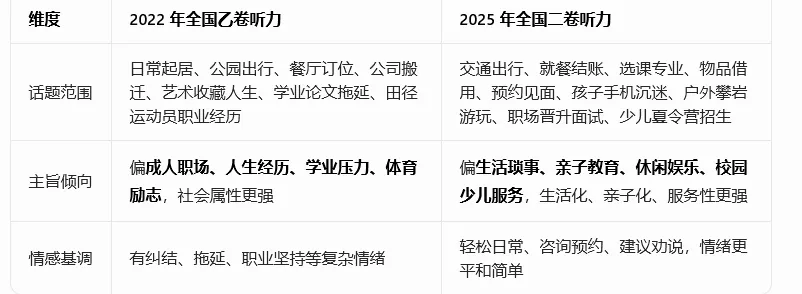
2022 年:多考行为目的、原因推断、时间地点、人物关系、细节推理、态度观点,推理题占比高,直白信息题少。
2025 年:多考出行方式、计划安排、说话内容、人物态度、活动信息、时间地点,直白细节题更多,难度略有增加。
阅读主旨比较
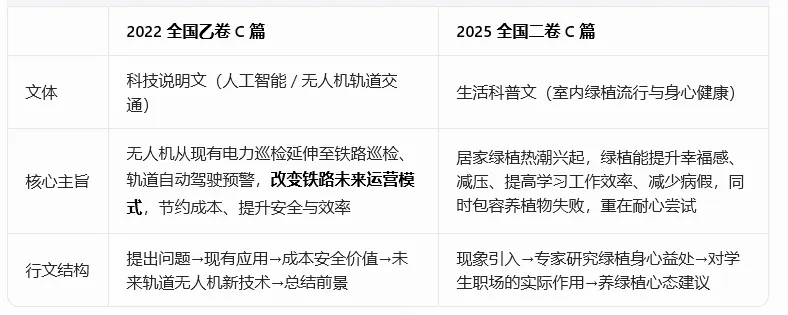
2022:28 细节理解、29 词义猜测、30 细节推断、31 标题主旨;词义猜测 + 科技推理是难点。
2025:28 细节理解、29 细节归纳、30 句意推理、31 标题主旨;无生僻词义猜测,以细节 + 简单推理 + 主旨题为主。
2025年考得比较灵活!
复习建议
最后20天,听力以稳手感、抓细节为主。每日精练一套高考真题听力,不刷偏题难题。2025真题趋势为生活化直白对话,少复杂推理,训练时重点抓取时间、地点、人物态度、行为目的。听完必须复盘:标出听错选项,总结同音混淆、语气判断等易错点,坚持跟读原声,熟悉高考语速、连读,保持耳朵敏感度,切忌中途断练。
阅读逐渐体会贴合近年命题趋势。每天两篇真题阅读,优先精练生活科普、科技类文章。做题坚持先读第一段,然后读题再定位原文,细节题锁定原句,词义猜测依托上下文,主旨题抓首尾段。2025年阅读难度下降、直白信息增多,避免过度脑补推理。整理高频同义替换、熟词生义,积累科技、生活类高频名词。
最后阶段拒绝题海,反复吃透真题。听力重在保持语感,阅读重在定位技巧,减少低级失误,稳住基础分值,做到简单题不丢分、中档题稳拿分。
2022年听力及阅读C篇答案
题号 | 1 | 2 | 3 | 4 | 5 | 6 | 7 | 8 | 9 | 10 |
答案 | B | C | B | A | C | A | C | A | C | A |
题号 | 11 | 12 | 13 | 14 | 15 | 16 | 17 | 18 | 19 | 20 |
答案 | A | C | C | B | A | B | B | C | A | B |
题号 | 28 | 29 | 30 | 31 | ||||||
答案 | A | C | A | D | ||||||
2025年听力及阅读C篇答案 | ||||||||||
题号 | 1 | 2 | 3 | 4 | 5 | 6 | 7 | 8 | 9 | 10 |
答案 | C | B | A | B | C | B | C | B | A | B |
答案 | 11 | 12 | 13 | 14 | 15 | 16 | 17 | 18 | 19 | 20 |
答案 | A | C | C | A | A | C | A | B | B | C |
题号 | 28 | 29 | 30 | 31 | ||||||
答案 | D | D | C | B |


