

人单脚站一分钟,通常已经开始晃、腿酸、努力维持平衡。所以看到火烈鸟一条细腿撑着整个身体、甚至还能睡觉,我们很自然会觉得:That must require excellent balance and strong muscles.结果 2017 年,两位研究者做了一个非常奇怪、但极其漂亮的实验:把已经死亡的火烈鸟身体调整到正常的单腿站立姿势,然后发现——它竟然可以在没有任何肌肉活动的情况下,被动地稳定支撑自身重量。更反直觉的是:研究人员想把同一身体摆成近似 two-legged stance,反而无法获得同样稳定的被动支撑。换句话说:火烈鸟单腿站着,可能不是更费劲,而是正好卡进了一个很省力的机械位置。
Young-Hui Chang、Lena H. Ting,Published: 24 May 2017
研究者结合 cadaver manipulation(尸体姿态实验)和 force-plate measurements(活体受力与平衡测量),研究火烈鸟究竟需要多少主动肌肉力量才能保持单腿站姿。核心结论是:火烈鸟可能利用一种 passively engaged gravitational stay apparatus——依靠身体重量自动进入稳定状态的机械支撑机制——从而长时间单腿站立,却不需要大量持续肌肉收缩。
原文链接:pmc.ncbi.nlm.nih.gov/articles/PMC5454233/
注意:这两篇研究回答的其实不是完全同一个问题——2009/2010 问 Why might this behavior be useful?;2017 问 How can the bird physically maintain it so cheaply?
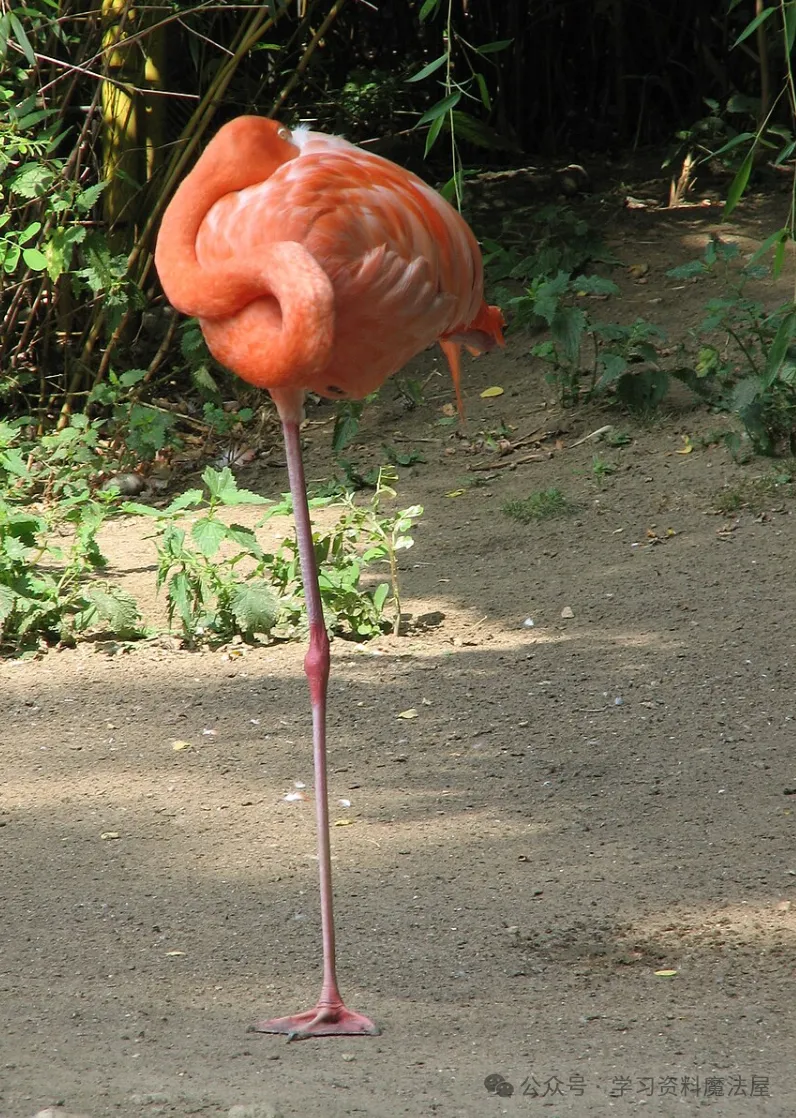
A flamingo standing on one leg looks as if it is performing a difficult balancing trick. For a human, the same posture requires continuous muscular adjustments. It therefore seems reasonable to assume that flamingos must use considerable muscle power to stay upright.
Biomechanical research suggests almost the opposite. In a 2017 study, Young-Hui Chang and Lena Ting investigated how flamingos support their body weight during one-legged standing.
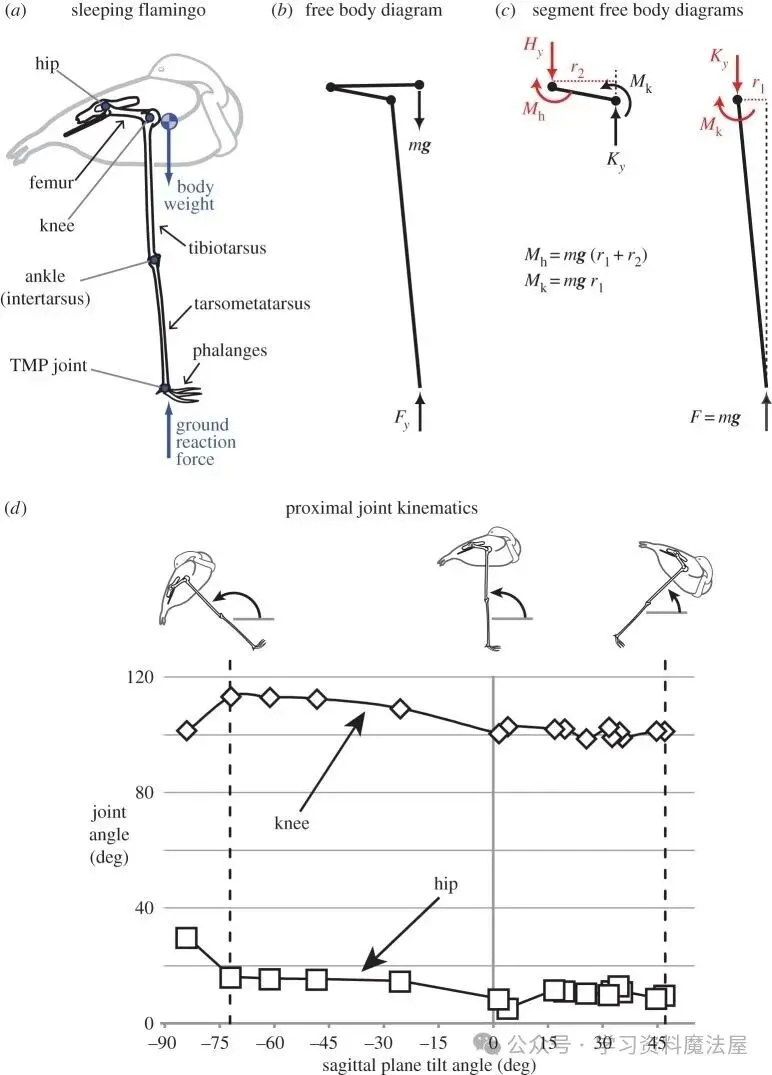
Their most unusual experiment involved flamingo cadavers. The researchers positioned the bodies in a posture resembling that of a resting flamingo. Surprisingly, a cadaver could support its own weight on one leg without any active muscle contraction. The joints settled into a stable configuration. When researchers tried to place the same body in a position approximating a two-legged stance, however, the joints did not remain stable in the same passive way.
The researchers proposed that flamingos possess a gravitational stay apparatus. In the correct posture, body weight itself helps move the hip and knee joints toward positions where anatomical limits prevent further movement. The leg effectively becomes mechanically locked into a narrow range of stable positions.
This does not mean a living flamingo uses no muscles at all. Balance still matters. To examine this, the researchers measured the movement of the centre of pressure beneath the feet of live flamingos. When birds were quiet, with their eyes closed, their bodies swayed remarkably little. When they became alert or started grooming, movement increased substantially.
The finding suggests that during restful one-legged standing, the bird does not need constant large muscular corrections to maintain balance.
This mechanical explanation answers an important question: How can a flamingo stand on one leg for so long without becoming exhausted? But it does not fully answer another question: Why did one-legged standing evolve or become common in the first place?
Earlier behavioral research had suggested a different benefit. Scientists observing Caribbean flamingos found that birds used the one-legged posture more frequently in water than on land. They also found that one-legged resting became less common as temperature increased. Because birds can lose body heat through their legs and feet, tucking one leg against the body could reduce the amount of exposed surface and help conserve heat.
The two explanations are not necessarily competitors. One describes a possible benefit of the posture: reduced heat loss. The other describes a possible mechanism that makes the posture inexpensive: passive mechanical support. Together, they illustrate an important principle in biology. Knowing how an animal performs a behavior is not the same as knowing why the behavior is useful. Sometimes science needs separate experiments to answer both.
答案偏 biomechanics:关节、重心、肌肉、稳定性。
WHY question— Why might flamingos use this posture?
答案偏 function / evolution:比如减少 heat loss。
因为研究人员想知道:单腿姿势本身能不能在没有主动肌肉收缩的情况下支撑身体?活鸟站着,你很难确定到底用了多少肌肉力量;但 cadaver 没有 active muscle contraction——如果仍然能够稳定支撑,就说明至少存在很强的 passive mechanical support。
我们的直觉:两条腿 more support,一条腿 less support。但 2017 实验发现:在那个特定姿态下,cadaver 可以 passively stable on one leg,而近似 two-legged position 没有出现同样的稳定状态。
近似双腿姿态:没有出现同样稳定的被动状态
看火烈鸟长腿中间那个向后弯的"关节",很多人以为是 knee,其实那更接近鸟类的 ankle region。真正的膝关节和髋关节位置更靠近身体,通常藏在羽毛附近。Georgia Tech 研究团队特别指出:火烈鸟的大腿骨几乎呈水平状态,这也是它特殊力学结构的一部分。
研究人员用 force plate 测 quiescent(眼睛闭着、安静休息)和 alert(睁眼、警觉)状态。结果:安静休息时 body sway 更小;一旦警觉、梳理羽毛、活动,身体压力中心移动就明显增加。听起来非常反直觉——通常我们觉得"越努力控制,应该越稳",但火烈鸟可能是进入正确机械位置以后,少动反而更稳定。
alert / grooming(警觉活动):压力中心移动明显增加
有。而且证据逻辑完全不同。2009 发表、2010 卷期出版的行为研究观察到:In water,单腿站立比例更高;Temperature rises,单腿站立比例下降。为什么这与保温假说一致?鸟类腿脚羽毛覆盖少、容易散热,把一条腿收进腹部羽毛附近,就减少暴露面积。Smithsonian 目前的火烈鸟资料也把减少腿脚热量流失列为单腿站姿的一种解释。
温度升高→ 单腿休息比例下降
解释:收腿减少腿脚暴露面积 → conserve heat
这一点非常重要。观察到 temperature ↑ → one-leg standing ↓,与 heat conservation 非常一致,但是这是 observational evidence——不是研究者随机把同一只火烈鸟放进 10℃、20℃、30℃ 再严格控制其他变量。所以更准确地说:strongly supports,而不是 proves beyond doubt。原论文自己的措辞也是:结果 strongly suggest 单腿休息有助于 thermoregulation。
这是整篇最适合出主旨题的地方。
假说 B · Passive mechanics— 告诉我们为什么这样站成本可能不高(low cost)。
passive 这里不是"消极的",而是 occurring without continuous active muscular force(被动的、无需主动输出维持的)。比如 passive stability 依靠结构本身产生的稳定,而 active control 需要肌肉和神经系统不断调节。这在 biomechanics、engineering、robotics 里都很常见。
2.passively stable in one posture ≠ one leg is always more stable than two
3.temperature associated with behavior ≠ temperature proved to be the only cause
4.may conserve heat ≠ only used for thermoregulation
5.cadaver supports weight ≠ dead flamingo behaves like a live bird
6.HOW ≠ WHY
7.mechanism ≠ evolutionary benefit
8.two explanations ≠ two competing explanations(它们有时可以 complement each other)
2. stability— postural stability,稳定性。
3. muscular— muscular force,肌肉的。
4. passive— passive support,被动的。
5. sway— body sway,身体晃动。
6. conserve— conserve body heat,保存、节省。
7. thermoregulation— aid thermoregulation,体温调节。
8. apparatus— a stay apparatus,装置、结构系统。科研文里不一定指"机器"。
3 分钟— 只画两个问题:HOW? → biomechanics → passive stability;WHY? → possible benefit → heat conservation。告诉学生:科学里 mechanism 和 function 经常是两套不同问题。
5 分钟— 做 Q1、Q4、Q6,分别训练:实验为什么这么设计、哪条证据对应哪个解释、两个假说不一定互相排斥。结束。
难度参考:高考 D 篇—考研英语阅读
核心题型:实验设计、机制解释、观察研究、证据匹配、相关与因果、多假说整合、学术词义、最佳标题
little → none
supports → proves
associated → caused
mechanism → purpose
one condition → universal rule
possible benefit → only reason
different explanations → contradictory explanations
研究显示,火烈鸟尸体在被调整到特定单腿姿态后,可以在没有主动肌肉活动的情况下被动支撑体重,而近似双腿姿势不能形成同样的稳定状态。对活体火烈鸟的 force-plate 测量还发现,安静单腿休息时身体晃动很小,而警觉或活动状态下晃动明显增加。作者据此提出,火烈鸟可能利用一种由重力参与的 passive stay apparatus,以较低肌肉成本维持长时间单腿站立。(pmc.ncbi.nlm.nih.gov/articles/PMC5454233/)
Zoo Biology|2010— Why do flamingos stand on one leg?,Matthew J. Anderson、Sarah A. Williams,*Zoo Biology* 29(3): 365–374
研究通过观察圈养 Caribbean flamingos 发现,火烈鸟在水中更常采用单腿休息,而且随着环境温度升高,单腿休息比例下降。研究者认为这些现象强烈支持单腿姿势有助于减少热量损失的解释。主体阅读材料为根据上述研究整理改写的高考化版本,非原文全文。(onlinelibrary.wiley.com/doi/10.1002/zoo.20266)
Smithsonian's National Zoo— American Flamingo 资料
Smithsonian 目前的 American flamingo 资料指出,火烈鸟经常单腿站立并把另一条腿收进腹部附近,这种姿势能够减少腿脚的热量流失;其科普资料同时介绍了现代生物力学研究提出的"单腿站立可能比双腿站立需要更少肌肉力量"的解释。(nationalzoo.si.edu/animals/american-flamingo)
How ≠ Why
Mechanism ≠ Function
Two Explanations ≠ Two Contradictions
一个行为可以同时存在"为什么值得这样做"以及"身体怎样低成本做到"两套解释。
所以高考 D 篇和考研阅读里,如果文章同时出现 mechanism、function、adaptation、benefit、evolution,不要把它们揉成一句"科学家找到了原因"。先问:Is this explaining HOW the system works — or WHY the behavior may be useful?很多看起来冲突的研究,到了这一步,其实根本没有冲突。
下期外刊精读,继续带你押考点


