

你一定见过这种月亮:刚刚升到楼顶,巨大,像贴在城市后面;过几个小时再抬头,月亮升到高空,突然感觉怎么小了这么多。最直觉的解释是:地平线上的月亮离我们更近,或者大气像放大镜一样把它放大了。但 NASA 说:都不是。如果你用完全相同的镜头焦距分别拍下刚升起的月亮和高空中的月亮,把照片叠在一起,你会发现它们的横向直径基本一样——甚至低空月亮还可能因为大气折射被稍微压扁。所以月亮没有突然变大,变的是 your perception of it。这个已被人类观察了几千年的现象叫 The Moon Illusion。更有意思的是:我们已经能够非常容易地证明它是错觉,但到今天,科学家对于为什么大脑一定要把月亮看大,仍然没有一个所有研究者都完全认可的单一答案。
Preston Dyches,January 24, 2023(Updated February 13, 2025)
NASA 明确指出:照片可以证明,月亮在地平线附近和升到高空以后,横向角直径基本相同;"巨大月亮"主要是视觉系统造成的知觉错觉,而不是大气把月球物理放大。NASA 同时强调,对这一错觉产生的完整机制,至今仍缺乏一个完全确定的科学解释。
原文链接:science.nasa.gov/solar-system/moon/the-moon-illusion-why-does-the-moon-look-so-big-sometimes/
NASA 把同一天 8:30 p.m. 的低空月亮和 9:50 p.m. 的高空月亮并列比较。绿色辅助线清楚显示:两个月亮的横向直径相同;而低空月亮垂直方向反而略微变扁,这是大气折射的结果。
原文链接:science.nasa.gov/resource/photographing-the-moon-illusion/
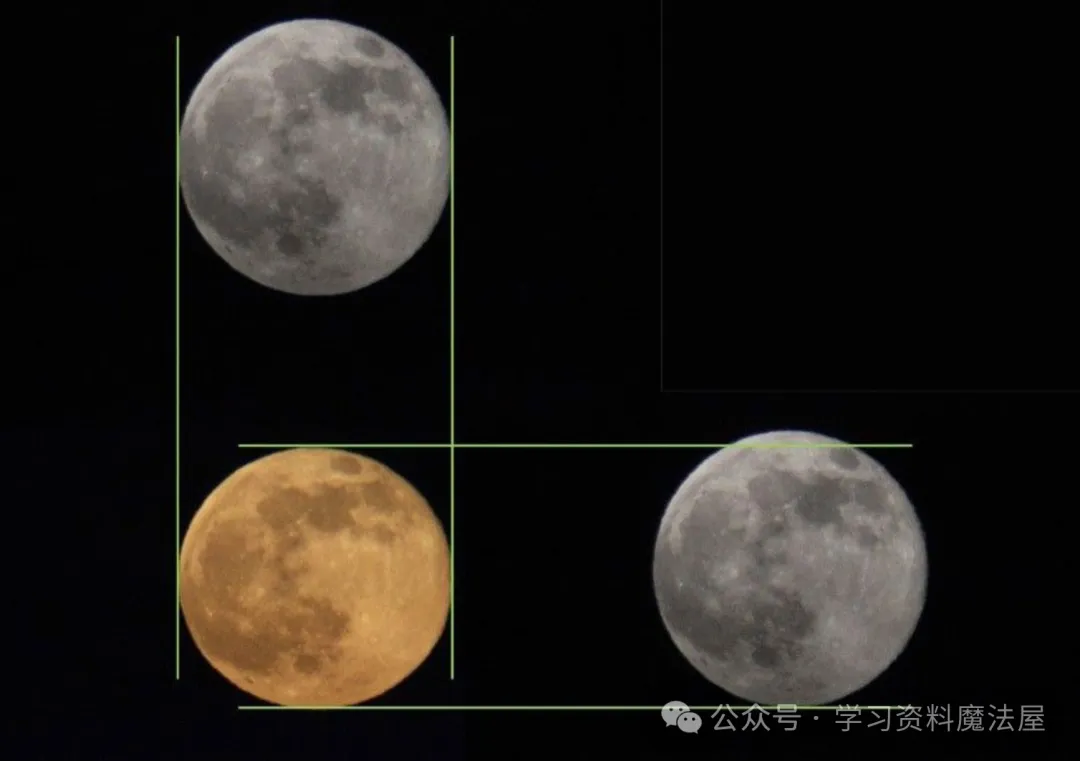
来源:science.nasa.gov/resource/photographing-the-moon-illusion/
A full Moon rising behind buildings or mountains can look enormous. A few hours later, when the same Moon is high in an empty sky, it often appears much smaller.
It is tempting to assume that something physical has changed. Perhaps the Moon is closer to Earth when it rises. Or perhaps the atmosphere works like a magnifying glass. Neither explanation works.
One of the simplest ways to test the effect is to photograph the Moon near the horizon and again when it is high in the sky, using exactly the same camera settings. The photographs show that its horizontal angular size is essentially unchanged.
In fact, the atmosphere can slightly flatten the Moon near the horizon rather than enlarge it. Light from the lower part of the Moon passes through the atmosphere differently from light from the upper part, producing a small amount of vertical distortion.
So why does the Moon still look huge? The answer lies not simply in the eye but in the brain's interpretation of visual information. Human vision does not directly measure physical size. The brain constantly combines the image reaching the eyes with information about distance.
Imagine two people who produce images of the same size on your retina. If you believe one person is much farther away, your brain normally concludes that the distant person must actually be larger.
A similar process may contribute to the Moon illusion. Objects near the horizon are surrounded by powerful distance cues: roads, trees, buildings and landscapes stretching far away. The horizon itself is also generally perceived as farther away than the sky directly overhead. If the Moon produces roughly the same retinal image but is perceived as being farther away, the brain may interpret it as physically larger.
A famous visual effect called the Ponzo illusion demonstrates a related principle. Two identical lines placed between converging lines can appear different in size because the background creates an impression of depth.
However, foreground objects cannot be the whole explanation for the Moon illusion. The effect can still occur when the horizon is relatively empty. NASA notes that astronauts in orbit have also reported the illusion even though they lack ordinary trees and buildings as foreground distance cues.
Researchers have therefore proposed several overlapping explanations involving perceived distance, the apparent shape of the sky and the brain's mechanisms for judging size.
The puzzle is ancient. People have discussed the strange appearance of the horizon Moon for thousands of years, and thinkers from Aristotle to medieval scholar Ibn al-Haytham proposed explanations. Yet one especially useful fact is now easy to establish: what we perceive is not the same thing as what we measure.
This does not mean our visual system is badly designed. Normally, interpreting size together with distance helps us navigate a three-dimensional world. A person walking away does not seem to physically shrink even though the image on our retina becomes smaller.
The Moon presents the system with an unusual situation: its actual distance barely changes as it moves across the sky, but the visual context around it changes dramatically. Our brain applies ordinary rules to an extraordinary object. And the result is an illusion so convincing that even knowing the truth usually does not make it disappear.
这是今天最重要的一组:
Perceived size— 你的大脑说:"好大!"
NASA 给出了一个非常干净的方法:同一台相机、同一个焦距,拍 horizon Moon,再拍 high Moon,然后比较像素直径。
这是非常常见的解释,但实际情况甚至有一点反过来。NASA 指出:低空月亮经过更厚的大气层,确实会受到 atmospheric refraction(大气折射),但结果主要是 slightly squashed vertically(上下方向稍微压扁),而不是整体变成一个巨大的圆。
而不是:整体放大成巨大的圆
这里很适合训练:有些视觉变化是真的,有些是错觉。月亮在地平线附近更黄、更橙,这并不完全是错觉——因为月光要穿过更长的大气路径,更多较短的蓝色波长被散射掉,于是留下更多红、橙波长。
More orange?确实存在 physical optical explanation(蓝光被散射,红光保留)
看铁路:两条铁轨越远越靠近。现在在铁轨上横着画两条实际一样长的线,远处那条往往看起来更长。原因可能是:大脑判断"它那么远,却还能形成这么大的视觉图像",于是自动推断它应该更大。这就是 size–distance relationship:距离知觉和大小知觉互相影响。Scientific American 也把 Ponzo illusion 和人类对天空距离、形状的知觉视为解释 Moon illusion 的重要部分。
Perception uses context. Measurement does not.
一种重要解释认为:人脑并不把天空知觉成完美的半球。我们通常感觉 horizon 更远,而 sky directly overhead 更近。如果两个位置的月亮在视网膜形成差不多大小的图像,但地平线那个被大脑判断为 farther away,根据 size–distance 机制,它就可能被解释成 larger object。
很常见的说法:月亮旁边有楼、有树,所以看起来大。确实 foreground objects 可能参与效果,但它不能解释所有情况——即使在相对空旷的地平线,Moon illusion 仍然存在。NASA 甚至指出:太空中的 astronauts 也报告过这种错觉,而他们没有树、房屋、普通地平线景物作为参照。
这里有两个完全不同的问题:
Question B— 为什么大脑会产生这个错觉?这个问题复杂得多。
这可能是整篇最有意思的地方。你现在已经知道照片量出来一样,但下一次满月刚升起来,你还是会觉得巨大——因为很多视觉加工并不是我们靠一句"我知道真相了"就可以随意关闭的。Scientific American 的 Phil Plait 甚至写到:他是天文学家,明知道 Moon illusion 的原理,仍然无法"看不见这个错觉"。
网上经常有这种图:一轮巨大月亮占满半座城市后面。这不一定是假图,但它往往用了 telephoto lens(长焦):摄影师站得很远,同时把远处建筑和更远的月亮一起放大,于是画面里月亮相对于建筑显得非常巨大。NASA 专门提醒:这类照片实际上通过 zoomed-in view 模拟、强化了我们熟悉的巨大月亮效果。
2.perception ≠ physical measurement
3.atmospheric refraction ≠ major magnification
4.one proposed mechanism ≠ complete explanation
5.foreground objects may contribute ≠ foreground objects are necessary
6.we know it is an illusion ≠ we completely understand why it occurs
7.knowing the truth ≠ no longer experiencing the illusion
8.giant-Moon photograph ≠ Moon physically became giant
2. perceive— perceive the Moon as larger,感知、察觉。名词:perception。
3. apparent— apparent size,表面看起来的、视知觉上的。
4. diameter— the Moon's apparent diameter,直径。
5. refraction— atmospheric refraction,折射。
6. distort— distort an image,使图像失真。
7. foreground— foreground objects,前景物体。反义概念:background。
8. mechanism— the underlying mechanism,潜在机制。
3 分钟— 讲两个完全不同的问题:Is the Moon physically bigger? → No;Why does it look bigger? → Still debated。训练学生不要把"排除了错误答案"理解成"已经完全证明正确答案"。
5 分钟— 做 Q3、Q5、Q6,分别训练:两个现象不能混、反例如何削弱理论、已知事实与未解决问题。结束。
难度参考:高考 D 篇—考研英语阅读
核心题型:实验验证、替代解释、概念辨析、机制推断、反例作用、科学争议、图像信息、结论边界、最佳标题
looks → is
perceived → measured
contributes → completely causes
possible explanation → established mechanism
known illusion → fully explained phenomenon
visual context → physical change
NASA 指出,同样设置拍摄的照片显示,月亮位于地平线附近和高空时的横向大小基本相同,因此"巨大地平线月亮"主要属于视觉知觉错觉,而不是月球本身变大或大气把它整体放大。NASA 同时指出,关于这一错觉为何如此稳定地产生,目前仍没有完整、确定的单一机制解释。(science.nasa.gov/solar-system/moon/the-moon-illusion-why-does-the-moon-look-so-big-sometimes/)
NASA Science— Photographing the Moon Illusion(Updated: February 12, 2025)
NASA 展示同一天晚上约 8:30 和 9:50 拍摄的月亮,用辅助线比较后可以看到两张照片的横向直径一致;低空月亮的垂直直径反而受到大气折射影响而略微缩短。主体阅读材料为根据上述报道整理改写的高考化版本,非原文全文。(science.nasa.gov/resource/photographing-the-moon-illusion/)
Scientific American— Why Does the Moon Look Bigger Near the Horizon?,Phil Plait,October 18, 2024
文章梳理了 Moon illusion 的历史和主要知觉解释,包括 size–distance perception、Ponzo illusion 以及人类对天空距离与形状的主观判断,并指出纯粹依赖附近树木和建筑物作为参照,并不能解释该现象的全部情况。(scientificamerican.com/article/why-does-the-moon-look-bigger-near-the-horizon/)
Seeing ≠ Measuring
Rejecting One Explanation ≠ Proving Another
Knowing That an Illusion Exists ≠ Knowing Exactly Why It Exists
我们通常觉得"我亲眼看见了"是一种非常强的证据。但 Moon illusion 告诉我们:眼睛提供的是 sensory input,而我们真正"看到"的世界,还经过了 brain interpretation。
所以高考 D 篇和考研阅读里,一旦文章出现 appear、seem、perceive、estimate、measure、actually 这些词,第一件事就是检查:Is the author talking about what something IS — or what it LOOKS LIKE?这一条,在科学阅读里非常值钱。
下期外刊精读,继续带你押考点


