

✍️ 上期打卡答案
上期我们留的表达是:
press ahead with 坚定推进……
参考答案:
Despite the delays, the team decided to press ahead with the project.
尽管有所延误,团队还是决定继续推进这个项目。
常见错误:❌ press ahead the project✅ press ahead with the project说继续推进某件事,要用press ahead with,别漏掉with。尤其适合在表达遇到一些困难的情况下继续推进。
好,今天继续精读 ↓(下次想精读哪篇文章可以在评论区告诉我们哦~)
Sorry—Who Are You? |脸盲症
Prosopagnosia is a medical condition that stops people from recognizing people’s faces, but how common is it and why does it happen?
Reading Passage 1|(考场真题)
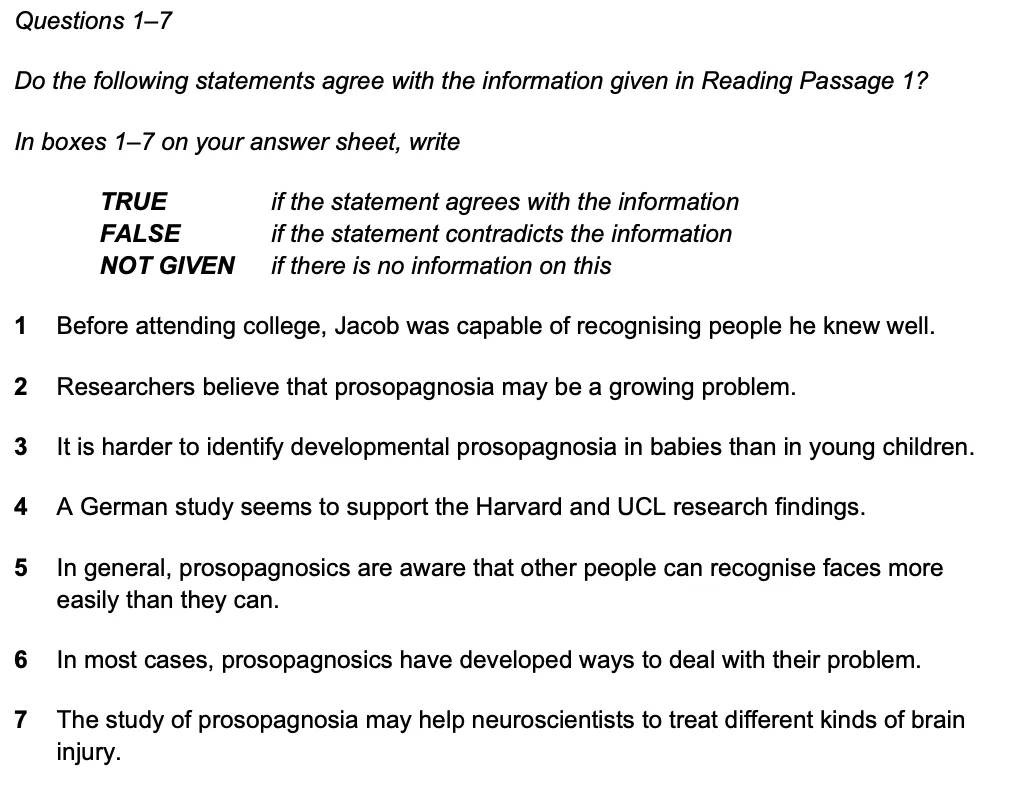
Questions 1–7:判断题
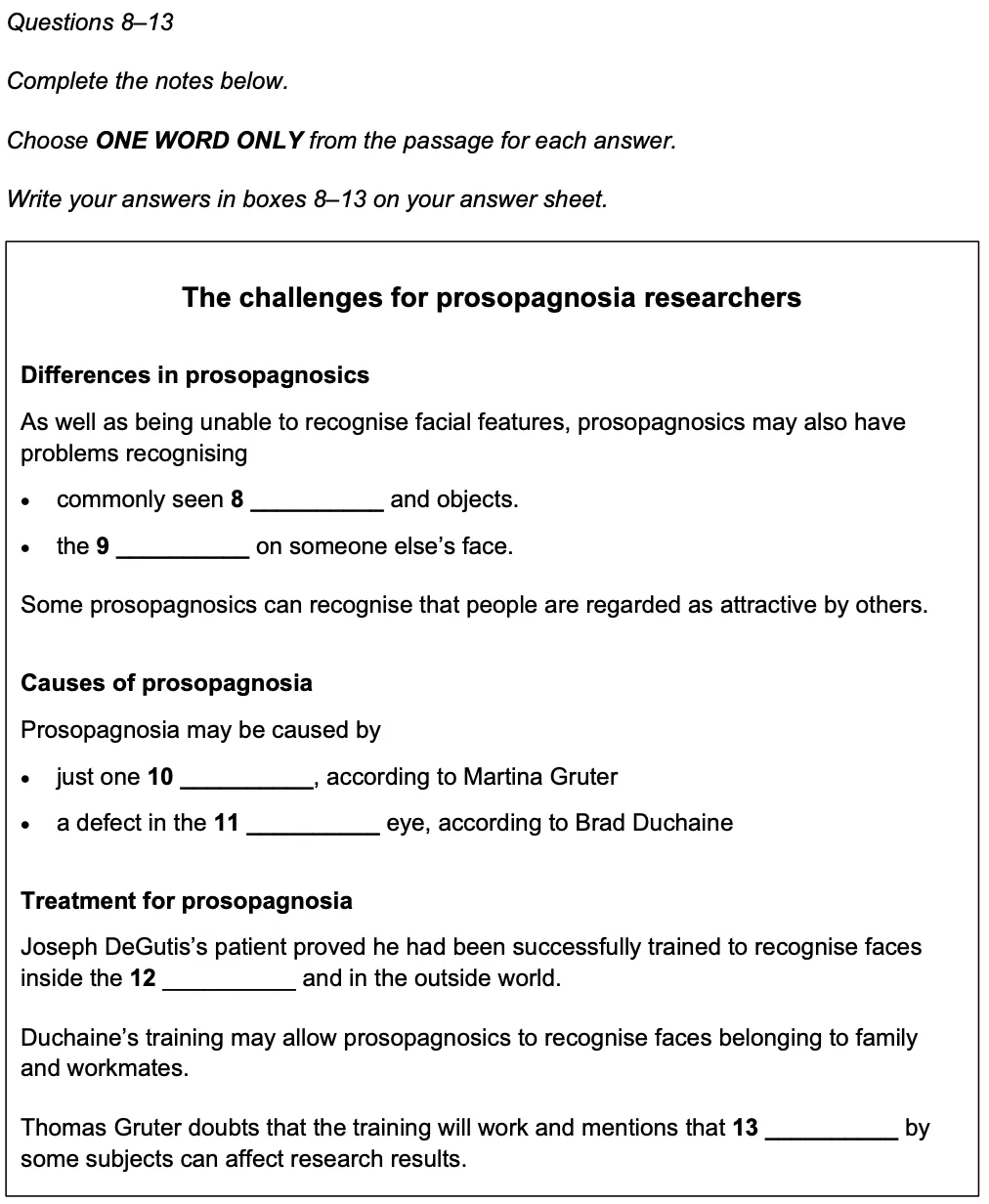
Questions 8–13:填空题
建议:先限时20m完成整篇,再回来一起逐段精读。
开始逐段精读吧:
It was Jacob Hodes’s first day at college. He can still recall spending an enjoyable afternoon being shown around campus by a second-year student named Daniel Byrne, who happened to be from his home town. Jacob then spent the rest of the year ignoring him. ‘I never saw him again,’ he says. ‘Well, I’m sure I walked past him plenty of times, but I just didn’t see him.’ This behaviour wasn’t intentional. Jacob just couldn’t recollect what his fellow student looked like. He had had the same trouble all his life. Friends and relatives would greet him and he would have no idea who they were.
段落大意:Jacob记得同学带他参观校园的经历,却记不住对方的脸;这种认人困难在上大学前就一直存在。
recall doing 记得做过……。
be shown around 被带着参观。
happen to be 碰巧是……。
spend time doing 花时间做……。
intentional 故意的。
recollect 回想起;记起。
fellow student 同学。
have no idea 完全不知道。
记得一段经历,不等于记得其中那个人的脸。
开头的recall说明Jacob还记得参观校园的下午;后面的couldn’t recollect说他记不起同学长什么样。两句谈的是不同的记忆内容,并不矛盾。
I just didn’t see him在这个故事里不是说眼睛完全没看见对方,而是没有认出他。下一句This behaviour wasn’t intentional排除了故意不理人的解释。
He had had the same trouble all his life把时间拉回大学之前。had had是过去完成时,后一个had才是表示“有”的实义动词。
Q1|FALSE
定位证据: He had had the same trouble all his life. Friends and relatives would greet him and he would have no idea who they were.
all his life包括上大学之前;friends and relatives就是他熟悉的人。原文说连这些人他也认不出,与题目的was capable of recognising相反。不要把大学第一天的故事误当作症状第一次出现。
那是雅各布·霍兹上大学的第一天。他至今还记得,一个名叫丹尼尔·伯恩的二年级学生带他参观校园,两人度过了愉快的下午。丹尼尔碰巧与他来自同一个家乡。然而,在这一年剩下的时间里,雅各布再也没有理会他。“我之后就没再见过他,”他说,“嗯,我肯定从他身边走过很多次,但就是没认出他。”他并非有意如此,而是真的想不起那位同学长什么样。他一生都遇到同样的困难:朋友和亲戚向他打招呼,他却完全不知道对方是谁。
It wasn’t until five years ago that it all made sense. That was when Hodes was diagnosed with prosopagnosia, a condition that means he is unable to recognise faces. According to researchers, he is far from alone. In fact, the condition is not that uncommon, but until a few years ago only a few dozen cases had ever been described, and all of these had been caused by brain injury. Recently, though, researchers identified a second form of face blindness, developmental prosopagnosia, which is either present from birth or develops very early in life.
段落大意:确诊解释了Jacob长期的困难。研究者还发现,除了脑损伤引起的脸盲症,也存在出生时或生命早期出现的发育性脸盲症。
make sense 说得通;变得可以理解。
be diagnosed with 被诊断患有……。
prosopagnosia 面孔失认症,通常称为脸盲症。
be far from alone 远不止一个人有这种情况。
not that uncommon 并没有那么罕见。
a few dozen cases 几十个病例。
brain injury 脑损伤。
developmental prosopagnosia 发育性脸盲症。
be present from birth 自出生起就存在。
It wasn’t until … that …表示“直到……才……”。
Jacob并不是五年前才开始认不出人,而是在五年前确诊后,才明白此前的经历是怎么回事。“five years ago”相对于文章写作时间,不按今天的日期换算。
but until a few years ago转向过去的病例记录:当时只描述过几十例,而且都是脑损伤所致。Recently, though又补充后来发现的第二种类型。
发现了新的类型,说明研究认识有所增加;not that uncommon说明这种情况并不罕见。它们都没有交代患病比例是否随时间增加。
Q2|NOT GIVEN
定位证据: the condition is not that uncommon, but until a few years ago only a few dozen cases had ever been described
题目关键在growing,即问题可能在增加或变严重。原文说这种情况并不罕见、过去记录的病例少,C段再给出两项调查结果。这些内容说明过去认识不足,没有说研究者认为患病比例正在上升,也没有说它不会上升,因此选NOT GIVEN。may只是把语气放软,不能补出原文缺少的趋势。
Q3|NOT GIVEN
定位证据: which is either present from birth or develops very early in life.
from birth与very early in life讲的是出现时间。题目问的是婴儿与幼儿之间哪一组更难被识别或诊断,原文没有作这种比较。两个年龄阶段都出现了,不等于给出了难度高低。
直到五年前,雅各布才明白这一切是怎么回事。那时,他被诊断患有面孔失认症,也就是无法识别人脸的情况。研究者指出,像他这样的人远不止一个。实际上,这种情况并没有那么罕见,但直到几年前,被记录描述的病例还只有几十个,而且全都由脑损伤引起。不过,研究者最近识别出了第二种脸盲症,即发育性脸盲症:它可能自出生起就存在,也可能在生命很早期出现。
In May a team from Harvard University in the US and University College London (UCL) announced the results of a web survey of 1,600 people, suggesting that up to 2 per cent of people have some degree of face blindness. Then in August, Martina Gruter and colleagues at the Institute for Human Genetics in Munster, Germany, similarly reported that 2.5 per cent of 700 secondary-school pupils they had tested had trouble recognising faces. The results of the surveys took everyone by surprise.
段落大意:一项1600人的网络调查和一项700名中学生参加的德国研究,都发现认脸困难并不罕见,结果令人意外。
announce the results 公布结果。
web survey 网络调查。
up to 高达;至多,需结合语境。
some degree of 某种程度的……。
similarly 同样地;类似地。
secondary-school pupils 中学生。
have trouble doing 做……有困难。
take someone by surprise 使某人感到意外。
similarly把两项研究联系起来。
第一项调查的样本是1600人,报告有多达2%的人存在某种程度的认脸困难;第二项测试了700名中学生,比例为2.5%。作者将它们作为相近发现介绍,而不是强调相互矛盾。
不能把May的2%和August的2.5%直接连成一条增长曲线。两项研究的样本、对象和方法不同,原文没有说它们测量的是同一群人在不同时点的变化。
took everyone by surprise说的是人们对结果的反应,也不等于疾病突然变得更多。
Q4|TRUE
定位证据: similarly reported that 2.5 per cent of 700 secondary-school pupils they had tested had trouble recognising faces.
前一项哈佛和UCL调查报告多达2%,德国研究报告2.5%,作者用similarly把它们联系起来。题目只说seems to support,不要求两个比例完全相同。两项研究支持“并不罕见”这一认识,但不能用不同样本的比例推算随时间增长。
5月,美国哈佛大学与伦敦大学学院的一个团队公布了一项1600人参加的网络调查结果。调查显示,多达2%的人存在某种程度的脸盲症。随后在8月,德国明斯特人类遗传学研究所的玛蒂娜·格鲁特及其同事也报告了类似发现:他们测试的700名中学生中,有2.5%的人难以识别人脸。这些调查结果让所有人都感到意外。
It seems that if you have never known what it is to recognise a face, you don’t necessarily know that you are supposed to be able to. Prosopagnosics almost always know that they have trouble recognising people, but they often don’t realise that other people have better recognition skills than they do, says Brad Duchaine, a researcher at UCL.
段落大意:患者通常知道自己认人有困难,但往往没有意识到,其他人的认脸能力比自己好。
not necessarily 不一定。
be supposed to do 按理应该做……。
prosopagnosic 脸盲症患者;也可作形容词。
almost always 几乎总是。
realise 意识到。
recognition skills 识别能力。
两处know/realise后面接的内容不同。
他们知道的是“自己认人有困难”;他们往往不知道的是“别人认人比自己容易”。题目如果把后一种认识写成他们普遍拥有的认识,就把原意反过来了。
第一句解释了这种情况:如果从未体验过轻松认出一张脸,就不一定知道自己按理也应该有这种能力。not necessarily表示“不一定”,不是“绝不”。
than they do中的do代替have recognition skills,比较的是其他人与患者的识别能力。
Q5|FALSE
定位证据: they often don’t realise that other people have better recognition skills than they do
题目说患者普遍意识到别人认脸更容易;原文说他们往往没有意识到这一点,直接相反。前面的almost always know仅指他们知道自己认人有困难,不能拿来支持题目中另一个认识。
如果一个人从来不知道认出一张脸是什么感觉,他似乎也不一定知道,自己本应具备这种能力。伦敦大学学院研究者布拉德·杜尚说,脸盲症患者几乎总是知道自己认人有困难,但他们往往没有意识到,其他人的识别能力比自己更好。
Despite these issues, the majority of developmental prosopagnosics possess strategies that allow them to get around their difficulty—for instance, by recognising hair, clothing, or a person’s way of speaking—so, unless they see a familiar person out of context, with a new hairstyle or in different clothes, they can recognise people just fine. Even so, the discovery of developmental prosopagnosia has attracted attention from neuroscientists keen to discover what is different about the brain of face-blind people. This difference, they believe, could help solve the problem of how the brain deals with information in general, not just visual data. In other words, it may show whether the brain has specialised parts for specific tasks or is more of a general-purpose information processor.
段落大意:多数发育性脸盲症患者会借助发型、衣着或说话方式认人。研究这种差异,也可能帮助科学家了解大脑怎样处理信息。
the majority of ……中的大多数。
possess strategies 拥有应对策略。
get around a difficulty 设法应对或绕过困难。
out of context 脱离熟悉的情境。
even so 即便如此。
be keen to do 渴望做……。
deal with information 处理信息。
in other words 换句话说。
general-purpose 通用的。
两个破折号之间是例子,可以先放一边。
主干是the majority … possess strategies that allow them to get around their difficulty。接着so引出结果:依靠这些策略,他们通常能认出人。
unless从句限定了这个结果。如果遇见熟人的情境变了,对方换了发型或衣服,原先的线索就可能不够用。recognise people just fine并不表示面孔识别困难已经消失。
后半段的问题是大脑如何处理信息:各部分是否各司其职,还是像通用处理器一样工作。理解机制与治疗脑损伤是两个不同问题,不能自动从前者推出后者。
Q6|TRUE
定位证据: the majority of developmental prosopagnosics possess strategies that allow them to get around their difficulty
In most cases对应the majority,ways to deal with对应strategies … get around。头发、衣服和说话方式都是具体例子。题目说有应对方法,并没有说他们的困难已经被治好。
Q7|NOT GIVEN
定位证据: could help solve the problem of how the brain deals with information in general, not just visual data.
原文谈这项研究可能帮助理解大脑怎样处理信息,题目却转向治疗不同种类的脑损伤。文中没有交代这种治疗用途,也没有否定它。B段出现brain injury,并不能把两处信息拼成治疗结论。
尽管存在这些问题,大多数发育性脸盲症患者仍有办法应对自己的困难,例如通过头发、衣着或说话方式来认人。因此,只要不是在不熟悉的情境下遇见熟人,或者对方换了发型、穿着不同的衣服,他们通常能顺利认出人。即便如此,发育性脸盲症的发现还是引起了神经科学家的注意,他们很想弄清脸盲者的大脑有什么不同。研究者相信,这种差异可能帮助解决大脑如何处理一般信息的问题,而不只是视觉信息。换句话说,它或许能说明,大脑是否由分别负责特定任务的专门区域构成,还是更像一个通用的信息处理器。
One issue, however, that will present challenges for researchers is that no two prosopagnosics are the same. Some have problems only with faces, while others have trouble with ordinary everyday objects and, so it turns out, animals which would normally be familiar as well. Some prosopagnosics can train themselves to recognise specific faces; others can’t even recognise their own in a mirror. When some have been tested they could identify the emotion that was conveyed on another’s face, even though the face itself seemed unfamiliar, while for other subjects this was an impossibility. Some cannot recognise the faces of old friends or fellow students but have no trouble telling whether a particular face from such groups would be attractive to most people. Because of this diversity, working out the cause of prosopagnosia will not be easy.
段落大意:患者的困难各不相同:有人还难以识别物品和动物,有人能判断情绪或吸引力,却认不出面孔所属的人。
present challenges 带来挑战。
no two … are the same 没有两个……完全相同。
ordinary everyday objects 普通日常物品。
so it turns out 事实证明。
convey an emotion 传达一种情绪。
subject 受试者;这里不是“科目”。
have no trouble doing 做……没有困难。
diversity 多样性;差异。
work out the cause 弄清原因。
反复出现的some … others …是在列举患者之间的差异。
第一组比较能否识别日常物品和动物;后面分别比较能否认出特定面孔、看出情绪、判断吸引力。不要把某一组人的表现套到所有患者身上。
When some have been tested …后面说,一些受试者能识别情绪;while for other subjects this was an impossibility补充,另一些人做不到。this指识别脸上的情绪,并不是泛指整场测试。
认出“这是谁”、看出“他是什么情绪”、判断“这张脸是否有吸引力”,是文中区分的几项能力。末句正是用这些差异解释为什么病因难查。
Q8|animals
定位证据: animals which would normally be familiar as well
commonly seen对应normally be familiar。原文列出objects和animals,题目把它们的顺序调换了,且objects已经给出,所以填animals,保留复数。
Q9|emotion
定位证据: they could identify the emotion that was conveyed on another’s face
on someone else’s face对应on another’s face。前半句说部分患者能识别情绪,后面的while for other subjects this was an impossibility说明另一些患者做不到,符合题目may also have problems。答案沿用原文单数emotion。
不过,研究者将面临一个难题:没有两位脸盲症患者的情况完全相同。有些人只在人脸识别上有问题,另一些人还难以识别普通日常物品,以及原本应该熟悉的动物。有些患者能通过自我训练认出特定面孔,另一些人却连镜子里的自己都认不出来。在测试中,有些人虽然觉得面孔陌生,却能识别那张脸传达的情绪;另一些受试者则做不到。有些人认不出老朋友或同学的脸,却能毫不费力地判断这些面孔是否会被大多数人认为有吸引力。正因为存在这些差异,弄清脸盲症的原因并不容易。
In Martina Gruter’s study, the prosopagnosics who agreed to have their parents and relatives tested reported at least one relative with the condition. Having looked at 38 cases in seven families, the German team believe they have good evidence that a single gene could be responsible. Duchaine also has some evidence that face blindness could be inherited but thinks other factors might be more significant. He refers to studies of babies born with a condition which means the eye’s lens is not clear, and when it’s the left one, being unable to see through this eye during the first two months of life is a major risk factor for prosopagnosia.
段落大意:家族研究提示基因可能起作用;Duchaine也考虑遗传,但认为早期视觉问题等其他因素可能更重要。
at least 至少。
be responsible 是成因;负有责任,本段指成因。
be inherited 由遗传获得。
significant 重要的;显著的。
refer to 提到;引用。
lens 晶状体;镜片,本段指眼睛的晶状体。
risk factor 风险因素。
who agreed …限定了家族测试涉及哪些患者。
原文说,愿意让父母和亲属接受测试的患者,报告至少有一位亲属也有这种情况。不能把这个句子扩大成所有脸盲症患者都有患病亲属。
Having looked at 38 cases in seven families交代德国团队作判断的依据;a single gene could be responsible保留了could,并未把单一基因写成已经确定的唯一病因。
Duchaine also has some evidence … but thinks …说明他并非全盘否定遗传,而是认为其他因素可能更重要。the left one里的one代替eye;后面的this eye仍然指左眼。
Q10|gene
定位证据: a single gene could be responsible
just one对应a single,may be caused by对应could be responsible。空格填gene;不能填遗传这一抽象概念,也不要多抄single。
Q11|left
定位证据: when it’s the left one, being unable to see through this eye during the first two months of life is a major risk factor for prosopagnosia.
one代替eye,所以the left one就是左眼。题目空格后已有eye,只填left。原文把出生后最初两个月的左眼视觉问题称作风险因素,不是说任何左眼问题都必然导致脸盲症。
在玛蒂娜·格鲁特的研究中,那些同意让父母和亲属接受测试的患者,都报告至少有一位亲属存在同样的情况。德国团队研究了七个家庭中的38个病例后,认为有较充分的证据表明,单个基因可能就是成因。杜尚也掌握了一些脸盲症可能遗传的证据,但他认为其他因素也许更重要。他引用了针对一些婴儿的研究:这些婴儿出生时,眼睛的晶状体就不透明。如果受影响的是左眼,生命最初两个月无法通过这只眼睛看见东西,就是脸盲症的一个重要风险因素。
Whatever the cause, what most prosopagnosics want to know is whether they can do anything to improve their face-recognition skills. Joseph DeGutis, a graduate student at the University of California, recently reported successfully training a severe developmental prosopagnosic to recognise faces during tests carried out in the laboratory. The subject also reported that recognising faces in everyday life became easier due to the training. Duchaine now plans to attempt to train sufferers to recognise the five people they most need to know—maybe their immediate family, for example, and essential colleagues. Thomas Gruter, Martina Gruter’s husband, who also works on her team, however, is not convinced it will work. ‘I don’t know how you can have more training than you have already had,’ he says. ‘Humans already spend all day looking at faces.’ He also points out that cheating is a possibility during tests and provides an example. One person we studied said that when she was doing the face-recognition test, she memorised the distance between nose and upper lip. She wasn’t the only one. So you can perform well in the test and not do so well in real life.
段落大意:训练报告带来了希望,但Thomas Gruter质疑效果,并指出记住局部特征可能让测试成绩好于真实生活中的认脸表现。
whatever the cause 无论原因是什么。
carry out tests 开展测试。
due to 由于;因为。
attempt to do 尝试做……。
immediate family 至亲;通常指父母、配偶、子女等亲近家人。
be convinced 确信;信服。
point out 指出。
cheating 作弊;本段所举例子是借助局部特征在测试中认脸。
memorise 记住;熟记。
先把三位研究者的说法分开。
DeGutis报告一位重度患者接受训练后,在实验室测试中能识别人脸;日常生活更容易认脸,是受试者自己的报告。Duchaine接着提出训练患者识别五位重要人物的计划,plans to不等于计划已经成功。
Thomas Gruter则表示怀疑。他认为人们本来就整天看脸,还指出测试中可能存在“取巧”:一位受试者记住鼻子与上唇的距离来完成任务。
最后一句把test与real life对照起来。文章没有说所有训练都无效,也没有证明这种训练对所有人都有效;它提醒读者检查测试究竟测到了什么。
Q12|laboratory
定位证据: to recognise faces during tests carried out in the laboratory. The subject also reported that recognising faces in everyday life became easier due to the training.
inside the后面问地点,填laboratory;in the outside world对应in everyday life。注意证据的区别:实验室中有测试结果,日常改善来自受试者自述。题目用proved概括两者偏强,但不影响这一空的地点定位。
Q13|cheating
定位证据: He also points out that cheating is a possibility during tests
本段此处的He指Thomas Gruter。题目mentions对应points out,空格需要填他指出的测试问题cheating。后面的鼻唇距离是例子,不是答案本身。
无论原因是什么,大多数脸盲症患者最想知道的是,自己能否做些什么来改善面孔识别能力。加利福尼亚大学研究生约瑟夫·德古蒂斯最近报告,他成功训练了一位重度发育性脸盲症患者,使其在实验室测试中能够识别人脸。受试者也报告,训练让自己在日常生活中更容易认出面孔。杜尚现在计划尝试训练患者,让他们认出最需要认识的五个人,例如至亲和重要的同事。
然而,同样在玛蒂娜·格鲁特团队工作的丈夫托马斯·格鲁特,并不相信这个办法会奏效。“我不知道,你怎么可能获得比已经经历过的还多的训练,”他说,“人类本来就整天都在看脸。”他还指出,测试中有可能出现作弊,并举了一个例子:一位参与研究的人说,她做面孔识别测试时,记住了鼻子与上唇之间的距离。这样做的不止她一个人。所以,你可能在测试中表现很好,在真实生活中却没那么好。
Q1 FALSEQ2 NOT GIVENQ3 NOT GIVENQ4 TRUEQ5 FALSEQ6 TRUEQ7 NOT GIVENQ8 animalsQ9 emotionQ10 geneQ11 leftQ12 laboratoryQ13 cheating
Q1|people he knew well↔ Friends and relatives
Q4|seems to support↔ similarly reported
Q5|are aware↔ don’t realise(方向相反)
Q6|In most cases↔ the majority
Q6|ways to deal with↔ strategies … get around
Q8|commonly seen↔ would normally be familiar
Q9|someone else’s face↔ another’s face
Q10|just one / may be caused by↔ a single / could be responsible
Q12|in the outside world↔ in everyday life
Q13|mentions↔ points out
1. recall doing 记得做过……
2. happen to be 碰巧是……
3. make sense 说得通;变得可以理解
4. have trouble doing 做……有困难
5. take someone by surprise 使某人感到意外
6. be supposed to do 按理应该做……
7. out of context 脱离原有情境
8. be keen to do 渴望做……
9. work out 弄清;想出
10. be convinced 确信;信服
用本文里的这个表达进行造句练习:
have trouble doing 做……有困难
把你的句子留在评论区,明天我们会放参考答案和常见错误。
如果你刷了不少题,分数却一直上不去,可能真正需要解决的不是“刷题量”,而是找到自己的卡分点。关注公众号发送 “阅读” 两个字,看看你到底卡在哪里。

这里是「将来时」
每天用真实雅思材料一起练:
阅读精读 | 听力精听 | 写作拆解 | 口语表达
不只是知道答案。
更重要的是:
读懂原文,也看懂雅思是怎么从原文变成题目的。
将来时,从现在开始。


