金榜题名
在这个喜庆的日子里,家家户户都洋溢着欢声笑语,一切都充满了希望与期待。新的一年代表着新的开始,是我们追求梦想实现目标的起点。愿您在新的一年里,心怀憧憬、勇往直前。


问
如何进行满分备考?
【2026 年中考英语真题C篇真题】
While the size of Arctic sea ice has dropped by about 40 percent over 40 years, until recently, the size of the sea ice around Antarctica was slowly increasing. Then, after 2015, Antarctic ice extent fell from a record high to several record lows, losing an area as large as Greenland.
Some research has suggested that higher air temperatures may be the cause. However, two new studies show that ocean warming played a bigger role in this dramatic change. As part of global ocean circulation, warm saltwater moves southward from the tropics and circles Antarctica 200 metres below the surface. But temperature and salinity records of the past 20 years suggest that this warm deep saltwater has been rising towards the surface, where it can melt sea ice.
Antarctica is encircled by a belt of strong winds and storms. Climate change has pushed this storm belt southward, bringing more rain and snow into the sea ice area, according to a study by Earle Wilson and other researchers at Stanford University. The rain and snow create a layer of fresh surface water that better protects the bottom of the sea ice from warm deep saltwater, allowing it to grow to its 2014 record high. But the same southward‑moving storm belt also brings stronger winds. These winds blow surface water and ice forward. As this happens, warm deep saltwater rises up to fill the empty space.
Between 2014 and 2016, this wind‑driven rising began to get the upper hand against the protective layer of increased rain and snow, and sea ice began to melt away. When the researchers input the recorded ocean data into a computer model, it projected that sea ice would grow and then become smaller, as it did in the real world.
The researchers plan to study and model other things, which also likely play roles throughout Antarctica. Examples include changes in sea ice movement and increases in ocean mixing resulting from more storms. By studying the ocean data, they hope to build a model to project changes in Antarctic sea ice in the years to come.
【高频词汇短语讲解】
1. Arctic /ˈɑːktɪk/adj. 北极的 n. 北极
(1)词根:arkt‑(希腊语,熊;大熊星座,代指北方)
(2)同根 / 派生词
(3)Antarctica /ænˈtɑːktɪkə/n. 南极洲(anti‑对立 + arctic 北极,对立北极→南极)
(4)Antarctic /ænˈtɑːktɪk/adj. 南极的 n. 南极地区
习惯短语
(1)Arctic sea ice 北极海冰
(2)the Arctic Ocean 北冰洋
(3)the Arctic Circle 北极圈
例句
(1)The Arctic is warming much faster than other parts of the planet.北极变暖的速度远快于地球其他区域。
(2)Arctic sea ice has shrunk greatly over recent decades.近几十年来北极海冰已经大幅缩减。
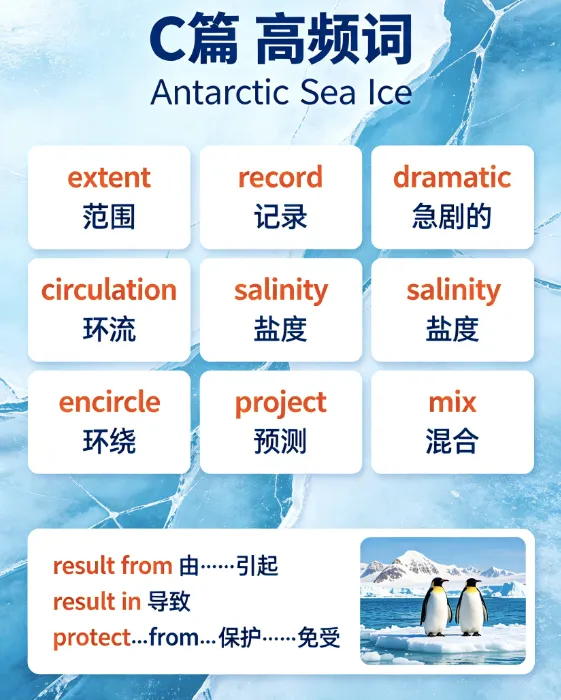
2. extent /ɪkˈstent/n. 范围;程度;面积
(1)词根:tend‑伸展(ex‑向外 + ‑tent 伸展 →向外延展→范围、程度)
(2)同根派生词
①extend /ɪkˈstend/v. 延伸;扩大;延长
②extension /ɪkˈstenʃn/n. 延伸;扩建;延期
③extensive /ɪkˈstensɪv/adj. 广阔的;大量的;广泛的
习惯短语
(1)ice extent 海冰覆盖面积
(2)to some extent 在某种程度上
(3)to a great extent 在很大程度上
例句
(1)The extent of Antarctic sea ice changes from year to year.南极海冰的覆盖面积逐年变化。
(2)To some extent, human activities influence global climate.在某种程度上,人类活动影响全球气候。
3. record
① /ˈrekɔːd/n. 记录;纪录 adj. 创纪录的② /rɪˈkɔːd/v. 记录;录制
④词根:\cord‑\心(re‑回 +‑cord 心→记在心里→记录)
同根派生词
①recorder /rɪˈkɔːdə(r)/n. 录音机;记录器
②recording /rɪˈkɔːdɪŋ/n. 录音;录制
习惯短语
①record high 历史最高纪录
②record low 历史最低纪录
③keep a record of … 记录……
④break a record 打破纪录
⑤set a record 创造纪录
例句
(1)Temperatures reached a record high this summer.今年夏天气温达到历史最高值。
(2)Scientists record changes in sea‑ice extent every year.科学家每年记录海冰面积的变化。
4. dramatic /drəˈmætɪk/adj. 急剧的;巨大的;戏剧性的
(1)词根:\drama‑\戏剧
(2)同根派生词
①drama /ˈdrɑːmə/n. 戏剧;戏剧性事件
②dramatize /ˈdræmətaɪz/v. 使戏剧化;改编成戏剧
③dramatically /drəˈmætɪkli/adv. 显著地;急剧地
习惯短语
①dramatic change 急剧的变化
②dramatic increase/decrease 大幅上升 / 下降
例句
①We have seen a dramatic change in Antarctic sea‑ice.我们见证了南极海冰的急剧变化。
②The number of wild animals has dropped dramatically.野生动物数量已经急剧下降。
5. circulation /ˌsɜːkjəˈleɪʃn/n. 环流;循环;流通
(1)词根:\circ‑\圆,环
(2)同根派生词
①circle /ˈsɜːkl/n. 圆圈 v. 环绕
②circulate /ˈsɜːkjəleɪt/v. 循环;环流;传播
③circular /ˈsɜːkjələ(r)/adj. 圆形的;循环的
习惯短语
①global ocean circulation 全球海洋环流
②blood circulation 血液循环
例句
①Ocean circulation moves heat around our planet.海洋环流把热量输送到全球各地。
②Warm water circulates from the tropics toward the poles.暖水从热带向两极循环流动。
6. tropic /ˈtrɒpɪk/n. 回归线;热带地区
(1)词根:\trop‑\转向(太阳转向的区域→回归线、热带)
(2)同根派生词tropical /ˈtrɒpɪkl/adj. 热带的
习惯短语
①the tropics 热带地区(复数,必考)
②tropical rainforest 热带雨林
③Tropic of Cancer 北回归线
例句
①Warm water from the tropics flows southwards.来自热带的暖水向南流动。
②Many special plants live in tropical areas.许多特殊植物生长在热带地区。
7. salinity /səˈlɪnəti/n. 盐度
(1)词根:\sal‑\盐
(2)同根派生词
①salt /sɔːlt/n. 盐
②salty /ˈsɔːlti/adj. 咸的;含盐的
习惯短语
①water salinity 水的盐度
②high‑salinity seawater 高盐度海水
例句
(1)Rain can lower the salinity of surface seawater.降雨可以降低表层海水的盐度。
(2)The water here is salty because of sea salt.因为海盐,这里的水是咸的。
8. encircle /ɪnˈsɜːkl/v. 包围;环绕
(1)词根:\circ‑\圆,环(en‑使…+circle 圆圈→使形成圆圈→环绕)
(2)同根派生词:circle n./v. circular adj.(见上)
习惯短语
①be encircled by … 被…… 环绕 / 包围(被动高频)
例句
(1)Antarctica is encircled by cold ocean water.南极洲被寒冷的海水所环绕。
(2)Mountains encircle the small lake.群山环绕着这片小湖。
9. belt /belt/n. 地带;带;腰带
(1)习惯短语
①a belt of strong winds 强风带
②storm belt 风暴带
③green belt 绿化带
(2)例句
①A storm belt has moved further south.风暴带已经进一步向南移动。
②This is a belt of warm climate.这是一片气候温暖的地带。
10. storm /stɔːm/n. 风暴;暴风雨 v. 起风暴
(1)同根派生词
stormy /ˈstɔːmi/adj. 暴风雨的;狂风大作的
(2)习惯短语
①heavy storm 强风暴
②storm warning 风暴预警
(2)例句
①Strong storms bring more rain and snow.强风暴带来更多雨雪。②The sea becomes rough on stormy days.暴风雨天气海面会变得波涛汹涌。
11. fresh /freʃ/adj. 淡的;新鲜的
中考熟词生义:fresh water 淡水(不是 “新鲜水”) |
(1)同根派生词
①freshen /ˈfreʃn/v. 使变淡;使清新
②freshness /ˈfreʃnəs/n. 新鲜;淡度
(2)习惯短语
①fresh surface water 表层淡水
②fresh water 淡水
③fresh air 新鲜空气
(2)例句
①Rain and snow produce fresh surface water on the ocean.雨雪在海洋表层形成淡水。
②We cannot drink sea water; we need fresh water.我们不能喝海水,我们需要淡水。
12. protect /prəˈtekt/v. 保护
(1)词根:\tect‑\遮盖(pro‑向前 + tect 遮盖→在前面遮挡→保护)
(2)同根派生词
①protection /prəˈtekʃn/n. 保护
②protective /prəˈtektɪv/adj. 保护性的
③protector /prəˈtektə(r)/n. 保护者
(2)习惯短语
①protect … from … 保护…… 免受…… 伤害 / 侵蚀(阅读高频)
②under the protection of … 在…… 的保护之下
例句
(1)The layer of fresh water protects sea ice from warm saltwater.这层淡水保护海冰不受温热咸水侵蚀。
(2)We must protect wild animals from being killed.我们必须保护野生动物免遭捕杀。
13. project
① /prəˈdʒekt/v. 预测;推算;投射② /ˈprɒdʒekt/n. 项目;课题
(1)词根:\ject‑\投掷(pro‑向前 + ject 投掷→向前推算、投射)
(2)同根派生词:projection /prəˈdʒekʃn/n. 预测;推算;投射
习惯短语
(1)project changes 预测变化
(2)research project 研究项目
例句
①The computer model projects future sea‑ice change.计算机模型预测未来海冰的变化。
②This science project studies polar climate.这个科研课题研究极地气候。
14. mix /mɪks/v. 混合
(1)同根派生词
①mixing /ˈmɪksɪŋ/n. 混合
②mixture /ˈmɪkstʃə(r)/n. 混合物
习惯短语
①ocean mixing 海水混合
②mix A with B 把 A 和 B 混合
例句
①More storms lead to increased ocean mixing.更多风暴造成海水混合加剧。
②Oil does not mix with water.翻译:油无法和水相融合。
15. result from 短语:由…… 引起;因…… 造成
①result from:原因在后(A result from B A 由 B 造成)
②result in:结果在后(A result in B A 导致 B)
例句
①The increase in ocean mixing results from more storms.海水混合加剧是由更多风暴造成的。
②Heavy rain resulted in serious flood.大雨引发了严重洪水。
文中阅读高频短语补充
(1)play a bigger role in… 在…… 方面起到更大作用
①Ocean warming plays a bigger role in sea‑ice melting.海洋变暖对海冰消融起到更大作用。
(2)get the upper hand 占上风;取得优势
Warm water began to get the upper hand.暖水开始占据主导。
(3)melt away 逐渐消融;慢慢消失
The sea ice began to melt away.海冰开始逐步消融。
长难句拆解
句 1:While the size of Arctic sea ice has dropped by about 40 percent over 40 years, until recently, the size of the sea ice around Antarctica was slowly increasing. |
•结构:While 引导让步状语从句,“尽管……”
•翻译填空:尽管 40 年来北极海冰面积缩减约 40%,但直到不久之前,南极洲周边的海冰面积还在缓慢增长。
句 2:The rain and snow create a layer of fresh surface water that better protects the bottom of the sea ice from warm deep saltwater, allowing it to grow to its 2014 record high. |
•结构:that 定语从句修饰 water;allowing… 现在分词作结果状语
•翻译填空:雨雪形成一层表层淡水,更好地保护海冰底部不受深层温热咸水的侵蚀,使海冰扩张至 2014 年的历史最高值。
句 3:Between 2014 and 2016, this wind‑driven rising began to get the upper hand against the protective layer of increased rain and snow, and sea ice began to melt away. |
•短语:get the upper hand 占上风;取得优势;melt away 逐渐消融
•翻译填空:2014 至 2016 年间,这种风力驱动的海水上涌开始压倒雨雪形成的保护层,海冰开始逐步消融。
题目深度解读 + 选项逐句翻译
27.Which of the following best shows the Antarctic sea ice changes around 2015?题干翻译:以下哪一项最能体现 2015 年前后南极海冰的变化?题型:图表细节理解题A:先上升至峰值,之后下降翻译:Rise to the peak and then fallB:持续上升翻译:Keep rising continuouslyC:缓慢上升翻译:Rise slowlyD:小幅波动,保持平稳翻译:Slight fluctuation and stay stable
[28.In](28.In) which order are the following events discussed in Paragraph 3?题干翻译:第 3 段中事件叙述的先后顺序是?题型:事件排序题①Warm deep saltwater rises to the surface.翻译:深层温热咸水上涌至表层。②A layer of fresh surface water is created.翻译:形成一层表层淡水。③Surface water and ice are blown forward.翻译:表层海水与海冰被风吹向远方。④More rain and snow are brought into the sea ice area.翻译:更多雨雪被带入海冰区域。
A. ②④①③ 翻译:②④①③B. ②④③① 翻译:②④③①C. ④②①③ 翻译:④②①③D. ④②③① 翻译:④②③①
29.Which of the following is the best title for this passage?题干翻译:本文最佳标题是哪一项?题型:主旨大意‑标题选择题A. Where is Antarctic sea ice loss taking us?翻译:南极海冰消融将把我们带向何方?B. Is this the cause of Antarctic sea ice loss?翻译:这就是南极海冰消融的原因吗?C. Will a new model explain Antarctic sea ice melting?翻译:新模型能够解释南极海冰消融吗?D. How does fresh surface water protect Antarctic sea ice?翻译:表层淡水如何保护南极海冰?
对应题型通用答题方法论(北京中考标准)
图表信息题(27 题)
①定位原文时间 + 变化动词:increasing、record high、fell;②抓趋势:前期缓慢增长→2015 前后到达峰值→之后暴跌;③排除:只升不降、平稳波动选项。
事件排序题(28 题)
①定位指定段落,圈出动作动词;②按原文叙事顺序,不要自己逻辑推理;③首尾选项做排除,快速缩小答案范围。
主旨 / 标题题(29 题)
正确标题两大标准:①覆盖全文核心:探究南极海冰由增转消融的真正成因;②体现文章主线:探究南极海冰消融的原因;干扰项特征:局部细节,不能概括全文;偏离文章讨论对象。
C 篇原文定位 + 逐题解析
27. 答案:A定位句:Then, after 2015, Antarctic ice extent fell from a record high to several record lows…解析:2015 之前海冰缓慢增加达到历史峰值,2015 之后从最高点跌落至多次历史低点,对应先上升到峰值后下降。
28. 答案:D定位句(第 3 段):bringing more rain and snow…→The rain and snow create a layer of fresh surface water…→These winds blow surface water and ice forward.→As this happens, warm deep saltwater rises up to fill the empty space.解析:事件顺序:④带来更多雨雪 →②形成表层淡水 →③表层海水和海冰被吹走 →①深层温热咸水上涌填补空位。故选 D。
29. 答案:B解析:文章提出旧观点(气温升高),引出新研究探究海冰消融真正诱因。A 文章没有讨论海冰消融带来的后果,偏离主题;C 模型只是文末计划,并非全文核心;D 表层淡水仅为第三段局部细节,不能概括全篇。