2026届山东省潍坊市高考模拟考试英语试题 答案 语篇主题 考点简析 2026.05.30
潍坊 市 高 考 模 拟 考 试
英语2026.5
温馨提示:学研资料,方便学研,转载注明,勿商用!
感谢江苏省海安高级中学 景苏华老师
研习悟:选材丰富、设题科学、难度梯度合理,考查语言基础思维品质与文化素养并重,对高三复习备考具有良好的诊断与导向作用。
语篇主题、考点简析
阅读理解
A篇:青少年阅读现状调查(社科类)以数据图表呈现英国青少年阅读的性别、动机差异,考查细节定位与信息整合,数据解读能力。
B篇:文学改编与文化传承(人文类)以《绿山墙的安妮》为例,讨论经典文本的跨时代改编与文化生命力。考查词义猜测、段落主旨、文本标题提炼,强调批判性思维。
C篇:文化差异与AI行为(科技类)探讨语言模型是否体现文化特征,涉及跨文化心理学与AI伦理。体现学科融合,考查逻辑推理与观点提炼。
D篇:杰文斯悖论与环境技术(科普类)分析技术进步、能源效率与资源消耗的关系,破除常见误解。要求考生理解因果、区分现象与本质,具有思辨价值。
七选五:保持开放思维(说理类)引托尔斯泰名言切入,讨论开放心态的方法与价值。选项与段落逻辑衔接紧密,考查语篇连贯能力。
语言运用
完形填空记叙文,讲述母亲如何帮助“我”战胜恐惧、获得勇气的成长故事。考查词汇在语境中的精确运用(如 consumed, buffeted, comforting)与情感线索把握。
语法填空介绍无锡二胡工艺与文化传承,融入地方非遗、工匠精神。考点覆盖谓语动词、非谓语、冠词、名词化、从句引导词等,突出基础语法在语篇中的运用。
写作
应用文:校园动物乐园征名创设真实校园情境,要求说明名字含义与理由。考察学生结合文化元素进行创意表达,体现语言交际功能。
读后续写材料温馨,围绕“图书馆小助手”的故事展开,情感线索清晰。两段开头句具有引导性,考察学生围绕“挽留图书馆”与“问题解决”展开合理、连贯、有温度的续写。
第一部分听力(共两节,满分30分)
第一节(共5小题;每小题1.5分,满分7.5分)
听下面5段录音。每段录音后有一个小题,从题中所给的A、B、C三个选项中选出最佳选项。听完每段录音后,你都有10秒钟的时间来回答有关小题和阅读下一小题。每段录音播放两遍。
1. What will the man do on Saturdayevening?
A.Catch a flight.B. Attend a party.C. Collect his father.
2. What does the man think ofProfessor Wang?
A.Strict.B. Humorous.C.Easy-going.
3. What mistake did the man make?
A.He failed to place an order.
B.He forgot the woman’s number.
C.He went to the wrong address.
4. Where does the conversationprobably take place?
A.In a police stationB. Ina classroom.C. In anelevator.
5. What are the speakers mainlytalking about?
A.A course.B.An assignment.C. Asummary.
第二节(共15小题;每小题1.5分,满分22.5分)
听下面5段录音。每段录音后有几个小题,从题中所给的A、B、C三个选项中选出最佳选项。听每段录音前,你将有时间阅读各个小题,每小题5 秒钟;听完后,每小题都有5秒钟的作答时间。每段录音播放两遍。
听第6段录音,回答第6、7题。
6. Howfrequent is the bus service?
A. Every 15 minutes.B. Every 30minutes.C. Every hour.
7. Whatwill the speakers do?
A. Buy bus tickets.B. Wait for the train.C.Check the schedule.
听第7段录音,回答第8至10题。
8. Whyis the man talking to Jennifer?
A. To seek her advice.B. To give her atask.C. To help her.
9. Whatdoes Jennifer say about data in the report?
A. It needs replacing.B. It is fine.C.It is far from perfect.
10. Whatis the man going to do?
A. Analyze the data.B. Revise theslides.C. Delete the images.
听第8段录音,回答第11至13题。
11. Whatis probably Alexi?
A. A receptionist.B. A photographer.C. A painter.
12. Whatis required to get a permit?
A. A leader’s letter.B. Amagazine picture.C. A performance ticket.
13. Whatshould Alexi do after receiving his permit?
A. Visit a website.B. Contact the Help DeskC. Upload some documents.
听第9段录音,回答第14至17题。
14. Whatis the man doing?
A. Promoting a project.B. Hosting aprogram.C. Chairing a meeting.
15.What’s the aim of the zero-waste movement?
A. To cut living cost.B. To createthe blog.C. To reduce waste greatly.
16. Whatdid Emma learn from the neighbourhood survey?
A. Recycling habits vary widely.
B. Unnecessary waste is severe.
C. People are upset about the waste.
17. Whatadvice does Emma give to zero-waste life beginners?
A. Throw away plastic stuff.B. Buy wood or metal things.C.Make full use of their items.
听第10段录音,回答第18至20题。
18. Whatare the children expected to do in the project?
A. Look after the elderly.B. Write letters to the elderly.C. Improve speaking skills.
19. Whatmakes the children proud?
A. Writing for a real reader.
B. Getting mutual understanding.
C. Knowing about the outside world.
20. Whydoes the school set up the pen license?
A. To encourage neat handwriting.
B. To reward hard-working students.
C. To help choose excellent pen friends.
第二部分阅读(共两节,满分50分)
第一节(共15小题;每小题2.5分,满分37.5分)
阅读下列短文,从每题所给的A、B、C、D四个选项中选出最佳选项。
A
In recent years, the UK has seen growingconcern over teenage reading engagement, as both reading enjoyment and dailyreading have declined sharply, reaching their lowest levels in over twodecades. Thus, public and educational attention is drawn to its current state,differences and key influencing factors.
Age and Gender Differences
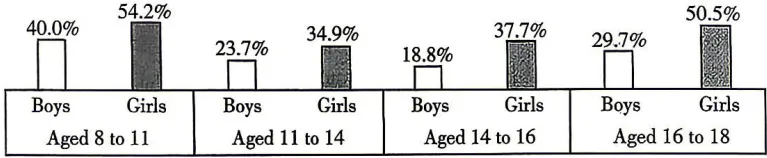
★ Age differences: Reading enjoymentdrops sharply in early adolescence (青少年时期) (11—14), with 46.9% of 8—11s, 29.5% of11—14s and 28.6% of 14—16s enjoying reading.
★ Gender differences: Girls enjoy readingmore than boys at every age; 37.7% of 14—16 girls vs 18.8% of boys, and girls’engagement partly recovers later.
Motivations and Habits
★ Gender-based motivation differences:Girls tend to read more for relaxation and escape, while boys focus more onlearning new things and acquiring knowledge.
★ Boys’ digital reading habits: Many boysare likely to read in digital forms, such as on phones, through games orsubtitles, even if they do not often read printed books.
★ Shared reading preferences: Bothgenders want books matching their interests and the freedom to choose readingmaterials.
Overall, supporting UK teenage readingneeds approaches fitting their real lives. Adolescence is not a time ofrejecting reading but of facing pressure and competing priorities, so we shouldcreate conditions to make reading relevant, accessible, and rewarding for all.
21. Which of the following has thelowest reading enjoyment rate?
A.Girls aged 8—11.B. Boys aged 16—18.
C.Girls aged 14—16.D.Boys aged 11—14.
22. What do boys tend to do interms of reading?
A.Choose printed books.B.Adopt electronic means.
C.Stick to assigned books.D. Aim for leisure reading.
23. What is the key to encouragingteens to read?
A.Setting strict reading rules.B. Stressing various dailypriorities.
C.Cutting down on teenagers’ screen time.D.Making reading practical and worthwhile.
B
Most books have a short “shelf life” astopics of conversation, but a handful find new audiences year after year.Everyone knows that Sherlock Holmes or Alice in Wonderlandcontinues to capture the imagination. The same could be said of Anne ofGreen Gables — except that it saw so many adaptations that it faded intothe background of pop culture, almost invisible.
That changed in 2017 when Netflixpresented an all-new adaptation of the novels as Anne with an E. Asopposed to almost every other adaptation of the books, Netflix dug into thestory’s implied darkness and went with an “edgy” (前卫的) approach tothe story that had its devotedfans up in arms. They flooded social media with commentsto cancel the show, and accused Netflix of ruining the beloved story’s innocentspirit.
Of course, people only have fiercearguments about literature that remains vital. The fact that we’re stilldiscussing Anne of Green Gables in the 21st century is a sign of howpowerful the story is. With nearly 40 adaptations so far, and more to come asnew artists compete to put their stamp on it, the book may already be themost-adapted of all time.
Anne of Green Gables stands the test of time for severalreasons. Its universal story, a parentless girl who has bounced among foster (寄养) homes herwhole life and comes to a place where she is initially not wanted, appeals toall generations. The book also fits perfectly into the growing youth market asa coming-of-age tale. Most importantly, the bittersweet ending — joy mixed withsadness, hard choices over simple happiness — offers emotional complexity thatnever grows tiresome.
Anne of Green Gables will almost certainly end up one of —if not — the most adapted novels of all time. Its timeless nature and simplecharm are a guarantee.
24. Whathappened to Anne of Green Gables before 2017?
A.It lost its shelf life.B.It grew less popular.
C.It limited imagination.D. It seldom gotadapted.
25. What do the underlined words“up in arms” in paragraph 2 mean?
A.Fully satisfied.B.Really annoyed.
C.Deeply embarrassed.D.Greatly surprised.
26. Whatcontributes most to the lasting charm of Anne of Green Gables?
A.A classic story pattern.B.Popular market demand.
C.An appealing structure.D.Unique emotional depth.
27. What is the best title for thetext?
A.Evergreen, And Ever NewB. Everlasting, Yet StillSilent
C.Timeworn, And Time-fadedD. Beloved, Yet RarelyAdapted
C
Cultural differences shape distinctsocial orientations (取向) andcognitive styles across nations. In the United States, people tend to have anindependent social orientation characterized by autonomy and uniqueness, alongwith logic and rules. In China, people tend to have an interdependent socialorientation emphasizing harmony and connectedness, along with an overallcognitive style focused on context and open to contradiction.
Building on these widely acceptedcultural distinctions, the researchers carried out a controlled experiment totest whether large language models show similar cultural features. They chosethe world’s two most popular and advanced AI models — OpenAI’s GPT and Baidu’sErnie — and tested them with the prompts (提示词) based on the two key culturalpsychology ideas mentioned earlier: social orientation and cognitive style. Theteam collected over 10,000 responses from the models under exactly the sametask situations. The only thing they changed was the language.
The researchers found that thegenerative AI models — trained on textual data that is essentially cultural —exhibited those cultural tendencies when prompted in each language. When posedquestions in Chinese, GPT and Ernie exhibited a more interdependent socialorientation and overall cognitive style. For example, both models owed aperson’s actions at a basketballcampto the context rather than to individual personality.
When the researchers asked the models torecommend the effective marketing slogans for fictional startups, therecommendations shifted simply because the prompt language had changed. For aneco-friendly water bottle company, English questions produced slogans focusingon personal strength and health benefits, like “Hydrate Your Best Self”. On theother hand, Chinese questions made slogans showing family ties and grouphappiness, such as “Share Pure Water with Your Loved Ones”.
“Leaders should be aware that promptlanguage can quietly influence generative AI’s recommendations and, in turn,business decisions,” the researchers wrote. “Managers and executives,especially those working in multi-language teams or serving global customers,should therefore treat language choice as a strategic decision.”
28. What is a feature of the UScultural tendency?
A.Unity and bond.B. Rejection ofcriticism.
C.Self-reliance and reasoning.D. Pursuit of dependence.
29. What did the researchers do toget the finding?
A.They created new AI models.B.They fixed all task conditions.
C.They improved language outputs.D.They asked the models questions.
30. What does paragraph 4 mainlytalk about?
A.Chinese slogans gain more popularity.
B.Brand design must meet public needs.
C. Family ties can be strengthened viaAI.
D. Prompt language has businessinfluence.
31. What arebusiness leaders advised to do?
A. Increase the investment in AItechnology.
B. Prioritize Chinese for local businesssuccess.
C. Value language selection forstrategic planning.
D. Standardize languages in themarketing operation.
D
William Stanley Jevons, an Englisheconomist, noticed in 1865 that the overall consumption of coal actuallyincreased when technological progress improved the efficiency of steam engines,strangely enough. This seemingly illogical outcome came to be known as theJevons paradox (悖论).
However, the Jevons paradox is commonlymisinterpreted in environmental debates. Many people mistakenly conclude thatenergy-efficient technologies are unavoidably worse for the environment simplybecause improved efficiency may stimulate greater resource. consumption. Thisis not the case.
Today, the transformative technology,transportation and food differ fundamentally from traditional heat-poweredequipment. They are not simple improvements in power plants, heat engines oranimal agriculture. Instead of enhancing existing fossil-fuel-dependentsystems, they replace polluting energy carriers and production processes,greatly limiting the possibility of a heavy pollution.
In energy, solar PV and wind powergenerate electricity without direct fossil fuel burning, so they are unlikelyto cause a Jevons paradox for the greenhouse gases. In transportation, electricvehicles reduce reliance on gasoline and cut down direct tailpipe (尾气) emissions.In food, the game-changing technologies such as precision agriculture have thepotential to gradually replace resource-intensive animal farming, eliminatingthe greenhouse gas emissions substantially. They will also free up over 2.5billion hectares of land, thus opening the door to reforestation. conservationand rewilding opportunities.
So, the Jevons paradox typically emergeswhen technological improvement still depends on harmful resources. Consumingenergy is harmful if that energy comes from coal, but it is harmless if thatenergy comes from renewables. Modern innovative technologies act as powerfultools. With sensible policy guidance and proper public application, we can makeenormous changes for the good to achieve long-term environmental benefits.
32. What is acommon misunderstanding of the Jevons paradox?
A. Technological progress boostsefficiency.
B. Energy-efficient technologies areoutdated.
C. High efficiency causes greaterresource use.
D. New technologies tend to harm theenvironment.
33. How are modern technologiesdifferent from the traditional ones?
A.They upgrade energy facilities.B.They rely on fuel-based systems.
C.They abandon sources of pollution.D.They target at productivity advance.
34. What is the function of the categorized eases in paragraph 4?
A.Presenting process.B. Making comparisons.
C.Providing evidence.D. Explaining concepts.
35. What doesthe author imply in the last paragraph?
A.Energy consumption keeps rising.
B.Energy policies determine the future.
C.The Jevons paradox has been widely updated.
D.The Jevons paradox can be effectively avoided.
第二节(共5小题;每小题2.5分,满分12.5分)
阅读下面短文,从短文后的选项中选出可以填入空白处的最佳选项。选项中有两项为多余选项。
“The most difficult subjects,” novelistLeo Tolstoy once wrote, “can be explained to the most slow witted (智力的) man if hehas not formed any idea of them already; but the simplest thing cannot be madeclear to the most intelligent man if he is firmly persuaded that he knowsalready, without a shadow of doubt, what is laid before him.”36 Fortunately, a new paper offers some groundsfor optimism, which has uncovered many techniques to open our minds.
Maintaining an open mind requires a lotto deal with the mental discomfort in admitting our mistakes. 37People who offer more detailed descriptions oftheir inner weather are better able to consider different perspectives thanthose who simply label their moods as “good” or “bad”. This ability tounderstand your feelings might explain why open-mindedness helps some people tothink more clearly and wisely.
38In one study, people were taught to put on aninternal act and respond to upsetting events “like scientists, objectively andanalytically”. After this training, they tended to be more open-minded aboutsome of the most extreme topics. Alternatively, we can place the point ofdisagreement in the broader context of our lives. 39 Briefly describing one of those otherqualities to ourselves — be it our loyalty to our friends or our sense ofhumour — can reduce the sense of threat when we face a difference of opinion.
Researchers of the new paper emphasizethat many of these techniques need to be tested more thoroughly. 40 Put some of these strategies into practiceourselves the next time we find our beliefs challenged!
A. Until recently, I would have agreed.
B. But the existing research at leastoffers a place to start.
C. Actively open-minded thinking comeswith many benefits.
D. This may start with understandingyour own feelings better.
E. If that way doesn’t appeal, we mightconsider a little role-playing.
F. We often forget we are many-sidedbeings with many values and talents.
G. For most of us, exercisingopen-minded thinking is often easier said than done.
第三部分语言运用(共两节,满分30分)
第一节(共15小题;每小题1分,满分15分)
阅读下面短文,从每题所给的A、B、C、D四个选项中选出最佳选项。
I was a timid (胆小的) child whenMother began her long efforts to give me courage. Among my earliest memoriesare Mother’s words, “Go right up and look your 41 inthe face — and then do something!”
To remove my unease of the dark, Mother 42a gentle game for us to play beneath the nightsky. She circled the house in one direction, I m the other. At the far corner,just as shadows closed in, anxiety 43me.Next, I 44 straight into her 45 arms.
As I grew older, the most frighteningexperience for me was staying in the house alone at night. My parents 46 built up my courage to face this difficulty.Mother would occupy me with a beloved puzzle or a favourite book, before sheand Father 47 , leaving me to my own devices. Then,one night, I 48 myself all alone for two whole hours. Afterthat, I spent entire evenings by myself in happy activities, totally 49allfear.
Years later, I took my first job to 50 photos of Lake Lure over the Blue RidgeMountains aboard a small plane. When we flew through a rock y mountain pass,strong turbulence (气流) 51 the plane violently and I was seized by greatfear that we would never get out safely. In that 52 moment, Mother’s words came to me: “Look fearin the face, and do something!” I pulled myself together, kept 53 and tried to catch every clear moment to takephotos.
Now, spending a night alone in the woodsis a beautiful experience that 54my inner life. This peace is possible onlybecause my mother’s advice 55 me from fear.
41. A. hopesB. fearsC. dreamsD. illness
42. A. designedB. improvedC. borrowedD. purchased
43. A. changedB. relievedC. shelteredD.consumed
44. A. wanderedB. racedC.cycledD. paced
45. A. exhaustingB. tremblingC.comfortingD. surprising
46. A. graduallyB. suddenlyC. quicklyD.casually
47. A. held onB. broke downC.stayed upD. slipped away
48. A. wishedB. foundC.treatedD. felt
49. A. forgettingB. experiencingC. displayingD. sensing
50. A. printB. recordC. markD. shoot
51. A. packedB. liftedC.buffetedD. stopped
52. A. memorialB. criticalC. historicD. magical
53. A. informedB. lockedC.focusedD. suspected
54. A. exploresB. provesC. restoresD. covers
55. A. separatedB. hidC.excusedD. freed
第二节(共10小题;每小题1.5分,满分15分)
阅读下面短文,在空白处填入1个适当的单词或括号内单词的正确形式。
The city of Wuxi, located south of theYangtze River, represents a harmonious combination of contemporary industry andcultural heritage. Among its most celebrated traditions 56 (be) the craftsmanship of the erhu, atwo-stringed instrument central to Chinese classical music. When discussing theerhu, enthusiasts always reference Erquan Yingyue, a masterpiece 57 (compose) seven decades ago by the blindmusician Hua Yanjun, better known as Ah Bing.
Wuxi’s Meicun district has been crucialin sustaining this art form. Since 1965, the town has specialized in erhuproduction under 58 guidance of master artisans like Lu Linshengand Wan Qixing. Today, over 50,000 instruments 59(craft) annually by 18 workshops under theMeicun brand. The establishment of an erhu association has 60 (far) institutionalized this tradition,ensuring its passing to new generations.
Wan Qixing, a lifelong craftsman born inMeicun in 1938, is a perfect example of legacy (传承). After 61(found) the Guyue Erhu Workshop in 1991, heearned the title of “master erhu maker” in 2009 62his unequalled skill. Such dedication hassecured Meicun’s 63 (include) in China’s intangible culturalheritage list. 64 (remarkable), Wuxi has produced more than halfof the nation’s premier erhu performers over the past century.
By preserving ancient techniques whileadapting to modern demands, Wuxi demonstrates 65the prosperity of cultural heritage alongsidesocial progress looks like.
第四部分写作(共两节,满分40分)
第一节(满分15分)
假定你是李华,上周你参与了学校组织的校园动物乐园征名活动。请你给英国朋友Jack写一封邮件分享你起的中文名字。内容包括:
(1)名字及含义;
(2)你的理由。
注意:
(1)写作词数应为80个左右;
(2)请按如下格式在答题卡的相应位置作答。
Dear Jack, I took part in the naming activity for our school’s pet park last week. Yours, Li Hua |
第二节(满分25分)
阅读下面材料,根据其内容和所给段落开头语续写两段,使之构成一篇完整的短文。
When I was a librarian at View RidgeSchool in Seattle, a fourth-grade teacher approached me. She had a student whofinished his work before all the others and needed a challenge. “Could he helpin the library?” she asked. I said, “Send him along.”
Soon a slight, sandy-haired boy in jeansappeared. He looked around the quiet library with curious eyes before walkingup to my desk and asking softly, “Do you have a job for me?”
I told him about the Dewey DecimalSystem for shelving books, explaining how each number matched a subject to keepbooks in order. Then I showed him a pack of cards for long-overdue books that Isuspected had been returned but mis-shelved with wrong cards. His eyes lit up:“Is it kind of a detective job?” I answered yes, and he became a determinedlittle detective, focusing closely on his task.
“Time for a break”, I opened the windowto let in the fresh afternoon breeze andannounced.“I wanted to finish finding those books,” he begged. I persuaded him to take ashort walk. I won, and he stood up reluctantly (勉强地), stillglancing at the shelves.
The boy showed up faithfully everysingle afternoon. He moved silently among the shelves, his fingers brushingover book spines, immersed in his detective work. One quiet afternoon, however,I learned that his family would be moving to the neighboring school. He had topart with the beloved library.
In the following three days, he sat inhis usual corner without turning a single page, stealing glances at me everyfew minutes as if wanting to say something but hesitating. I pretended not tonotice, giving him the space to gather his courage. I could tell his heart washeavy.
注意:
(1)续写词数应为150个左右;
(2)请按如下格式在答题卡的相应位置作答。
Para 1. Unable to bear the thought of leaving the library, he walked slowly towards me. Para 2. “It worked!” A voice broke the silence of the library the next morning. |
高三英语参考答案2026.05.30
第一部分听力(共20小题; 每小题1.5分,满分30分)
1-5CACCB6-10BBABB 11-15BABBC16-20BCBAA
第二部分阅读(共两节. 满分50分)
第一节(共15小题; 每小题25分, 满分37.5分)
21-23DBD24-27BBDA 28 -31CDDC32-35DCCD
第二节(共5小题; 每小题2.5分,满分12.5分)
36-40GDEFB
第三部分语言运用(共两节. 满分30分)
第一节(共15小题; 每小题1分, 满分15分)
41-45BADBC46-50ADBAD 51-55CBCCD
第二节(共10小题; 每小题1.5分. 满分15分)
56.is57.emnposed58.the59.are crafted60. further
61.fouuding62.for63.inclusion64.Remarkably65. what
第四部分写作(共两节,满分40分)
第一节(满分15分)
Ouepossible version:
DearJack.
I took part in the naming activity fur our school'spet park last week. I'd like to tell you about the Chinese name I came up with.
The name is "萌趣小筑". "萌" means cute and lovely, which perfectly describesthe lovely pets like fluffy rabbits and gentle kittens. "趣" stands for fun and joy because we students can relax and play withthe pets alter class. "小筑" means a small and warm home for the pets anda cozy corner for us to get close to nature.
The name is simple and vivid. Our school wants tocreate a place where we can not only take care of small animals but alsocultivate our sense of responsibility and love for life. "萌趣小筑" conveys this idea perfectly.
Have you ever taken part in such interesting activitiesin your school? I'm looking forward to your reply.
Yours,
Li Hua
第二节读后续写(满分25分)
Onepossible version:
Unable to bear the thought of leaving the library,he walked slowly towards me. He told me how much he hated leaving the library, the books, and the"detective work". The fear of losing thesense of attachment had weighed onhim without knowing how to face the upcoming transfer. I could clearly sensehis sadness and reluctance. Seeing his depressed look, I patted him on the shouldergently and comforted him: "Don't worry, talk to your parentsopenly. Tell them how much this place means to you, show them your sincerity, andthey will understand."
It worked!" A voice broke the silence of thelibrary the next morning. It was the familiar voice of the boy full of excitement and pride. As itturned out, he poured out all his thoughts and feelingsto his parents, letting them see how happy he was here. Moved deeply by hissincerity and passion, his parents finally decided not to move to the nearbydistrict anymore. Hearing this, I felt truly delighted for him. That old spark was back in his eyes. I smiledwarmly and handed him the overdue card pack gently. "Detective," Isaid cheerfully, "we've got work to do.
来源:转自网络