题目:
Some school children dislike learning maths. What might be the reasons for this?
What might be the best ways to make learning maths enjoyable for school children?
中文:
一些学童不喜欢学习数学。可能的原因是什么?让学童享受学习数学的最佳方法可能是什么?
题目解读
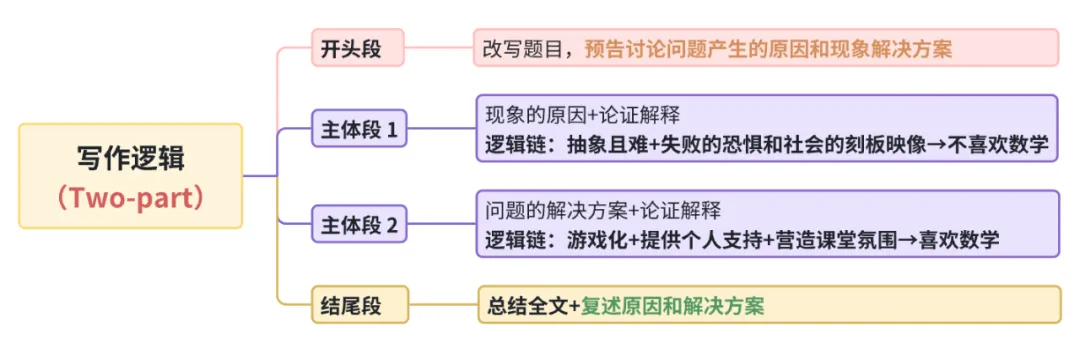
该题目要求我们不仅要分析学生不喜欢数学这个问题的原因,还要讨论这种现象的解决方案。对于前者,我们可以从数学本身的抽象性和高难度入手,然后继续讨论学习数学失败的恐惧和社会的刻板映像加剧这个问题
对于后者,我们可以从游戏化、个人支持、课堂支持这三个角度阐述解决方案。注意不要仅仅罗列理由,要给出逻辑论证,也不要只给出简单的例子就结束,而要给出例证,通过例子来支撑
写作框架
1.开头段(Introduction)
一些学童在学习数学时遇到困难,这可能会阻碍他们的学业进步。了解这一问题背后的原因,并探索有效的策略,使数学学习变得有趣,是至关重要的
Some school children struggle to enjoy mathematics, which can hinder their academic progress. Understanding the reasons behind this issue and exploring effective strategies to make learning maths engaging are crucial.
2.主体段
主体段1:
主题:孩子们不喜欢数学的一个关键原因是,他们认为数学难以理解且过于抽象
解释1:许多数学概念需要逻辑思维和解决问题的能力,对于缺乏自信的学生来说,这可能会令人沮丧。此外,如果学生早期没有掌握基础概念,可能会越来越难以跟上进度,从而产生无助感
解释2:传统的教学方法往往侧重于死记硬背和重复练习,而不是实际应用,使得数学显得枯燥且缺乏现实意义
解释3:另一个因素是对失败的恐惧——在数学上遇到困难的学生可能会产生焦虑,形成逃避、动力下降和成绩不佳的恶性循环
解释4:在某些情况下,社会刻板印象认为数学是“天才的学科”,这可能会进一步打击那些认为自己没有天赋的学生
主体段2:
主题:为了让数学学习变得更有趣,教育者应采用互动性强且贴近现实的教学方法,以激发学生的兴趣和好奇心
例子1:游戏化教学可以通过挑战、奖励和互动式解题,让学习变成一种愉快的体验。使用技术,如教育应用程序或虚拟模拟,可以使抽象概念更加具体且易于理解
解释1:将数学概念与日常生活联系起来,比如预算管理、体育统计或烹饪测量,也可以提高学生的兴趣和理解能力
解释2:提供个性化支持、适应性学习项目,并鼓励成长型思维模式,可以帮助学生克服对失败的恐惧,并建立自信
例子2:一个支持性的课堂环境——将错误视为学习过程的一部分,而不是失败的象征——也能培养学生对数学的更积极态度
结尾段(Conclusion)
通过引入创新的教学方法,数学可以成为一门有趣的学科。通过让学习变得互动、有现实意义且充满支持,教育者可以培养学生对数学的长期兴趣
Incorporating innovative teaching methods can transform maths into an enjoyable subject for children. By making learning interactive, relevant, and supportive, educators can foster a lifelong appreciation for mathematics.
范文精析版
⭐️ 蓝色部分-生动动作表达:增加写作词汇丰富程
⭐️ 黄色部分-地道名词形容词表达:增加写作词汇丰富程度
⭐️ 橙色部分-必备连接词汇:增加写作连接词的积累
⭐️ 绿色部分-高级语法积累:提高写作时语法多样性和准确性
▼
范文
Some school children struggle to enjoy mathematics, which can hinder their academic progress. Understanding the reasons behind this issue and exploring effective strategies to make learning maths engaging are crucial.
One key reason children dislike maths is the perception that it is difficult and abstract. Many mathematical concepts require logical thinking and problem-solving skills, which can be frustrating for students who lack confidence in these areas. Additionally, if students fail to grasp fundamental concepts early on, they may find it increasingly difficult to catch up, leading to a sense of helplessness. Moreover, traditional teaching methods often focus on rote memorization and repetitive exercisesrather thanreal-world applications, making the subject feel dry and irrelevant. Another factor is the fear of failure—students who struggle with maths may develop anxiety, leading to a negative cycle of avoidance, decreased motivation, and poor performance. In some cases, societal stereotypes that label maths as a subject for "geniuses" can further discourage students who feel they are not naturally gifted in the subject.
To make maths more enjoyable, educators should adopt interactive and practical teaching approaches that encourage engagement and curiosity. Gamification, for example, can turn learning into an enjoyable experience by incorporating challenges, rewards, and interactive problem-solving. Using technology, such aseducational apps or virtual simulations, can make abstract concepts more tangible and easier to understand. Relating mathematical concepts to everyday life, such as budgeting, sports statistics, or cooking measurements, can also increase students’ interest and comprehension. Additionally, providing personalized support, adaptive learning programs, and encouraging a growth mindset can help students overcome their fear of failure and build confidence in their abilities. A supportive classroom environment, where mistakes are seen as part of the learning process rather than a sign of failure, can also foster a more positive attitude toward maths.
Incorporating innovative teaching methods can transform maths into an enjoyable subject for children. By making learning interactive, relevant, and supportive, educators can foster a lifelong appreciation for mathematics.
高分表达
exploring effective strategies 探索有效策略
lack confidence 缺乏信心
fail to grasp fundamental concepts 未能掌握基本概念
catch up 赶上
struggle with maths 在数学学习上有困难
label maths as a subject for "geniuses" 数学是“天才的学科”
adopt interactive and practical teaching approaches 愉快的体验
transform maths into an enjoyable subject 将数学转变为一门有趣的学科
logical thinking and problem-solving skills 逻辑思维和解决问题的能力
a sense of helplessness 无助感
rote memorization and repetitive exercises 死记硬背和重复练习
real-world applications 实际应用
cycle of avoidance, decreased motivation, and poor performance 形成逃避、动力下降和成绩不佳的恶性循环
societal stereotypes 社会刻板印象
naturally gifted 天生有天赋的
enjoyable experience 愉快的体验
educational apps 教育应用程序
virtual simulations 虚拟模拟
supportive classroom environment 支持性的课堂环境
appreciation for mathematics 对数学的兴趣
①Some school children struggle to enjoy mathematics, which can hinder their academic progress.
一些学童在学习数学时遇到困难,(which引导非限定性定语从句)这可能会阻碍他们的学业进步
②One key reason children dislike maths is the perception that it is difficult and abstract.
孩子们不喜欢数学的一个关键原因是,他们认为(that引导同位语从句修饰抽象概念)数学难以理解且过于抽象
③Additionally, providing personalized support, adaptive learning programs, and encouraging a growth mindset can help students overcome their fear of failure and build confidence in their abilities.
此外,(动名词并列作主语)提供个性化支持、适应性学习项目,并鼓励成长型思维模式,可以帮助学生克服对失败的恐惧,并建立自信
④By making learning interactive, relevant, and supportive, educators can foster a lifelong appreciation for mathematics.
(介词by+动名词表示方式)通过让学习变得互动、有现实意义且充满支持,教育者可以培养学生对数学的长期兴趣
▼