

应用文
范文一(基础级)
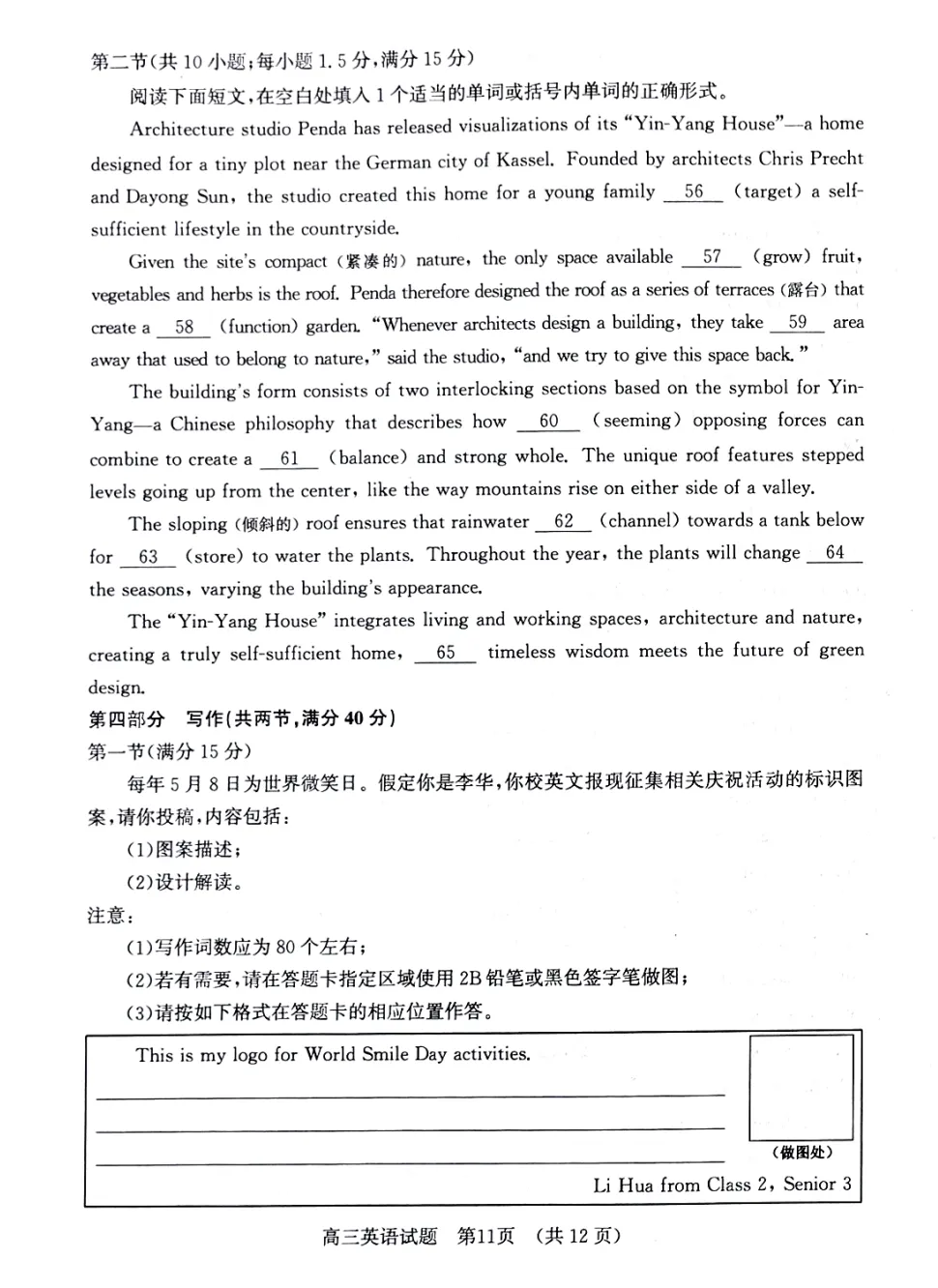
This is my logo for World Smile Day activities. In the center, I draw a big bright yellow smiley face. Around it, I paint several colorful hands forming a circle. The background is light blue, like the sky.
The smiley face shows happiness and kindness. The hands mean support and unity, representing people from different backgrounds. The blue background stands for peace and hope. My logo tells us that a smile can bring everyone together.
这是我为世界微笑日活动设计的标识。在正中央,我画了一个大大的亮黄色笑脸。在它周围,我画了几只彩色的手围成一个圆圈。背景是浅蓝色,就像天空一样。
笑脸代表快乐和友善。双手象征着支持与团结,代表着来自不同背景的人们。蓝色背景寓意和平与希望。我的标识告诉我们,微笑能把所有人凝聚在一起。
语言亮点:
简单主谓宾结构,清晰明了
forming a circle(现在分词短语作定语,修饰hands)
representing people...(现在分词短语作状语)
stand for(短语动词,象征)
bring together(短语动词,使团结)
范文二(中级)
This is my logo for World Smile Day activities. In the middle of the design is a smiling face, whose mouth is shaped like a blooming flower. Surrounding the face are five figures holding hands, each wearing a different color. The background is painted in warm orange, creating a friendly atmosphere.
The smiling face represents joy, while the flower-shaped mouth suggests that a smile can grow and spread like a flower in spring. The five figures, each standing for a continent, show global unity. The warm orange background, which reminds us of sunrise, expresses hope and a fresh start. My logo is meant to convey that a smile knows no borders.
这是我为世界微笑日活动设计的标识。图案中央是一张笑脸,它的嘴角弯成一朵盛开的花朵的形状。笑脸周围是五个手拉手的人形,每人穿着不同颜色的衣服。背景是温暖的橙色,营造出友好的氛围。
笑脸代表快乐,而花朵形状的嘴角暗示微笑可以像春天的花朵一样生长和传播。五个人形象征着五大洲,体现了全球团结。温暖的橙色背景让人联想到日出,表达了希望和崭新的开始。我的标识旨在传达:微笑无国界。
语言亮点:
whose mouth is shaped like...(定语从句,whose指代smiling face)
Surrounding the face are five figures...(完全倒装,强调位置)
each wearing a different color(独立主格结构)
creating a friendly atmosphere(现在分词短语作结果状语)
while(连词,表示对比)
which reminds us of sunrise(非限制性定语从句)
is meant to convey that...(被动语态 + 宾语从句)
knows no borders(拟人化表达)
范文三(高阶级)
This is my logo for World Smile Day activities. At the heart of the design lies a half-hidden smiling face, whose eyes are replaced by two tiny mirrors, reflecting the viewer’s own image. Surrounding the face are scattered light beams, radiating from the center like ripples on water. The background is a gradient from deep gray to warm gold, symbolizing the transition from sorrow to joy.
The smiling face, though partially hidden, suggests that happiness can exist even in difficult times, waiting to be discovered. The mirrors serving as eyes are intended to remind us that a smile starts with ourselves — we must first see our own smile before sharing it with others. The radiating beams, functioning as extensions of the smile, represent the spreading power of kindness. The color change, moving from gray to gold, implies that a single smile has the ability to brighten a gloomy day. My logo, as a whole, is designed to inspire a simple yet profound truth: a smile, once given, not only lights up our own face but also illuminates the world around us.
这是我为世界微笑日活动设计的标识。在设计的中心,藏着一张半隐半现的笑脸,它的双眼被替换成两面小镜子,映照出观看者自己的样子。笑脸周围是散落的光束,像水面上的涟漪一样从中心向外辐射。背景是从深灰色到暖金色的渐变,象征着从悲伤到快乐的转变。
这张半隐藏的笑脸表明,即使在困难时期,快乐依然存在,等待着被发现。作为眼睛的镜子旨在提醒我们,微笑始于我们自己——我们必须先看见自己的微笑,才能与他人分享。辐射的光束作为微笑的延伸,代表着善意的传播力量。从灰色到金色的颜色变化暗示着一个微笑就有能力照亮阴郁的一天。我的标识整体旨在激发一个简单而深刻的真理:一个微笑,一旦绽放,不仅点亮我们自己的脸庞,也照亮我们周围的世界。
语言亮点:
At the heart of the design lies...(完全倒装,增强文学性)
whose eyes are replaced by...(定语从句)
reflecting the viewer’s own image(现在分词短语作定语)
radiating from the center like ripples on water(现在分词短语 + 明喻)
symbolizing the transition...(现在分词短语作状语)
though partially hidden(省略的让步状语从句,though it is partially hidden)
waiting to be discovered(现在分词短语作伴随状语)
serving as eyes(现在分词短语作定语)
are intended to remind us that...(被动语态 + 宾语从句)
before sharing it with others(before + 动名词短语)
functioning as extensions of the smile(现在分词短语作定语)
moving from gray to gold(现在分词短语作定语)
implies that...(宾语从句)
has the ability to brighten...(不定式作定语)
as a whole(插入语)
a smile, once given, not only lights up... but also illuminates...(状语从句省略 + not only...but also...平行结构 + 拟人化)
范文一(基础级)
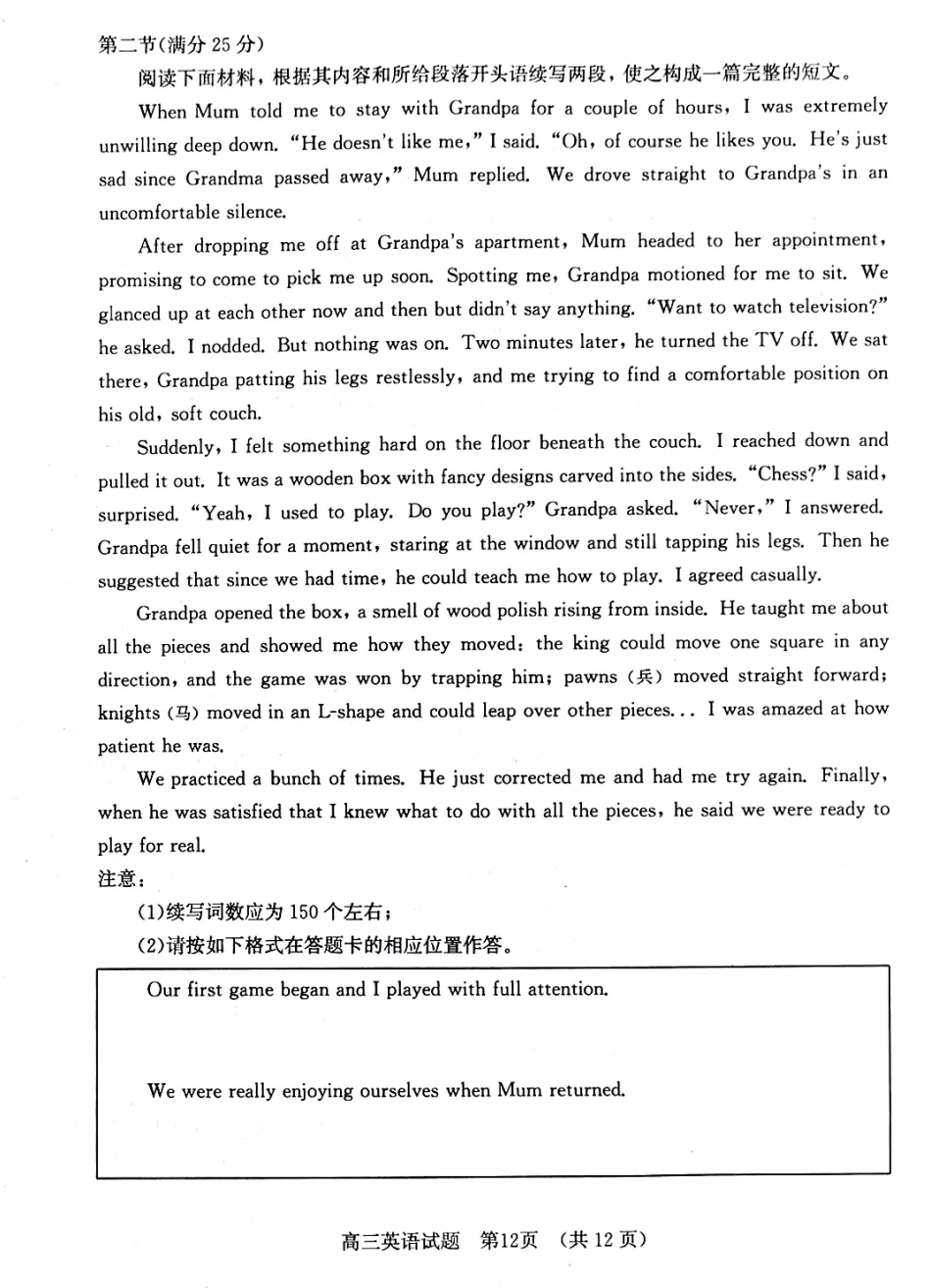
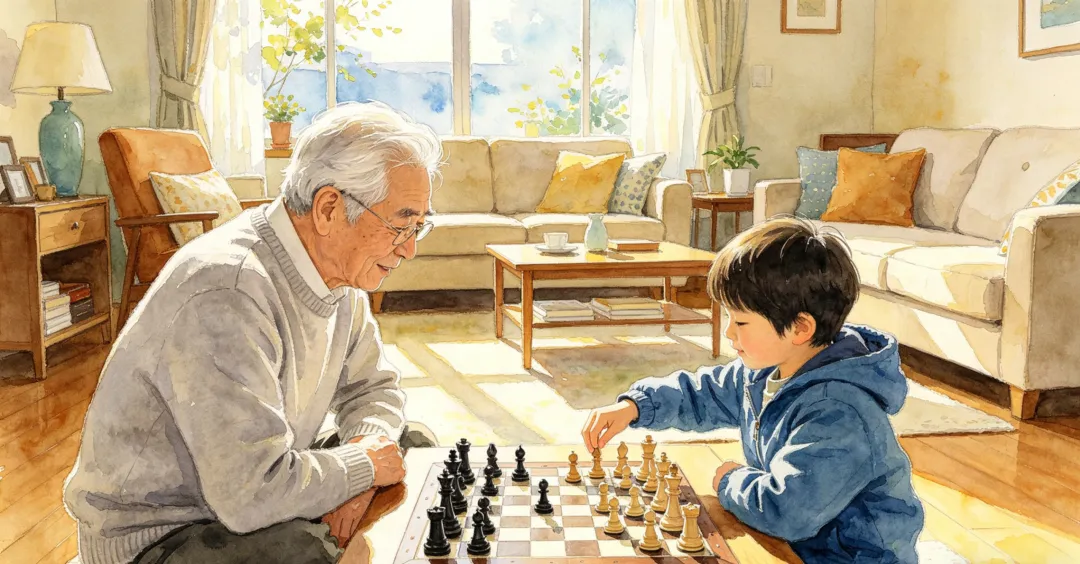
Our first game began and I played with full attention. Grandpa moved his pawn first, and I tried to remember all the rules he had taught me. I moved my knight carefully, but I made a mistake soon. Instead of getting angry, Grandpa smiled gently and pointed at my wrong move. “Try again,” he said softly. I followed his advice and corrected my step. As the game went on, I began to understand how the pieces worked together. Grandpa let me win the first game, and I could see the pride in his eyes. A warm feeling rose in my heart.
We were really enjoying ourselves when Mum returned. She stood by the door, surprised at what she saw. Grandpa was laughing while teaching me a new opening trick. I was sitting on the couch, holding the wooden knight tightly. “Look, Mum! Grandpa taught me chess!” I shouted happily. Mum smiled and said nothing, but her eyes were wet. I suddenly realized that Grandpa was not scary at all. He was just lonely. That day, I not only learned chess but also found a friend in Grandpa.
我们的第一局开始了,我全神贯注地下着。爷爷先动了兵,我努力记住他教我的所有规则。我小心地移动了马,但很快就犯了一个错误。爷爷没有生气,而是温和地笑了笑,指了指我走错的那步。“再试一次,”他轻声说。我听从了他的建议,纠正了那步棋。随着对局的进行,我开始理解棋子是如何配合的。爷爷让我赢了第一局,我能看到他眼中的骄傲。一股暖流涌上我的心头。
妈妈回来时,我们正玩得很开心。她站在门口,对眼前的景象感到惊讶。爷爷一边笑着一边教我一个新的开局技巧。我坐在沙发上,紧紧握着那枚木制的马。“看,妈妈!爷爷教我下棋了!”我开心地喊道。妈妈笑了笑,没说什么,但她的眼睛湿润了。我突然意识到,爷爷一点也不可怕。他只是孤独而已。那一天,我不仅学会了国际象棋,还在爷爷身上找到了一个朋友。
语言亮点:
Instead of getting angry(介词短语 + 动名词,表转折)
pointed at my wrong move(简单动词短语)
as the game went on(时间状语从句)
how the pieces worked together(宾语从句)
surprised at what she saw(过去分词短语作状语 + 宾语从句)
holding the wooden knight tightly(现在分词短语作伴随状语)
I not only learned chess but also found a friend(not only...but also 平行结构)
范文二(中级)
Our first game began and I played with full attention. Grandpa opened with a traditional move, pushing his pawn two steps forward. Having remembered all the rules, I responded cautiously, moving my knight to control the center. To my surprise, Grandpa didn’t go easy on me. He captured my pawn within five moves, leaving me completely exposed. However, instead of feeling frustrated, I found myself enjoying the challenge. Watching his fingers gently touching each piece before deciding, I gradually learned to think ahead. By the end of the game, though I lost badly, a sense of achievement washed over me. Grandpa nodded approvingly, his eyes shining with satisfaction.
We were really enjoying ourselves when Mum returned. She paused at the doorway, frozen by the scene unfolding before her. There we were, sitting face to face across the small wooden table, completely absorbed in our second game. The afternoon sunlight, streaming through the window, fell softly on Grandpa’s silver hair. “Your grandson is a fast learner,” Grandpa said, without looking up. Mum walked over quietly, afraid to break the magic. I raised my head and grinned. “He promised to teach me the knight fork next time!” Mum’s lips trembled slightly. At that moment, I understood: the wooden box had opened not only the chess game but also Grandpa’s closed heart.
我们的第一局开始了,我全神贯注地下着。爷爷以传统的走法开局,将兵向前推了两步。在记住了所有规则之后,我谨慎地回应,移动我的马去控制中心。令我惊讶的是,爷爷并没有对我手下留情。他在五步之内就吃掉了我的兵,让我的防线完全暴露。然而,我并没有感到沮丧,反而发现自己很享受这种挑战。看着他每次做决定前轻轻抚摸每一枚棋子的手指,我逐渐学会了提前思考。到对局结束时,虽然我惨败,但一种成就感涌遍全身。爷爷赞许地点了点头,眼中闪烁着满意。
妈妈回来时,我们正玩得很开心。她在门口停下,被眼前展开的场景惊呆了。我们就这样面对面地坐在小木桌的两旁,完全沉浸在第二局中。午后的阳光透过窗户,轻柔地洒在爷爷的银发上。“你孙子学得很快,”爷爷头也不抬地说。妈妈悄悄地走过来,生怕打破这份美好。我抬起头,咧嘴笑了。“他答应下次教我骑士叉!”妈妈的嘴唇微微颤抖。在那一刻,我明白了:那个木盒不仅打开了棋局,也打开了爷爷紧闭的心门。
语言亮点:
Having remembered all the rules(现在分词完成式作状语,表示动作已完成)
moving my knight to control the center(现在分词短语作伴随状语)
leaving me completely exposed(现在分词短语作结果状语,“留下我完全暴露”)
instead of feeling frustrated(介词短语 + 动名词)
Watching his fingers...(现在分词短语作时间状语)
a sense of achievement washed over me(无灵主语:成就感“冲刷”我)
his eyes shining with satisfaction(独立主格结构,表伴随状态)
frozen by the scene unfolding before her(过去分词短语作状语,表被动)
There we were, sitting face to face...(倒装强调 + 现在分词短语)
completely absorbed in our second game(过去分词短语作状语)
streaming through the window(现在分词短语作定语,修饰sunlight)
afraid to break the magic(形容词短语作伴随状语)
the wooden box had opened not only the chess game but also Grandpa’s closed heart(无灵主语:木盒“打开”了心门 + not only...but also)
范文三(高阶级)
Our first game began and I played with full attention. Grandpa, seated across from me with his back straight, made the first move silently. Having been taught all the rules, I responded with my knight, my fingers trembling slightly on the wooden piece. To my amazement, Grandpa didn’t correct me this time. Instead, a faint smile appeared at the corner of his mouth, as if a forgotten joy were quietly returning. The game unfolded slowly, each move telling a story of patience and strategy. Though I lost within fifteen minutes, defeat brought no disappointment — only a strange warmth spreading from my chest to my fingertips. Setting up the pieces again without a word, Grandpa signaled for a second round.
We were really enjoying ourselves when Mum returned. The moment she stepped in, what greeted her eyes was an unexpected scene: Grandpa, usually silent and distant, now leaning forward with his hands on his knees, explaining the “fool’s mate” with unusual animation. I, sitting on the edge of the couch, my feet not even touching the floor, was listening with all my heart, occasionally nodding or asking questions. Mum’s arrival went unnoticed until Grandpa, finishing his explanation, looked up and said calmly, “We’re in the middle of a game.” Instead of feeling offended, Mum smiled — a genuine, relieved smile that seemed to have been absent for years. She backed away quietly, leaving us undisturbed. At that moment, sitting in the warm afternoon light with chess pieces scattered between us, I realized: love, like chess, sometimes requires patient teaching and humble learning. And Grandpa, after all, had never disliked me. He was simply waiting for someone to sit at the other side of the board.
我们的第一局开始了,我全神贯注地下着。爷爷坐在我对面,腰背挺直,沉默地走出了第一步。在学完了所有规则之后,我用马回应,手指在木制棋子上微微颤抖。令我惊讶的是,这次爷爷没有纠正我。相反,一抹淡淡的微笑浮现在他的嘴角,仿佛一种被遗忘的快乐正在悄然回归。棋局缓慢地展开,每一步都诉说着耐心与策略的故事。虽然我在十五分钟内就输了,但失败并没有带来失望——只有一种奇异的温暖,从胸口蔓延到指尖。爷爷一言不发地重新摆好棋子,示意开始第二局。
妈妈回来时,我们正玩得很开心。她踏进门的那一刻,映入她眼帘的是一个意想不到的画面:平时沉默而疏远的爷爷,此时双手撑在膝盖上,身体前倾,正以一种少见的生动表情讲解着“傻瓜将杀法”。我坐在沙发的边缘,双脚甚至够不着地面,正全心倾听,偶尔点头或提问。没有人注意到妈妈来了,直到爷爷讲完,抬起头平静地说:“我们正在下棋呢。”妈妈没有感到被冒犯,反而露出了一个真诚的、如释重负的微笑——那笑容似乎已经缺席了许多年。她悄悄退后,没有打扰我们。在那一刻,坐在温暖的午后阳光里,棋子散落在我们之间,我明白了:爱,就像国际象棋,有时需要耐心的教导和谦逊的学习。而爷爷,自始至终,从未讨厌过我。他只是在等待着有人坐到棋盘的另一边。
语言亮点:
seated across from me with his back straight(过去分词短语 + 独立主格中的with结构)
Having been taught all the rules(现在分词完成被动式作状语,表被动且先于主句动作)
my fingers trembling slightly on the wooden piece(独立主格结构,表伴随状态)
as if a forgotten joy were quietly returning(as if引导的虚拟语气状语从句)
each move telling a story of patience and strategy(独立主格结构,表伴随)
defeat brought no disappointment(无灵主语:失败“带来”失望)
a strange warmth spreading from my chest to my fingertips(独立主格结构,表伴随)
Setting up the pieces again without a word(现在分词短语作时间状语)
what greeted her eyes was an unexpected scene(主语从句 + 无灵主语:景象“迎接”她的眼睛)
Grandpa, usually silent and distant, now leaning forward...(独立主格结构,中间插入形容词短语作同位语)
my feet not even touching the floor(独立主格结构)
listening with all my heart(现在分词短语作伴随状语)
until Grandpa, finishing his explanation, looked up(until引导的时间状语从句 + 插入的现在分词短语)
a genuine, relieved smile that seemed to have been absent for years(定语从句修饰smile)
leaving us undisturbed(现在分词短语作结果状语)
sitting in the warm afternoon light with chess pieces scattered between us(现在分词短语 + with复合结构)
love, like chess, sometimes requires patient teaching and humble learning(插入的明喻 + 无灵主语)
He was simply waiting for someone to sit at the other side of the board(不定式作定语)


