


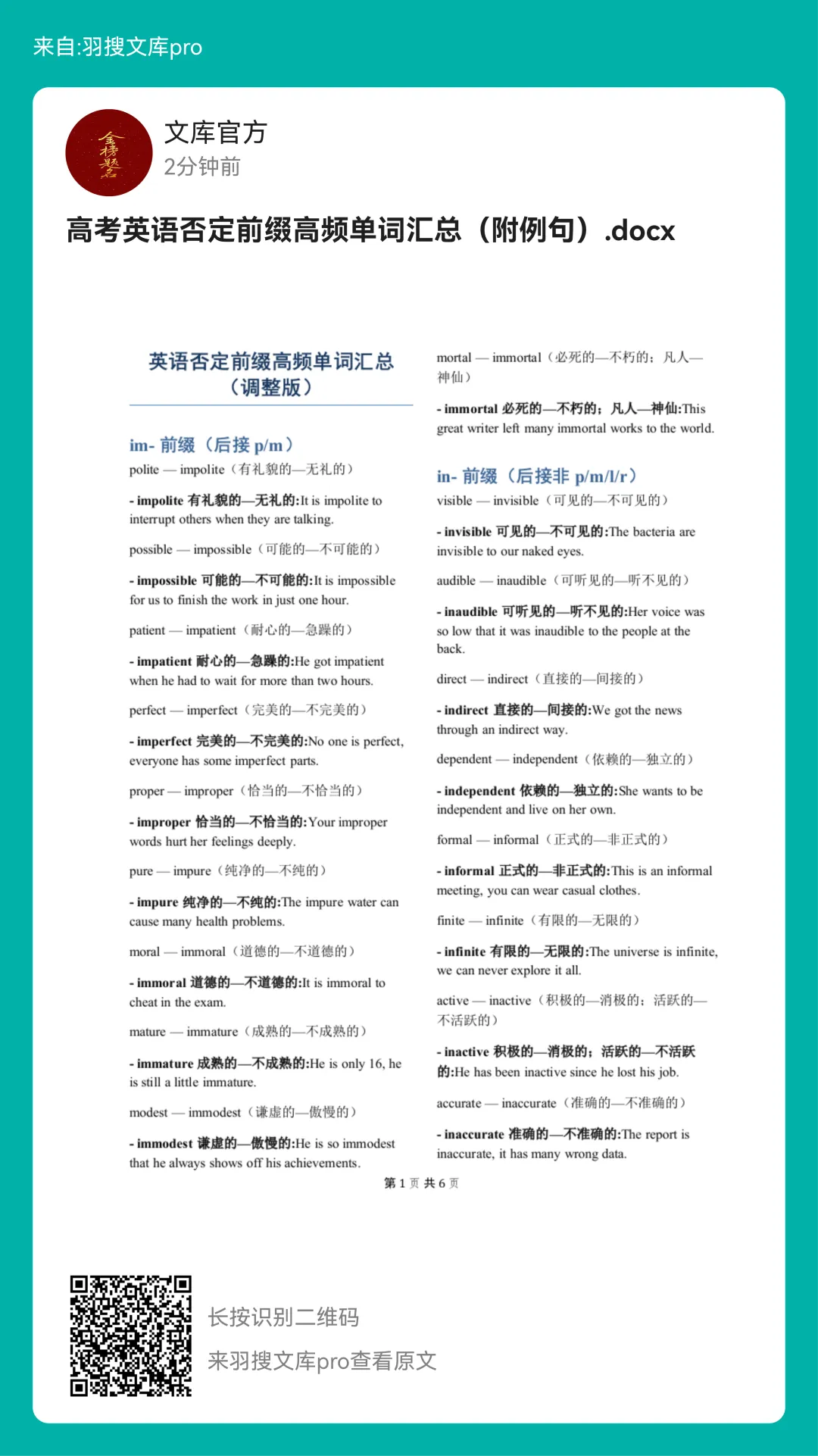
英语否定前缀高频单词汇总
整理高频否定前缀+对应单词,附简单例句,方便背诵和应用,适配高考及日常英语积累,排版清晰,可直接收藏背诵~
一、im- 前缀(后接 p/m)
polite — impolite(有礼貌的—无礼的)
👉 例句:It is impolite to interrupt others when they are talking.
possible — impossible(可能的—不可能的)
👉 例句:It is impossible for us to finish the work in just one hour.
patient — impatient(耐心的—急躁的)
👉 例句:He got impatient when he had to wait for more than two hours.
perfect — imperfect(完美的—不完美的)
👉 例句:No one is perfect, everyone has some imperfect parts.
proper — improper(恰当的—不恰当的)
👉 例句:Your improper words hurt her feelings deeply.
pure — impure(纯净的—不纯的)
👉 例句:The impure water can cause many health problems.
moral — immoral(道德的—不道德的)
👉 例句:It is immoral to cheat in the exam.
mature — immature(成熟的—不成熟的)
👉 例句:He is only 16, he is still a little immature.
modest — immodest(谦虚的—傲慢的)
👉 例句:He is so immodest that he always shows off his achievements.
mortal — immortal(必死的—不朽的;凡人—神仙)
👉 例句:This great writer left many immortal works to the world.
二、in- 前缀(后接非 p/m/l/r)
visible — invisible(可见的—不可见的)
👉 例句:The bacteria are invisible to our naked eyes.
audible — inaudible(可听见的—听不见的)
👉 例句:Her voice was so low that it was inaudible to the people at the back.
direct — indirect(直接的—间接的)
👉 例句:We got the news through an indirect way.
dependent — independent(依赖的—独立的)
👉 例句:She wants to be independent and live on her own.
formal — informal(正式的—非正式的)
👉 例句:This is an informal meeting, you can wear casual clothes.
finite — infinite(有限的—无限的)
👉 例句:The universe is infinite, we can never explore it all.
active — inactive(积极的—消极的;活跃的—不活跃的)
👉 例句:He has been inactive since he lost his job.
accurate — inaccurate(准确的—不准确的)
👉 例句:The report is inaccurate, it has many wrong data.
adequate — inadequate(足够的—不足的)
👉 例句:The food is inadequate for so many people.
convenient — inconvenient(方便的—不方便的)
👉 例句:It is inconvenient for me to pick you up at that time.
correct — incorrect(正确的—错误的)
👉 例句:Your answer to this question is incorrect.
human — inhuman(有人情味的—冷酷的;人类的—非人的)
👉 例句:The prisoners suffered from inhuman treatment in that prison.
credible — incredible(可信的—难以置信的)
👉 例句:It is incredible that he finished the marathon in just 2 hours.
definite — indefinite(明确的—模糊的;确定的—不确定的)
👉 例句:We have an indefinite plan for the next trip.
expensive — inexpensive(昂贵的—便宜的)
👉 例句:This shirt is inexpensive but of good quality.
三、il- 前缀(后接 l)
legal — illegal(合法的—非法的)
👉 例句:It is illegal to drive after drinking alcohol.
logical — illogical(合乎逻辑的—不合逻辑的)
👉 例句:Your argument is illogical, it doesn't make sense.
literate — illiterate(有文化的—文盲的)
👉 例句:Many people in that poor area are illiterate.
legible — illegible(清晰的—难以辨认的)
👉 例句:His handwriting is so bad that it is illegible.
liberal — illiberal(开明的—狭隘的;自由的—不自由的)
👉 例句:He has an illiberal attitude towards different opinions.
四、ir- 前缀(后接 r)
regular — irregular(规则的—不规则的;定期的—不定期的)
👉 例句:He has irregular working hours, so he is very busy sometimes.
responsible — irresponsible(负责任的—不负责任的)
👉 例句:It is irresponsible of you to leave the children alone at home.
resistible — irresistible(可抗拒的—无法抗拒的)
👉 例句:The chocolate cake is so delicious that it is irresistible.
rational — irrational(理性的—非理性的)
👉 例句:He made an irrational decision when he was angry.
relevant — irrelevant(相关的—不相关的)
👉 例句:Your question is irrelevant to the topic we are talking about.
replaceable — irreplaceable(可替代的—不可替代的)
👉 例句:This old photo is irreplaceable to me.
五、dis- 前缀
honest — dishonest(诚实的—不诚实的)
👉 例句:He was dishonest to his parents about his exam results.
loyal — disloyal(忠诚的—不忠的)
👉 例句:He was accused of being disloyal to his country.
like — dislike(喜欢—不喜欢)
👉 例句:I dislike getting up early on weekends.
agree — disagree(同意—不同意)
👉 例句:I disagree with your opinion on this matter.
appear — disappear(出现—消失)
👉 例句:The sun disappeared behind the clouds.
connect — disconnect(连接—断开)
👉 例句:The phone call was disconnected suddenly.
cover — discover(遮盖—发现)
👉 例句:Columbus discovered America in 1492.
trust — distrust(信任—不信任)
👉 例句:I distrust him because he lied to me before.
able — disable(使丧失能力—有能力的)
👉 例句:The accident disabled him from walking.
arm — disarm(武装—解除武装)
👉 例句:The soldiers were ordered to disarm the rebels.
honor — dishonor(尊敬—使蒙羞;荣誉—耻辱)
👉 例句:You have dishonored your family by your bad behavior.
obey — disobey(遵守—违抗)
👉 例句:He was punished because he disobeyed the school rules.
please — displease(使高兴—使不快)
👉 例句:His words displeased his boss very much.
solve — dissolve(解决—溶解;解散)
👉 例句:The sugar will dissolve in the hot water quickly.
六、mal- 前缀
treat — maltreat(对待—虐待)
👉 例句:It is a crime to maltreat children or animals.
function — malfunction(运转—发生故障)
👉 例句:The machine malfunctioned because of the power cut.
nourish — malnourish(滋养—使营养不良)
👉 例句:The poor children in that area are malnourished.
practice — malpractice(做法—渎职;不当行为)
👉 例句:The doctor was accused of medical malpractice.
nutrition — malnutrition(营养—营养不良)
👉 例句:Many children suffer from malnutrition in the poor village.
七、mis- 前缀
administer — misadminister(管理—滥用职权;管理不当)
👉 例句:The official was fired because he misadministered the public funds.
behave — misbehave(表现—行为不端)
👉 例句:The boy was punished because he misbehaved in class.
lead — mislead(带领—误导)
👉 例句:The false advertisement mislead many consumers.
understand — misunderstand(理解—误解)
👉 例句:Don't misunderstand me, I didn't mean to hurt you.
judge — misjudge(判断—误判)
👉 例句:I misjudged his ability, he is much better than I thought.
spell — misspell(拼写—拼错)
👉 例句:He misspelled my name in the email.
take — mistake(拿—误解;弄错)
👉 例句:I mistook him for his brother, they look so similar.
read — misread(阅读—误读)
👉 例句:I misread the date, so I missed the meeting.
write — miswrite(书写—写错)
👉 例句:He miswrote the phone number, so I couldn't reach him.
hear — mishear(听见—听错)
👉 例句:I misheard what you said, could you say it again?
guide — misguide(引导—误导)
👉 例句:The wrong information misguide us to the wrong place.
八、anti- 前缀(表“反/抗”,否定延伸)
war — antiwar(战争—反战的)
👉 例句:Many people joined the antiwar movement to stop the fight.
cancer — anticancer(癌症—抗癌的)
👉 例句:This kind of food has anticancer effects.
virus — antivirus(病毒—抗病毒的)
👉 例句:We need to install antivirus software on the computer.
clockwise — anticlockwise(顺时针的—逆时针的)
👉 例句:Turn the knob anticlockwise to open the bottle.
九、contra- 前缀(表“相反/对立”,否定延伸)
dict — contradict(口述—反驳;与…矛盾)
👉 例句:What you said now contradicts what you told me yesterday.
pose — contrapose(放置—使对立;对照)
👉 例句:We need to contrapose the two plans to see which is better.
dictory — contradictory(矛盾的—矛盾的;对立的)
👉 例句:The two reports are contradictory to each other.
十、un- 前缀
able — unable(能够的—不能的)
👉 例句:I am unable to attend the meeting because I am sick.
happy — unhappy(开心的—不开心的)
👉 例句:She felt unhappy because she failed the exam.
lucky — unlucky(幸运的—不幸的)
👉 例句:He was unlucky to miss the last bus home.
healthy — unhealthy(健康的—不健康的)
👉 例句:Eating too much junk food is unhealthy.
usual — unusual(平常的—不寻常的)
👉 例句:It is unusual for him to be late for work.
friendly — unfriendly(友好的—不友好的)
👉 例句:The waiter was very unfriendly to us.
fair — unfair(公平的—不公平的)
👉 例句:It is unfair to ask me to do all the work alone.
fit — unfit(合适的—不合适的;健康的—不健康的)
👉 例句:He is unfit for this job because he has no experience.
welcome — unwelcome(受欢迎的—不受欢迎的)
👉 例句:His unexpected visit made him unwelcome.
aware — unaware(意识到的—未意识到的)
👉 例句:He was unaware of the danger around him.
certain — uncertain(确定的—不确定的)
👉 例句:I am uncertain about whether I can go there tomorrow.
comfortable — uncomfortable(舒适的—不舒服的)
👉 例句:The chair is so hard that it is uncomfortable to sit on.
conscious — unconscious(有意识的—无意识的)
👉 例句:He was unconscious for three days after the accident.
fold — unfold(折叠—展开)
👉 例句:He unfolded the letter and read it carefully.
lock — unlock(锁上—解锁)
👉 例句:He unlocked the door and let us in.
pack — unpack(打包—拆包)
👉 例句:I need to unpack my luggage after the trip.
tie — untie(系上—解开)
👉 例句:He untied the rope and set the dog free.
load — unload(装载—卸载)
👉 例句:The workers are unloading the goods from the truck.


