


2026届高三一模英语试卷
注意事项
1.答题前,先将自己的姓名、准考证号、考场号、座位号填写在试卷和答题卡上,并将准考证号条形码粘贴在答题卡上的指定位置。
2.请按题号顺序在答题卡上各题目的答题区域内作答,写在试卷、草稿纸和答题卡上的非答题区域均无效。
3.选择题用2B铅笔在答题卡上把对应题目所选答案的标号涂黑;非选择题用黑色签字笔直接答在答题卡上对应的答题区域内。
4.考试结束后,请将本试卷和答题卡一并上交。
第一部分听力(共两节,满分30分)
做题时,先将答案标在试卷上。录音内容结束后,你将有两分钟的时间将试卷上的答案转涂到答题卡上。
第一节(共5小题;每小题1.5分,满分7.5分)
听下面 5段对话。每段对话后有一个小题,从题中所给的A、B、C 三个选项中选出最佳选项。听完每段对话后,你都有 10 秒钟的时间来回答有关小题和阅读下一小题。每段对话读两遍。
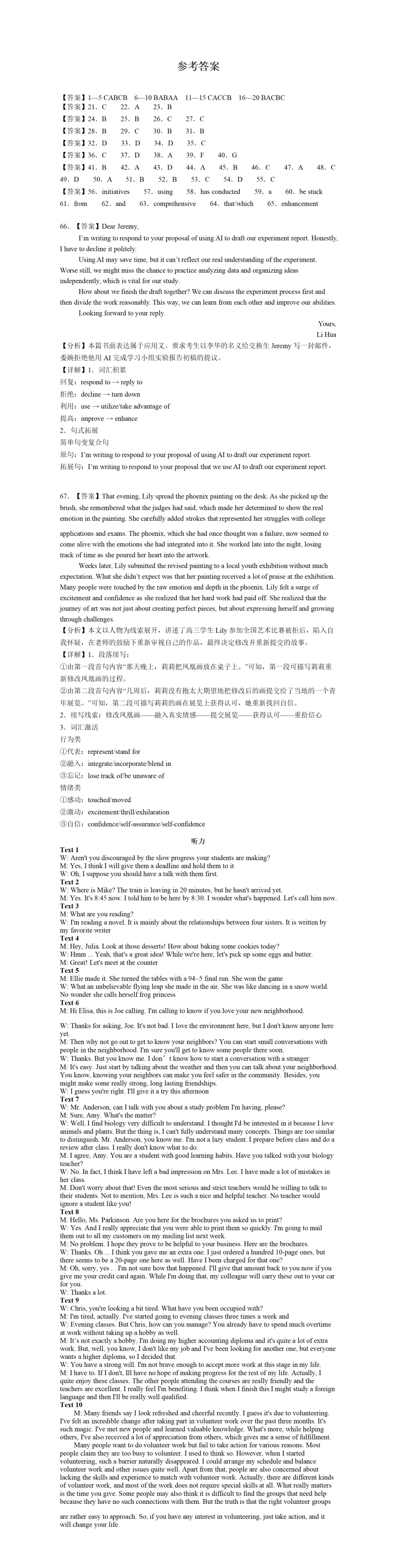
1.What does the woman suggest to deal with the students?
A. Giving encouragementB. Setting a deadline. C. Having a talk
2. When is Mike expected to arrive?
A. By 8:30.B. By 8:45. C. By 9:05.
3.What is the story the woman is reading about?
A. AnimalsB. Sisterhood. C. Her favorite writer.
4. Where does the conversation probably take place?
A. In a dormitory.B. In a restaurant. C. In a supermarket.
5. What are the speakers talking about?
A. A snow sport.B. A sports star. C. A musical
第二节(共15小题;每小题1.5分,满分22.5分)
听下面5段对话或独白。每段对话或独白后有几个小题,从题中所给的A、B、C三个选项中选出最佳选项。听每段对话或独白前,你将有时间阅读各个小题,每小题5秒钟;听
完后,各小题将给出5秒钟的作答时间。每段对话或独白读两遍。
听第6段材料,回答第 6、7题。
6. Where does the conversation take place?
A. In a community meeting.B. Over the phoneC. At Alisa's house.
7.What does Joe suggest Alisa do?
A. Familiarize herself with neighbors.
B. Introduce her neighborhood to him.
C. Move to a safer community.
听第7段材料,回答第8至10题。
8. What is the woman’s problem with biology class?
A. She doesn’t like animals or plants.
B. She can’t understand some concepts.
C. She doesn’t have good learning habits
9.What is Mr. Anderson's suggestion?
A. Talking to her biology teacher
B. Doing more preparation and review
C. Leaving a good impression on Mrs. Lee
10.How does Mr. Anderson describe Mrs. Lee?
A. Kind. B. Serious. C. Talkative.
听第8段材料,回答第 11至13 题。
11. What is the woman going to do next week?
A. Make a mailing list B. Meet all her customers C. Mail the printed materials
12. How many pages did each of the ordered brochures have?
A.10B.20C.100
13.What will the man do next?
A. Carry the brochures out.
B. Offer his credit card number.
C. Return the overcharged money.
听第9段材料,回答第14 至17题。
14. What has the man been up to these days?
A. Looking for a part-time job.
B. Taking up a new hobby.
C. Attending evening classes
15. What kind of person is the man?
A. Pessimistic. B. Determined.C. Patient
16.What does the man think of the courses he is learning?
A. Challenging.B. Rewarding.C. Boring.
17. Why does the man want to learn a foreign language?
A. To get more chances.B. To make more friends.C. To further study abroad
听第10段材料,回答第18 至20 题。
18. When did the speaker start volunteering?
A. Three days ago.B. Three weeks ago. C. Three months ago.
19. What has the speaker gained from the volunteer work?
A. A sharp eye to discover beauty.
B. A great sense of achievement.
C. An open mind to appreciate differences.
20. What is the author's main message about volunteering?
A. It’s challenging for some.
B. It’s only for those with special skills.
C. It’s easier to get into than you may think.
第二部分:阅读(共两节,满分50分)
第一节(共15小题;每小题2.5分,满分37.5分)
阅读下列短文,从每题所给的 A、B、C和 D四个选项中,选出最佳选项。
A
Nowadays, more and more emphasis is being placed on a building’s “green” certification. On Earth Day, look through four noteworthy green buildings from around the world.
One Central Park (Sydney, Australia)
A park at the foot of the building literally continues up the structure, as vegetation of 250 species of Australian plants and flowers cover One Central Park. An architectural website says it has 25% less energy consumption compared with a conventional building of its size.
Shanghai Tower (Shanghai, China)
Shanghai Tower has a transparent second skin wrapped around the building which creates a zone of captured air that serves as natural ventilation (通风), reducing energy costs. Besides, 270 wind devices incorporated into the right side power its outside lights.
Marco Polo Tower (Hamburg, Germany)
Each floor of Marco Polo Tower is turned a few degrees away from the one below, around an axis (轴线). This allows for recessed (嵌入式) buildings that protect residents from direct sun. This tower also includes many other green features. There is a heat exchanger on the roof that turns warm air into a cooling system. And the natural ventilation can make residents sleep soundly without being disrupted by outside noise.
Torre Reforma (Mexico City, Mexico)
Torre Reforma rises to 807 feet and stands tall on energy-saving measures, too. The tower’s slimness maximizes the amount of natural light let in, which in turn cuts down on the need for electric lights. And when the weather permits, controls can automatically open windows to let air in.
21.What do we know about One Central Park?
A.It makes full use of solar energy.
B.It uses a great cooling system.
C.It has many plants and flowers.
D.It has self-control windows.
22.What do the Shanghai Tower and Marco Polo Tower have in common?
A.They are naturally ventilated.
B.They are both transparent.
C.They generate electricity by wind.
D.They harvest energy from sunshine.
23.Where can the text be found?
A.In science fiction.B.In an architectural magazine.
C.In an autobiography.D.In a weather report.
B
On a recent trip through the Himalayas, my bruises (淤伤) became the truest souvenirs. More personal than anything bought, they carry a unique memory. Over time, my desire for typical souvenirs has faded; I now value experiences over objects. But maybe that’s just me. Two out of three Americans bring back a souvenir from their travels, with US sales topping $21bn in 2022.
Humans have long collected objects to remember experiences. With the rise of industrialization and tourism, souvenirs became more common. Souvenirs bring back happy memories, serving as a simple way to say, “I was there.” “At the heart of our actions is a desire to feel heard, seen and connected,” explains Madarkal, a professor in India.
Travellers today are more aware of their impact on local community, but the problems caused by travel souvenirs are often overlooked. In a 2022 Australian report, up to 75% of souvenirs marketed as “local” are made overseas. Real goods are expensive due to time-consuming labour involved, so some shops sell cheap fakes (假货) with most customers giving little regard to their origins. While buying fakes may seem to support local sellers, it often minimizes the profit of the traditional handicrafts, creating a negative cycle.
So, how can you buy meaningful souvenirs? “Be curious... it’s not just about buying or choosing carefully, it’s about rejecting and explaining why,” said Madarkal. Asking where an item comes from and how it is made is a good first step. Choosing unique designs over mass-produced goods at fair-trade markets helps support local communities. Intentions also matter, as souvenirs should be chosen for personal meaning rather than habit. And souvenirs don’t always have to be objects — journals or skills gained can become lasting reminders.
Ultimately, there’s no universal rule for a “meaningful” souvenir. But next time you’re grabbing a quick airport souvenir, pause and reflect.
24.What changed the author’s view on souvenirs?
A.A search for adventures.B.A desire for experiences.
C.Fear of physical injuries. D.Changes in life stages.
25.What is paragraph 2 mainly about?
A.The increasing popularity of souvenirs.B.The psychological need for souvenirs.
C.The importance of modern tourism.D.The memories tourism brings back.
26.What is the consequence of the negative cycle in paragraph 3?
A.Tourism becomes more profitable.B.Local sellers gain long-term benefits.
C.Traditional handicrafts lose the market.D.Souvenir design becomes standardized.
27.What does the author suggest about buying meaningful souvenirs?
A.Picking timeless common designs.B.Following your own shopping habits.
C.Choosing intention over convenience.D.Weighing possession over remembrance.
C
A new major study suggests that maintaining healthy eating habits in midlife is linked to better aging in later years. Conducted by researchers from Harvard, the University of Copenhagen, and the University of Montreal, this study does not just focus on living a long life. Instead, it looks at “healthy aging,” which is defined as living to age 70 or older without major chronic diseases while maintaining good cognitive, physical, and mental health.
The team observed over 105,000 female and male health professionals in midlife for 30 years. Participants regularly completed detailed dietary questionnaires. The researchers scored these answers based on eight different healthy dietary patterns. These patterns, such as the Mediterranean diet or the DASH diet, generally encourage high intakes of fruits, vegetables, whole grains, and healthy fats, while limiting red and processed meats. They also carefully examined the amount of ultra-processed foods participants consumed.
The results are promising. A total of 9.3% of the population aged healthily. Overall, those who stuck to any of these healthy dietary patterns were more likely to age well. The top performer was the AHEI diet. People with high scores were much more likely to live past 70 in good health than those with low scores. Another strong option was the PHDI, which emphasizes plant-based foods while considering planetary health. In contrast, eating too much processed meat and sugary drinks lowered the chances of healthy aging.
The researchers emphasize that there is no “one-size-fits-all” diet. Healthy diets can be adapted to fit individual needs and preferences. The main goal is to eat mostly plant-based foods with a moderate inclusion of healthy animal products. This flexibility helps people maintain an independent and active quality of life as they age, which is a priority for both individuals and public health.
However, the study has some limitations. The participants were all health professionals, meaning their socioeconomic status and education levels might be higher than average. To apply the results more widely, future studies should repeat the research in populations with more diverse backgrounds.
28.How does the study define “healthy aging”?
A.By living a long life without any illnesses.
B.By maintaining physical and mental health at 70.
C.By following a strict diet plan in midlife.
D.By avoiding animal-based foods totally.
29.What is a common feature of the recommended dietary patterns?
A.They are high in red meat intake.
B.They strictly exclude all dairy products.
C.They encourage eating more plant-based foods.
D.They focus mainly on environmental protection.
30.What does the author suggest about healthy diets?
A.They require people to eat the same foods.
B.They can be adapted to individual needs.
C.They are difficult to follow for young people.
D.They are better than medicine for diseases.
31.Why does the author mention the study’s limitation?
A.To prove the study is unscientific.
B.To suggest the need for more diverse subjects.
C.To show health professionals eat poorly.
D.To indicate the diet is harmful.
D
As is known to us all, reading books is good for children. Now, a new study suggests that just being around books has its benefits (益处). A team of researchers in Australia finds that growing up with a large library at home improves literacy (读写能力), number-sense, and even technological skills in later life. It appeared in Social Science Research.
The researchers were exploring the advantages of scholarly culture. They were interested in an extra finding that some call the “radiation effect”. “The radiation effect is a situation where children grow up around books, but they don’t read books. But somehow books benefit them, even though they don’t read them as much as their parents wish them to,” said Joanna Sikora, a scientist in Australia. Joanna and her workmates studied information collected between 2015 and 2019 by the Organization for Economic Development. The survey tested the literacy, numeracy (计算能力) and technological abilities of more than 160,000 adults from 31 countries. And it included a question about how many books participants (参加者) had in their homes during adolescence (青春期). “What we were able to make clear was that people growing up around books had better literacy, numeracy and technological problem-solving skills than people who had fewer books growing up but had similar education levels, similar jobs, and even similar adult habits in connection with reading or working at numeracy-improving activities,” she said.
In fact, teens who only made it through high school but were raised in a bookish environment did as well in adulthood as college graduates who grew up in a house without books. Now, how might a simple display lead to intellectual (智力的) improvement? “If we grow up in a house, in a home where parents enjoy books, where books are given as birthday presents and valued, this is something that becomes a wealth of knowledge and gives us this lifelong driving force (驱动力) to always come close to books and read more than we would.”
So keep shelves filled with books. Your kids will not only be thankful, they’ll be more likely to be able to spell “thankful” correctly as well.
32.What’s “the radiation effect” according to the text?
A.The terrible influence of radiation on men and things.
B.The negative influence of giving teens birthday presents which are not valued.
C.The beneficial influence of reading books on adolescents.
D.The good influence of the bookish environment on adolescents.
33.What can we learn about the participants from Paragraph 2?
A.They all graduated from college.
B.They had only one answer to the survey.
C.They had all been to a sizable library at least once.
D.They were brought up in different growth environments.
34.How does the display of books improve intellect?
A.Books help to provide a chance to come close to society.
B.Books are always given to adolescents as valuable presents.
C.Books will offer teens a drive to make great achievements.
D.Books bring a sense of being rich in knowledge and longing to read more.
35.What’s the best title for the text?
A.Reading More Helps Improve Children’s Abilities
B.Reading at Home Brings Children Many Advantages
C.Growing Up Around Books Benefits Children a Lot
D.Creating a Bookish Environment for Children Ts of Much Importance
第二节(共5小题;每小题2.5分,满分12.5分)
阅读下面短文,从短文后的选项中选出可以填入空白处的最佳选项。选项中有两项为多余
选项。
Whether you visit regularly or you’re new to using libraries, you might be surprised to learn how much they can do for you — beyond letting you borrow amazing books for free.36Here are some of the many things the library has to offer.
Research and recommendations.
Librarians can help you research a school project or paper, show you how to do an Internet search, and guide you to reliable sources of correct information. They can also help you find a book you’re looking for, even if you can’t remember the exact title.37Tell them what books you have enjoyed, as well as subjects that interest and inspire you. They can recommend your next read.
38
Besides books, you or an adult in your family can also borrow and stream movies, music, and TV shows with the help of library apps like Hoopla and Kanopy — find out which app your library uses. There are also computers to use for free and quiet zones where you can do homework without distractions (分心的事). You may also find free or discounted printing and photocopying.
Fun clubs and classes.
Many libraries host free events for young people. You can ask a librarian or check the library’s website for a schedule of upcoming activities and sign up with your card. These can include teen book clubs, gaming clubs, art workshops, makerspaces, and classes like chess and crafting (手工).39
Volunteer opportunities.
Many libraries welcome volunteer help from kids. You can learn valuable skills, such as managing responsibility and communicating with others.40. Others need kids to volunteer to read advance reader copies of books.
A.A multimedia center.
B.An essential library card.
C.Library is more than a collection of books.
D.Besides, librarians can make great book suggestions.
E.Librarians also help people with online benefits applications.
F.These activities provide entertainment and offer opportunities for socializing.
G.Some libraries ask kids to write book reviews to help other kids decide what to read.
第三部分:语言运用(共两节,满分30分)
第一节(共15小题;每小题1分,满分15分)
阅读下面短文,从短文后各题所给的 A、B、C和 D四个选项中,选出最佳选项。
In a remote village in Zambia, where roads seem to stretch endlessly before reaching the nearest town, a classroom is filled with the energy of its young learners. The desks are basic, the books are41, and the room is crowded beyond capacity — but something42is happening here. Andrew, a 38-year-old teacher, has43his under-resourced and overcrowded classroom.
Students in Andrew’s class travel 5 to 15 kilometers each day to attend his lessons. The daily44reflects the broader barriers to45in Zambia, where over 800,000 primary school-aged children are out of school.
Andrew46to let these barriers limit the potential of the47young learners who make the daily journey to his classroom. Drawing from local culture, he48traditional games — like skipping rope. These49helped children understand numbers and develop foundational skills in50ways. At the same time, he51support from the school administration and fellow teachers, even using his own funds to obtain essential teaching materials.52to developing a sense of professionalism and53among teachers, Andrew and his colleagues printed T-shirts decorated with “Catch-Up Program Teacher”. It was a small but powerful54that reinforced their identity as teachers dedicated to transforming learning outcomes.
One of his students55Andrew’s impact best: “My mother asked me why I go to school. I replied, to become just like my teacher when I grow up.”
41.A.inappropriateB.insufficientC.inexpensiveD.incredible
42.A.extraordinaryB.shockingC.urgentD.amusing
43.A.decoratedB.equippedC.occupiedD.transformed
44.A.struggleB.exerciseC.scheduleD.choice
45.A.transportationB.educationC.communicationD.accommodation
46.A.managedB.tendedC.refusedD.threatened
47.A.determinedB.straightforwardC.generousD.talented
48.A.appreciatedB.namedC.includedD.created
49.A.beliefsB.missionsC.instructionsD.activities
50.A.attractiveB.complexC.typicalD.abstract
51.A.withdrewB.securedC.confirmedD.ignored
52.A.ContraryB.CommittedC.SensitiveD.Addicted
53.A.humourB.justiceC.prideD.relief
54.A.lessonB.organizationC.routineD.gesture
55.A.got overB.benefited fromC.summed upD.brought about
第二节(共10小题;每小题1.5分,满分15分)
阅读下面短文,在空白处填入1个适当的单词或括号内单词的正确形式。
Over the past years, Suzhou in Anhui Province has rolled out a range of56(initiative) to boost the physical and mental health development of teenagers, which are producing remarkable outcomes. For instance, at the city’s minor psychological (心理的) health consulting center, teenagers can release stress and stay active57(use) tools such as VR exercise bikes and inflatable boxing targets. This year alone, so far the center58(conduct) psychological assessments for more than 1 million teachers and students.
Miao Xunhong, mother of59participant, says she can see the positive influence of sports on her child. She mentions that her son used to60(stick) at home but now he is more eager to go out, socialize and exercise even on rest days and his psychological assessment results also have improved since joining team sports.
“The benefits of sports now extend61the court and campus and into our home. As my son has become more lively and outgoing, our relationship has improved. Furthermore, through competitions, winning and losing, he has learned resilience (坚韧不拔), helping him develop reflective abilities62a tougher mindset,” Miao adds.
This year, Suzhou plans to expand its cooperation with more schools to establish a63(comprehend) sports development framework64facilitates young athletes’ growth. Professional coaches will make weekly visits to schools, co-teaching physical education classes alongside school teachers and providing specialized after-school training, ensuring skill65(enhance) and sustained progress.
第四部分:写作(共两节,满分40分)
第一节:应用文写作(满分15分)
66.假设你是高中生李华。你与交换生Jeremy同属一个学习小组,他提议用AI完成实验报告的初稿。请你用英语给他写一封电子邮件,内容包括:1. 委婉拒绝;2. 理由及建议。
注意:
1.写作词数应为80词左右;
2.请按如下格式在答题卡的相应位置作答。
Dear Jeremy,
____________________________________________________________________________________________________________________________________________________________________________________________________________________________________________________________________________________________________________________________________________________________________________________________________________________________________________________________________________________
Yours,
Li Hua
第二节:读后续写(满分25分)
67.阅读下面材料,根据其内容和所给段落开头语续写两段,使之构成一篇完整的短文。
Lily stared at the wrinkled rejection letter from the national art competition, her watercolor phoenix (凤凰) lying untouched beside her. As a senior three student struggling with college application stress and endless exams, she’d poured every ounce of frustration and hidden hope into the artwork — its blazing flames a metaphor for her desire to rise above overwhelming academic pressure. Yet the letter’s cold judgment crushed her: “Looks seemingly flawless (完美的), yet lacks artistic expression, depth and meaning.” In that moment, her confidence fell apart, the phoenix’s fire fading as sharply as her own spirit.
For weeks, Lily locked her paintbrushes away, convinced her lifelong passion for art was a meaningless distraction from her college dreams. The studio she once frequented became a place of shame; she would quicken her pace whenever she passed, unable to face the reminder of her failure.
One afternoon after self-study, Lily entered the classroom to find a book on her desk, left by her art teacher Ms. Hale. Put inside was a short note: “Growth isn’t about never falling — it’s about learning to rise, just like your phoenix.” Curiosity overcame her despair as she leafed through the pages, discovering an article titled Reflections on Reflecting. Its words struck a chord: “Self-awareness grows when we face our doubts, not flee from them.”
As Lily re-read the note and article, she realized the judges’ words weren’t disapproval of her talent, but a challenge to dig deeper. In her pursuit of a “flawless” victory symbol, she had polished away the raw edges of her own struggle, leaving the phoenix technically impressive but emotionally distant. With renewed purpose, slowly, she took out her paintbrushes from the drawer. Instead of starting a new piece immediately, she felt a strong urge to revisit the phoenix — the very symbol of her failure, ready to fill it with the raw, authentic emotion she’d hidden before — rising, like her phoenix, from the ashes of self-doubt.
注意:
1.续写词数应为150个左右;
2.请按如下格式在答题卡的相应位置作答。
That evening, Lily spread the phoenix painting on the desk.
____________________________________________________________________________________________________________________________________________________________________________________________________________________________________________________________________________________________________________________________________________________________________________________________________________________________________________________________________________________
Weeks later, Lily submitted the revised painting to a local youth exhibition without much expectation.
____________________________________________________________________________________________________________________________________________________________________________________________________________________________________________________________________________________________________________________________________________________________________________________________________________________________________________________________________________________

「2026届湖南高三下学期一模英语试题及答案(有听力)」
链接:https://pan.quark.cn/s/698d53021549


