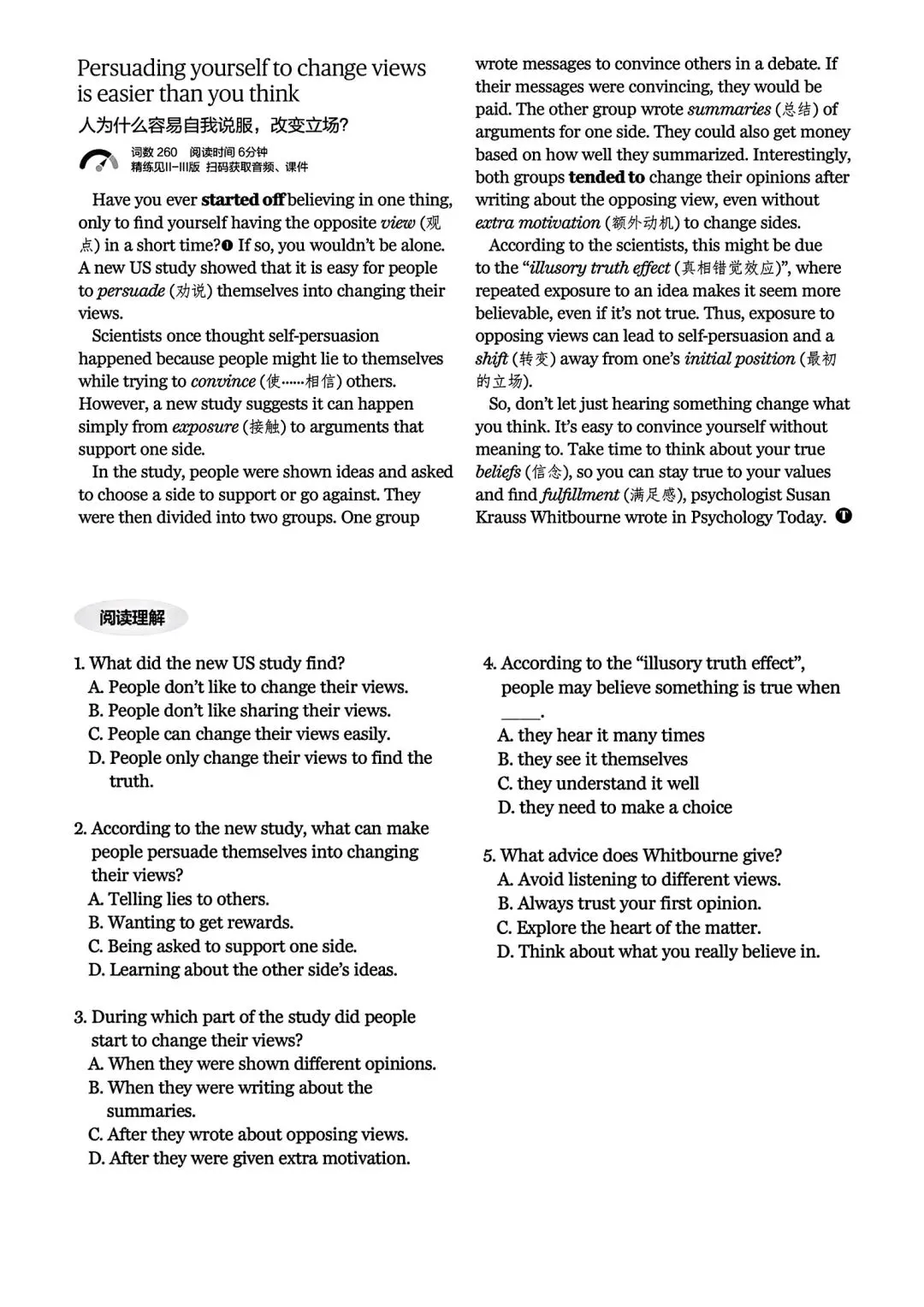
针对初三学生的阅读文章,题型会涉及阅读理解,完型,短文填空和任务型阅读。
🌟食用指南:可以先保存图片自己完成题目,再核对答案。
开始我们的第12篇阅读☝
☑️答案:
1,C
解析:文章第一段明确指出“A new US study showed that it is easy for people to persuade (劝说) themselves into changing their views.”,与选项C对应。
2,D
解析:文章提到“exposure to opposing views can lead to self-persuasion”,即接触对立观点(了解另一方的想法)会导致自我说服,与选项D对应。
3,C
解析:第三段提到“both groups tended to change their opinions after writing about the opposing view”,说明在写下对立观点后,人们开始改变看法,与选项C对应。
4,A
解析:第四段解释“illusory truth effect”时指出“repeated exposure to an idea makes it seem more believable”,即反复接触(多次听到)某个观点会让人觉得它更可信,与选项A对应。
5,D
解析:最后一段引用Whitbourne的建议:“Take time to think about what your true beliefs (信念) are”,即花时间思考你真正相信的东西,与选项D对应。
✅译文
第一段:你是否曾经一开始相信某件事,却在短时间内发现自己持有相反的观点?如果是这样,你并不孤单。美国一项新的研究表明,人们很容易说服自己改变观点。
第二段:科学家曾经认为,自我说服的发生是因为人们在试图说服他人时可能会对自己撒谎。然而,一项新的研究表明,这可能仅仅是因为接触到支持某一方的论点。
第三段:在这项研究中,人们被展示了一些观点,并被要求选择支持或反对某一方。然后他们被分成两组。一组人写信息在辩论中说服他人。如果他们的信息有说服力,就会得到报酬。另一组人写支持某一方的论点总结,他们也可以根据总结的好坏获得报酬。有趣的是,两组人在写下对立观点后,都倾向于改变自己的观点,即使没有额外的动机去改变立场。
第四段:科学家表示,这可能是由于“真相错觉效应”,即反复接触某个观点会让它看起来更可信,即使它不是真的。因此,接触对立观点可能会导致自我说服,并使人们从最初的立场转变。
第五段:所以,不要只让听到的东西改变你的想法。在没有意义的情况下说服自己是很容易的。心理学家苏珊·克劳斯·惠特伯恩在《今日心理学》中写道,花时间思考你真正的信念,这样你就能忠于自己的价值观,并找到满足感。
✅知识点
一、核心单词(按出现顺序)1. persuade /pəˈsweɪd/ (v.) 说服,劝说
2. view /vjuː/ (n.) 观点,看法
3. opposite /ˈɒpəzɪt/ (adj.) 相反的,对立的
4. convince /kənˈvɪns/ (v.) 使确信,使信服
5. exposure /ɪkˈspəʊʒə(r)/ (n.) 接触,暴露
6. support /səˈpɔːt/ (v./n.) 支持,拥护
7. debate /dɪˈbeɪt/ (n./v.) 辩论,争论
8. convincing /kənˈvɪnsɪŋ/ (adj.) 有说服力的,令人信服的
9. summary /ˈsʌməri/ (n.) 总结,概要
10. motivation /ˌməʊtɪˈveɪʃn/ (n.) 动机,动力
11. effect /ɪˈfekt/ (n.) 效果,效应
12. repeated /rɪˈpiːtɪd/ (adj.) 重复的,反复的
13. believable /bɪˈliːvəbl/ (adj.) 可信的
14. shift /ʃɪft/ (v./n.) 转变,转移
15. initial /ɪˈnɪʃl/ (adj.) 最初的,初始的
16. position /pəˈzɪʃn/ (n.) 立场,位置
17. meaning /ˈmiːnɪŋ/ (n.) 意义,含义
18. belief /bɪˈliːf/ (n.) 信念,信仰
19. value /ˈvæljuː/ (n.) 价值观,价值
20. fulfillment /fʊlˈfɪlmənt/ (n.) 满足感,成就感
二、重点短语
1. start off doing sth. 开始做某事
2. persuade sb. into doing sth. 说服某人做某事
3. lie to oneself 对自己撒谎
4. be divided into 被分成……
5. tend to do sth. 倾向于做某事
6. due to 由于,因为
7. exposure to 接触……
8. lead to 导致,通向
9. stay true to 忠于……
10. think about 思考,考虑
✅词汇短语填空练习
1. 她一开始相信这个计划,但后来改变了主意。
She __________ believing in the plan, but later changed her mind.
2. 反复接触这个想法让它看起来更可信。
__________ the idea makes it seem more __________.
3. 这项研究表明,人们很容易说服自己改变观点。
The study shows that it's easy for people to __________ themselves __________ their __________.
4. 我们被分成两组来讨论这个问题。
We __________ two groups to __________ the problem.
5. 他的论点很有说服力,所以我们都被说服了。
His argument was so __________ that we were all __________.
6. 由于“真相错觉效应”,人们可能会相信不真实的事情。
__________ the “illusory truth __________”, people may believe things that are not true.
7. 写下对立的观点后,他们倾向于改变自己的立场。
After writing about the __________ view, they __________ change their __________.
8. 花时间思考你真正的信念,这样你才能忠于自己的价值观。
Take time to __________ what your true __________ are, so you can __________ your __________.
9. 了解另一方的想法会导致自我说服。
__________ the other side's ideas can __________ self-persuasion.
10. 不要对自己撒谎,要忠于自己的内心。
Don't __________, and __________ your heart.
参考答案
1. started off
2. Repeated exposure to; believable
3. persuade; into changing; views
4. were divided into; debate
5. convincing; convinced
6. Due to; effect
7. opposite; tend to; position
8. think about; beliefs; stay true to; values
9. Exposure to; lead to
10. lie to yourself; stay true to
✅同义句改写练习
1. At first, I didn't like this movie, but now I think it's great.
→ I __________ not liking this movie, but now I think it's great.
2. He made me believe that he was telling the truth.
→ He __________ me that he was telling the truth.
3. The class was split into three small groups.
→ The class __________ three small groups.
4. People usually get nervous before exams.
→ People __________ get nervous before exams.
5. Because of the heavy rain, we had to put off the sports meeting.
→ __________ the heavy rain, we had to put off the sports meeting.
6. Too much screen time can cause eye problems.
→ Too much screen time can __________ eye problems.
7. You should be faithful to your own ideas.
→ You should __________ your own ideas.
8. I need to consider my future plans carefully.
→ I need to __________ my future plans carefully.
9. The story he told was not trustworthy at all.
→ The story he told was not __________ at all.
10. She changed her opinion after hearing the new information.
→ She __________ her opinion after hearing the new information.
参考答案
1. started off
2. convinced
3. was divided into
4. tend to
5. Due to
6. lead to
7. stay true to
8. think about
9. believable
10. shifted
本期阅读摘自《21世纪英文报-初三第18期》,可购买纸质版了解更多内容。
自己手写,有错误欢迎指正