

诺贝尔奖得主奥马尔·亚吉讲述他如何爱上化学
文章出自《科学美国人》(Scientific American)| 无境中高考 · 外刊阅读 | 2026 年 10 月 27 日
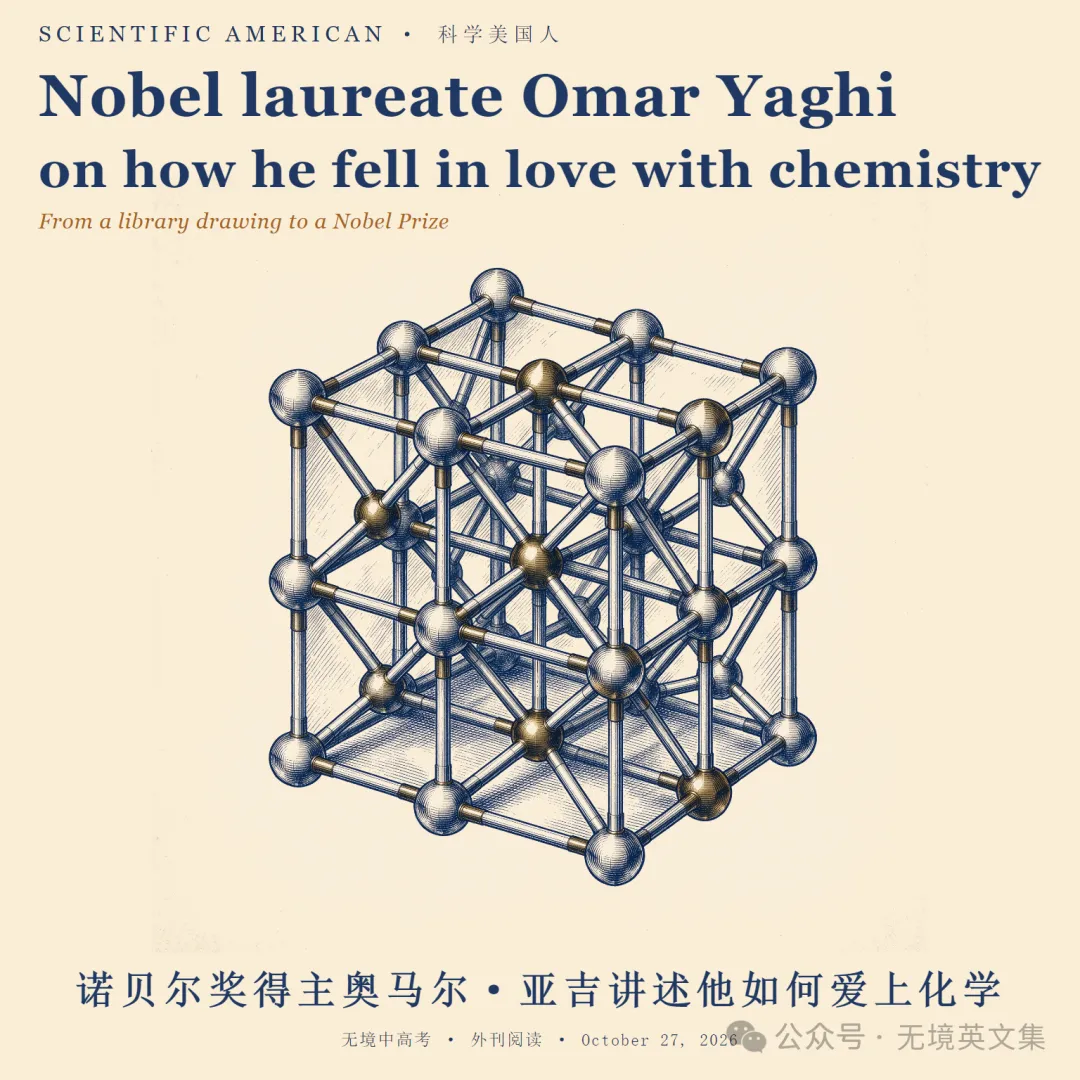
图 1 MOF-5 金属有机框架晶体结构(无境中高考 · 外刊阅读)
文章导读:从 10 岁图书馆里的分子绘图,到 2025 年诺贝尔化学奖——奥马尔·亚吉凭什么爱上化学?面对 1 亿美元高风险资助,他又为何选择「自主实验室」?
一、中考改编版全文
1. Omar Yaghi is a chemistry professor at the University of California, Berkeley. He shared the 2025 Nobel Prize in Chemistry for his early work on metal-organic frameworks (MOFs). Yaghi is also the founding director of the Berkeley Global Science Institute. The institute wants to build research centers in developing countries.
译文:奥马尔·亚吉是加州大学伯克利分校的化学教授。他因在金属有机框架(MOFs)领域的早期开创性工作,分享了2025年诺贝尔化学奖。亚吉也是伯克利全球科学研究所的创始主任,该研究所希望在发展中国家建立研究中心。
2. I think American science has always been strong because of something special: the mentoring between a scientist and the students. A mentor gives all his knowledge and experience to the students with no reservations. In this way, innovation passes from one generation to the next.
译文:我认为美国科学一直很强,是因为一件特别的事:科学家与学生之间的指导关系。导师毫无保留地把自己的知识和经验教给学生。就这样,创新一代一代传下去。
3. Good research needs money. For many years, our government gave money to scientists in a fair way. If you worked hard and did good research, you could get funding. But now the situation is not so good. The government is cutting back on grants and support. Science is becoming very expensive, and people all over the world want to know what the cost will lead to. We often forget that our best products are the young scientists who think in different ways and can solve problems nobody else can.
译文:好的研究需要钱。多年来,政府以公平的方式资助科学家。只要努力工作、做出好研究,就能得到资助。但现在情况不太乐观。政府正在削减资助和支持力度。科学正变得非常昂贵,世界各地的人们想知道这些投入会带来什么。我们常常忘记,我们最好的成果是那些用不同方式思考、能解决别人解决不了的问题的年轻科学家。
4. Scientists need to take part in the AI revolution. We need to use AI models to make them more useful, not just to save time and speed up work in the lab, but also to ask new questions. This is important for the future of science in the U.S. AI can help us modernize our labs and keep up with the speed of our society.
译文:科学家需要参与人工智能革命。我们要让AI模型发挥更大作用,不仅在实验室里节省时间、加快工作,还要提出新问题。这对美国科学的未来很重要。AI能帮助我们实现实验室现代化,跟上社会发展的速度。
5. My students and I also use AI in our lab. We make porous materials that can get water from the air, take carbon dioxide out of the air, or store hydrogen for clean energy. It used to take years to crystallize these materials, but with ChatGPT we can do it in weeks. Students using our machine-learning algorithm find twice as many new compounds. For me, this is a revolution. And my love for chemistry began in a library when I was ten years old, looking at drawings of molecules. Since then, nothing has turned me away from chemistry.
译文:我和我的学生也在实验室里使用AI。我们制造多孔材料,它们可以从空气中取水、去除二氧化碳,或储存氢气作为清洁能源。过去让这些材料结晶要花几年时间,但借助ChatGPT,我们几周就能完成。使用我们机器学习算法的学生能发现两倍多的新化合物。对我来说,这是一场革命。而我对化学的热爱始于十岁时在图书馆里看分子绘图。从那以后,没有什么能让我离开化学。
二、高考改编版全文
1. Omar Yaghi is a professor of chemistry at the University of California, Berkeley, and a joint winner of the 2025 Nobel Prize in Chemistry for his pioneering work on metal-organic frameworks (MOFs). He is also founding director of the Berkeley Global Science Institute, an organization aimed at creating research centers in developing countries. Scientific American spoke to Yaghi about the state of science today, the coming artificial-intelligence revolution, and how researchers can prepare.
译文:奥马尔·亚吉是加州大学伯克利分校的化学教授,也是2025年诺贝尔化学奖的共同获奖者,获奖原因是他在金属有机框架(MOFs)领域的开创性工作。他还是伯克利全球科学研究所的创始主任,该组织致力于在发展中国家建立研究中心。《科学美国人》就当今科学现状、即将到来的人工智能革命以及研究人员如何做好准备,采访了亚吉。
2. Yaghi believes that American science has always been strong because of the mentoring between scientists and students. The mentor passes knowledge and experience from one generation to the next with no reservations. This is how innovation gets passed on. What fuels this innovation are top thinkers and researchers who are well funded by the government. For many years, funding was very competitive: if you worked hard and did good research, you would get funding. Yet the current state is not so encouraging because agencies are cutting back on grants and support.
译文:亚吉认为,美国科学之所以一直强大,在于科学家与学生之间的指导关系。导师毫无保留地把知识和经验一代代传下去,创新就是这样传承的。为创新提供动力的是得到政府充足资助的顶尖思想家和研究人员。多年来,资助机制竞争非常公平:只要努力工作、做出好研究,就能拿到资助。然而,由于各机构正在削减资助和支持,目前的情况并不令人乐观。
3. One problem, he says, is that science is becoming very expensive to carry out, so society is demanding answers as to what this cost is leading to. We often emphasize that we have a product that could be deployed or commercialized, but we forget that our best products are young scientists who think in different ways and solve problems nobody else can. The human element—education and the ability to discover new things—is not emphasized as much as the actual product.
译文:他说,一个问题是开展科学研究的成本正变得非常高昂,因此社会要求回答这些投入究竟会带来什么。我们经常强调自己拥有一款可以投入应用、能够商业化的产品,却忘记我们最好的成果是那些以不同方式思考、能解决别人解决不了的问题的年轻科学家。人文要素——教育以及发现新事物的能力——并没有像实际产品那样受到重视。
4. What needs to change? Scientists need to engage in the artificial-intelligence revolution and make AI models more useful, not just in speeding up tasks in the laboratory but also in suggesting questions we wouldn't normally ask. That is a matter of survival of the advanced research system. It will also be revolutionary for recruitment of the best minds among young scholars, because they will go into modern labs where they don't have to slow down.
译文:需要改变什么?科学家需要投身人工智能革命,让AI模型发挥更大作用,不仅在实验室里加快任务处理,还要提出我们通常不会想到的问题。这是先进研究体系赖以生存的大事。对青年学者中顶尖人才的招募而言,这也将是革命性的,因为他们将进入无需放慢科研节奏的现代化实验室。
5. Yaghi is optimistic because a large society can always find enough young people willing to do the hard work. But he worries that we are not preparing for the AI revolution and need to reinvent how research is done. AI can speed up discoveries and carry out tasks that consume our time and resources. Yet in many labs, things proceed very slowly—there is no reason for that when society is operating at the speed of light.
译文:亚吉之所以乐观,是因为像美国这样的大型社会总能找到足够多愿意吃苦的年轻人。但他担心我们没有为人工智能革命做好准备,需要彻底革新研究的开展方式。AI可以加快发现的速度,并完成大量耗费我们时间和资源的任务。然而在许多实验室里,工作进展十分缓慢——在当今社会以光速运转的情况下,这毫无理由。
6. Asked about a eureka moment, Yaghi recalled a student in the mid-1990s who observed the formation of a beautiful crystal that looked like diamond. When taken out of its original solution, it turned into a white powder. Yaghi asked the student to analyze it without removing it from the solution. They discovered MOF-5, the compound that broke all records of porosity and started the field of MOFs. He knew they had done something significant.
译文:当被问及顿悟时刻时,亚吉回忆起上世纪90年代中期的一名学生,他观察到了一块像钻石的美丽晶体的形成过程。当它被从原溶液中取出时,变成了白色粉末。亚吉让学生不要把它从溶液中取出就进行分析。他们发现了MOF-5,这种化合物打破了所有孔隙率纪录,开创了MOFs领域。他知道他们做出了意义重大的成果。
7. In his early career, Yaghi fell in love with chemistry through molecular drawings he saw in a library when he was ten. The love came from the most humble circumstances. Today his field, reticular chemistry, builds structures from molecular building blocks: porous materials that extract water from air, remove carbon dioxide, or store hydrogen. With ChatGPT, his lab has sped up crystallization from years to weeks, and students using a machine-learning algorithm discover twice as many new compounds. The answer to how AI transformed his field, he says, is simple: it's a revolution.
译文:在职业生涯早期,亚吉通过十岁时在图书馆看到的分子绘图爱上了化学,这份热爱源自最平凡的处境。如今,他的研究领域网状化学用分子构筑单元构建结构:从空气中提取水、去除二氧化碳或储存氢气的多孔材料。借助ChatGPT,他的实验室将结晶时间从数年缩短到数周,使用机器学习算法的学生能发现两倍多的新化合物。至于AI如何改变了他的领域,他说答案很简单:这是一场革命。
三、学术原版全文
Nobel laureate Omar Yaghi on How He Fell in Love with Chemistry
译文:诺贝尔奖得主奥马尔·亚吉讲述他如何爱上化学
Omar Yaghi is a professor of chemistry at the University of California, Berkeley, and a joint winner of the 2025 Nobel Prize in Chemistry for his pioneering work on metal-organic frameworks (MOFs). Yaghi is also founding director of the Berkeley Global Science Institute, which is aimed at creating research centers in developing countries. He is co-director of the Kavli Energy NanoSciences Institute, the California Research Alliance by BASF and the Bakar Institute of Digital Materials for the Planet. Scientific American spoke to Yaghi about the state of science today, the coming artificial-intelligence revolution, and how researchers can prepare.
译文:奥马尔·亚吉是加州大学伯克利分校的化学教授,也是2025年诺贝尔化学奖的共同获奖者,获奖原因是他在金属有机框架(MOFs)领域的开创性工作。亚吉还是伯克利全球科学研究所的创始主任,该研究所致力于在发展中国家建立研究中心。他同时是卡弗里能源纳米科学研究所、巴斯夫加州研究联盟和巴卡尔地球数字材料研究所的共同主任。《科学美国人》就当今科学现状、即将到来的人工智能革命以及研究人员如何做好准备,采访了亚吉。
An edited transcript follows.
译文:以下为经过编辑的采访实录。
How would you describe the state of science in the U.S. today?
译文:你如何描述当今美国的科学现状?
I think that American science, the culture of innovation, has always been strong because of something the U.S. system has that other systems don't: the mentoring between a scientist and the students. This mentoring passes the knowledge from one generation to the next. The mentor also gives all they have, all they know, all their experiences, to the student with no reservations. This is how innovation gets passed on.
译文:我认为美国的科学,也就是创新文化,一直都很强大,是因为美国的体系拥有其他体系所没有的特质:科学家与学生之间的指导关系。这种指导将知识代代相传。导师也会把自己拥有的一切——所有知识、所有经验——毫无保留地传授给学生。创新就是这样传承下去的。
What fuels this innovation are top thinkers and researchers who are well funded by our government. For many, many years our funding was very competitive; if you worked hard and you were doing good research, you would get funding. The current state is not so encouraging because of the cutting back on grants and support of science by the very agencies that many university researchers rely on.
译文:为这项创新提供动力的是得到政府充足资助的顶尖思想家和研究人员。在很长很长的一段时间里,我们的资助机制竞争非常公平;只要你努力工作、开展优质研究,就能拿到资助。如今的情况却不太乐观,因为许多大学研究人员所依赖的那些机构正在削减科研资助和支持力度。
I think one problem is that science is becoming very expensive to carry out, so society is demanding some answers as to what this cost is leading to. And we often emphasize that "I have a product that could be deployed, that could be commercialized." We forget that our best products are these new young scientists who think in a different way, who can solve problems in ways that nobody else can. The human element of this—human education and the human ability to solve problems and to discover new things that change the world—is not as emphasized as the actual product that might result. And I think that's missing the point of why universities are there in the first place.
译文:我认为一个问题是,开展科学研究的成本正变得非常高昂,因此社会正要求得到一个答案,即这些投入究竟能带来什么结果。而且我们经常强调:“我有一款可以投入应用、能够商业化的产品。”我们忘记了,我们最出色的成果是这些能够以不同方式思考、能用其他人都无法采用的方式解决问题的年轻新科学家。这其中的人文要素——即人的教育、人类解决问题以及发现能改变世界的新事物的能力——并没有得到对最终可能产出的实际产品那般的重视。而且我认为这样就偏离了大学设立的初衷。
"I think the love for things like [science] comes from the most humble and unexceptional circumstances." —Omar Yaghi U.C. Berkeley
译文:“我认为对[科学]这类事物的热爱,源自最平凡普通的境遇。”——奥马尔·亚吉,加州大学伯克利分校
What needs to change in how research is conducted?
译文:科学研究的方式需要做出哪些改变?
Scientists need to engage in this artificial-intelligence revolution. We need to engage in these AI models to make them more useful, not just in speeding up tasks in the laboratory but also in suggesting questions that we normally wouldn't ask. That needs to happen as a matter of survival of the advanced research system in the U.S. We need to be engaged in this important AI revolution so that we can modernize our labs and be commensurate with how society is proceeding and the rate at which it's moving forward. That will be revolutionary for recruitment of the best minds among those young scholars because now they are going into a modern lab where they don't have to slow down.
译文:科学家需要投身于这场人工智能革命。我们需要参与到这些人工智能模型的开发与应用中,让它们发挥更大的作用,不仅要加快实验室的任务处理速度,还要提出我们通常想不到的研究问题。这一行动是美国先进研究体系赖以生存的必要举措。我们必须投身这场重要的人工智能革命,才能实现实验室的现代化,跟上当前社会的发展步伐和前进速度。这对于招募青年学者中的顶尖人才而言将是革命性的改变,因为他们将进入一个现代化的实验室,在这里完全无需放慢自己的科研节奏。
What gives you optimism?
译文:是什么让你感到乐观?
In a large society like the U.S., you can always find enough young people interested in doing research and stimulating their minds by doing the hard work. And not everybody has to be able to do that, just enough to form a nucleus of great thinkers who want to study and advance the frontiers. What worries me is that we are not preparing for what I think is an AI revolution. We need to reinvent how research is being done to account for the fact that AI can speed up discoveries and potentially carry out a lot of the tasks that are consuming our time and resources. In our labs, things proceed very slowly, and there is no reason for that, given that society is operating at the speed of light, whether it is trade or aviation or even [getting information more through] online resources and LLMs [large language models] than from some of their university classes.
译文:在像美国这样的大型社会中,你总能找到足够多的年轻人,他们热衷于从事研究,并通过艰苦工作来激发自己的思维。而且并非所有人都得具备这种能力,只要人数足以构成一个由有志于钻研、推动前沿领域发展的伟大思想家组成的核心群体即可。令我担忧的是,我们并没有为我所认为的人工智能革命做好准备。我们需要彻底革新现有的研究开展方式,以适配这样一个现实:人工智能能够加快科研发现的速度,还有潜力完成大量耗费我们时间和资源的任务。在我们的实验室里,各项工作进展十分缓慢,而这根本毫无理由——毕竟当今社会的运转速度快如光速,无论是贸易、航空领域,乃至人们[更多通过]在线资源和大语言模型(LLMs)获取信息,而不是从部分大学课程中获取信息的情况,都是如此。
If you were given a $100-million grant that didn't require any preliminary data or guaranteed milestones, what high-risk project would you start?
译文:如果你获得了一笔1亿美元的资助,且这笔资助不要求任何初步数据或预设必须达成的里程碑,你会启动什么高风险项目?
I would target the development of autonomous labs, where a researcher can sit at a terminal next to a box that will do the chemistry and instruct the robot on what to do, and the robot goes off and finds the conditions under which to make a new material, then characterizes the material and gives you data.
译文:我将把自主实验室的开发作为目标:在那里,研究人员可以坐在一个操作台旁的终端前,该操作台可进行化学实验,研究人员给机器人下达操作指令,机器人就会出发并找到合成新材料的条件,随后对该材料进行表征并为你提供数据。
What was a eureka moment when you realized a big idea was going to work?
译文:你意识到某个重大构想即将成功的顿悟时刻是什么时候?
I think when I was talking to one of my students back in the mid-1990s. He had observed the formation of a beautiful crystal that looked like diamond, and he had taken this crystal out of its original solution, and it turned from looking like a diamond into looking like a white powder. The student deemed this observation unimportant because it meant that whatever compound was behind this change was not interesting, and it was not stable.
译文:我想那是在20世纪90年代中期,我和我的一名学生交谈的时候。他观察到了一块看起来像钻石的美丽晶体的形成过程,然后他把这块晶体从原溶液中取了出来,它的外观就从类似钻石的样子变成了类似白色粉末的样子。这名学生认为这一观察结果并不重要,因为这意味着导致这一变化的任何化合物都没有研究价值,而且性质不稳定。
I said to the student, "Analyze it without taking it out of its original solution so that it doesn't lose its diamondlike character." When he analyzed that, we discovered that it is what we called MOF-5, the very compound that the Nobel Committee [for Chemistry] cited and the very compound that broke all records of porosity and started the field of MOFs. We looked at each other, and I knew we had done something significant.
译文:我对学生说:“不要把它从原始溶液中取出来进行分析,这样它就不会失去其类金刚石特性。”当他分析它时,我们发现它就是我们所称的MOF-5,正是[化学]诺贝尔奖委员会引用的那种化合物,也是打破所有孔隙率纪录并开创了MOFs领域的那种化合物。我们对视了一眼,我知道我们做出了一项意义重大的成果。
He was at the Nobel celebration and reminded me of what I said when we saw the structure: "This is Nobel-worthy."
译文:他当时在诺贝尔颁奖典礼现场,这让我想起了我们看到该结构时我说过的话:“这成果配得上诺贝尔奖。”
What's a favorite story from your early career?
译文:你早期职业生涯中有什么最喜欢的故事?
When I was a kid, the way I fell in love with chemistry was through chemistry drawings, molecular drawings. I didn't know they were molecules. But when I was 10 years old, I saw those drawings in a library, and I thought, "Wow, this is very interesting." I thought I had discovered drawings that nobody had seen before. So it got me interested in the drawings. And then later I learned they were molecules, and the molecules are all around us. I became really, really interested in chemistry, and nothing since has turned me away from chemistry. I think the love for things like that comes from the most humble circumstances and the most unexceptional circumstances. It was not an intellectual moment by any means. It was more like, "Oh, I see these things look strange, but something is drawing me to them." And I felt, deep down, that maybe this is a secret I can keep, as if nobody has seen them before.
译文:我小时候爱上化学的方式,是通过化学绘图,也就是分子绘图。我当时不知道那些是分子。但我10岁那年,在一家图书馆里看到了那些绘图,我当时心想:“哇,这太有意思了。”我以为自己发现了以前没人见过的绘图。所以这让我对这些绘图产生了兴趣。后来我才知道它们是分子,而分子遍布我们周围。我当时对化学产生了极其浓厚的兴趣,从那以后没有任何事能让我离开化学。我认为对这类事物的热爱,往往源自最平凡、最普通的处境。这绝不是什么理性思辨的时刻。更像是这种感觉:“哦,我发现这些东西看起来很奇怪,但有某种力量正在吸引我靠近它们。”我内心深处觉得,这或许是一个只属于我的秘密,仿佛从前从来没有人发现过它们。
In retrospect, when I think deeply about it, maybe I was looking for structure in my life. My life was chaotic. My humble home with many kids was quite chaotic, and we were not a well-to-do family. Maybe I saw that as a structure in my life, maybe something that I can think about away from the day-to-day circumstances.
译文:现在回想起来,当我深入思考这件事的时候,或许我当时是在为我的生活寻求一种条理性。我的生活当时一团乱。我那个住着很多孩子的简陋家当时非常混乱,而且我们家并不富裕。或许我把那视作我生活中的一种条理,一件能让我脱离日常琐事去思索的事物。
How has AI changed your own research?
译文:人工智能是如何改变你自己的研究的?
My field, reticular chemistry, is about making structures from molecular building blocks. We make porous materials that have applications in extracting water out of the air to make drinking water, taking carbon dioxide out of the air to make clean air, or storing hydrogen to deliver clean energy. The fact that they can be designed precisely on the atomic and molecular level makes them extremely important in customizing materials for very specific applications.
译文:我的研究领域是网状化学,它研究的是用分子构筑单元构建各类结构。我们制备多孔材料,这类材料的应用场景包括从空气中提取水以制取饮用水、从空气中去除二氧化碳以净化空气,或是储存氢气以输送清洁能源。它们可以在原子和分子层面进行精准设计这一特性,使其在为非常特定的应用定制材料时极具重要性。
Two or three years ago a colleague and a young student in my lab decided that AI would be very important in furthering the field because you can get to your answers much faster. It's easy to make these materials but not so easy to crystallize them. So we've discovered that just by using ChatGPT, we could speed up the crystallization from years to weeks. Crystallization is the ability of the building units to come together in an ordered fashion based on the conditions under which you assemble them. That's a trial-and-error process of trying to find the right conditions under which all the pores are homogeneously distributed and the material can work cohesively and repeatedly for, in the case of water harvesting, many, many years.
译文:两三年前,我实验室的一位同事和一名年轻学生认定,人工智能将在推动该领域发展方面发挥至关重要的作用,因为借助它能更快得到研究结果。制备这些材料很容易,但要让它们结晶却没那么简单。所以我们发现,仅借助ChatGPT,我们就能将原本耗时数年的结晶过程缩短至数周。结晶是指结构单元根据组装条件,以有序方式聚集在一起的特性。这是一个反复试错的过程,目的是找到合适的条件,让所有孔隙均匀分布,并且材料能够协同稳定地反复使用——以集水场景为例,材料可以稳定工作很多很多年。
Another example in my lab is that we are adapting machine-learning algorithms to a specific class of materials. Students who are using this machine-learning algorithm that has been adapted to our chemistry will discover twice as many new compounds compared with students not using it. So the answer to the question of "How did AI transform my field?": it's a revolution.
译文:我实验室里的另一个例子是,我们正在将机器学习算法应用于一类特定的材料。使用这种已经适配我们化学领域的机器学习算法的学生,与不使用它的学生相比,发现的新化合物数量是后者的两倍。所以,对于“人工智能是如何改变我的领域的?”这个问题的答案是:它是一场革命。
Shideh Ghandeharizadeh
译文:希德赫·甘德哈里扎德
四、核心词汇精选
中考核心词汇精选
innovation /ˌɪnəˈveɪʃən/ n. 创新(B1)
语境:In this way, innovation passes from one generation to the next(就这样,创新一代一代传下去)
点拨:technological innovation 技术创新;同义 invention 发明。
science /ˈsaɪəns/ n. 科学(A2)
语境:American science has always been strong because of something special(我认为美国科学一直很强,是因为一件特别的事)
点拨:science and technology 科学技术。
mentoring /ˈmentərɪŋ/ n. 指导;辅导(C1)
语境:the mentoring between a scientist and the students(科学家与学生之间的指导关系)
点拨:mentoring program 导师制项目;同义 guidance 指导。
高考核心词汇精选
support /səˈpɔːrt/ n./v. 支持;资助(B1)
语境:agencies are cutting back on grants and support(各机构正在削减资助和支持)
点拨:support of science 对科学的支持;同义 backing 支持;反义 opposition 反对。
competitive /kəmˈpetətɪv/ adj. 竞争性的;有竞争力的(B2)
语境:funding was very competitive(资助机制竞争非常公平)
点拨:competitive market 竞争激烈的市场;同义 rival 竞争的;反义 cooperative 合作的。
reinvent /ˌriːɪnˈvent/ v. 彻底改造;重新发明(C1)
语境:need to reinvent how research is done(需要彻底革新研究的开展方式)
点拨:reinvent the wheel 重复劳动;同义 reshape 重塑。
学术英语核心词汇精选
pioneering /ˌpaɪəˈnɪrɪŋ/ adj. 开创性的;先驱的(C1)
语境:his pioneering work on metal-organic frameworks (MOFs)(他在金属有机框架(MOFs)领域的开创性工作)
点拨:pioneering work 开创性工作;同义 groundbreaking 开创性的;反义 conventional 常规的。
extract /ɪkˈstrækt/ v. 提取;抽取(B2)
语境:extracting water out of the air(从空气中提取水)
点拨:extract water from 从……中提取水;同义 draw out 抽出;反义 insert 插入。
porosity /pɔːˈrɑːsəti/ n. 孔隙率;多孔性(C2)
语境:the very compound that broke all records of porosity(打破所有孔隙率纪录的化合物)
点拨:high porosity 高孔隙率。
五、长难句精选
中考长难句
Science is becoming very expensive, and people all over the world want to know what the cost will lead to.
中文:科学正变得非常昂贵,世界各地的人们想知道这些投入会带来什么。
结构:and 连接两个并列分句;what 引导宾语从句作 know 的宾语;lead to 意为“导致”。
语法:并列句 + what 引导宾语从句。
It used to take years to crystallize these materials, but with ChatGPT we can do it in weeks.
中文:过去让这些材料结晶要花几年时间,但借助 ChatGPT,我们几周就能完成。
结构:used to do 表示“过去常常”;it 作形式主语,真正主语是不定式短语 to crystallize these materials;but 表转折。
语法:形式主语 it + used to do + but 转折并列。
高考长难句
What fuels this innovation are top thinkers and researchers who are well funded by the government.
中文:为创新提供动力的是得到政府充足资助的顶尖思想家和研究人员。
结构:what 引导主语从句(What fuels this innovation);主句谓语 are 用复数呼应 thinkers and researchers;who 引导定语从句修饰 researchers。
语法:主语从句 + 主谓一致 + 定语从句。
It will also be revolutionary for recruitment of the best minds among young scholars, because they will go into modern labs where they don't have to slow down.
中文:对青年学者中顶尖人才的招募而言,这也将是革命性的,因为他们将进入无需放慢科研节奏的现代化实验室。
结构:it 指代前文“投身人工智能革命”这一行为;because 引导原因状语从句;where 引导定语从句修饰 labs。
语法:because 原因状语从句 + where 定语从句。
Yet in many labs, things proceed very slowly—there is no reason for that when society is operating at the speed of light.
中文:然而在许多实验室里,工作进展十分缓慢——在当今社会以光速运转的情况下,这毫无理由。
结构:破折号引出补充说明;when 引导时间状语从句;operate at the speed of light 意为“以光速运转”。
语法:破折号补充说明 + when 时间状语从句。
学术英语长难句
The fact that they can be designed precisely on the atomic and molecular level makes them extremely important in customizing materials for very specific applications.
中文:它们可以在原子和分子层面进行精准设计这一特性,使其在为非常特定的应用定制材料时极具重要性。
结构:that 引导同位语从句说明 fact;主句谓语 makes;介词短语 in doing sth 表“在做某事方面”。
语法:同位语从句 + 介词短语 in doing 作状语。
We need to reinvent how research is being done to account for the fact that AI can speed up discoveries and potentially carry out a lot of the tasks that are consuming our time and resources.
中文:我们需要彻底革新现有的研究开展方式,以适配这样一个现实:人工智能能够加快科研发现的速度,还有潜力完成大量耗费我们时间和资源的任务。
结构:how 引导宾语从句;不定式 to account for 表目的;that 引导同位语从句说明 fact;嵌套 that 定语从句修饰 tasks。
语法:宾语从句 + 不定式目的状语 + 同位语从句 + 定语从句。
Just by using ChatGPT, we could speed up the crystallization from years to weeks.
中文:仅借助 ChatGPT,我们就能将原本耗时数年的结晶过程缩短至数周。
结构:介词 by + 动名词短语表方式;speed up ... from ... to ... 表“从……缩短到……”;could 表过去的能力。
语法:介词 by + 动名词作方式状语。
六、本期考点速览
中考 · 细节定位题:文章明确交代亚吉 10 岁在图书馆看到分子绘图后爱上化学,考事实细节定位与时间信息识别。
模拟真题(源自本期文章):
When did Omar Yaghi first see the drawings of molecules?
A. When he was ten years old.
B. When he started university.
C. When he won the Nobel Prize.
D. When he became a professor.
参考答案:A
点拨:考查事实细节定位:原文明确给出“My love for chemistry began in a library when I was ten years old, looking at drawings of molecules.”定位 when I was ten years old 即可;B/C/D 均属文中出现的其他事实,属时间偷换干扰。
高考 · 推理判断题:原文「funding was very competitive」与「agencies are cutting back on grants」形成对比,考因果推理与干扰项识别。
模拟真题(源自本期文章):
What can be inferred about the funding of science from Paragraph 2?
A. Funding has become less available than before.
B. The government has stopped funding science.
C. Young scientists get more funding than before.
D. Funding is no longer competitive at all.
参考答案:A
点拨:考查因果推理:原文“funding was very competitive”与“the current state is not so encouraging because agencies are cutting back on grants”形成对比——过去竞争公平、现在机构削减资助。抓住转折 Yet 与因果 because,可推断资助比以前更难获得;B/D 属绝对化过度推断。
学术 · 段落主旨题:该段先定义网状化学、再列举多孔材料应用与精准设计,考段落中心句识别。
模拟真题(源自本期文章):
What is mainly discussed in the paragraph beginning with "My field, reticular chemistry, is about making structures from molecular building blocks"?
A. The applications and precise design of porous materials.
B. How ChatGPT speeds up crystallization.
C. The history of reticular chemistry.
D. Why hydrogen is stored in porous materials.
参考答案:A
点拨:考查段落主旨概括:该段先定义网状化学(用分子构筑单元构建结构),再列举多孔材料应用(取水/除碳/储氢),最后强调“可在原子和分子层面精准设计”使其在定制材料中重要。中心句在段首尾(making structures... applications... precisely designed),故选 A;B 属另一段内容,C/D 为细节以偏概全。
【继续阅读】完整内容见无境中高考知识星球外刊阅读。


