

Day 92 · 每日一练初一英语阅读理解每天一篇,轻松提分适用对象:初一学生及家长 | 难度:★★★★☆【双文本】
建议用时:8-10分钟|字数:约200词|话题:校园生活
🔥 坚持「初一英语阅读理解」每日打卡,100天拿捏初一英语阅读理解!
Reading 阅读材料/ Passage
请认真阅读上文,完成以下「初一英语阅读理解」练习题。
🎨 NOTICE
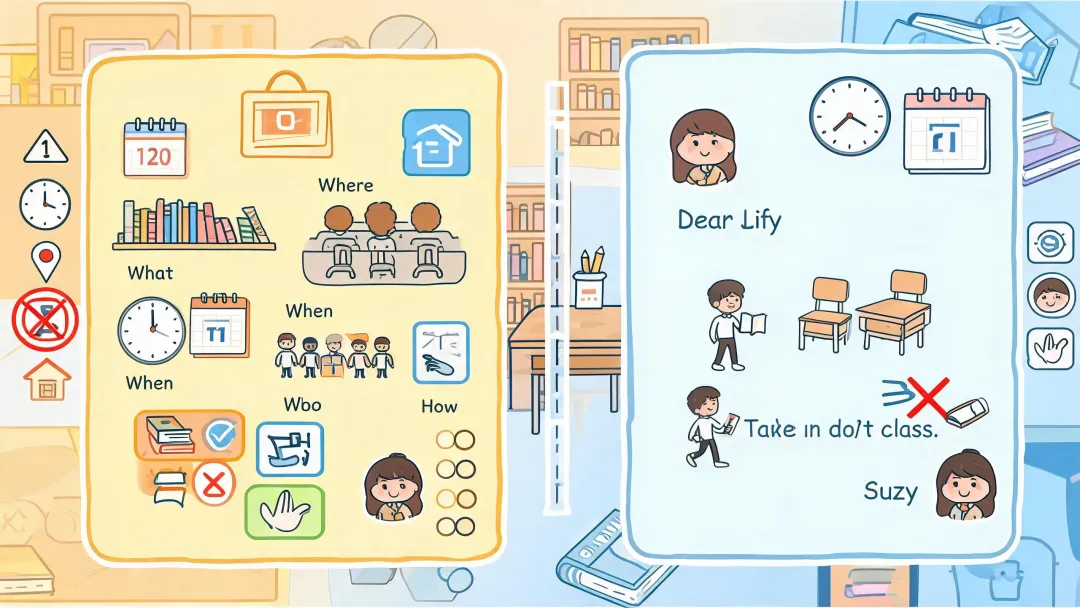
Our class is going to open a Book Corner at the back of the classroom. It will open on Monday, 27 October. Every student should bring one good book from home. Books about science, history and English stories are all welcome. Please write your name on the first page. If you have no extra book at home, you may borrow one from the school library. Opening hours: 12:30 p.m. – 1:30 p.m. every weekday. Please follow these two rules: 1. Take one book at a time and keep it clean. 2. Write your name and the date in the record book, and return the book in two weeks. Anyone who wants to help, please tell me after class. Thank you! Miss Wang Class 3, Grade 7 |
📝 第二则 · 贴在图书角旁的一张留言条
3:20 p.m., Thursday Dear Lily, Tom came to return your storybook this afternoon, but you were not here. He left it on your desk, under your pencil box. Please take it home today — don't leave it in the classroom over the weekend. Tom said the story was wonderful and he thanked you very much. He also asked me if you have any other books by the same writer. He wants to read them too. You can call him or write him a note. See you tomorrow! Suzy |
🎨 本篇高亮 = 应用文的"信息三件套": 蓝色 = 时间 / 地点信号(考场 90% 的题目都问这两个) 红色 = 要求与语气(should / Please / Don't…——命令、规定、请求全在这) 绿色 = 核心名词(看懂它,整篇在说什么就有了) |
Questions 阅读理解题/ Choose the best answer
请认真阅读上文,完成以下「初一英语阅读理解」练习题。
1Every student should ______ for the new Book Corner.细节题
A. pay five yuan to the teacher
B. bring one good book from home
C. clean the classroom every weekday
D. buy a new storybook in the bookshop
2Where did Tom leave Lily's storybook?细节题
A. In the school library
B. In his own schoolbag
C. On Lily's desk, under her pencil box
D. In the classroom Book Corner
3Why did Suzy write this note to Lily?推断题
A. Because Lily was not there when Tom returned her book
B. Because Tom lost Lily's book and felt sorry
C. Because Suzy wants to borrow books from Lily
D. Because Lily asked Suzy to buy a new storybook
4Which is usually NOT found in a NOTICE like the one above?格式题
A. The time of the activity
B. The place of the activity
C. The writer's phone number and home address
D. The name of the person or class that gives it
5"Please take it home today — don't leave it in the classroom." The sentence "don't leave it..." is a ______.语法题
A. general question(一般疑问句)
B. negative imperative(祈使句否定式)
C. exclamatory sentence(感叹句)
D. object clause(宾语从句)
Answers 答案详解/ Detailed Analysis
以下是「初一英语阅读理解」Day 92 的详细答案与解析。
✅ 先自己做,再看答案哦!
第 1 题 · 答案B细节题 📍 原文出处:"Every student should bring one good book from home." 💡 易错点:最容易误选D(去书店买)。原文说的是from home(从家里带);家里实在没有,原文给的第二方案是 "may borrow one from the school library(向校图书馆借)"——全文没要求任何人花钱买书。A、C 原文完全没提。
|
第 2 题 · 答案C细节题 📍 原文出处:"He left it on your desk, under your pencil box."(第二则便条第一段) 💡 易错点:D(图书角)是第一则通知里的地点,属于典型的"跨文本张冠李戴"——双文本阅读最常见的坑。做题时务必先确认这题问的是哪一篇。
|
第 3 题 · 答案A推断题 📍 原文出处:"Tom came to return your storybook this afternoon, but you were not here." 💡 易错点:B 说 Tom 把书弄丢了 —— 原文是left(留下),书好好在桌上,方向完全相反;C 想借书的是Tom,不是写便条的 Suzy;D 原文无依据。
|
第 4 题 · 答案C格式题 📍 依据:通知必须有的是 —— 时间(Opening hours / Monday, 27 October)、地点(at the back of the classroom)、发布者(Miss Wang, Class 3, Grade 7)。 💡 易错点:通知是对全班或全体张贴的公开信息,落款只写班级或单位(Class 3, Grade 7),绝不会附私人手机号和家庭住址——那是私人便条或广告才有的东西。
|
第 5 题 · 答案B语法题 📍 原文出处:"don't leave it in the classroom over the weekend."(Don't + 动词原形) 💡 这是 Day 88 祈使句的复习:判定标准三条 —— ① 没有主语(省略了 you);② 开头是Don't;③ 后面接动词原形 leave(不是 leaves / leaving)。通知和便条里祈使句特别多,因为它们的任务就是"告诉别人做什么、别做什么"。本篇还有 Please write... / Take one book at a time / Please take it home...
|
Grammar Focus 语法聚焦/ Simple Past Tense
本篇「初一英语阅读理解」重点考察一般过去时的运用,请同学们认真掌握。
一、通知 Notice:先认"长相",再读内容
通知是贴在公告栏、黑板或发给全体的一段正式消息。它最大的特点是:格式固定、语言精简、信息密度极高——往往一两个词就藏着一个考点。所以读通知,先抬头看格式,再低头挖细节。
📢 英文通知标准格式(四块缺一不可) ① 标题 正中间写NOTICE / Notice(全部大写最标准,一眼认出文体) ② 日期 24 October, 2026 或 October 24, 2026(写在标题下方或落款下方) ③ 正文 交代活动的 What / Where / When / Who / How,句子短,常省略主语 ④ 落款 右下角写发布者:单位或班级 + 人名(Class 3, Grade 7 / Miss Wang) |
二、通知的语言"三多"(看准这三多,细节题跑不掉)
特点 | 典型标志 | 作用 |
将来时多 | will... / is going to... | 说明还没发生的事(活动、比赛、开会) |
情态动词多 | should / must / can / may | 表示要求、允许或禁止(should=应该做的事) |
祈使句多 | Please... / Don't... / Keep... | 直接下指令、讲规则(Day 88 考点在这里复活) |
💡 读通知三步法:① 读标题定文体→ ② 读正文圈出时间、地点、要求(一个圈就是一个潜在答案)→ ③ 读落款确认谁发的(常考"这则通知写给谁")。
三、便条 Note:熟人之间的"临时交代"
便条(留言条)是写给熟人、来不及当面说时的短消息,通常贴在桌上、门上或夹在书里。它比书信随意得多:可以有称呼,但不一定有完整日期;句子很短,口语味重。核心使命只有一句——让对方知道一件事,并且知道下一步该做什么。
📝 英文留言条标准格式 ① 日期 右上角:3:20 p.m., Thursday(可省略,但写上更规范) ② 称呼 Dear Lily, / Lily,(顶格写,逗号结尾) ③ 正文 讲清"发生了什么 + 要你做什么",多含过去时 + Please / Don't ④ 署名 右下角写名字:Suzy(只写名字,不写姓) |
📌 便条三问定位法:· 谁写的?→ 看右下角署名· 写给谁的? → 看开头称呼· 要对方做什么? → 看带Please / Don't / remember to的那一句(这就是"留言的目的",也是主旨题的答案)
四、Notice vs Note 一图对比(考试最爱问区别)
对比项 | 通知 Notice | 便条 Note |
对象 | 全体 / 一个群体(不指名) | 某一个具体的人(有称呼) |
标题 | 必须有:NOTICE | 没有标题 |
落款 | 班级 / 单位(偶尔加人名) | 只写个人名字 |
语气 | 正式、客气(Thank you!) | 随意、亲切(See you!) |
时态 | 以将来时为主 | 以过去时(已发生)+ 祈使(要你做)为主 |
五、可直接套用的万能句型
🧰 写通知、写便条,照着这些句子填词就行 通知·开场 Our school / class is going to hold ... / There will be ... 通知·交待 It will be held in + 地点, on + 日期, from ... to ... 通知·要求 Everyone should / must ... / Please bring ... / Don't forget to ... 通知·收尾 Anyone who wants to join, please ... / Thank you! 便条·开场 I came to see you, but you were not here. / I'm sorry I missed you. 便条·请求 Please take it home. / Don't forget to call me back. 便条·收尾 See you tomorrow! / Best, Suzy |
六、通知 / 便条必考三大题型
题型 | 标志问法 | 破题方法 |
信息查找题 | When / Where / What time / Who gives the notice? | 带着疑问词回原文扫关键词,数字和星期最显眼 |
规则判断题 | What must students do? Which is TRUE? | 只找should / must / Please / Don't所在句,逐条对照 |
目的主旨题 | Why did he write it? The note is to ______. | 便条看Please/Don't 那句;通知看首段第一句 |
七、易错警示牌
1. ✗通知里写 "Dear students" → ✓通知不需要称呼,称呼是书信和便条的专利。 2. ✗混淆"借入借出" → ✓borrow = 借进(borrow...from),lend = 借出(lend...to),return = 归还。 3. ✗通知用过去时写活动 → ✓通知讲的是还没发生的事,用will / be going to。 4. ✗看到 Please / Don't 当普通陈述句读 → ✓那是祈使句,且后面必须跟动词原形。 5. ✗双文本题不看出处随手选 → ✓先给每篇编号标记,再回对应篇目找。 |
八、通关自测(答案在最后)
① Please ______ quiet in the library. (keep / keeps / keeping) ② There will ______ a sports meeting next Friday. (have / be / is) ③ The notice ______ by Class 3, Grade 7. (gives / is given / gave) ④ I ______ ask Tom to call you back. (will going to / am going / will) ⑤ Don't ______ to bring your book tomorrow. (forget / forgets / forgetting) |
答案与解析:
① keep—— Please 后接动词原形(祈使句)。
② be—— There will be(there be 的将来时,will 后必须用原形be,不能用have)。
③ is given —— 通知"被发布",用被动语态。
④ will—— will 后直接接原形ask;will going to 是经典错形。
⑤ forget—— Don't 后必须接动词原形。
九、记忆口诀
📌 通知便条四句诀: 通知抬头写 NOTICE,时间地点含其中; 将来说事情态提要求,班级单位来落款; 便条开头有称呼,右下署名是朋友; Please 与 Don't表托付,看懂这句答主旨。 |
Vocabulary 核心词汇/ Key Words
📌 今日必背词汇
notice /ˈnəʊtɪs/ n. 通知;布告 There is a notice on the blackboard. 黑板上有一则通知。 | borrow /ˈbɒrəʊ/ v. 借入(borrow...from) You may borrow one from the library. 你可以从图书馆借一本。 |
return /rɪˈtɜːn/ v. 归还;回来 Please return the book in two weeks. 请在两周内归还这本书。 | record /ˈrekɔːd/ n. 记录;记载 Write your name in the record book. 把你的名字写在登记簿上。 |
weekday /ˈwiːkdeɪ/ n. 工作日(周一至周五) It opens at noon every weekday. 每个工作日的中午开放。 | extra /ˈekstrə/ adj. 额外的;多余的 Do you have an extra pen? 你有多余的笔吗? |
Parent Tips 家长辅导指南/ For Parents
本栏目为家长提供「初一英语阅读理解」家庭辅导建议,帮助孩子高效学习。
1. 今天玩"贴公告"游戏:用一张 A4 纸,和孩子一起写一则真实的家庭通知——比如"本周六下午 3 点家庭电影之夜,地点客厅,每人带一个靠垫"。要求严格按格式:标题NOTICE + 日期+ 正文+ 落款,贴在冰箱门上。写一次,格式就记牢了。
2. 用留言条替代口头传达:今晚如果家里有人先睡、出门买菜或加班,用英文写一张便条留在桌上(Mum, I went to the shop. Please take the chicken out of the fridge. — Tom)。让英语从练习册里走出来,成为"家里真的用得上的工具"。
3. 带孩子认身边的英文应用文:小区电梯里的维保通知、电梯里的停水公告、绘本版权页上的出版信息、饮料瓶上的保质期。看到就问一句"What does it say?" —— 最后 10 天,把"阅读"的定义扩大,是性价比最高的练习。
4. 重点纠 borrow / lend / return 三兄弟:这三个词在初一试卷里几乎年年出现,孩子最容易混。用中文类比讲最快:borrow = 借进(向别人借)、lend = 借出(借给别人)、return = 还回去。今晚用家里的书演练三遍,比背表格有效。
Progress 每日打卡/ Daily Check-in
今天是「初一英语阅读理解每日一练」第 92 天
进入第二阶段 难度上升
坚持 100 天,阅读理解不再是弱项
📌 明天预告Day 93:海报与广告类 · 一般过去时 vs 一般现在时对比每天中午11:00 准时推送,记得来看!持续练习「初一英语阅读理解」,每天进步一点点!
下载完整版看这里👇
后台回复「初一英语阅读每日一练」即可领取完整版资料


