

People are talking a lot about artificial intelligence (AI), viewing it as a force that could reshape how society works. But there is something important missing from this discussion. It isn’t enough to ask how it will change us. We also need to understand how we shape AI and what it can tell us about ourselves.
Every AI model we develop mirrors our rules and expresses our beliefs. A few years ago, while looking for new workers, a famous company gave up an AI‑powered tool after finding it unfavorable to women. The AI was not designed to behave this way, instead, it was influenced by the historical data (数据) favoring men. Similarly, a recent study found that lending algorithms (算法) often offer less favorable terms to colored people, worsening long‑standing unfairness in money‑lending business. In both cases, AI isn’t creating new biases (偏见), it is mirroring the ones that are already present.
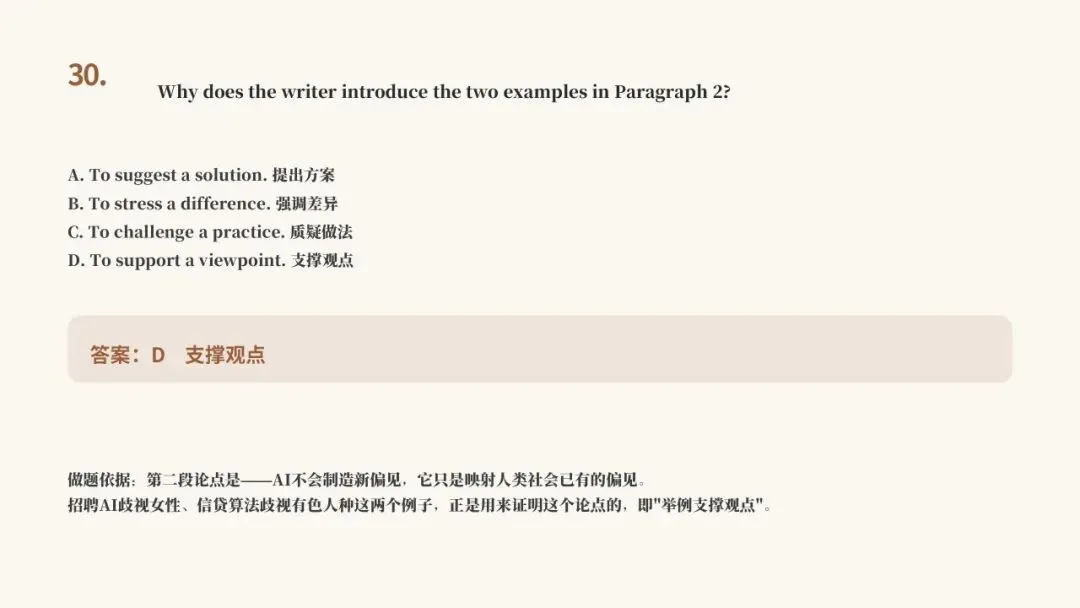
These reflections (反映) give us an important chance to take a close look at ourselves. By making these problems seen and more pressing, AI challenges us to recognize and address what causes algorithmic bias. As AI continues to develop, we must ask ourselves how we as average people want to shape its role in society. We should not only improve AI models, but also make sure that AI is developed and used responsibly.
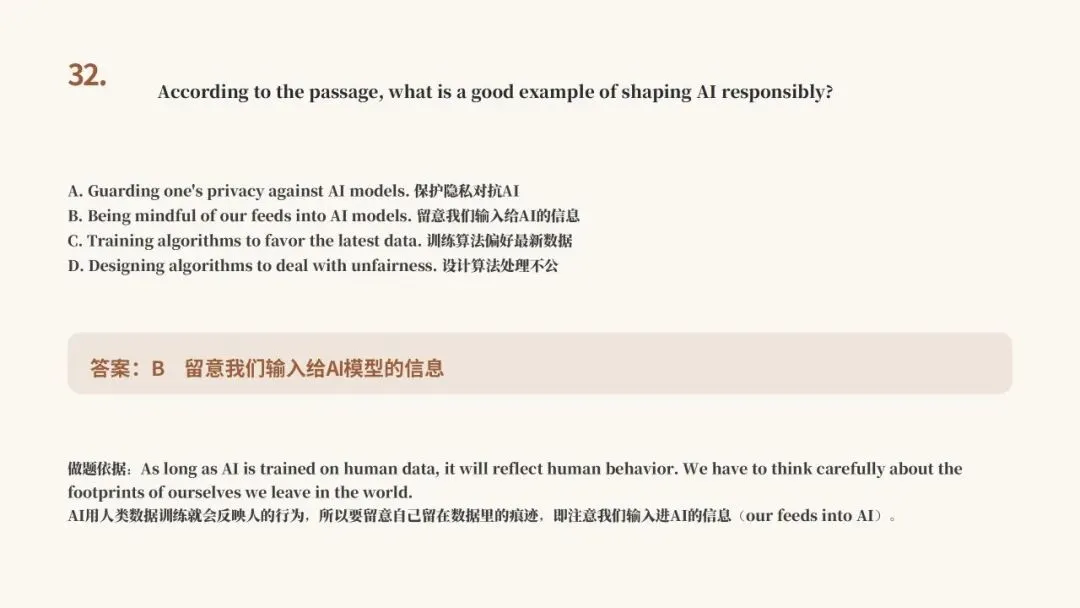
A number of companies are already taking action. They are judging the data, rules, and beliefs that shape the behavior of AI models. Still, we cannot expect the companies to do all the work. As long as AI is trained on human data, it will reflect human behavior. That means we have to think carefully about the footprints of ourselves we leave in the world. I may value privacy, but if I give it up in a heartbeat to visit a website, the algorithms may make a very different judgment of what I really want and what is good for me. If I want meaningful human connections yet spend more time on social media and less time in the physical company of my friends, I am indirectly training AI models about the true nature of humanity.
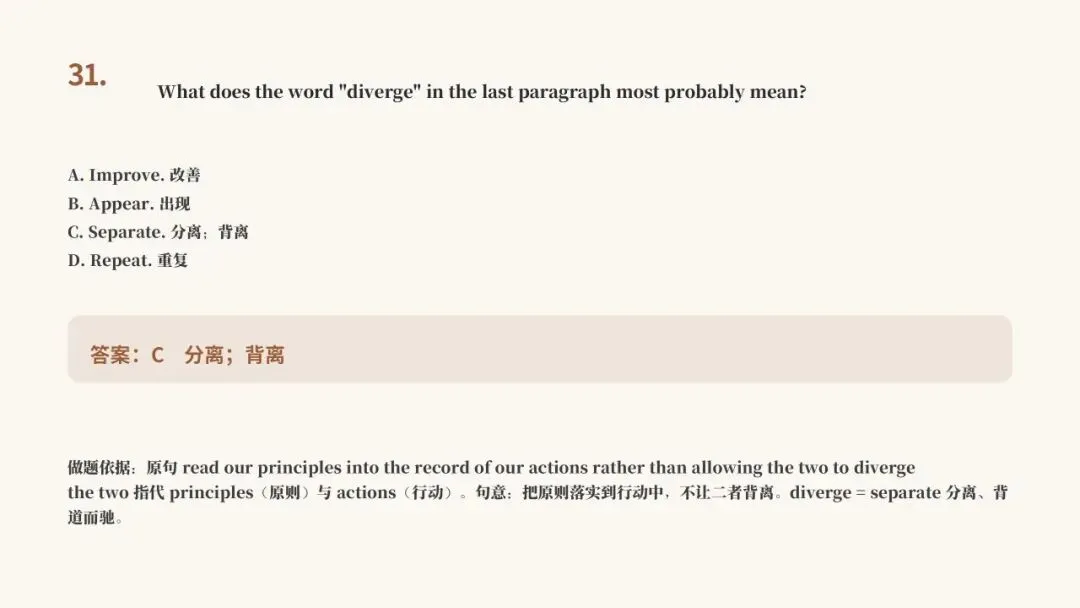
As AI becomes more powerful, we need to take increasing care to read our principles (原则) into the record of our actions rather than allowing the two to diverge. Recognizing this allows us to make better decisions, but only when we are prepared to look closely and take responsibility for what we see.
30. Why does the writer introduce the two examples in Paragraph 2?
A. To suggest a solution. B. To stress a difference.
C. To challenge a practice. D. To support a viewpoint.
31. What does the word “diverge” in the last paragraph most probably mean?
A. Improve. B. Appear. C. Separate. D. Repeat.
32. According to the passage, what is a good example of shaping AI responsibility?
A. Guarding one’s privacy against AI models.
B. Being mindful of our feeds into AI models.
C. Training algorithms to favor the latest data.
D. Designing algorithms to deal with unfairness.
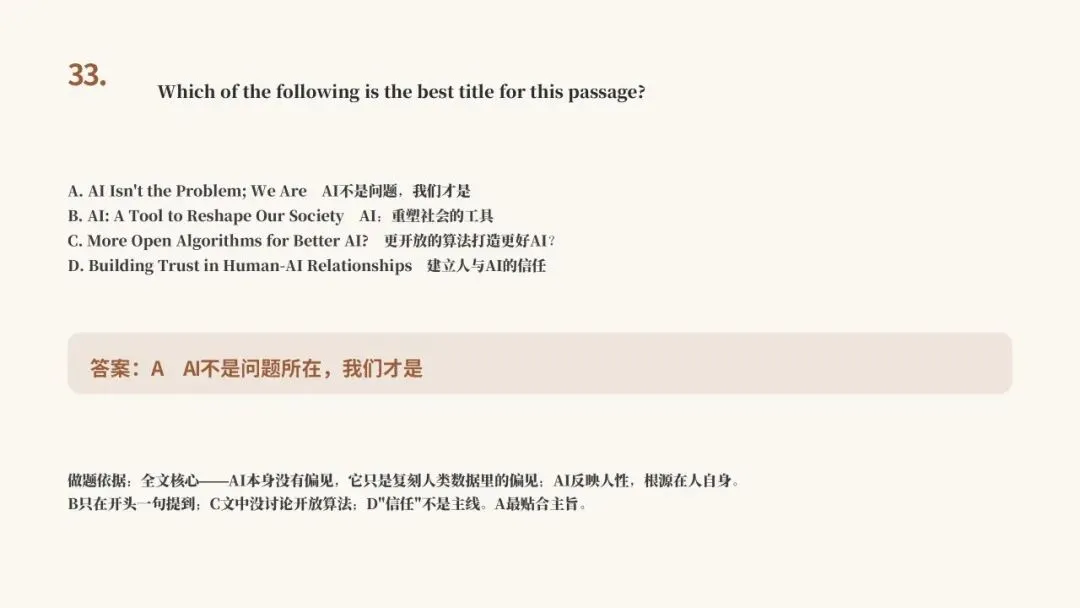
33. Which of the following is the best title for this passage?
A. AI Isn’t the Problem; We Are
B. AI: A Tool to Reshape Our Society
C. More Open algorithms for Better AI?
D. Building Trust in Human‑AI Relationships
【译文】
人们一直在热烈讨论人工智能(AI),将它视为一股可能重塑社会运行方式的力量。但这场讨论忽略了一件重要的事。只问人工智能会如何改变我们,这远远不够。我们同样需要理解,人类如何塑造人工智能,以及人工智能能让我们看到自身的哪些特质。
我们开发的每一个人工智能模型,都映射着人类制定的规则,承载着人类的观念。几年前,一家知名企业在招聘时使用一款人工智能工具,后来却放弃了它,因为发现该工具对女性存在偏见。这款人工智能并不是被刻意设计成这样,而是受到了过往偏向男性的历史数据影响。同样,近期一项研究发现,信贷算法往往会给有色人种提供更不利的贷款条件,加剧借贷行业长期存在的不公现象。这两个案例中,人工智能并没有制造出新的偏见,它只是映射出那些本就存在于人类社会中的偏见。
这些映射,为我们提供了审视自我的重要机会。人工智能让这类问题暴露出来、变得更加紧迫,促使我们去认识并解决算法偏见背后的根源。随着人工智能持续发展,我们普通人必须思考,我们希望它在社会中扮演什么样的角色。我们不仅要优化人工智能模型,还要确保人工智能的研发与使用合乎责任。
不少企业已经开始采取行动。他们会评估影响人工智能模型行为的数据、规则与价值观念。但我们不能指望企业独自完成所有工作。只要人工智能是基于人类数据训练的,它就会反映人类的行为。这意味着,我们必须慎重思考自己留在世间的种种行为痕迹。我或许看重隐私,但如果为了访问一个网站就轻易放弃隐私,算法对我的真实诉求和最佳利益就会做出截然不同的判断。如果我渴望有意义的人际交往,却把更多时间花在社交媒体上,很少和朋友线下相聚,那我其实就在间接训练人工智能,让它学习理解人性的真实面貌。
随着人工智能的能力越来越强,我们需要更加用心,把我们的行为原则落实到日常行动记录之中,而不是让原则和实际行动背道而驰。认识到这一点,我们才能做出更好的抉择,但前提是我们愿意仔细审视,并为所见的一切承担责任。
参考答案。
1. artificial /ˌɑːtɪˈfɪʃl/ adj. 人造的;人工的
2. reshape /ˌriːˈʃeɪp/ v. 重塑;改变
3. mirror /ˈmɪrə(r)/ v. 反映;映射
4. unfavorable /ʌnˈfeɪvərəbl/ adj. 不利的;不赞同的
5. historical /hɪˈstɒrɪkl/ adj. 历史的
6. algorithm /ˈælɡərɪðəm/ n. 算法
7. colored /ˈkʌləd/ adj. 有色人种的;带颜色的
8. worsen /ˈwɜːsn/ v. 恶化;加剧
9. long-standing /ˌlɒŋˈstændɪŋ/ adj. 长期存在的;由来已久的
10. unfairness /ˌʌnˈfeənəs/ n. 不公;不公平
11. bias /ˈbaɪəs/ n. 偏见
12. reflection /rɪˈflekʃn/ n. 反映;映射
13. pressing /ˈpresɪŋ/ adj. 紧迫的;急迫的
14. address /əˈdres/ v. 解决;处理;应对
15. responsible /rɪˈspɒnsəbl/ adj. 负责任的
16. judge /dʒʌdʒ/ v. 评估;判断
17. reflect /rɪˈflekt/ v. 反映;折射
18. footprint /ˈfʊtprɪnt/ n. 足迹;痕迹
19. privacy /ˈprɪvəsi/ n. 隐私
20. judgment /ˈdʒʌdʒmənt/ n. 判断;评判
21. meaningful /ˈmiːnɪŋfl/ adj. 有意义的
22. humanity /hjuːˈmænəti/ n. 人性;人类
23. physical /ˈfɪzɪkl/ adj. 现实的;身体的
24. indirectly /ˌɪndəˈrektli/ adv. 间接地
25. diverge /daɪˈvɜːdʒ/ v. 偏离;分叉
26. recognize /ˈrekəɡnaɪz/ v. 认识到;认出
27. principle /ˈprɪnsəpl/ n. 原则;准则
(二)词组
1. artificial intelligence (AI) 人工智能
2. AI‑powered tool 人工智能驱动的工具
3. historical data 历史数据
4. lending algorithm 信贷算法
5. colored people 有色人种
6. long‑standing unfairness 长期存在的不公
7. money‑lending business 借贷行业
8. algorithmic bias 算法偏见
9. take action 采取行动
10. shape the behavior 塑造行为
11. in a heartbeat 一瞬间;毫不犹豫地;轻易地
12. meaningful human connections 有意义的人际联系/交往
13. physical company 现实陪伴;线下相聚
14. the true nature of humanity 人性的真实面貌
15. read … into … 把……落实到……之中
16. take responsibility for 对……负责
17. give up 放弃
18. look closely 仔细审视;仔细观察


