CET4听力真题3|性别差异的社科类篇章
今天我们来精析 2026 年 6 月四级听力 Passage Three,这篇围绕男女家务分工、性别差异研究展开,是四级听力高频的社科类篇章,这类文章喜欢考观点对比、研究发现、注意事项,一起来拆解!Questions 22 to 25 are based on the passage you have just heard.22. A) By attributing them to current cultural influences. B) By attributing them to conservative thinking. C) In terms of new genetic findings. D) In terms of personal preferences.23. A) Sharing with women the chores they see necessary. B) Dividing housework that is demanding for women. C) Performing household tasks that they enjoy. D) Doing tasks that are physically challenging.
24. A) The large within-group differences.
B) The great similarities across groups.
C) The researchers’ subjective biases.
D) The noticeable overgeneralizations.
25. A) They seem to be universal.
B) They impact people’s whole life.
C) They shape one’s role in society.
D) They appear at an early age.
Script
Women continue to spend more time than men taking care of children and doing chores around the house. This is generally attributed to backward thinking and conservative values, but new research shows that such differences could be linked to differences in the preferences of males and females. The new study looked at how women and men were dividing work at home and why they divided it that way.
In general, both men and women took more responsibility for tasks they liked. For example, men liked yard care and home maintenance more than women. They tended toward taking primary responsibility for such tasks. The researchers found differences in employment of household and childcare tasks matched men and women’s preferences. The researchers added that this was not a single task kitchen table like most had known. Keep in mind, however, that as with any research on group differences, there were large within-group differences. The study’s authors concluded that differences in men’s and women’s time spent on household and household tasks do not mean misclassification. The authors noted that previous research revealed gender differences in attitudes toward family and career. These differences appear as early as six years old: girls that age already show more interest in helping and caring for others than boys do, and they exhibit a clearer orientation toward family versus career.
题干 & 选项高频词
- attribute /əˈtrɪbjuːt/ v. 把… 归因于 搭配:attribute A to B 把 A 归因于 B
e.g.:People attribute the difference to conservative thinking.2. conservative /kənˈsɜːvətɪv/ adj. 保守的;守旧的 e.g.:conservative values 保守观念3. preference /ˈprefrəns/ n. 偏好,喜好 e.g.:personal preferences 个人喜好4. reveal /rɪˈviːl/ v. 揭示,显示;透露 e.g.:The research reveals gender differences.5. gender /ˈdʒendə(r)/ n. 性别 搭配:gender differences 性别差异6. housework /ˈhaʊswɜːk/ n. 家务劳动7. chore /tʃɔː(r)/ n. 家务杂事;琐事(常用复数 chores) e.g.:doing chores around the house 做家务8. maintenance /ˈmeɪntənəns/ n. 维护,保养 搭配:home maintenance 房屋维护9. within-group /wɪˈðɪn ɡruːp/ adj. 群体内部的 e.g.:large within-group differences 巨大的群体内部差异10. subjective /səbˈdʒektɪv/ adj.主观的 subjective biases 主观偏见11. overgeneralization /ˌəʊvəˌdʒenrəlaɪˈzeɪʃn/ n. 过度概括12. universal /ˌjuːnɪˈvɜːsl/ adj.普遍的,全体的13. orientation /ˌɔːriənˈteɪʃn/ n.倾向,定位;方向 e.g.:orientation toward family 对家庭的倾向14. orientation /ˌɔːriənˈteɪʃn/ n.(岗前,学前,任职前的)迎新会,培训,训练 听力原文信号词(听力提分关键,听到就要警觉)
- generally /ˈdʒenrəli/ adv.
- previous /ˈpriːviəs/ adj. 先前的,以往的(previous research 以往研究,区分新旧研究)
- however /haʊˈevə(r)/ adv.
- keep in mind
- for example 例如(举例,例子本身一般不是答案,例子前面的主旨句才是重点)
短语固定搭配(听力填空、阅读都能用)
- be attributed to 归因于(听力原句核心短语,四级超级高频)
- take responsibility for… 承担…… 的责任
- match one’s preferences 符合某人的偏好
- in terms of… 在…… 方面;就…… 而言(22 题选项短语)
✅背诵小建议
听力单词不要只看拼写,点开音频跟读,做到听到发音立刻反应中文意思。
逐题精讲
22. How do people generally account for differences between men and women in the amount of time spent on housework?
✅答案:B) By attributing them to conservative thinking.👉题干:人们通常如何解释男女做家务时长的差异?定位句:This is generally attributed to backward thinking and conservative valuesbe attributed to 归因于;conservative values/thinking 保守观念。💡考点:generally 代表大众旧观点,注意区分【大众普遍看法】vs【新研究结论】,这是听力高频坑!干扰项:A 当前文化影响,原文没有;C 新基因发现,无中生有;D 个人偏好,这是新研究的结论,不是人们普遍的看法,张冠李戴。23. What did men tend toward doing according to the new study?✅答案:C) Performing household tasks that they enjoy.👉题干:根据这项新研究,男性倾向于做什么?定位句:In general, both men and women took more responsibility for tasks they liked.男女共性:愿意承担自己喜欢的家务。举例男性更喜欢庭院、房屋维护这类家务。💡考点:抓住主旨句,例子用来支撑观点,不要被例子细节带偏。干扰项:A 和女性分担她们认为必要的家务;B 分担女性繁重家务;D 做体力有挑战的家务。原文只是举例男性喜欢庭院维护,不等于只做重活,过度推断。24. What should we keep in mind as regards any research on group differences?✅答案:A) The large within-group differences.👉题干:针对任何有关群体差异的研究,我们应该记住什么?定位句:Keep in mind, however, that as with any research on group differences, there were large within-group differences.within-group differences 群体内部差异。💡考点:keep in mind 听力信号词,后面大概率是考点;however转折,重点必听!干扰项:B 群体之间高度相似;C 研究者主观偏见;D 明显的过度概括,原文均未提及。25. What did previous research reveal about gender differences in attitudes toward family and career?✅答案:D) They appear at an early age.👉题干:以往的研究揭示了对待家庭和事业态度的性别差异有什么特点?定位句:previous research revealed gender differences in attitudes toward family and career. These differences appear as early as six years old.早在六岁就出现,也就是在幼年就显现。💡考点:previous research 又是观点切换词,区分【新研究】【过往研究】,听力最爱考不同研究的不同结论。干扰项:A 似乎具有普遍性;B 影响人的一生;C 塑造社会角色,原文没有提到。
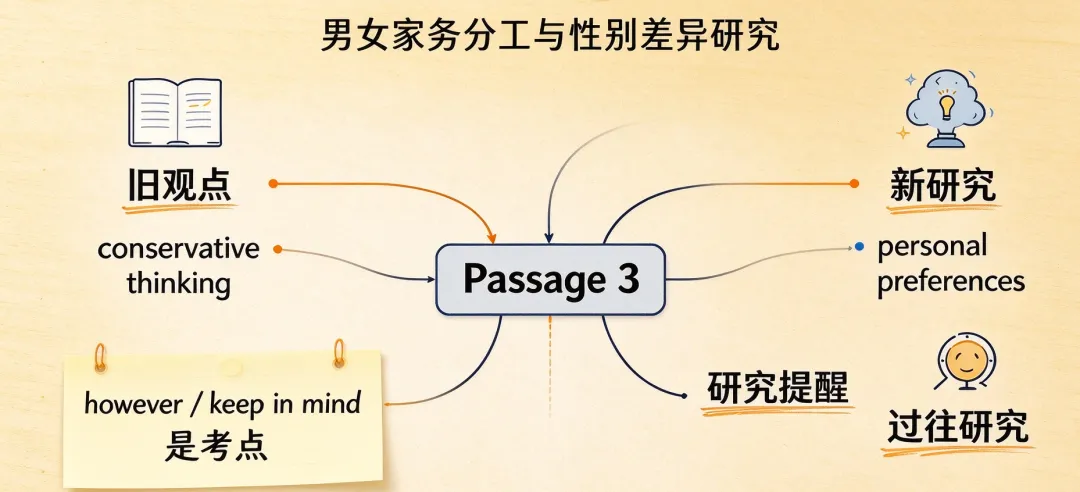
听力社科篇章经常出现:人们普遍看法 / 新研究 / 过去研究。读题时注意标记 generally / new study / previous research,防止选项张冠李戴!转折、keep in mind强调、for example举例,例子是辅助,例子前面的主旨句才是答案。
💬备考小贴士
这篇属于四级听力很典型的社科说明文,语速平稳,难点在于观点多,容易混淆新旧结论。
平时精听练习:听到 research / study 立刻做笔记,分清是谁的观点,就能避开大部分陷阱!
版权声明:本文内容由互联网用户自发贡献,该文观点仅代表作者本人。本站仅提供信息存储空间服务,不拥有所有权,不承担相关法律责任。如发现本站有涉嫌抄袭侵权/违法违规的内容, 请发送邮件至23467321@qq.com举报,一经查实,本站将立刻删除;如已特别标注为本站原创文章的,转载时请以链接形式注明文章出处,谢谢!