

聊到"时间与空间",你是不是想先背一波"高级词":**distance、location、century、temporary、permanent**?
这次我把近五年 **181 篇高考真题**(约 4.7 万词)全部扫了一遍,结果挺反直觉:
> **distance 只有 3 次,location 只有 5 次,century 11 次;**
> **temporary、permanent、delay、postpone 这些"高级时间词",全语料各只有 2 次。**
那是不是 through、across、after、now 这些最高频?它们确实篇篇都在——但它们是**介词和副词,是连接句子的"时空骨架"**,高考放在语法填空的虚词位去考,而不是当"话题词"让你背。
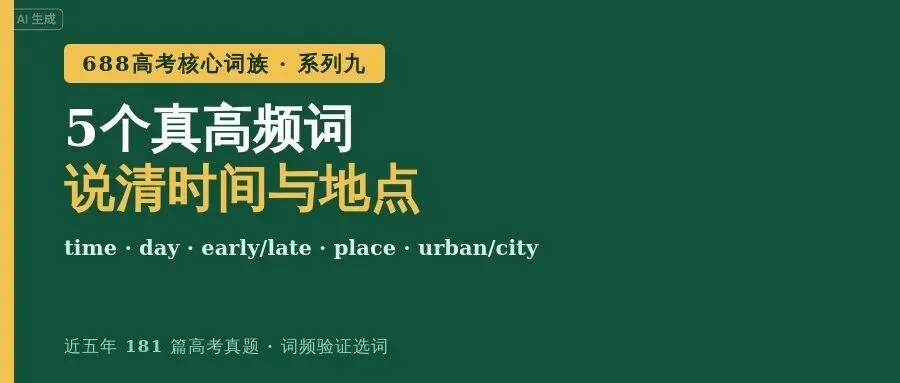
真正撑起时空话题的,是五个看着特别朴素的词族——
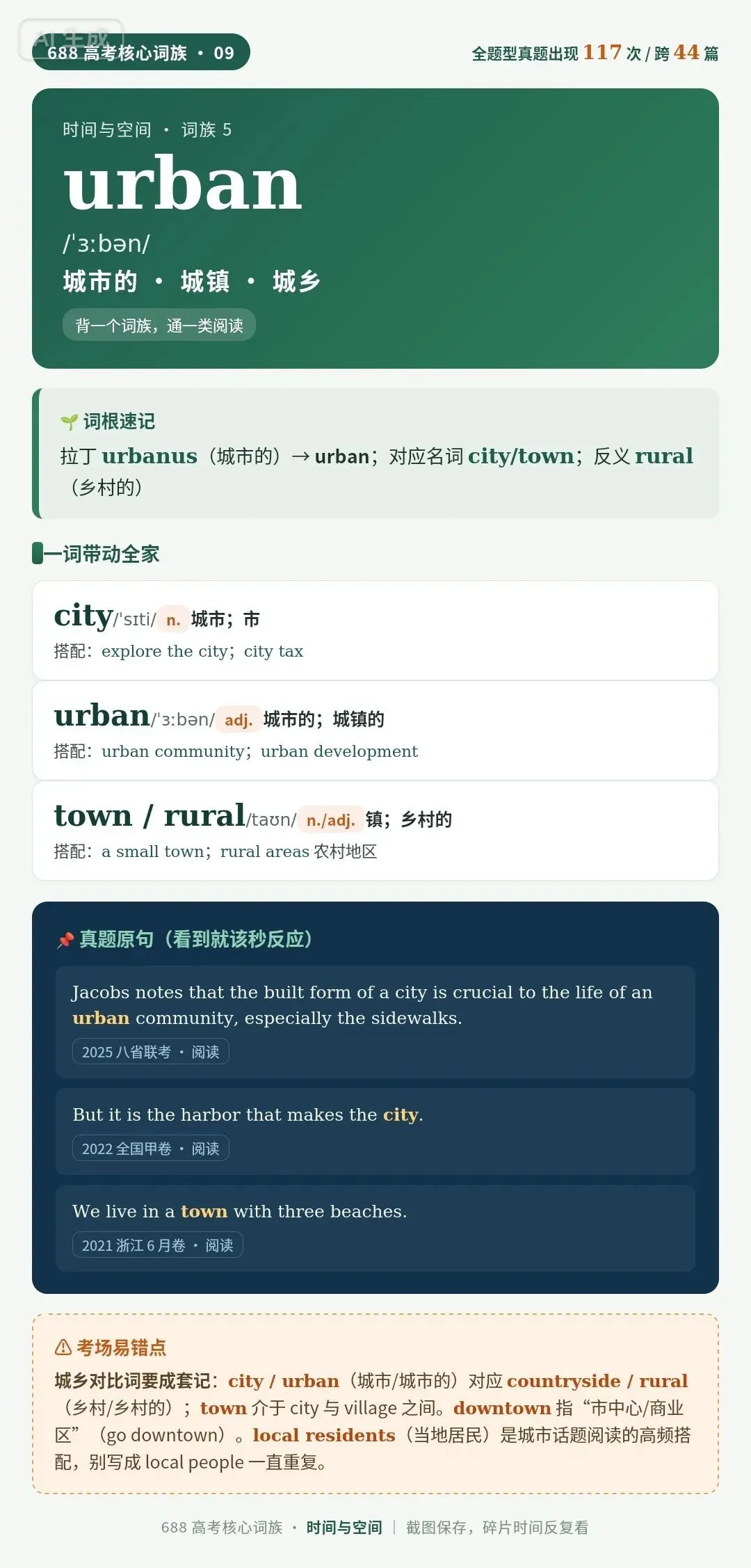
**time、day、early/late、place、urban/city。**
记住一句话:**高考写时空,不考你会不会用大词,考你能不能把"什么时候、在哪儿、前后怎么变"说清楚。**
今天我们就把这 5 个词族一次拿下,每个都配**词根速记、一词全家、真题原句、易错点**,最后还有时空话题专属练习和作文模板。
建议先**收藏**起来背,也欢迎**转发**给一起备考的同学。
---
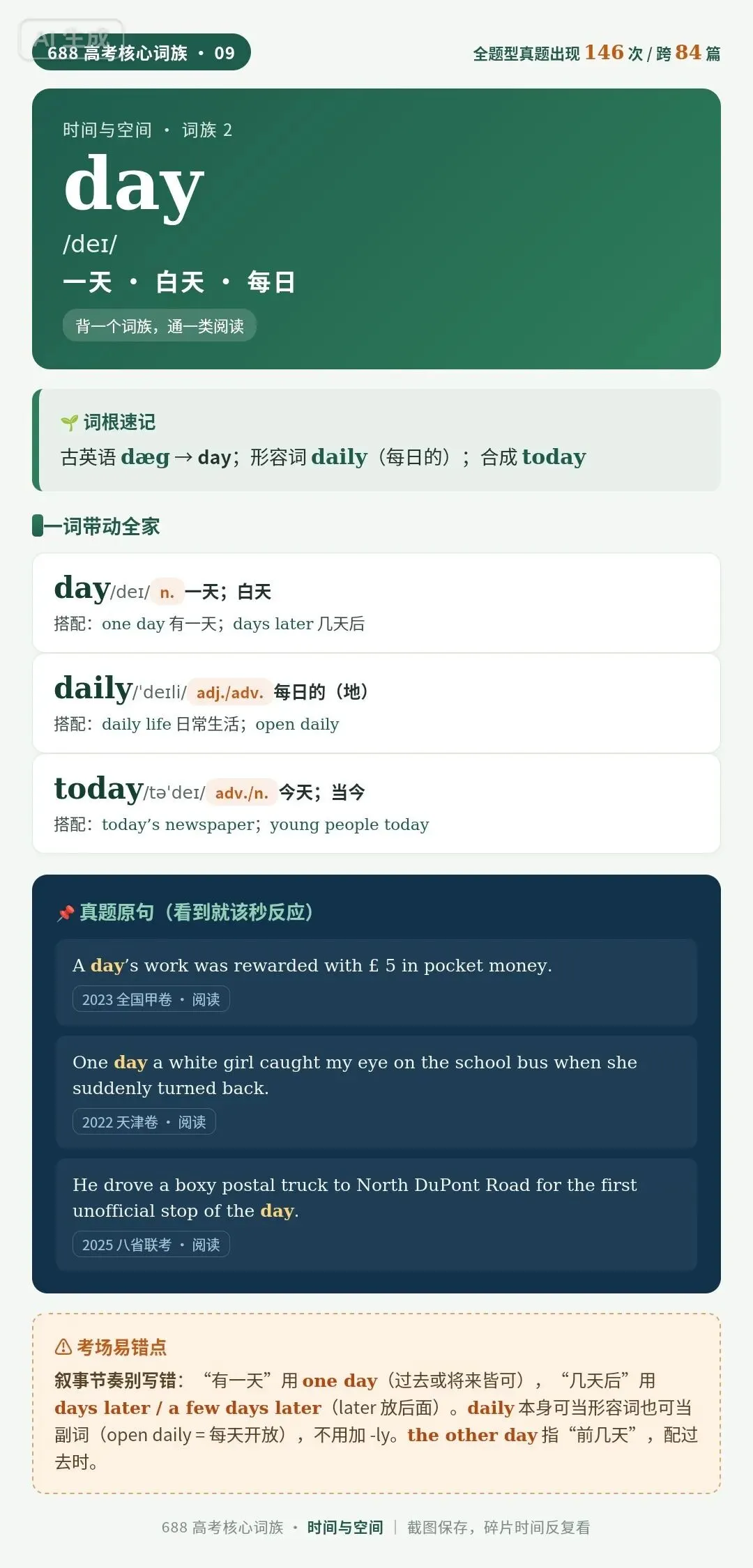
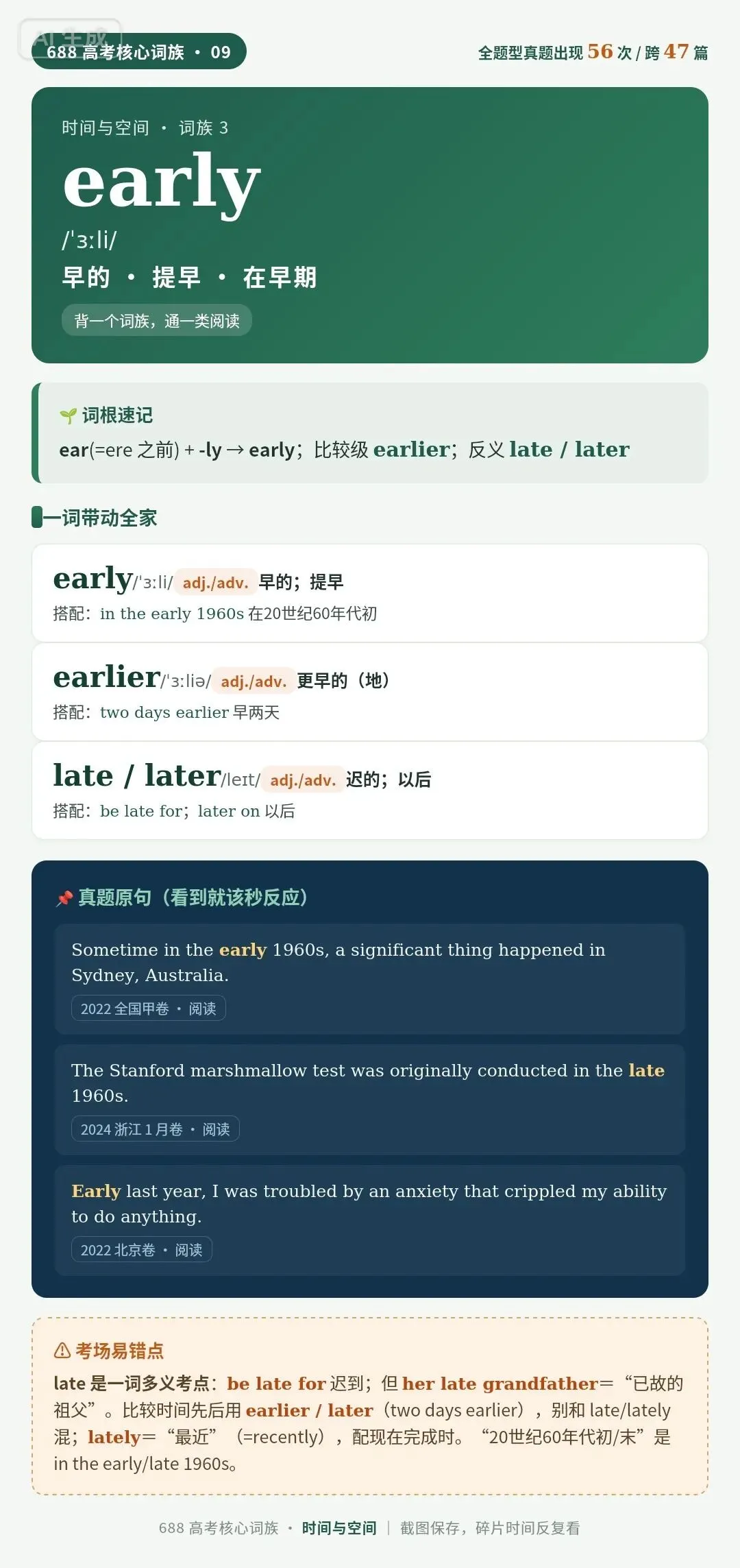
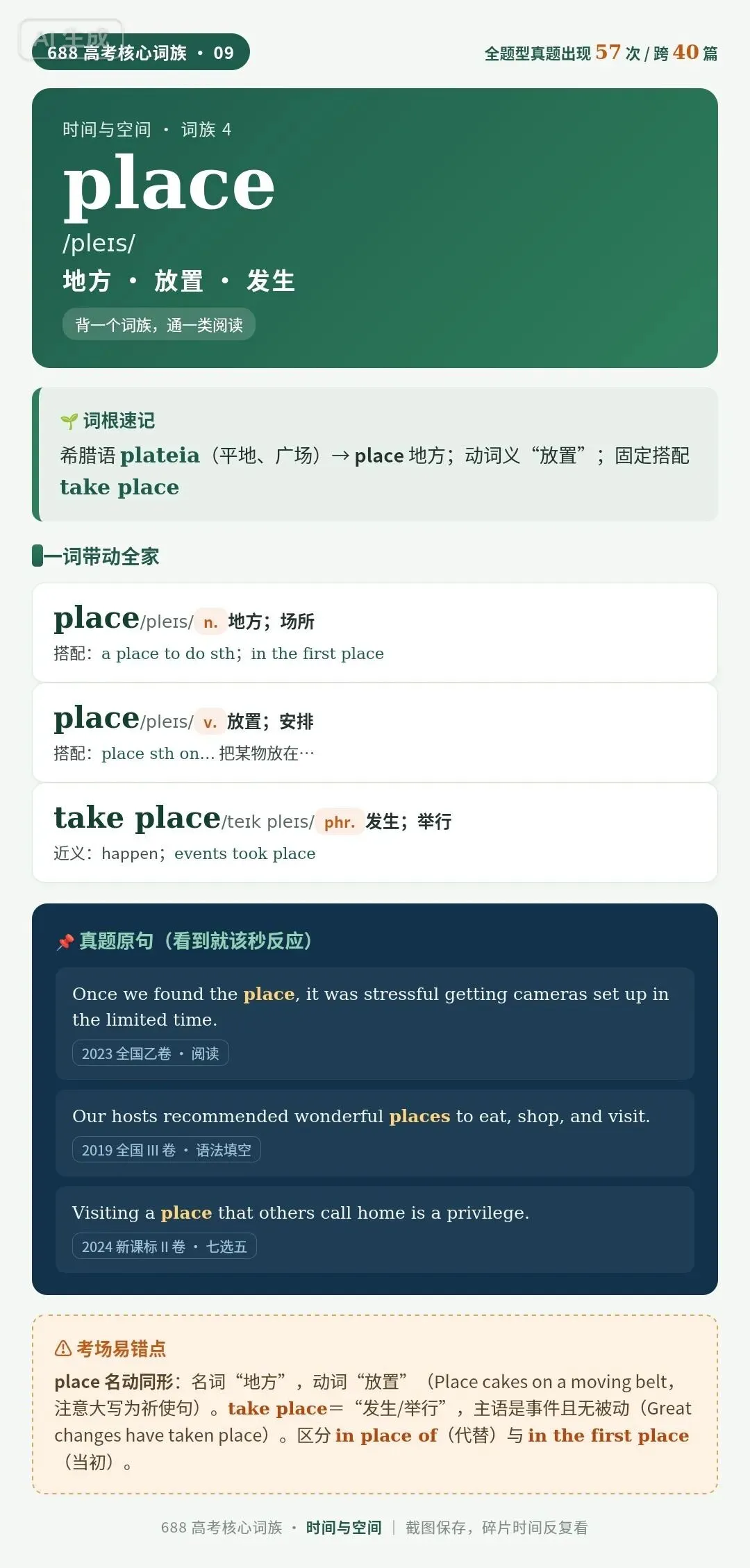
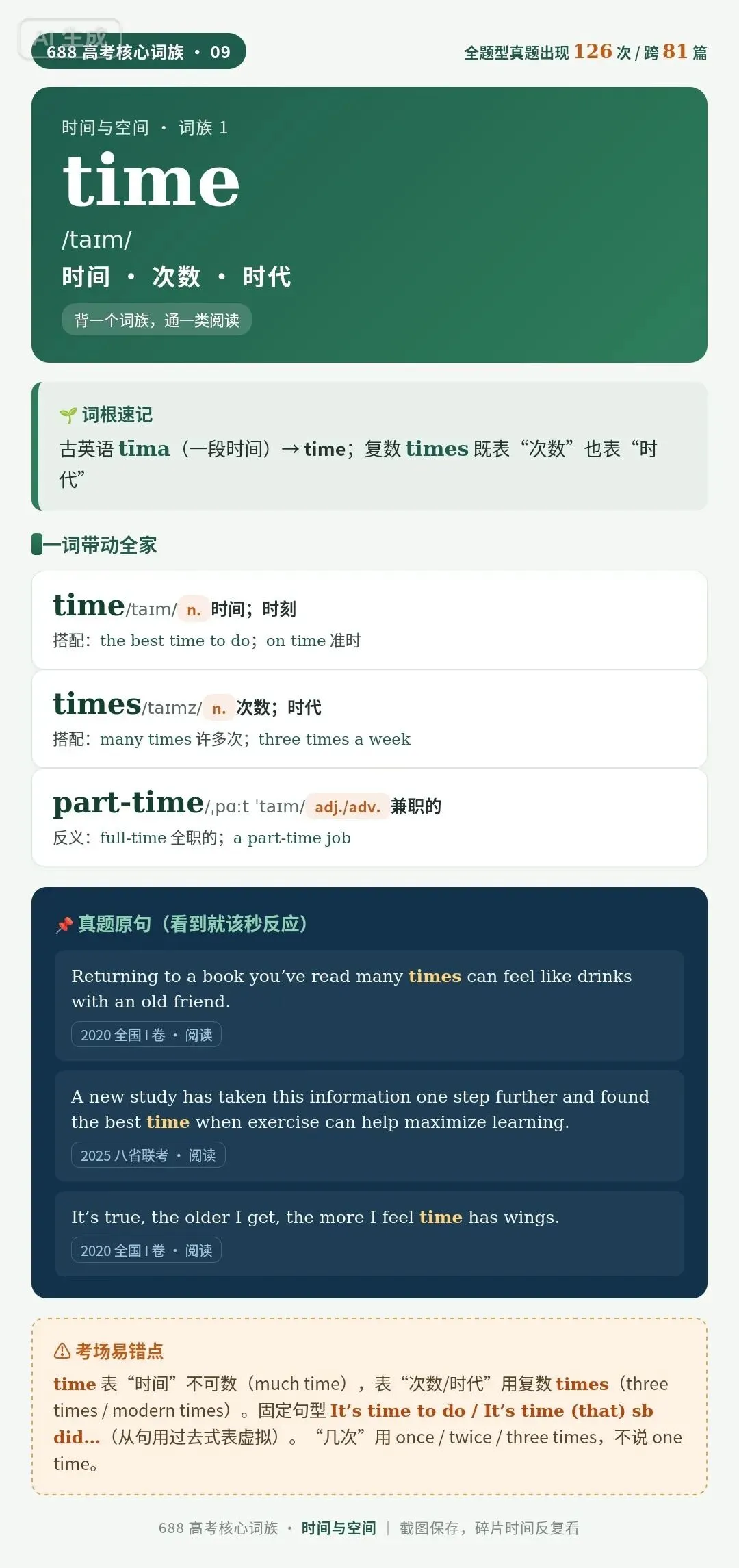
语法填空(仿真原创,对标新高考,7给词+3虚词)
阅读下面短文,在空白处填入 1 个适当的单词或括号内单词的正确形式。
> Our school organized a walking tour of the oldest part of the city last Saturday, and we met at the school gate very early in the morning, long before most people were awake. The sun had not **61** (rise) yet, and the narrow streets were almost empty except for a few shop owners opening their doors. Our teacher told us to stay **62** (close) together in small groups and to pay attention **63** the traffic whenever we crossed a road.
>
> We walked slowly **64** a narrow stone bridge over the river and soon reached the central market, which **65** (take) place there every weekend. **66** (early) that day, I had thought the old town would be dull and behind the times, but I soon changed my mind. The busy market was full of people selling fresh fruit, handmade clothes and all **67** (kind) of delicious local food that I had never tried before.
>
> What impressed me most was a small square right **68** the centre, surrounded by fine old buildings that were hundreds of years old. I stopped there for a long time, trying to imagine what daily life **69** (be) like in those streets centuries ago. By the time we walked back, the sun was already high and the whole city seemed busy and full of energy. It was a **70** (true) unforgettable day, and I felt proud to call this old city my home.
---
## 四、完形填空(仿真原创,对标新高考,15空)
阅读下面短文,从每题所给的 A、B、C、D 四个选项中选出最佳选项。
> I grew up in a small town where everyone knew everyone, and for years I could not wait to leave for a big city. To me, city life meant tall buildings, bright lights and endless excitement, while our town felt **41** and behind the times. The day I finally got accepted by a college in the city, I felt as if I were being set **42** .
>
> At first, everything was as wonderful as I had **43** . There were shops, museums and concerts on every corner, and I **44** a different part of the city almost every weekend. But after a few months, I began to notice something I had not **45** . Nobody seemed to know their neighbours. People lived side by side for years without **46** learning each other's names.
>
> One cold evening, I got lost on my way home and had to **47** for the bus at a quiet street corner. It was getting late, and the usually crowded street was almost **48** . Just then, an old woman who ran a small shop nearby **49** me in and gave me a cup of hot tea while I waited. She asked about my family and my town, and for the first time in months I did not feel **50** .
>
> That simple kindness made me **51** the place differently. I realized that a city is not made great by its tall buildings, but by the **52** who care for the strangers around them. I still love the excitement of urban life, **53** now I also look for the small, warm moments that **54** anywhere, in a busy city or a quiet town.
>
> Last week, I went back home for the first time. Walking through the familiar streets **55** that evening, I finally understood: home is not a place on a map, but wherever people know your name.
**41.** A. lively B. modern C. huge D. quiet
**42.** A. free B. aside C. apart D. out
**43.** A. doubted B. feared C. regretted D. imagined
**44.** A. deserted B. forgot C. explored D. missed
**45.** A. expected B. accepted C. admitted D. shared
**46.** A. once B. also C. still D. ever
**47.** A. apply B. send C. wait D. pay
**48.** A. full B. empty C. clean D. noisy
**49.** A. drove B. pushed C. invited D. followed
**50.** A. alone B. lucky C. proud D. safe
**51.** A. give up B. see C. leave D. desert
**52.** A. buildings B. buses C. people D. colleges
**53.** A. or B. so C. for D. but
**54.** A. exist B. disappear C. fail D. stop
**55.** A. early B. late C. back D. out
---
## 五、阅读理解(仿真原创,对标新高考,4题含完整题干)
阅读下列短文,从每题所给的四个选项中选出最佳选项。
> **The 15-Minute City**
>
> Imagine being able to reach your school, your doctor, a park and your favourite food shop all within a short walk or bike ride from home. That is the central idea of the "15-minute city," a plan first proposed by Professor Carlos Moreno. In too many modern cities, people spend hours every day travelling between distant homes, workplaces and services. Moreno argues that daily life does not have to be this way.
>
> The idea is simple to state but demanding to carry out. Shops, schools, health centers and public transport should be placed close to where people live, rather than gathered in a single crowded downtown. Streets ought to be safe for walking and cycling, and every district should contain a mix of housing, offices and green space. When these conditions are met, residents waste less time in traffic and have more time for family, rest and exercise.
>
> Critics, however, raise doubts. Some worry that making an area so convenient will quickly push up housing prices and force poorer families out. Others point out that older cities, built centuries ago, cannot easily change their narrow streets and historic centres. Moreno does not deny these difficulties, but insists they are reasons to plan carefully, not excuses to do nothing.
>
> Several cities around the world have already begun experimenting, closing certain streets to cars and turning empty parking areas into small parks. It is still early, and no one knows how far the model will spread. Yet the debate itself points to a deeper question: if a city exists to serve its people, why should so much of life be spent simply getting from place to place?
**1. What problem does the 15-minute city plan aim to solve?**
A. The high price of food in city shops.
B. People spending long hours travelling between distant places.
C. The lack of tall modern buildings.
D. Cities having too many small parks.
**2. According to the passage, what does the plan require?**
A. Moving all services into one downtown area.
B. Replacing every old street with a wider road.
C. Placing daily services close to where people live.
D. Building more parking lots outside the city.
**3. What concern do the critics raise?**
A. Housing might become too expensive for poorer families.
B. People will lose interest in cycling.
C. Doctors will refuse to work in cities.
D. Public transport will become overcrowded.
**4. What is the deeper question mentioned at the end?**
A. Why historic buildings should be protected.
B. Whether cars will disappear in the future.
C. How many parks a city truly needs.
D. Why so much of life is spent merely travelling between places.
---
## 六、书面表达(时空话题:建议信)
**题目:** 假设你是李华,你的英国笔友 Chris 即将来华,在你所在的城市做一年交换生,他来信想了解如何安排每天的时间、尽快熟悉这座城市。请你写一封回信,内容包括:
1. 建议他合理安排每天的时间;
2. 推荐一个了解这座城市的方式;
3. 表达祝愿。
**参考范文:**
> Dear Chris,
>
> I'm glad that you are coming to our city for a year. Here is some advice.
>
> First, plan your day early and make a simple daily schedule for study, rest and exercise, and try not to stay up late. At weekends, ride a bike around the old town instead of only visiting the busy downtown. Walking slowly through its streets is the best way to feel the city and meet local people.
>
> I hope you will soon feel at home and have an unforgettable year.
>
> Yours,
> Li Hua
---
## ⭐ 五步万能模板(建议信·时间安排/城市版)
| 步骤 | 作用 | 建议信万能句型 |
|---|---|---|
| 1. 开头点题 | 回应来信/目的 | I'm glad to hear that you are coming… |
| 2. 给出建议 | 用 First / plan your day | First, plan your day early and make a daily schedule. |
| 3. 补充做法 | 用 At weekends / instead of | At weekends, explore the old town instead of only the downtown. |
| 4. 说明理由 | 用 the best way to | Walking is the best way to truly feel the city. |
| 5. 祝愿结尾 | 用 I hope / have a… | I hope you will feel at home and have an unforgettable year. |
**挖空骨架(背下来,考场直接填):**
> Dear ____,
> I'm glad to hear that you ____. First, plan your day and make a simple ____ so that you have enough time for ____. At weekends, you can ____ instead of ____; it is the best way to ____. I hope you will soon feel at home and have a(n) ____ time. Yours, Li Hua
**话题词植入法**:把本期词族 **daily schedule、on time、explore the city、urban/old town、local people、in time** 自然写进建议信,词汇分立刻上来。
**高分三要素**:①用 First / At weekends / instead of 让条理清楚;②用 the best way to do、so that 提升句式;③结尾给祝愿,礼貌收束。
---
## ✅ 答案(先自己做,再往下翻)
.
.
.
.
.
**语法填空:**
61. risen 62. close 63. to 64. across 65. takes 66. Earlier 67. kinds 68. in 69. was 70. truly
**完形填空:**
41–45 DADCA 46–50 DCBCA 51–55 BCDAB
**阅读理解:**
1–4 BCAD
---
## 写在最后
时空话题,记住我们今天的核心结论:
> **别再迷信 distance、location、temporary 这些"大词"(真题里都只有个位数);高考真正反复用的是 time、day、early/late、place、urban/city,外加语法填空里的 through、after、now 这副"时空骨架"。**
如果这篇对你有用,记得:
- 点个**「在看」**,让更多同学看到;
- **转发**给一起备考的朋友;
- **关注**我,《688高考核心词族》持续更新,我们一期一个话题,把高考最高频的词族全部过一遍。
下一期,我们聊**系列十:人际关系**,同样先用真题词频帮你挑出最值得背的词。我们下期见。


