

开学了,推荐高中英语学习必备书:最新2026版应用文写作和读后续写:
2026年7月第10版《新高考英语应用文写作+读后续写+人教版单元词块整理三驾马车》来啦!
我用夸克网盘给你分享了「武汉九调听力.mp3」,点击链接或复制整段内容,打开「夸克APP」即可获取。
链接:https://pan.quark.cn/s/43d82a53b3bb
音频下载链接:
我用夸克网盘给你分享了「武汉九调听力.mp3」,点击链接或复制整段内容,打开「夸克APP」即可获取。
链接:https://pan.quark.cn/s/70a3cd613656
第一部分听力(共两节,满分 30 分)
第一节(共 5 小题;每小题 1.5 分,满分 7.5 分)
听下面 5 段对话。每段对话后有一个小题,从题中所给的 A、B、C 三个选项中选出最佳选项。听完每段对话后,你都有 10 秒钟的时间来回答有关小题和阅读下一小题。每段录音读两遍。
1.Where does the conversation probably take place?
A. In a café.B. In a hotel.C. In an office.
2.What is the man doing?
A. Cleaning the living room.B. Heading to the airport.C. Looking for his passport.
3.What are the speakers talking about?
A. A terrible accident.B. A fascinating novel.C. A late-night movie.
4.What is the problem with the smart home app?
A. It keeps restarting itself.B. It cannot control the light.C. It turns off the air conditioner.
5.What will the man do with the summary?
A. Print it.B. Email it.C. File it.
第二节(共 15 小题;每小题 1.5 分,满分 22.5 分)
听下面 5 段对话或独白。每段对话或独白后有几个小题,从题中所给的 A、B、C 三个选项中选出最佳选项。听每段对话或独白前,你将有时间阅读各个小题,每小题 5 秒钟;听完后,各小题将给出 5 秒钟的作答时间。每段录音读两遍。
听第 6 段录音,回答第 6、7 题。
6. Why does the man prefer running in the mountains now?
A. To challenge himself.B. To avoid the crowd.C. To get refreshed.
7. What has the man prepared for the race?
A. A tracking device.B. An online map.C. A professional suit.
听第 7 段录音,回答第 8 至 10 题。
8. What does the man think of the woman’s trip?
A. Its schedule is tight.B. Its cost is unaffordable.C. Its impact is short-lived.
9.What was the woman’s original intention to volunteer?
A. To bond with foreign students.
B. To support overseas education.
C. To strengthen her college application.
10.What does the man suggest the woman do in the end?
A. Help the elderly around her. B. Launch her own project. C. Hire more local workers.
听第 8 段录音,回答第 11 至 13 题。
11. How much does the man save at least every month?
A. $10. B. $20. C. $30.
12.What is the woman’s main concern about the service?
A. The waste of packaging. B. The safety of snacks. C. The uncertainty of items.
13.What is an additional benefit to the man?
A. Learning about local farms.
B. Saving time on food selection.
C. Improving his health condition.
听第 9 段录音,回答第 14 至 16 题。
14. How does the Electronic Nose work?
A. By taking digital photos.
B. By measuring air temperature.
C. By detecting chemical substances.
15.What is the current use of the Electronic Nose?
A. Helping doctors identify diseases.
B. Finding gas leaks in factories.
C. Checking the quality of fruit.
16.What is a limitation of the Electronic Nose?
A. It is too large to carry. B. It needs expensive sensors. C. It may fail in wet conditions.
听第 10 段录音,回答第 17 至 20 题。
17. What must students do before using the room?
A. Submit a form. B. Book it early. C. Call Mr. Clark.
18.What is the red button used for?
A. Adjusting the sound. B. Cutting off power. C. Starting the equipment.
19.What will happen to files left on the computer?
A. They will be removed. B. They will be printed out. C. They will be saved online.
20.Why does the speaker give the talk?
A. To offer guidelines. B. To promote a program. C. To share recording skills.
第二部分阅读理解(共两节,满分 50 分)
第一节(共 15 小题;每小题 2.5 分,满分 37.5 分)
阅读下列短文,从每题所给的 A、B、C 和 D 四个选项中,选出最佳答案。
A
Teen Summer Writing Fellowship at GrubStreet Center for Creative Writing
If you are a high school student who loves writing, a creative writing summer camp can give you the opportunity to focus intensively on your craft. Whether you are interested in fiction, poetry, nonfiction, or playwriting, this program enables you to explore your chosen area in depth and develop your writing skills through regular practice.
The Teen Summer Writing Fellowship at GrubStreet is a three-week program that brings together high school writers to practice and experiment with different forms of writing. Participants engage in the world of literature while exploring fiction, nonfiction, poetry, screenwriting, and genres and styles such as suspense fiction, poetic novels, and magical realism. Each day, they take part in writing sessions, feedback workshops, open-mic readings, and talks by guest authors. The program also introduces participants to the publishing world and offers guidance on pursuing a career in writing. It concludes with a final presentation of their work.
Participants can also sign up for a fourth or fifth week to help edit and format pieces for the YAWP (Young Adult Writers & Poets) Anthology, a collection of writing by teens who have participated in GrubStreet’s previous summer programs.
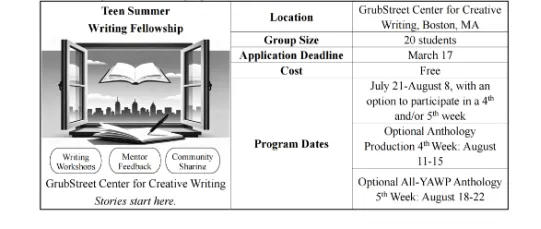
21.What can students do at the creative writing camp?
A. Chair feedback workshops.B. Publish their prior works.
C. Interview previous campers.D. Explore various literary forms.
22.What should participants do if they want to help with the YAWP Anthology?
A. Apply for the camp in July.B. Stay in the program after August 8.
C. Pay extra fees for two more weeks.D. Present their works to guest authors.
23.What is the purpose of the text?
A. To advocate creative writing.B. To introduce a writing program.
C. To appeal to fiction lovers.D. To search for literary talents.
B
Most of us have secret gardens where we can relax, stretch and refresh. For me, since I can remember, that world has been books.
As with many children, books first drew me in through their illustrations. My love of colour was stimulated by the original Babar books; my understanding of lines comes from the Our Wullie annuals, or Tintin. Later, the words became more important to me. I was not happy at boarding school, but I loved spending time in its library. Books became my private garden. So it was no surprise that I studied English at university.
Today “English literature” is in sharp decline among senior-level exam subjects and some universities are ceasing to offer it. This is a quiet cultural disaster, one in which we are stealing their best future from our children. It may not lead directly to a good-paying office job. But it has given people like me a reliable friend.
Later, work and family made it harder for me to read. As a journalist, I had many deadlines, and as a mother, I often had little time because of children and money worries. Sometimes I read while standing on a moving bus or train. It was difficult, but I kept reading. Every year, I still looked forward to new books by Ian McEwan and many other writers, such as Penelope Fitzgerald and Donna Tartt. Each book gave me a new world to explore and a new friend to meet.
At this point, readers may ask whether I would have been better off living—meeting and talking to fleshy actual humans or playing sports. Well, I don’t spend all my life on a sofa with books all around me. There seems to be time for chat and laughter. But without deep and repeated reading of writers who millions of other people have already found friendly and helpful, my life would just be so much narrower and meaner. The great books remain, across most of a lifetime, my secret garden.
24.What first attracted the author to books as a child?
A. The plots. B. The titles. C. The pictures. D. The reviews.
25.What does the author think of “English literature”?
A. Spiritually comforting. B. Academically difficult.
C. Economically rewarding. D. Practically advantageous.
26.What does paragraph 4 mainly tell us about the author?
A. Her busy life. B. Her favorite writers.
C. Her reading on trips. D. Her insistence on reading.
27.What does the author intend to do in the last paragraph?
A. Analyze a current trend. B. Defend her point of view.
C. Show readers’ misunderstanding of books. D. Prove the importance of real-life activities.
C
Want to lose fat? There’s one method scientifically proven to work: eating a little less food than your body needs to fuel itself each day. Do that, and your body starts using its energy reserves—its stored fat—to make up the deficit.
It sounds straightforward. You dutifully keep track of the calories in every meal to make sure your daily intake stays less than your fixed limit, but the number on your weight scale never changes at all. It’s frustrating and disheartening. But there’s good news: you’re not to blame.
Recent scientific findings suggest it’s almost impossible to count calories with any degree of accuracy, which explains why trying to lose weight by calorie counting is so hard. It’s not bad maths that trips most of us up, though. Generally, unless you diligently log every ingredient before you eat, humans just aren’t very good at recalling exactly what was on their plate, let alone the handful of snacks they ate without thinking. Given all that, it’s no surprise that studies suggest the average person underestimates their daily consumption by around 30 per cent (roughly 600 - 750 calories), or about 10 digestive biscuits.
The very idea of working out calorie amounts is problematic. And that’s before we even consider the effect your individual biology can have. For instance, a 2023 study tested the outcomes of giving people a high-fibre diet, designed to feed their gut microbes (肠道菌群). With growing microbial communities in their guts, the scientists found that the participants in the study lost a little bit of weight—without eating less or feeling hungry—because they were absorbing fewer calories from their food.
“That means, depending on what you eat and how many microbes are thriving (旺盛繁殖) in your gut, some calories are used by you, while others feed the microbes.” says Professor Rosa Brown, a co-author of the study.
If all this is starting to make you think that calorie monitoring might be off the menu, you’d be right.
28.What does the underlined word “deficit” in paragraph 1 mean?
A. Database.B. Shortfall.C. Nutrition.D. Weight.
29.What makes it hard for dieters to count calories?
A. Inaccuracy of intake records.B. Lack of tracking approaches.
C. Absence of scientific evidence.D. Complexity of calculation procedures.
30.What can we learn from the 2023 study?
A. Calorie absorption may vary.B. Eating less means losing weight.
C. Fibre reduces people’s hunger.D. Food calories determine body weight.
31.Which of the following can be the best title for the text?
A. Forget the Strict DietB. Simplify Your Calorie Log
C. Skip the Dietary MathD. Adjust Your Diet Structure
D
Food markets have experienced considerable instability in recent years. Global warming is causing droughts, soil desertification and extreme weather. Yet the fundamentals of food production were last transformed in the mid-20th century. Fortunately, global investments in agricultural innovation are on the rise. Funds for agritech companies reached $16.2 billion in 2025. Of this, $9 billion went to new research into boosting farm yields, up from $2.5 billion in 2016. The focus of sustainability efforts is switching from preventing climate change to dealing with it and finding solutions.
Scientists are developing alternatives to the pesticides and fertilisers that have dominated modern agriculture since the Green Revolution of the mid-20th century, based on a better understanding of plants themselves. B-COS, a team from Ghent University, is genetically engineering bacteria to produce a special kind of molecule (分子). Tomato and potato plants sprayed (喷洒) with the molecules are tricked into believing they are under attack and activate their natural defenses against infection. B-COS is applying this approach to two new products: one to improve growth and drought tolerance, and another which it claims can reduce disease incidence by 40 - 50%.
Naturally, there are also companies exploring the opportunities presented by artificial intelligence. The general idea of this combination is called “precision agriculture”, which is to help farmers connect everything from the environmental conditions of individual fields to the genetic sequences (序列) of the bacteria present in the soil, and those of the plants themselves. This is then run through AI models that make predictions about the best conditions and treatments to achieve the highest yields or produce the highest-quality crops.
“It is going to show us what’s going on in each square metre of the fields, such as temperature, water and carbon absorption,” says Mr. Anders, a managing partner of an agritech company.
There is still a long way to go. In 2024, agricultural tech companies attracted just 1.3% of global early-stage venture-capital funding despite agriculture accounting for about 4% of global GDP. But if high-tech innovations still make their way, and the funds keep flowing, a new age of precision agriculture is coming.
32.What is highlighted concerning agricultural investment in paragraph 1?
A. Its instability. B. Its source. C. Its influence. D. Its shift.
33.Why did the B-COS team spray the molecules on tomato and potato plants?
A. To evaluate disease tolerance. B. To eliminate harmful substances.
C. To boost natural resistance. D. To protect healthy plants.
34.What does “precision agriculture” contribute to?
A. Accurate market forecasting. B. Efficient harvesting techniques.
C. Sufficient genetic information. D. Reasonable agricultural planning.
35.What is the author’s purpose in presenting the data in the last paragraph?
A. To call for greater investment. B. To warn of potential risks.
C. To cast light on the achievements. D. To give credit to the companies.
第二节(共 5 小题;每小题 2.5 分,满分 12.5 分)
阅读下面短文,从短文后的选项中选出能填入空白处的最佳选项。选项中有两项为多余选项。
Imagine you’re a kid in an elementary school. You have spent all morning learning new words and practicing multiplication. Then finally, it is time for a break. You run out of the stuffy school building, only to find a large area of burning hot blacktop. 36 . Due to decades of paving entire schoolyards to reduce maintenance costs, this is the reality for thousands of city school children. Lamont was one of them.
Lack of access to nature does more than reduce social and emotional well-being. Asphalt (沥青) surfaces absorb and give off more heat, creating the “heat island effect,” which can negatively impact human health. 37 . When rainwater washes these substances away, they end up polluting rivers and streams.
However, thanks to Reflo and his partners, these lifeless blacktops are being replaced with rich natural environments where kids can learn and play. During the three-year design process, each school chooses which natural elements they want to include, from pollinator (传粉者) gardens to soccer fields to micro-forests. Most schools will include a bioswale (低洼地) that manages stormwater. 38 . The new schoolyards are built over the summer to minimize the impact on the academic year, and the habitats support wildlife, like butterflies and bees.
“39 ,” said Lamont. “Thousands of young people, including some of the most socially and economically disadvantaged children, will have significantly better experiences, and they can take a lot of pride in their schools.”
Schoolyards are the best strategic investment for environmental improvement. 40 . These benefits, in turn, contribute to improved academic performance. What’s more, once the school day is over, the schoolyards are open to the public and serve as community parks.
A. They also concentrate pollutants
B. Reflo’s work is truly transformational
C. They will also add outdoor classrooms
D. There isn’t a single tree or any grass in sight
E. The flat surface seems perfect for playing games
F. Nature reduces stress and boosts creative thinking
G. These surfaces prevent water from entering the ground
第三部分语言知识运用(共两节,满分 30 分)
第一节(共 15 小题;每小题 1 分,满分 15 分)
阅读下面短文,从短文后各题所给的 A、B、C、D 四个选项中,选出可以填入空白处的最佳选项。
I assumed being good meant not harming the world. But that understanding changed after I moved back home.
One day, while walking the dog, I41 my grandpa, Nicholas, who lived in the same village with us. He held a litter picker in one hand and a bag filled with rubbish in the other, with obvious42 on his face.
I knew he wanted to keep the village tidy, but I had no idea of his43 to the cause. He spends an hour or so each day litter picking—the extreme version, where no rubbish, no matter how44 it is to reach, will go unpicked. He’s even prepared to risk a fall into the canal to45 floating branches. The lengths he goes to are as worrying as they are46 .
I’d always considered myself a 47 citizen—I never littered, but neither did I48 with other people’s mess. Yet after seeing my grandpa’s efforts, it was hard not to get49 . I began following my grandpa’s example, picking up every takeaway cup I passed. And my efforts soon50 litter picking. Once, after a storm, I spent half an hour51 the newly planted trees blown over by the wind.
My experience with litter52 my way of life. I began to pursue more53 ways of shopping, eating and drinking whenever possible, like buying less packaged food. Being a good citizen means more than simply54 being “bad”. It’s about making a practical effort to 55 change, however small it is.
41.A. followed B. questioned C. encountered D. attended
42.A. pain B. pride C. sympathy D. curiosity
43.A. commitment B. response C. objection D. witness
44.A. convenient B. worthwhile C. difficult D. useless
45.A. cut B. throw C. shake D. remove
46.A. flexible B. disappointing C. admirable D. heartbreaking
47.A. decent B. modest C. open-minded D. well-informed
48.A. break B. part C. live D. bother
49.A. involved B. disturbed C. excited D. separated
50.A. rooted in B. centered on C. led to D. went beyond
51.A. righting B. appreciating C. observing D. shading
52.A. supported B. restricted C. reshaped D. assessed
53.A. fashionable B. sustainable C. innovative D. temporary
54.A. risking B. imagining C. regretting D. avoiding
55.A. resist B. effect C. manage D. notice
第二节(共 10 小题;每小题 1.5 分,满分 15 分)
阅读下面短文,在空白处填入 1 个适当的单词或括号内单词的正确形式.
Last month, a group of international visual creators and bloggers from nine countries 56.______ (tour) the Yungang Grottoes (洞穴) and the Hanging Temple in Datong, Shanxi province, to learn about ancient architecture and achievements in digital 57.______ (preserve).
The Yungang Grottoes were first carved during the Northern Wei Dynasty, making them China’s first large-scale royal grotto complex 58.______ (construct) after the introduction of Buddhism. Local authorities 59.______ (advance) digital conservation efforts and research on Yungang studies since 2003.
Fabio Nodari, an Italian photographer, visited Shanxi for the second time. In his view, the Yungang Grottoes represents the combination of multiple ethnic groups and diverse cultures. “The statues’ 60.______ (face) features, colorful costumes, and decorative patterns contain a wealth of foreign cultural elements integrated with Chinese artistic elements, forming a distinctive style 61.______their own among China’s art treasures,” he said. Veldesen Yaputra, a blogger from Indonesia, said after the show, “Digital technology allows us 62.______(visualize) the grotto statues, and also helps audiences truly appreciate 63.______ancient craftsmen created architectural miracles.”
64.______tour group recorded their visits in the form of short videos, photography and paintings, 65.______(share) Shanxi’s stories with audiences at home and abroad. Their works are part of Discovering Shanxi’s Ancient Chinese Architecture, a visual journey through cultural heritage recently launched by China Daily and Shanxi Daily.
第四部分写作(共两节,满分 40 分)
第一节(满分 15 分)
高三学习生活即将开始,你班英语老师要求同学们在课前演讲活动中分享一个能够激励自己前行的英文单词,并说明理由。请你以“A Word That Drives Me Forward” 为题写一篇演讲稿。 注意: (1) 写作词数应为 80 左右。 (2) 请按如下格式在答题纸的相应位置作答。
A Word That Drives Me Forward
第二节(满分 25 分)
阅读下面材料,根据其内容和所给段落开头语续写两段,使之构成一篇完整的短文。
Leo was not excited about spending his Saturday afternoons at the Oakwood Nursing Home. It was a requirement for his high school graduation, but to him, the place smelled like old medicine and boredom. He usually spent his shifts doing the bare minimum: passing out water cups and avoiding eye contact.
His least favorite resident was Mr. Henderson, a grumpy (暴躁的) 80-year-old man who always sat in a wheelchair in the far corner of the recreation room. Mr. Henderson never smiled, never joined the group activities, and frequently complained about the “noisy teenagers”. Leo made sure to keep his distance, annoyed by the constant complaints. Yet there was one thing Leo had noticed about the old man. Mr. Henderson always kept a small, worn-out songbook on his lap.
One stormy Saturday, the nursing home was hosting its monthly music hour. The residents were gathered in the hall, eagerly waiting for the local volunteer band to arrive. However, at 2:00 p. m., the activity coordinator (协调员), Sarah, rushed in looking panicked. “The band’s bus broke down on the way here,” she announced, her voice shaking slightly. “They can’t make it.”
A wave of disappointment swept through the room. Some residents sighed heavily; others lowered their heads. Sarah looked around helplessly, her eyes landing on an old, dusty piano in the corner of the room. “Does anyone know how to play?” she asked the room.
Leo froze. He had been playing the piano since he was six and was exceptionally good at it. But the thought of playing in front of a crowd terrified him. He looked at the floor, hoping nobody would notice him. But then, he glanced up at the residents. For the first time, Leo didn’t see a room full of annoying strangers. He saw disappointed people who had been looking forward to this small moment of joy. His eyes stopped at Mr. Henderson, noticing the usual anger had disappeared from his face. Instead, he was staring silently at the empty piano.
注意: (1) 续写词数应为 150 左右。 (2) 请按如下格式在答题卡的相应位置作答。
Paragraph 1: At that moment, Leo made a decision.
Paragraph 2: To everyone’s surprise, a rough, shaky voice began to sing along to the music.
2026-2027 学年度武汉市部分学校高三年级九月调研考试英语参考答案
第一部分听力(共两节,满分 30 分)
1-5 ACBBA6-10 CACCA11-15 BCBCA16-20 CBBAA
第二部分阅读理解(共两节,满分 50 分)
第一节(共 15 小题;每小题 2.5 分,满分 37.5 分)
21-23 DBB24-27 CADB28-31 BAAC32-35 DCDA
第二节(共 5 小题;每小题 2.5 分,满分 12.5 分)
36-40 DACBF
第三部分语言知识运用(共两节,满分 30 分)
第一节(共 15 小题;每小题 1 分,满分 15 分)
41-45 CBACD46-50 CADAD51-55 ACBDB
第二节(共 10 小题;每小题 1.5 分,满分 15 分)
56. toured57. preservation58. constructed59. have advanced60. facial 61. of62. to visualize63. how64. The65. sharing
第四部分写作(共两节,满分 40 分)
第一节
A Word That Drives Me Forward
Hello, everyone. I think the word that drives me forward is resilience. It refers to the ability to recover rapidly from frustrations rather than submit to hardships.
I once fell into despair amid repeated setbacks in English exams. Yet resilience reminded me that temporary failures couldn’t reflect my real capacity or determine my future. Every mistake served as a lighthouse guiding me to make significant progress.
As Senior Three approaches, countless challenges await us. I will embrace this word firmly and face the following trials. May we steady our steps with resilience together. Thank you!
第二节
At that moment, Leo made a decision. Taking a deep breath, Leo stepped out and walked towards the dusty piano. His heart was pounding wildly against his chest as he sat on the wooden bench. Wiping a layer of dust from the keys, he rested his trembling fingers on them. He closed his eyes, trying to block out the stares of the audience, and pressed down. A soft, clear chord filled the quiet room. He chose an old, familiar folk song. As the beautiful melody flowed from his fingertips, his nervousness gradually melted away, replaced by a sense of peace he had never felt before.
To everyone's surprise, a rough, shaky voice began to sing along to the music. Leo opened his eyes and looked up. It was Mr. Henderson. The grumpy old man was sitting up straight, tears welling in his eyes, singing the lyrics with deep emotion. Encouraged by him, other residents began to clap their hands and gently join the chorus. The once gloomy hall was instantly brought to life. When the song ended, the room erupted into warm applause. Mr. Henderson looked at Leo and offered a genuine, gentle smile. In that magical moment, the invisible wall between the reluctant teenager and the lonely old man completely disappeared.
听力材料
Text 1
M: Excuse me. Can I use my laptop here? I need to post my vlog while waiting for my order.
W: Certainly, sir. There’s a power outlet near the table by the window.
Text 2
W: Have you finished packing your suitcase, Jack? We are leaving for the airport in an hour.
M: Almost. I need to get my passport. It isn’t in the drawer in the living room.
Text 3
M: I stayed up until 2 a.m to finish it last night. The ending was a total surprise.
W: Really? I just read the first chapter today. Don’t tell me who the killer is.
Text 4
M: The light in the hallway won’t turn off. I think the smart home app is broken.
W: Try restarting your phone. I had the same issue with the air conditioner last night.
Text 5
M: I’ve finished the summary of the morning meeting. Shall I email it to the manager?
W: Actually, she needs a paper version of the file.
Text 6
W: Hi, Mark! I saw you running in the park yesterday. Are you preparing for a special event?
M: Yes, I’ve signed up for a mountain marathon.
W: A marathon in the mountains? That sounds like a huge challenge. I thought you preferred indoor exercise.
M: I used to, but running in nature gives me much more energy. Besides, the mountain air is much cleaner than that in a busy gym.
W: But… aren’t you worried about the extreme weather or getting hurt?
M: Actually, I’ve bought a pair of professional running shoes and a GPS watch to update my location in real time.
Text 7
W: I’m going abroad for a two-week volunteer trip to teach at a school.
M: That sounds noble, but have you considered whether two weeks is enough to make a real difference?
W: I’m helping the kids there.
M: But if volunteers keep changing, the kids will never form stable bonds. Plus, wouldn’t it be better to hire local workers to support their economy.
W: I never thought of it that way. I just want something for applying to college.
M: Maybe you should join a long-term project in our own city. Offering assistance to the elderly here is just as impactful and more sustainable.
Text 8
W: Paul, what’s that cardboard box? Is it another delivery?
M: It’s my new monthly snack box. I pay $30 a month and they send me 10 items I’ve never tried before.
W: Isn’t that risky? You might hate half of them. Why not just go to the supermarket and buy what you like?
M: Well, these are all from local farms and are sugar-free. If I bought them individually in a store, it would cost me at least $5 each.
W: So? You are saving money, but you give up the freedom to choose.
M: Exactly, I like the surprise. Also, it saves me the time of searching for healthy options myself. Am too busy to read every label in the shop.
Text 9
W: Doctor Lee, your team has created an Electronic Nose. Can you tell me how it senses smells?
M: Certainly, the device uses special sensors to identify chemicals in the air. We originally designed it to help factories detect gas leaks.
W: But I heard you are using it in hospitals now?
M: Yes, it turns out that many diseases change the way a person's breath smells. The machine can smell an illness long before a doctor notices any signs.
W: That’s brilliant. Is it difficult to use?
M: No, it’s as simple as a mobile phone. However, it works best in a dry environment. Otherwise, the sensors can get confused.
W: What is next for this technology?
M: We hope to put them in supermarkets. It can tell you if a fruit is ripe inside without you having to touch or break it.
Text 10
Hello everyone, and Mr. Clark, manager of the school’s recording room. Before you start making your audio programs, please remember these rules! First, you must book the room on our website at least one day in advance. Each group can only use it for two hours a week. Second, regarding the equipment. Please do not touch the red button on the desk. It is for killing the power in an emergency, not for adjusting the sound. Third, to protect the equipment, only water is allowed inside, and it must be kept in a closed bottle. No sweet drinks or food are permitted. Finally, remember to save your work in the online folder before you leave. Any files left on the computer will be automatically deleted at 9 p.m every night. We hope you make some great programs here.
答案解析
第一部分听力
第二部分阅读
阅读理解 A篇
主题语境:人与社会——文学活动与个人发展
语篇导读:本文是一则项目介绍,说明青少年暑期写作奖学金项目的内容、时间安排及文集制作机会。
第21题.D 细节理解。解析:根据“practice and experiment with different forms of writing”(练习并尝试不同写作形式)可知,学生可以探索多种文学形式。故选D项。
第22题.B 细节理解。解析:根据项目时间“July 21-August 8”以及“Optional Anthology Production 4th Week: August 11-15”(前三周于8月8日结束,文集制作周从8月11日开始)可知,参与文集制作需要在8月8日之后继续留在项目中。故选B项。
第23题.B 写作目的。解析:根据标题“Teen Summer Writing Fellowship”及全文对课程、活动和时间的介绍可知,本文旨在介绍一个写作项目。故选B项。
阅读理解 B篇
主题语境:人与自我——阅读与精神成长
语篇导读:本文是一篇夹叙夹议文。作者回顾自己一生与书相伴的经历,说明深度阅读为生活提供持久的精神慰藉。
第24题.C 细节理解。解析:根据“books first drew me in through their illustrations”(书最初通过插图吸引了我)可知,童年时最先吸引作者的是书中的图画。故选C项。
第25题.A 观点态度。解析:根据“It has given people like me a reliable friend”(它给了像我这样的人一个可靠的朋友)可知,作者认为英国文学能带来精神陪伴和慰藉。故选A项。
第26题.D 段落主旨。解析:根据“work and family made it harder for me to read”以及“but I kept reading”(工作和家庭让阅读更困难,但我仍坚持阅读)可知,本段重点表现作者对阅读的坚持。故选D项。
第27题.B 写作意图。解析:根据“readers may ask whether I would have been better off living”以及“But without deep and repeated reading ... my life would ... be narrower”(读者或许质疑阅读挤占真实生活,但作者认为没有深度阅读,生活会更狭窄)可知,作者在回应质疑并为自己的观点辩护。故选B项。
阅读理解 C篇
主题语境:人与自我——健康生活与科学认识
语篇导读:本文是一篇科普说明文,指出热量计算受记忆误差和个体生理差异影响,难以成为精确可靠的减脂工具。
第28题.B 词义猜测。解析:根据“using its energy reserves ... to make up the deficit”(动用储存的能量来弥补这一缺口)可知,deficit 指摄入能量不足形成的“短缺”。故选B项。
第29题.A 细节理解。解析:根据“humans just aren’t very good at recalling exactly what was on their plate”(人们并不擅长准确回忆吃过什么)可知,摄入记录不准确使热量难以计算。故选A项。
第30题.A 推理判断。解析:根据“some calories are used by you, while others feed the microbes”(有些热量被人体利用,另一些被肠道菌群利用)可知,不同人的实际热量吸收可能不同。故选A项。
第31题.C 标题判断。解析:根据“calorie monitoring might be off the menu”(热量监测也许该退出菜单)可知,文章主张不要迷信精确的热量计算。Skip the Dietary Math 最能概括主旨。故选C项。
阅读理解 D篇
主题语境:人与社会——农业科技与可持续发展
语篇导读:本文是一篇科技说明文,介绍生物技术和人工智能推动精准农业发展的路径,同时指出该领域仍需要更多资本投入。
第32题.D 细节理解。解析:根据“investments in agricultural innovation are on the rise”以及“The focus ... is switching”(农业创新投资上升,其重点也在转变)可知,本段突出农业投资规模和方向的变化。故选D项。
第33题.C 细节理解。解析:根据植物会“activate their natural defenses against infection”(激活自身抵御感染的天然防御机制)可知,喷洒分子的目的是增强植物的天然抗性。故选C项。
第34题.D 推理判断。解析:根据AI模型会预测“the best conditions and treatments to achieve the highest yields”(实现最高产量所需的最佳条件和处理方式)可知,精准农业有助于制订合理的农业生产方案。故选D项。
第35题.A 写作目的。解析:根据农业科技仅获得“1.3% of global early-stage venture-capital funding”,而农业约占全球GDP的“4%”(融资占比明显低于产业占比)可知,作者借数据说明投入不足,呼吁增加投资。故选A项。
七选五
主题语境:人与社会——校园环境与儿童福祉
语篇导读:本文是一篇说明文,介绍城市学校将沥青操场改造成自然化校园的项目及其环境、健康和教育价值。
第36题.D 上下文衔接。解析:根据空前“a large area of burning hot blacktop”(一大片灼热的黑色沥青地)和空后“this is the reality”(这就是现实)可知,空处应继续描写校园缺少自然环境,D项“看不到一棵树或一片草”衔接最紧密。故选D项。
第37题.A 指代与逻辑。解析:根据空前“Asphalt surfaces”以及空后“these substances ... polluting rivers and streams”(这些物质污染河流和溪流)可知,空处需要先引出污染物;A项中的“concentrate pollutants”正好提供 substances 的指代对象。故选A项。
第38题.C 并列关系。解析:根据空前“Most schools will include a bioswale”(多数学校会设置生态低洼地)可知,此处继续列举学校将增加的设施;C项“They will also add outdoor classrooms”(还会增设户外课堂)与之构成并列。故选C项。
第39题.B 引语概括。解析:根据空后“Thousands of young people ... will have significantly better experiences”(成千上万的年轻人将获得明显更好的体验)可知,Lamont在高度评价该项目的改变作用。B项“Reflo’s work is truly transformational”概括准确。故选B项。
第40题.F 因果衔接。解析:根据空后“These benefits ... contribute to improved academic performance”(这些益处进而有助于提高学业表现)可知,空处应列出自然环境的具体益处;F项“reduces stress and boosts creative thinking”提供了明确所指。故选F项。
第三部分语言运用
完形填空
主题语境:人与自我——公民责任与行为改变
语篇导读:本文是一篇记叙文。作者受祖父主动捡拾垃圾的影响,从不做坏事的消极守规转向主动改善环境,并形成更可持续的生活方式。
第41题.C 语境推断。解析:根据“while walking the dog”以及随后看到祖父手拿垃圾夹和垃圾袋可知,作者遛狗时偶然遇见了祖父。encountered 意为“偶遇”。故选C项。
第42题.B 语境推断。解析:根据“He held a litter picker ... and a bag filled with rubbish”(他拿着垃圾夹和装满垃圾的袋子)以及后文对其行动的肯定可知,祖父因劳动成果而面带自豪。故选B项。
第43题.A 词义辨析。解析:根据“He spends an hour or so each day litter picking”(他每天花约一小时捡垃圾)可知,作者此前不了解祖父对这项事业的投入程度。commitment to 意为“对……的投入”。故选A项。
第44题.C 语境推断。解析:根据“no rubbish ... will go unpicked”(任何垃圾都不会被漏掉)可知,即使垃圾很难够到,祖父也会捡起。故选C项。
第45题.D 动词辨析。解析:根据“risk a fall into the canal”及“floating branches”(冒着掉入运河的风险处理漂浮树枝)可知,他要把树枝移走。remove 意为“清除;移走”。故选D项。
第46题.C 语境推断。解析:根据“The lengths he goes to are as worrying as they are ...”(他的投入程度既令人担心,也令人……)可知,此处评价其行为值得钦佩。故选C项。
第47题.A 语境推断。解析:根据“I never littered”(我从不乱扔垃圾)可知,作者原以为自己算是一个守规矩的、像样的公民。decent 符合语境。故选A项。
第48题.D 固定搭配。解析:根据“but neither did I ... with other people’s mess”(但我也不会……别人留下的垃圾)可知,bother with 表示“费心处理”。故选D项。
第49题.A 语境推断。解析:根据“I began following my grandpa’s example”(我开始效仿祖父)可知,作者受到感染并参与其中。get involved 意为“参与”。故选A项。
第50题.D 逻辑关系。解析:根据后文作者去扶正被风吹倒的新栽树木可知,其环保行动已经超出捡垃圾的范围。went beyond 意为“超出”。故选D项。
第51题.A 动词辨析。解析:根据“the newly planted trees blown over by the wind”(被风吹倒的新栽树木)可知,作者花时间把树扶正。right 作动词意为“使恢复直立”。故选A项。
第52题.C 语境推断。解析:根据后文“I began to pursue more ... ways”(我开始追求更……的方式)可知,捡垃圾的经历重塑了作者的生活方式。故选C项。
第53题.B 语境推断。解析:根据“buying less packaged food”(少买带包装的食品)可知,作者追求的是更可持续的购物和饮食方式。故选B项。
第54题.D 逻辑关系。解析:根据“means more than simply ... being ‘bad’”(意味着不只是简单地……做“坏事”)可知,作者强调好公民不能只停留在避免作恶。故选D项。
第55题.B 固定搭配。解析:根据“making a practical effort to ... change”(采取实际行动来……改变)可知,effect change 是固定搭配,意为“促成改变”。故选B项。
语法填空
主题语境:人与社会——文化遗产的数字化保护
语篇导读:本文是一篇新闻报道,介绍国际创作者参访云冈石窟和悬空寺,并通过影像作品传播山西古建筑文化。
第56题.toured 动词时态。解析:根据时间状语“Last month”(上个月)可知,参访发生在过去,谓语动词用一般过去时。故填toured。
第57题.preservation 词性转换。解析:根据“achievements in digital ...”(数字……方面的成就)可知,形容词 digital 后需要名词作介词 in 的宾语。preserve 的名词形式为 preservation。故填preservation。
第58题.constructed 非谓语动词。解析:根据“grotto complex ... after the introduction of Buddhism”(佛教传入后……的石窟群)可知,complex 与 construct 构成被动关系,应用过去分词作后置定语。故填constructed。
第59题.have advanced / have been advancing 动词时态。解析:根据时间状语“since 2003”(自2003年以来)可知,动作从过去开始并与现在相关。强调截至目前取得的推进成果时,可用现在完成时 have advanced;强调持续推进的过程时,可用现在完成进行时 have been advancing。两者均符合本句语境,故填have advanced或have been advancing。
第60题.facial 词性转换。解析:根据“features”(特征)可知,空处应用形容词修饰名词,face 的形容词形式为 facial。故填facial。
第61题.of 介词。解析:根据“a distinctive style ... their own”(一种他们自己独有的风格)可知,of one’s own 为固定结构,表示“某人自己特有的”。故填of。
第62题.to visualize 非谓语动词。解析:根据“allows us ... the grotto statues”(使我们能够将石窟造像可视化)可知,allow sb. to do sth. 为固定结构。故填to visualize。
第63题.how 宾语从句。解析:根据“appreciate ... ancient craftsmen created architectural miracles”(领会古代工匠……创造建筑奇迹)可知,从句成分完整,空处表示方式,应用 how 引导宾语从句。故填how。
第64题.The 冠词。解析:根据前文“a group of international visual creators and bloggers”(一群国际视觉创作者和博主)可知,此处的 tour group 是再次提及的特定群体,应用定冠词。句首首字母大写。故填The。
第65题.sharing 非谓语动词。解析:根据“The tour group recorded their visits ..., ... Shanxi’s stories”(参访团记录行程,并以此向国内外观众分享山西故事)可知,share 与主语构成主动关系,应用现在分词作伴随或结果状语。故填sharing。


