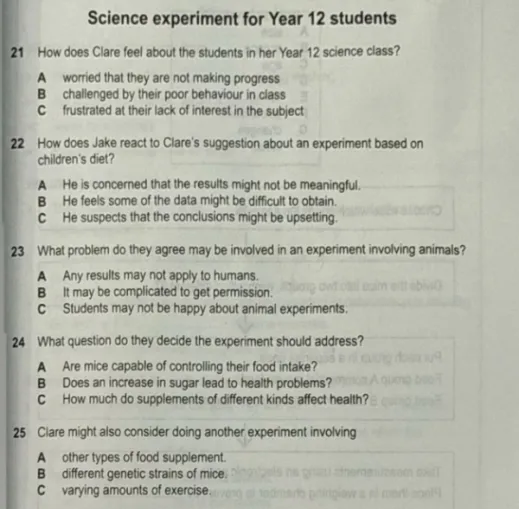
题干:Clare 还考虑增设一组对照实验,变量为? A 其他种类膳食补充剂 B 不同基因品系的小鼠 C 不同梯度的运动量
✅ 正解:C
音频定位:We could fix running wheels inside cages to test different exercise quantities. run wheel(跑轮)、exercise quantities 对应 varying amounts of exercise,其余两项不在拓展方案内。
二、流程填空26-30解析
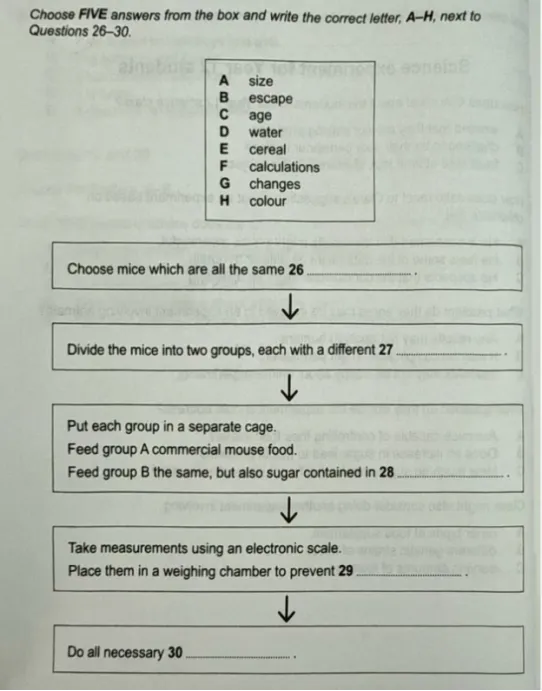
26 → C age:对照实验基础原则:所有实验小鼠保持统一年龄 age,消除年龄带来的个体差异。Choose mice which are all the same age
27 → H colour:将小鼠划分两组,依靠皮毛颜色 colour作为区分标识,实验期间快速区分两组个体。each with a different colour
28 → E cereal:对照组 B 正常喂食鼠粮,额外把糖分掺进谷物 cereal中一同喂食。sugar contained in cereal
29 → B escape:称重时把小鼠放入密闭称量仓,目的是防止小鼠逃跑 escape,保证称重数值准确。to prevent escape
30 → F calculations:全部数据采集完毕后,研究者完成所有必要的数据计算 calculations,整理实验报告。Do all necessary calculations
三、实验场景必背词汇表
英文
音标
中文释义
考场高频搭配
food intake
/ˈɪnteɪk/
进食量
control food intake 管控进食摄入
cereal
/ˈsɪəriəl/
谷物、谷物饲料
mouse cereal 小鼠谷物粮
electronic scale
/ɪˌlekˈtrɒnɪk skeɪl/
电子秤
weighing chamber 称量腔体
calculation
/ˌkælkjuˈleɪʃn/
数据计算
data calculations 数据运算
variable
/ˈveəriəbl/
实验变量
experimental variable 实验变量
apply to humans
/əˈplaɪ tuː/
适用于人体
experimental findings 实验结论
四、Part3 题型通用高分做题法则1)单选题(态度 & 观点类)
but / however / actually 转折词之后才是说话人真实想法,前面铺垫的客套表述基本都是出题人设置的干扰信息;被双方共同否定的方案选项直接排除。
五、完整听力原文 CLARE: Hi Jake. How are you getting on with the practical teaching? JAKE: It’s harder than I expected, but I’ve got some great classes. How about you? CLARE: Not brilliant. I’m really struggling with my Year 12 science class. JAKE: Are they hard to control? CLARE: Well, I don’t have discipline problems as such. It’s just that they don’t seem to think that science has anything to do with their lives. It’s depressing. They listen to what I say, and I gave them a test last week and the results weren’t too bad, but there’s no real engagement. 【Q21 → C】 JAKE: Right. CLARE: And as part of my teaching practice, I have to design an experiment for them to do. I was wondering about something on the children’s diets… you know, asking them to record what they eat and maybe linking it to their state of health. JAKE: Mmm. Let’s think. So your methodology would involve the children recording what they eat. OK, but you’d also need to have access to the children’s medical records and I don’t think people would be happy about that; confidentiality would be an issue. If you could get the right data, the conclusions might be significant, but I suspect it’s just not going to be easy to collect accurate data. 【Q22 → B】 CLARE: Right. JAKE: Have you thought about doing an experiment using animals? CLARE: Wouldn’t that be upsetting for the children? JAKE: Well, the animals don’t have to be harmed in any way. It could just be an experiment where they’re given a certain diet and the effects are observed. CLARE: Would I have to get permission to use animals? JAKE: Yes, you’d have to submit an outline of the experiment and fill in a form, but it’s quite straightforward. CLARE: But if we found out that, say, a particular diet affects the health of animals, the same thing wouldn’t necessarily be true for people, would it? 【Q23 → A】 JAKE: No that’s true, but the findings for any experiment are going to be limited. It’s inevitable. CLARE: I suppose so. So what animals could I use to investigate the effects of diet? Mice? JAKE: Yes. You’d need experimental mice – ones that have been specially bred for experiments. JAKE: OK, so what will your experiment be investigating exactly? CLARE: Well, something to do with nutrition. So maybe we could look at food supplements… things like extra iron and extra protein, and their impact on health. JAKE: Mmm. That might be rather broad. Maybe just look at the effects of one supplement, like sugar, on the health of the mice? CLARE: In fact, maybe the focus could be on whether mice can control their own food intake when they have unlimited access to sugar they don’t actually need. 【Q24 → A】 JAKE: Exactly. Do they eat it voluntarily, or choose to ignore the extra sugar supply? JAKE: Great. Then later on, you could do a follow-up experiment adding another variable. Like, you could give some of the mice the chance to be more active, running on a wheel or something, and the others just stay inactive with little movement. 【Q25 → C】 CLARE: Or I could repeat the experiment but change the type of food I provided… or use mice with a different genetic structure. But I think your exercise variable idea would be more interesting, I might consider that follow-up experiment later on. CLARE: So can I talk through a detailed procedure for this sugar supplement mouse experiment? JAKE: Sure, I carried out a very similar lab experiment back when I was at university. CLARE: Perfect. How many mice should I purchase? JAKE: I’d suggest around twelve specimens. Crucially, pick young mice only, keep them uniform in age, do not mix elderly and young individuals together. 【26 = C age】 CLARE: OK, split them into two equal groups of six each. How am I meant to tell the two groups apart during observation? I was thinking sticking labels on their bodies… or marking them somehow? JAKE: Marking tags might stress the mice out. It’s far simpler to select mice with different fur colour for each group, that way you can instantly distinguish Group A and Group B at a glance. 【27 = H colour】 CLARE: Got it, separate cages for each group then. Feeding plan: Group A gets standard commercial mouse feed only. What about Group B? JAKE: Identical basic mouse food, but you mix measured sugar into dry cereal to feed to Group B every day. 【28 = E cereal】 CLARE: Right, then we weigh the mice with an electronic scale regularly. JAKE: Important point: place each mouse inside a sealed weighing chamber during measurement. If you don’t seal the space properly, mice will try to climb out and escape, messing up your weight readings. 【29 = B escape】 CLARE: Got that sealed chamber step. Once we finish collecting all weight data over several weeks? JAKE: You have to organise all raw figures and complete all necessary calculations to analyse the difference in food intake between the two test groups. 【30 = F calculations】 CLARE: Thanks so much for walking me through the whole experiment plan!