
READING PASSAGE 2
You should spend about 20 minutes onQuestions14-26, which are based on Reading Passage 2.
The Constant Evolution of the Humble Tomato
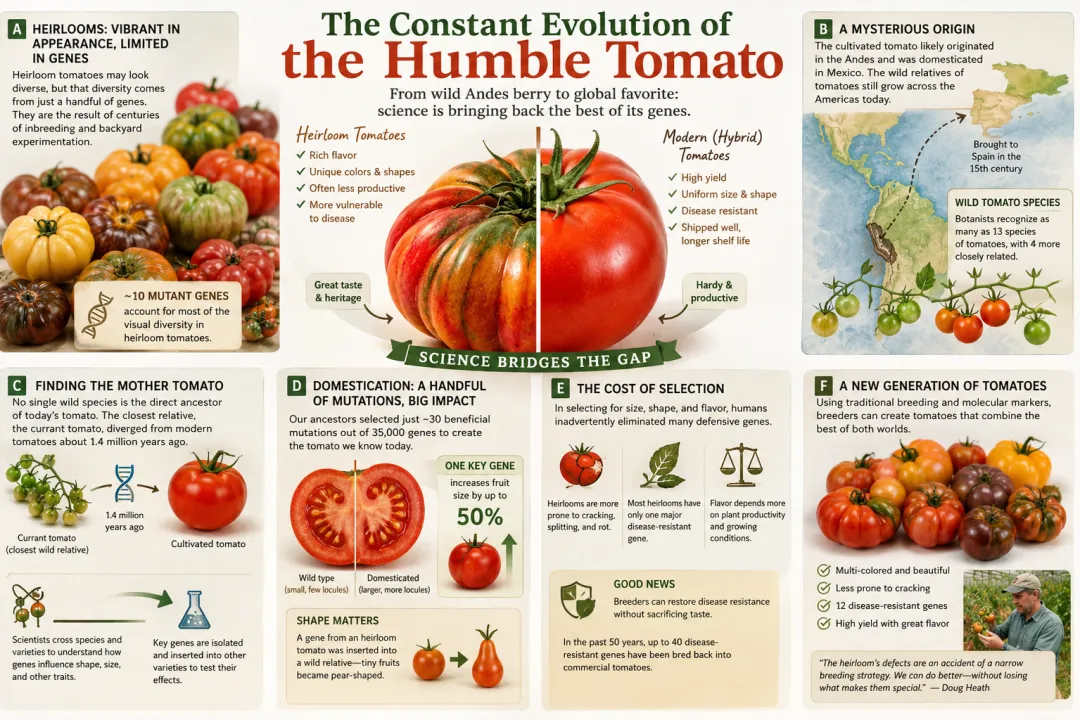
Heirloom tomatoes-varieties that have been passed down through several generations of a family because they are thought to have a particularly good flavor-are really no more 'natural' than the varieties available in grocery stores. New studies promise to restore their lost, healthy genes.
A Famous for their taste, color, and organic appearance, heirloom tomatoes are favorites of gardeners and advocates of locally grown foods.The tomato enthusiast might conclude that, given the immense varieties, heirlooms must have a more diverse and superiorset of genes than the tomatoes available in grocery stores, those ordinary hybrid varieties such as cherry and plum. However, their seeming diversity is only skin-deep: heirlooms are actually feeble and inbred—the defective product of breeding experiments that began hundreds of years ago, and exploded thanks to enthusiastic backyard gardeners. The irony of all this," says Steven Tanksley, a geneticist at Cornell University, is all that diversity of heirlooms can be accounted for by a handful of genes. There're probably no more than 10 mutant genes that create the diversity of heirlooms you see. But rather than simply proving that the myth about the heirloom's diversity is wrong, Tanksley's deconstruction of the tomato genome, along with work by others, is showing how a small berry-like fruit from the Andes became one of the world's top crops.
B The cultivated tomato is a member of the night shade family that includes New World crops such as the potato, which spread around the globe after Christopher Columbus brought them back to Spain in the 15th century. But whereas scientists have uncovered a wealth of archaeological evidence on early farming practices in the New World, the record is blank when it comes to the tomato.The modern tomato seems to have its origins in the Andesin South America and may have been domesticated in Vera Cruz, Mexico. Primitive varieties still grow throughout the Americas. All told, botanists call as many as 13 species 'tomatoes' and consider an additional four to be closely related.
C One might assume that one of these known wild species became today's cultivated crop, but that's not the case: the Mother Tomato has never been found. The closest relative is the currant tomato, which, based on genetic comparisons, split from today's tomato some 1.4 million years ago. So researchers like Tanksley have to work backward, crossing tomato varieties and species in order to understand how various genes influence shape and size.Once isolated, Tanksley later inserts those genes into other tomato varieties to make his case with a dramatic transformation.
D Tanksley concludes from his analyses that in their effort to make bigger, tastier, and faster- growing fruit, our ancestors ultimately exploited just 30 mutations out of the tomato's 35,000 genes. Most of these genes have only small effects on tomato size and shape, but recently Tanksley and his colleagues reported that they found a gene that increases fruit size by 50 percent. It was probably the most important event in domestication. The first written record of tomatoes-from Spainin the 15 oos - confirms that this mutation, which enlarges tomatoes by producing compartments known as locules, existed back in the same yellow tomatoes that gave Italians the word pomodoro, or golden apple. Besides size, tomato farmers also selected for shape. To discover those genes, Esther van der Knaap, a Tanksley alumnus now at The Ohio State University, took a gene from one heirloom tomato and inserted it into a wild relative. She observed that, as a result, the tiny fruits became shaped like pears.
Questions 14-17
Reading Passage has six paragraphs, A-F.
Which paragraph contains the following information?
Write the correct letter, A-F, in boxes 14-17 on your answer sheet
14 An explanation of research aimed at restoring the health of the heirloom tomato .............
15 A reference to a false belief about the heirloom tomato .............
16 A description of the flavor of the heirloom tomato .............
17 A reference to a single gene that significantly improves the cultivation of tomatoes .............
Questions 18-21
Look at the following statements (Questions 18-21) and the list of researchers below. Match each
statement with the correct researcher, A,B, C, or D.
Write the correct letter, A, B, C, or D, in boxes 18-21 on your answer sheet.
18 The transplanting of certain genes into tomatoes can change their shape. .............
19 The flavor of the heirloom tomato is largely dependent on actual yield and cultivation. .............
20 A new type of tomato can be produced that is stronger than the original heirloom tomato yet equally sweet and flavor some. .............
21 The wide variety of heirloom tomatoes is due to only a small number of genes. .............
私信up主免费领取完整原文,答案,解析,机考刷题账号!