PART.01
文本阅读

大意:本文是一篇说明文,介绍了一项剑桥大学的研究,发现深度欣赏艺术之美能提升抽象思维能力。
【原文出处】本文选自剑桥大学官网2025年5月7日名为 Pondering artistic beauty encourages 'big picture' thinking 的文章。
https://www.cam.ac.uk/stories/artistic-beauty-abstract-thinking?ucam-ref=research-most-popular
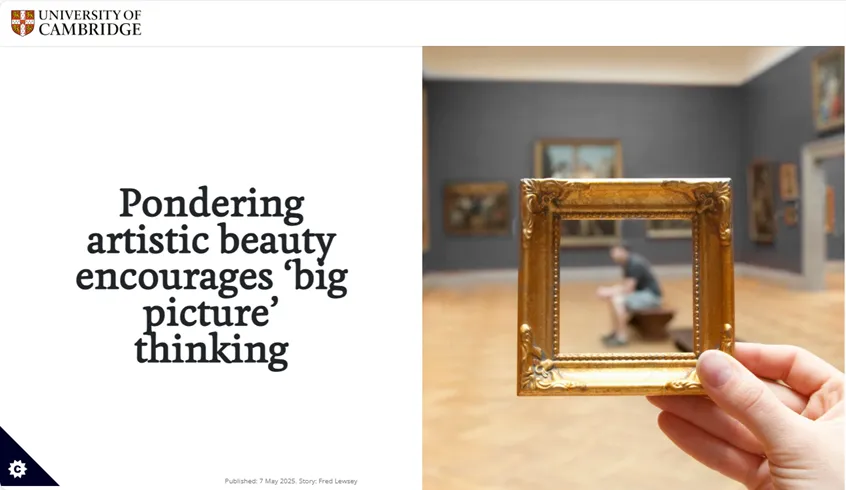
A team of Cambridge psychologists conducted an experiment to compare the cognitive(认知的) effects of merely seeing art with actively judging how beautiful it is.
In the study, 187 people were invited to visit Kettle's Yard gallery during an exhibition of handmade clay objects. Participants were randomly divided into two groups: the “beauty”group was asked to actively consider and then rate the beauty of each object they viewed, while the control group just matched a line drawing of the object with the artwork itself. All participants were then tested on how they process information, and whether it's in a more practical or abstract way.
Across all participants, those in the beauty group scored almost 14% higher on average than the control group in abstract thinking. While they were told the study was about cognitive processes, participants were asked about interests, with around half saying they had an artistic hobby. Among those, the effect was greater: those with an artistic hobby in the beauty group scored over 25% higher on average for abstract thinking than those with an artistic hobby in the control group.
Emotional states of participants were also measured by asking about their feelings while completing the gallery task. Across all participants, those in the beauty group reported an average of 23% higher levels of “transformative and self-transcendent feelings”—such as feeling moved, enlightened and inspired—than the control group. Importantly, however, the beauty group did not report feeling any happier than the control group, suggesting that it was the engagement with beauty that influenced abstract thinking, rather than any overall positivity from the experience.
"We usually think in very concrete terms when doing something on a screen,"said Simone Schnall, senior author of the study. "It's becoming much rarer to zone out and just let the mind wander, but that's when we think in ways that broaden our minds. Admiring the beauty of art may be the ideal way to initiate the abstract cognitive processes."
PART.02
阅读理解

32. What was the beauty group asked to do with the clay objects?
A. Draw their outlines
B. Give each piece a rating.
C. Compare their prices.
D. Make a copy of each piece.
33. Which participants got the highest score on average in the test?
A. Beauty group, with an artistic hobby.
B. Beauty group, without an artistic hobby.
C. Control group, with an artistic hobby.
D. Control group, without an artistic hobby.
34. Why were the participants' emotional states measured?
A. To discover their attitudes towards art.
B. To identify their specific thinking patterns.
C. To examine the difficulty of the tasks.
D. To determine factors behind the test results.
35. What is the major finding of the study regarding the appreciation of art?
A. It enhances emotional ties
B. It needs critical thinking skills.
C. It creates positive feelings.
D. It encourages abstract thinking.
PART.03
重点单词

1. conduct v 进行
2. merely adv 仅仅
3. actively adv 主动地
4. exhibition n 展览
5. handmade adj 手工制作的
6. clay n 黏土
7. object n 物品
8. participant n 参与者
9. randomly adv 随机地
10. rate v [名词动化]评估
11. process v 处理
12. practical adj 实际的
13. score v 得分
14. measure v 评估
15. transformative adj 具有变革性的;转化性的
16. enlighten v 启发
17. inspire v 赋予灵感
18. engagement n (与……的)密切关系;互动
19. overall adj 总体的
20. positivity n 积极性
21. concrete adj [熟词生义]具体的
22. admire v 欣赏
23. initiate v 开始
24. self-transcendent adj 超越自我的
PART.04
重点短语

PART.05
全文翻译

A team of Cambridge psychologists conducted an experiment to compare the cognitive(认知的) effects of merely seeing art with actively judging how beautiful it is.
In the study, 187 people were invited to visit Kettle's Yard gallery during an exhibition of handmade clay objects. Participants were randomly divided into two groups: the “beauty”group was asked to actively consider and then rate the beauty of each object they viewed, while the control group just matched a line drawing of the object with the artwork itself. All participants were then tested on how they process information, and whether it's in a more practical or abstract way.
剑桥大学的一组心理学家进行了一项实验,比较了仅仅观看艺术品与主动判断其美丽程度对认知的影响。
在这项研究中,187人被邀请在Kettle's Yard画廊参观一个手工粘土物品的展览。参与者被随机分为两组:“审美组”被要求主动思考并评价他们看到的每个物品的美丽程度,而对照组则只需将物品的线条图与艺术品本身配对。所有参与者随后接受了关于他们如何处理信息的测试,以及他们的思维方式是更实际还是更抽象。
Across all participants, those in the beauty group scored almost 14% higher on average than the control group in abstract thinking. While they were told the study was about cognitive processes, participants were asked about interests, with around half saying they had an artistic hobby. Among those, the effect was greater: those with an artistic hobby in the beauty group scored over 25% higher on average for abstract thinking than those with an artistic hobby in the control group.
在所有参与者中,审美组在抽象思维方面的平均得分比对照组高出近14%。尽管他们被告知这项研究是关于认知过程的,但参与者还被问及兴趣爱好,约有半数表示自己有艺术爱好。在这些有艺术爱好的人中,效果更为显著:审美组中有艺术爱好的人在抽象思维方面的平均得分比对照组中有艺术爱好的人高出超过25%。
Emotional states of participants were also measured by asking about their feelings while completing the gallery task. Across all participants, those in the beauty group reported an average of 23% higher levels of “transformative and self-transcendent feelings”—such as feeling moved, enlightened and inspired—than the control group. Importantly, however, the beauty group did not report feeling any happier than the control group, suggesting that it was the engagement with beauty that influenced abstract thinking, rather than any overall positivity from the experience.
研究还通过询问参与者在完成画廊任务时的感受来衡量他们的情绪状态。在所有参与者中,审美组报告的“转化性和超越自我的感受”——如感动、受到启发和灵感激发——的水平平均比对照组高出23%。然而,重要的是,审美组并没有报告他们比对照组感到更快乐,这表明影响抽象思维的是与美的互动本身,而非他们本次体验带来的整体积极情绪。
长难句分析:本句主干为the beauty group did not report feeling any happier。suggesting that...为动词-ing形式作结果状语;that引导宾语从句。从句中使用了it was ...that...强调句型,强调的部分是the engagement with beauty,rather than any overall positivity是与之比较的成分。
"We usually think in very concrete terms when doing something on a screen,"said Simone Schnall, senior author of the study. "It's becoming much rarer to zone out and just let the mind wander, but that's when we think in ways that broaden our minds. Admiring the beauty of art may be the ideal way to initiate the abstract cognitive processes."
“当我们在屏幕上做某些事情时,通常思维非常具体,”该研究的资深作者Simone Schnall说。“现在,放空自己、让思绪自由游荡变得越来越少见了,但正是在这种状态下,我们的思维方式才能拓宽思维。欣赏艺术之美可能是启动抽象认知过程的理想方式。”
PART.06
阅读理解解析

32. What was the beauty group asked to do with the clay objects?
A. Draw their outlines
B. Give each piece a rating.
C. Compare their prices.
D. Make a copy of each piece.
32. 审美组被要求对手工粘土物品做什么?A. 画出它们的轮廓B. 给每件作品打分C. 比较它们的价格D. 复制每一件作品
32. B 事实细节题 根据第二段 the“beauty”group was asked to actively consider and then rate the beauty of each object they viewed 可知,审美组的任务是对每件物品的审美进行评价打分,B项是 rate the beauty of each object they viewed 的同义替换。
33. Which participants got the highest score on average in the test?
A. Beauty group, with an artistic hobby.
B. Beauty group, without an artistic hobby.
C. Control group, with an artistic hobby.
D. Control group, without an artistic hobby.
33. 哪些参与者在测试中的平均得分最高?A. 有艺术爱好的审美组B. 没有艺术爱好的审美组C. 有艺术爱好的对照组D. 没有艺术爱好的对照组
33. A 事实细节题 根据第三段首句Across all participants, those in the beauty group scored almost 14% higher on average than the control group in abstract thinking.可知,审美组比对照组抽象思维的得分高14%,故可排除C、D两项。再结合最后一句 Among those, the effect was greater: those with an artistic hobby in the beauty group scored over 25% higher on average for abstract thinking than those with an artistic hobby in the control group.可知,审美组中有艺术爱好的参与者比对照组中有艺术爱好的抽象思维得分高25%,故选A项。
34. Why were the participants' emotional states measured?
A. To discover their attitudes towards art.
B. To identify their specific thinking patterns.
C. To examine the difficulty of the tasks.
D. To determine factors behind the test results.
34. 为什么要测量参与者的情绪状态?A. 为了发现他们对艺术的态度B. 为了识别他们具体的思维模式C. 为了检查任务的难度D. 为了确定测试结果背后的影响因素
34. D 推理判断题 根据第四段 the beauty group did not report feeling any happier than the control group, suggesting that it was the engagement with beauty that influenced abstract thinking, rather than any overall positivity from the experience. 可知,评估情绪状态是为了排除“整体积极情绪”这一因素,从而确定真正影响测试结果的是与美的互动,而非快乐情绪,故D项正确。
35. What is the major finding of the study regarding the appreciation of art?
A. It enhances emotional ties
B. It needs critical thinking skills.
C. It creates positive feelings.
D. It encourages abstract thinking.
35. 关于艺术欣赏,这项研究的主要发现是什么?A. 它能增强情感联系B. 它需要批判性思维技能C. 它能创造积极的情感体验D. 它能促进抽象思维
35. D 事实细节题 根据第三段审美组抽象思维得分更高、第四段排除快乐情绪的干扰,以及最后一段最后一句Admiring the beauty of art may be the ideal way to initiate the abstract cognitive processes.可知,欣赏艺术可以促进抽象思维。appreciation of art是Admiring the beauty of art的同义替换,encourages abstract thinking是initiate the abstract cognitive processes的同义替换。