
范文1
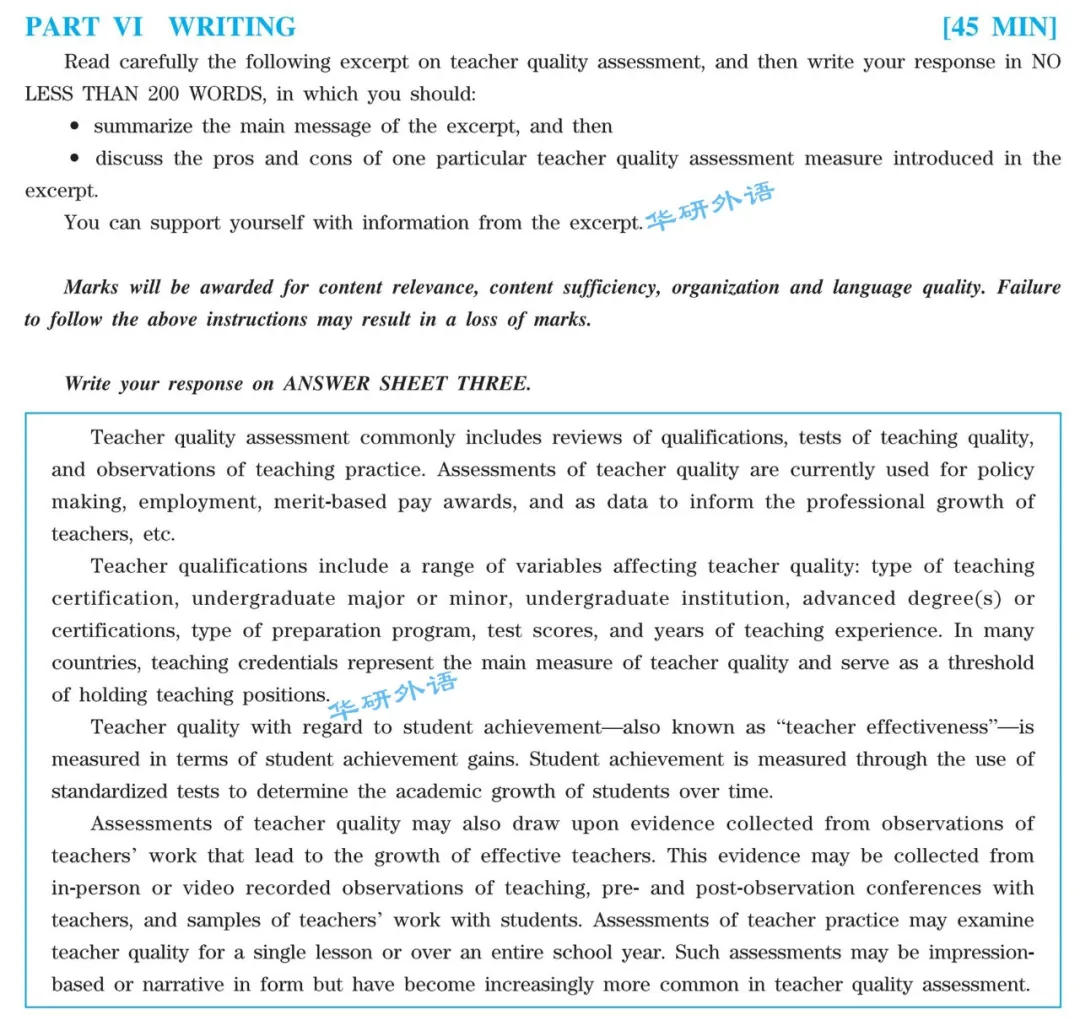
Teacher quality assessment commonly includes reviews of qualifications, tests of teaching qualityand observations of teaching practice. Assessments of teacher quality are currently used for policy making, employment, merit-based pay awards, and as data to inform the professional growth of teachers, etc.Teacher qualifications include a range of variables affecting teacher quality: type of teaching certification, undergraduate major or minor, undergraduate institution, advanced degree(s) or certifications, type of preparation program, test scores, and years of teaching experience. In many countries, teaching credentials represent the main measure of teacher quality and serve as a threshold of holding teaching positions.Teacher quality with regard to student achievement also known as “teacher effectiveness”--is measured in terms of student achievement gains. $tudent achievement is measured through the use of standardized tests to determine the academic growth of students over time.Assessments of teacher quality may also draw upon evidence collected from observations of teachers’ work that lead to the growth of effective teachers, This evidence may be collected from in-person or video recorded observations of teaching, pre- and post-observation conferences with teachers, and samples of teachers’ work with students, Assessments of teacher practice may examine teacher quality for a single lesson or over an entire school year, Such assessments may be impression-based or narrative in form but have become increasingly more common in teacher quality assessment.
范文2
Teacher quality assessment is a complex process that are used for multiple purposes including policy making, employment, merit-based pay awards, and professional development. It involves many aspects such as qualifications, teacher effectiveness, andobservation of teaching practices. There are some specific approaches to evaluate each aspect. This essay will discuss the benefits and drawbacks of measuring teacher effectiveness with regard to student achievement.On the one hand, using students' test results as a measurement for teacher performance can motivate teachers to improvetheir pedagogy and classroom management to enhance student achievements. In addition, this assessment approach can increase a sense of responsibility among teachers, prompting them to pay more attention to the neediest students in and outside the classroom.On the other hand, tying teacher performance to students' standardized test scores is not always fair. Several other factors including the quality of curriculum design, class size, and out-of-school learning experiences, can affect students’ academic outcomes. Consequently, using test scores as the sole criterion for evaluating teaching quality can undermine teacher morale. Moreover, this approach can also discourage teachers in the same school from working as a team, as individual teachers have to compete against one another for rewards and promotion. Exploring students’ maximum potential depends to a great extenton collaboration of the teaching staff who works across classroom and grade boundaries.In conclusion, although evaluating teaching quality based on students’ test results may bring some advantages, it is too narrow an approach. For more objective assessment of teacher performances, other measures are needed.