

1.简介
定义:时态用来表示动作发生的时间,是英语语法中的一个重要组成部分。
重要性:掌握时态对于正确表达时间概念、提高语言交流能力至关重要。
2.常见时态及其用法
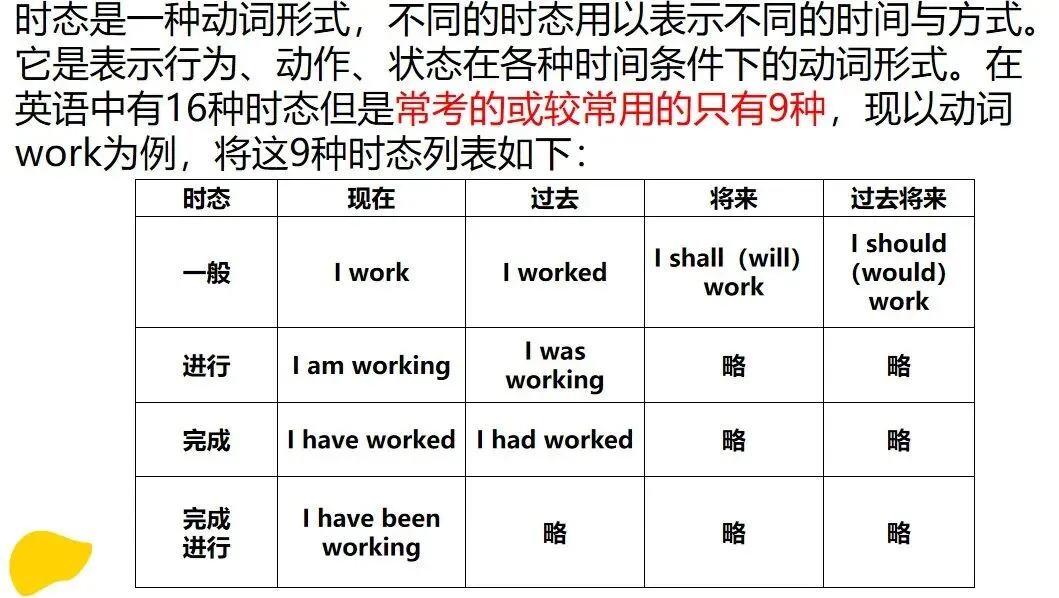
一般现在时(Simple Present Tense)
用法:
表示经常性或习惯性的动作(I go to school every day.)
表示普遍真理或事实(Water boils at 100 degrees Celsius.)
结构:主语+动词原形/动词+s/es (第三人称单数)
一般过去时(Simple Past Tense)
用法:
表示过去某一特定时间发生的动作或状态(She visited her grandparents last week.)
结构:主语+动词过去式
一般将来时(Simple Future Tense)
用法:
表示将来要发生的动作或状态(We will travel to Japan next year.)
结构:主语+ will +动词原形
现在进行时(Present Continuous Tense)
用法:
表示说话时正在进行的动作(He is reading a book.)
表示近期计划或安排(We are having a meeting tomorrow.)
结构:主语+ be (am/is/are) +动词-ing形式
过去进行时(Past Continuous Tense)
用法:
表示过去某一时刻正在发生的动作(They were playing football when it
started to rain.)
结构:主语+ was/were +动词-ing形式
将来进行时(Future Continuous Tense)
用法:
表示将来某一时刻正在发生的动作(At this time tomorrow, I will be
flying to New York.)
结构:主语+ will be +动词-ing形式
现在完成时(Present Perfect Tense)
用法:
表示过去发生的动作对现在的影响(I have just eaten.)
表示过去的经历(He has traveled to many countries.)
结构:主语+ have/has +过去分词
过去完成时(Past Perfect Tense)
用法:
表示过去的过去(By the time we arrived, the movie had already started.)
结构:主语+ had +过去分词
将来完成时(Future Perfect Tense)
用法:
表示将来某一时点前已经完成的动作(By next year, I will have finished
my degree.)
结构:主语+ will have +过去分词
3.例句与解析
一般现在时:
例句:She plays the piano every Sunday.
解析:表示她每个星期天都弹钢琴,是一个习惯性的动作。
一般过去时:
例句:He watched a movie yesterday.
解析:表示他昨天看了一部电影,动作发生在过去。
一般将来时:
例句:We will meet you at the airport.
解析:表示我们将要在机场见你,动作将在未来发生。
现在进行时:
例句:They are cooking dinner now.
解析:表示他们现在正在做饭,动作正在进行。
过去进行时:
例句:She was writing a letter when I called her.
解析:表示当我打电话给她时,她正在写信,动作在过去某个时间点正在进行。
将来进行时:
例句:This time next week, we will be enjoying our vacation.
解析:表示下周这个时候,我们将在享受假期,动作将在将来某个时间点正在进行。
现在完成时:
例句:I have just eaten breakfast.
解析:表示我刚刚吃过早餐,强调这个动作对现在的影响。
过去完成时:
例句:By the time he got home, she had already left.
解析:表示在他到家之前,她已经离开了,强调过去的过去。
将来完成时:
例句:By next year, I will have completed my project.
解析:表示到明年为止,我将已经完成了我的项目,强调将来某一时点
前已经完成的动作。
4.易错点提示
混淆一般现在时和现在进行时:注意区分经常性动作和正在进行的动作。
过去完成时的使用:确保理解“过去的过去”这一概念。
现在完成时的持续性:注意现在完成时可以用于表示持续到现在的情况。
5.练习题
基础题:选择合适的时态填空。
1.She (plays / is playing) the piano every Sunday.
2.They (watched / have watched) a movie yesterday.
3.We (will meet / will be meeting) you at the airport.
4.He (is cooking / cooks) dinner now.
5.By the time he got home, she (had left / has left).
中等题:改写句子,使其符合给定的时态。
6.She plays the piano every Sunday. (改为过去时)
7.They watched a movie yesterday. (改为现在完成时)
8.We will meet you at the airport. (改为将来进行时)
9.He is cooking dinner now. (改为过去进行时)
10. By the time he got home, she had left. (改为将来完成时)
高级题:根据上下文,使用适当的时态完成句子。
11. If you (need / will need) any help, just let me know.
12. It (could / can) be John; he promised to call.
13. You (ought to / should) apologize for being late.
14. (Will / Would) you mind closing the window?
15. (Must / Have to) we wear uniforms to the party?
答案及解析
基础题答案:
1.plays
2.watched
3.will meet
4.is cooking
5.had left
中等题答案:
6.She played the piano every Sunday.
7.They have watched a movie yesterday.
8.We will be meeting you at the airport.
9.He was cooking dinner then.
10. By the time he gets home, she will have left.
高级题答案:
11. If you need any help, just let me know.
12. It could be John; he promised to call.
13. You ought to apologize for being late.
14. Would you mind closing the window?
15. Must we wear uniforms to the party?
更多中考复习资料及专题练习,可公众号后台对话框回复:中考英语
你的关注和点赞是我更新的动力~
- END -


