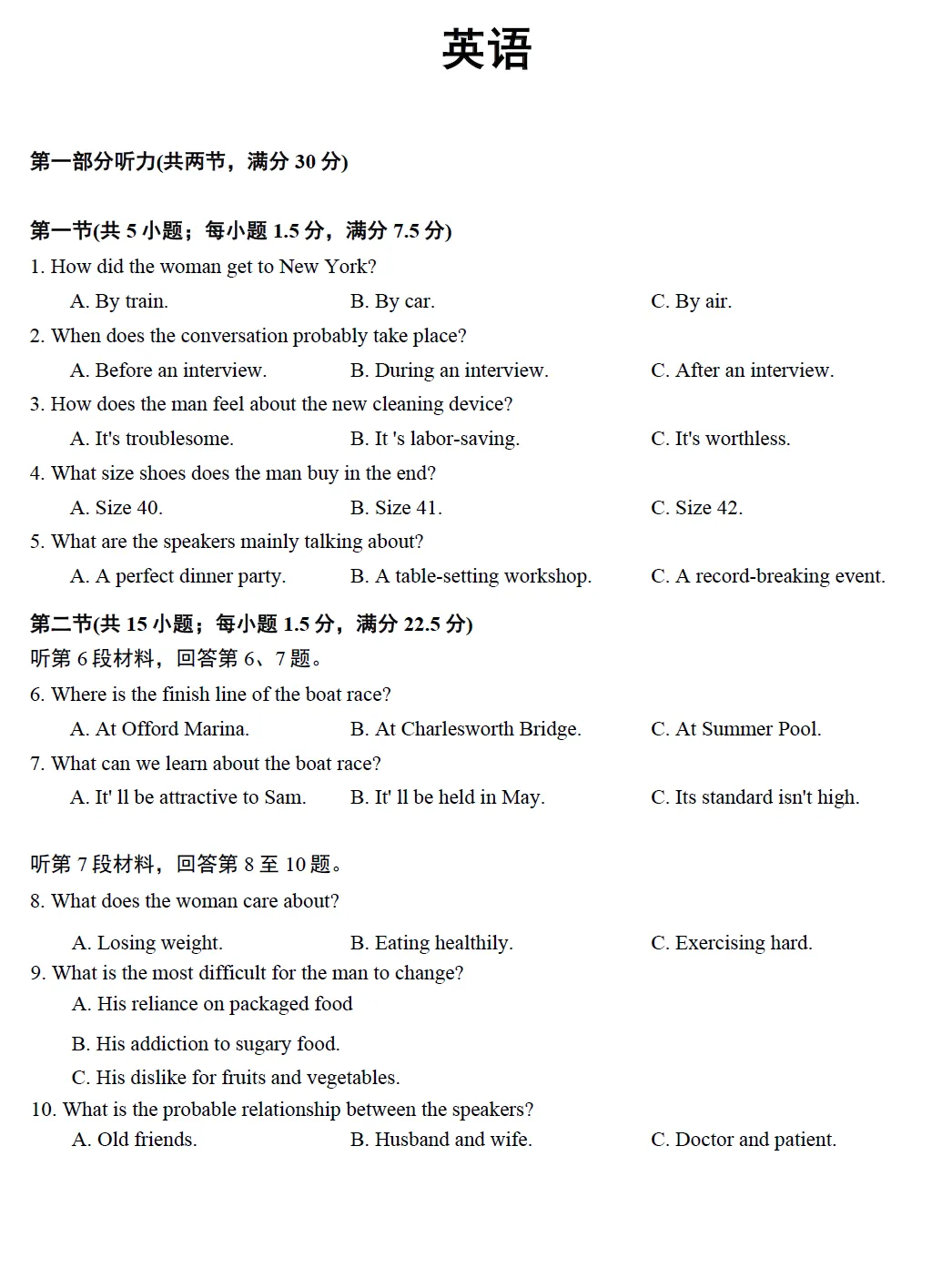
第一部分听力(共两节,满分30分)
第一节(共5小题;每小题1.5分,满分7.5分)
1. How did the woman get to New York?
A. By train.B. By car.C. By air.
2. When does the conversation probably take place?
A. Before an interview.B. During an interview.C. After an interview.
3. How does the man feel about the new cleaning device?
A. It's troublesome.B. It 's labor-saving.C. It's worthless.
4. What size shoes does the man buy in the end?
A. Size 40.B. Size 41.C. Size 42.
5. What are the speakers mainly talking about?
A. A perfect dinner party.B. A table-setting workshop.C. A record-breaking event.
第二节(共15小题;每小题1.5分,满分22.5分)
听第6段材料,回答第6、7题。
6. Where is the finish line of the boat race?
A. At Offord Marina.B. At Charlesworth Bridge.C. At Summer Pool.
7. What can we learn about the boat race?
A. It' ll be attractive to Sam.B. It' ll be held in May.C. Its standard isn't high.
听第7段材料,回答第8至10题。
8. What does the woman care about?
A. Losing weight.B. Eating healthily.C. Exercising hard.
9. What is the most difficult for the man to change?
A. His reliance on packaged food
B. His addiction to sugary food.
C. His dislike for fruits and vegetables.
10. What is the probable relationship between the speakers?
A. Old friends.B. Husband and wife.C. Doctor and patient.
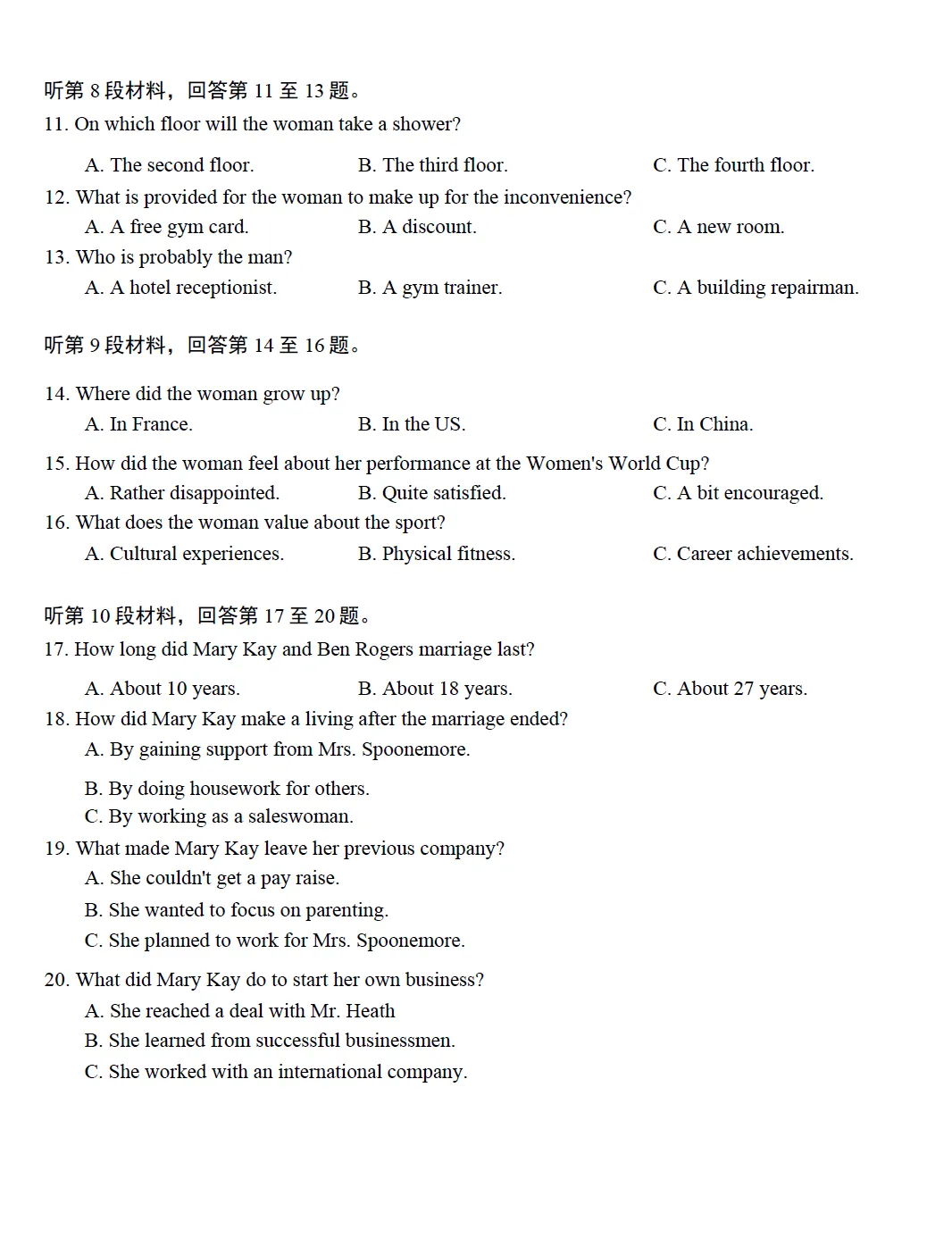
听第8段材料,回答第11至13题。
11. On which floor will the woman take a shower?
A. The second floor.B. The third floor.C. The fourth floor.
12. What is provided for the woman to make up for the inconvenience?
A. A free gym card.B. A discount.C. A new room.
13. Who is probably the man?
A. A hotel receptionist.B. A gym trainer.C. A building repairman.
听第9段材料,回答第14至16题。
14. Where did the woman grow up?
A. In France.B. In the US.C. In China.
15. How did the woman feel about her performance at the Women's World Cup?
A. Rather disappointed.B. Quite satisfied.C. A bit encouraged.
16. What does the woman value about the sport?
A. Cultural experiences.B. Physical fitness.C. Career achievements.
听第10段材料,回答第17至20题。
17. How long did Mary Kay and Ben Rogers marriage last?
A. About 10 years.B. About 18 years.C. About 27 years.
18. How did Mary Kay make a living after the marriage ended?
A. By gaining support from Mrs. Spoonemore.
B. By doing housework for others.
C. By working as a saleswoman.
19. What made Mary Kay leave her previous company?
A. She couldn't get a pay raise.
B. She wanted to focus on parenting.
C. She planned to work for Mrs. Spoonemore.
20. What did Mary Kay do to start her own business?
A. She reached a deal with Mr. Heath
B. She learned from successful businessmen.
C. She worked with an international company.
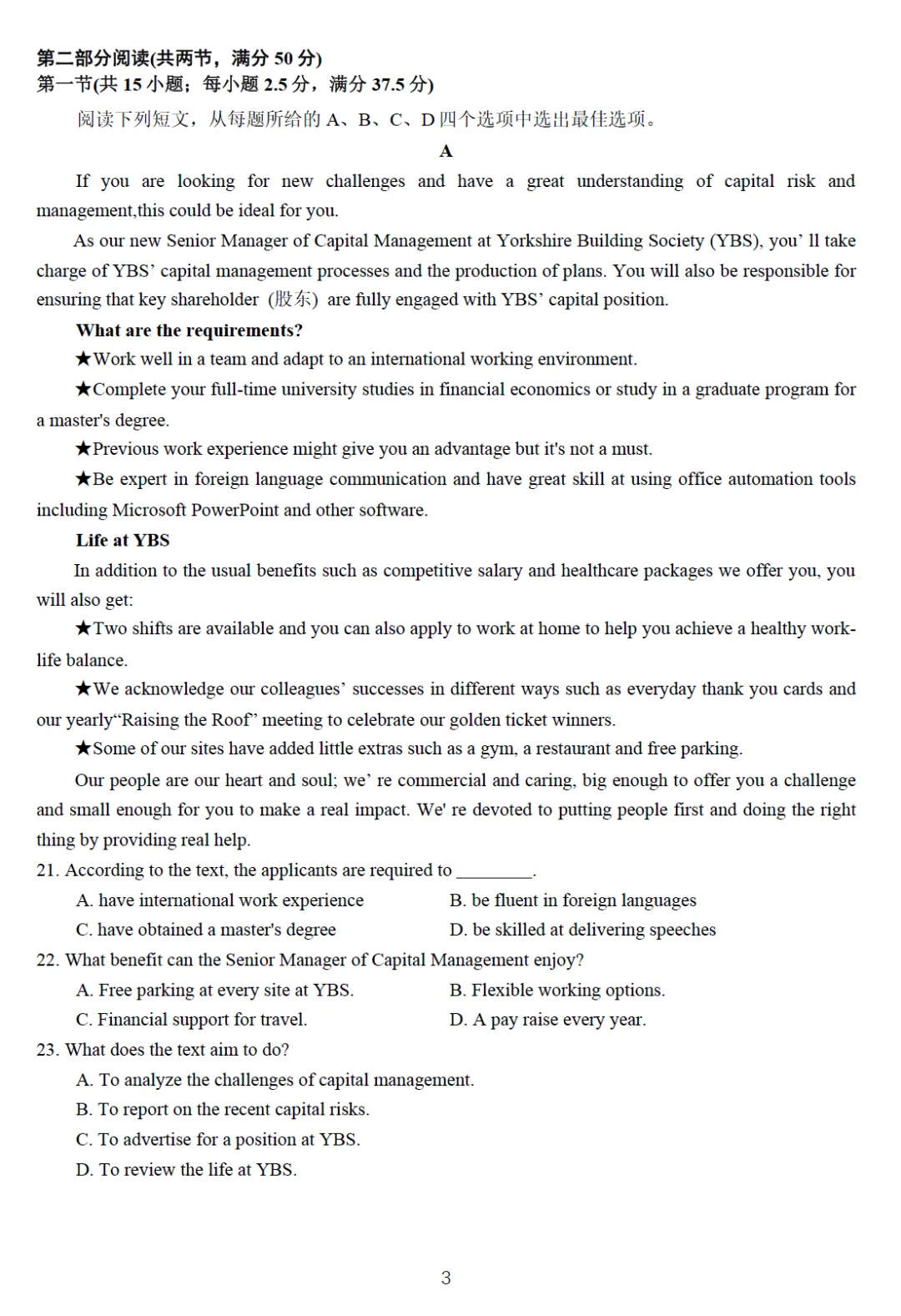
第二部分阅读(共两节,满分50分)
第一节(共15小题;每小题2.5分,满分37.5分)
阅读下列短文,从每题所给的A、B、C、D四个选项中选出最佳选项。
A
If you are looking for new challenges and have a great understanding of capital risk and management,this could be ideal for you.
As our new Senior Manager of Capital Management at Yorkshire Building Society (YBS), you’ ll take charge of YBS’ capital management processes and the production of plans. You will also be responsible for ensuring that key shareholder(股东)are fully engaged with YBS’ capital position.
What are the requirements?
★Work well in a team and adapt to an international working environment.
★Complete your full-time university studies in financial economics or study in a graduate program for a master's degree.
★Previous work experience might give you an advantage but it's not a must.
★Be expert in foreign language communication and have great skill at using office automation tools including Microsoft PowerPoint and other software.
Life at YBS
In addition to the usual benefits such as competitive salary and healthcare packages we offer you, you will also get:
★Two shifts are available and you can also apply to work at home to help you achieve a healthy work-life balance.
★We acknowledge our colleagues’ successes in different ways such as everyday thank you cards and our yearly“Raising the Roof” meeting to celebrate our golden ticket winners.
★Some of our sites have added little extras such as a gym, a restaurant and free parking.
Our people are our heart and soul; we’ re commercial and caring, big enough to offer you a challenge and small enough for you to make a real impact. We' re devoted to putting people first and doing the right thing by providing real help.
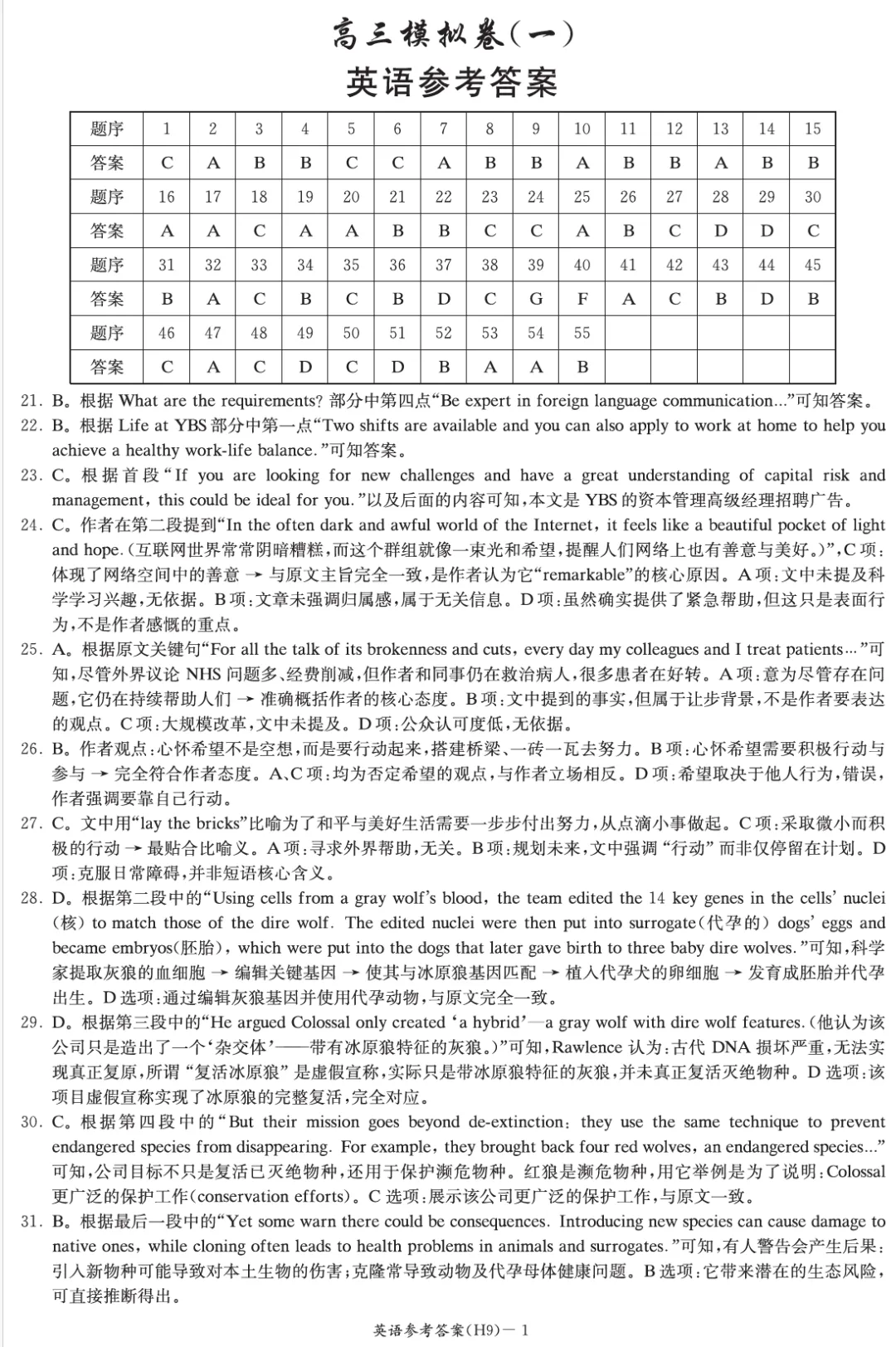
21. According to the text, the applicants are required to .
A. have international work experienceB. be fluent in foreign languages
C. have obtained a master's degreeD. be skilled at delivering speeches
22. What benefit can the Senior Manager of Capital Management enjoy?
A. Free parking at every site at YBS.B. Flexible working options.
C. Financial support for travel.D. A pay raise every year.
23. What does the text aim to do?
A. To analyze the challenges of capital management.
B. To report on the recent capital risks.
C. To advertise for a position at YBS.
D. To review the life at YBS.
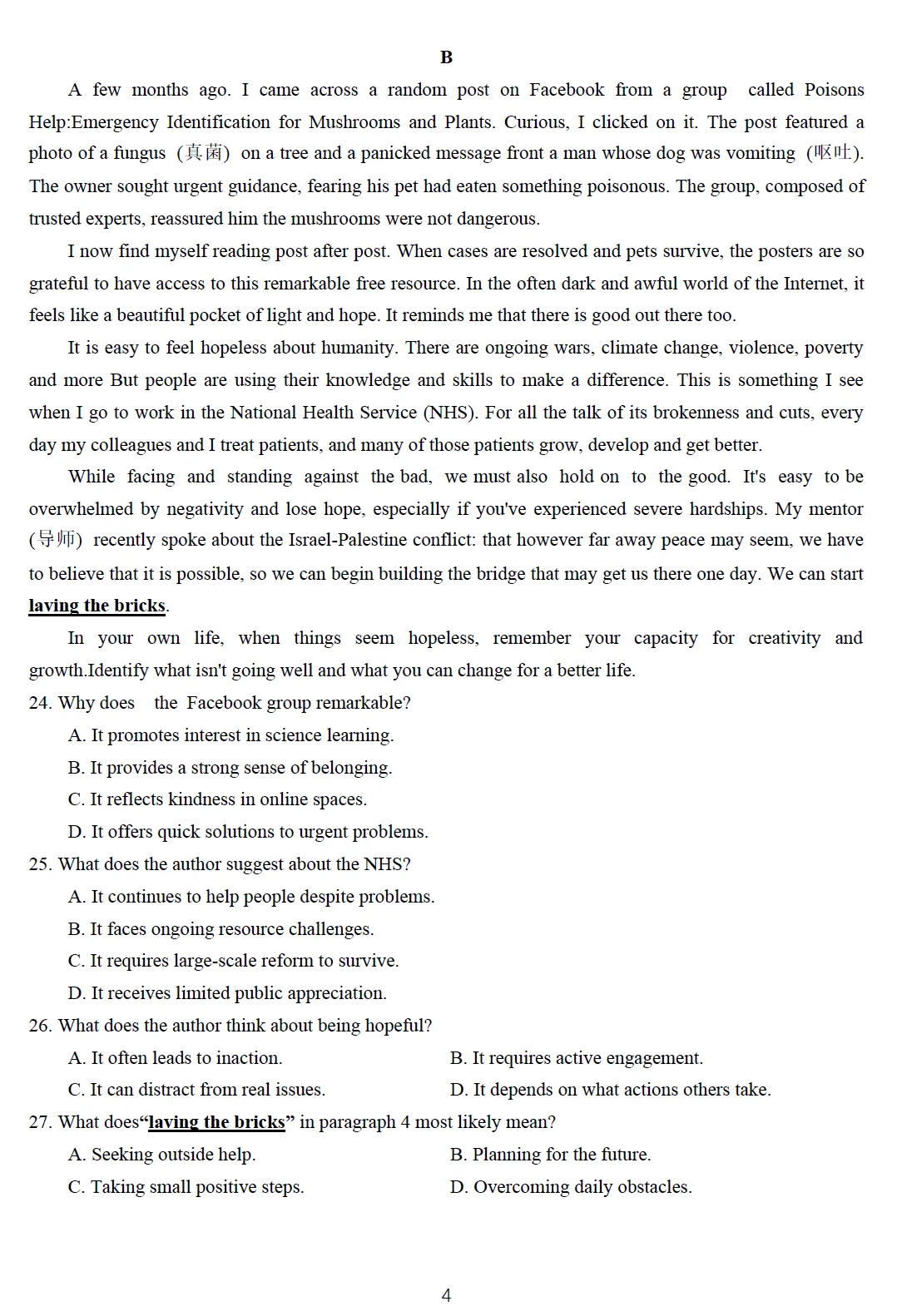
B
A few months ago. I came across a random post on Facebook from a groupcalled Poisons Help:Emergency Identification for Mushrooms and Plants. Curious, I clicked on it. The post featured a photo of a fungus(真菌)on a tree and a panicked message front a man whose dog was vomiting(呕吐). The owner sought urgent guidance, fearing his pet had eaten something poisonous. The group, composed of trusted experts, reassured him the mushrooms were not dangerous.
I now find myself reading post after post. When cases are resolved and pets survive, the posters are so grateful to have access to this remarkable free resource. In the often dark and awful world of the Internet, it feels like a beautiful pocket of light and hope. It reminds me that there is good out there too.
It is easy to feel hopeless about humanity. There are ongoing wars, climate change, violence, poverty and more But people are using their knowledge and skills to make a difference. This is something I see whenI go to work in the National Health Service (NHS). For all the talk of its brokenness and cuts, every day my colleagues and I treat patients, and many of those patients grow, develop and get better.
Whilefacingandstandingagainstthe bad,we must alsohold ontothe good.It'seasyto be overwhelmed by negativity and lose hope, especially if you've experienced severe hardships. My mentor(导师)recently spoke about the Israel-Palestine conflict: that however far away peace may seem, we have to believe that it is possible, so we can begin building the bridge that may get us there one day. We can start laving the bricks.
In your own life, when things seem hopeless, remember your capacity for creativity and growth.Identify what isn't going well and what you can change for a better life.
24. Why doestheFacebook group remarkable?
A. It promotes interest in science learning.
B. It provides a strong sense of belonging.
C. It reflects kindness in online spaces.
D. It offers quick solutions to urgent problems.
25. What does the author suggest about the NHS?
A. It continues to help people despite problems.
B. It faces ongoing resource challenges.
C. It requires large-scale reform to survive.
D. It receives limited public appreciation.
26. What does the author think about being hopeful?
A. It often leads to inaction.B. It requires active engagement.
C. It can distract from real issues.D. It depends on what actions others take.
27. What does“laving the bricks” in paragraph 4 most likely mean?
A. Seeking outside help.B. Planning for the future.
C. Taking small positive steps.D. Overcoming daily obstacles.
C
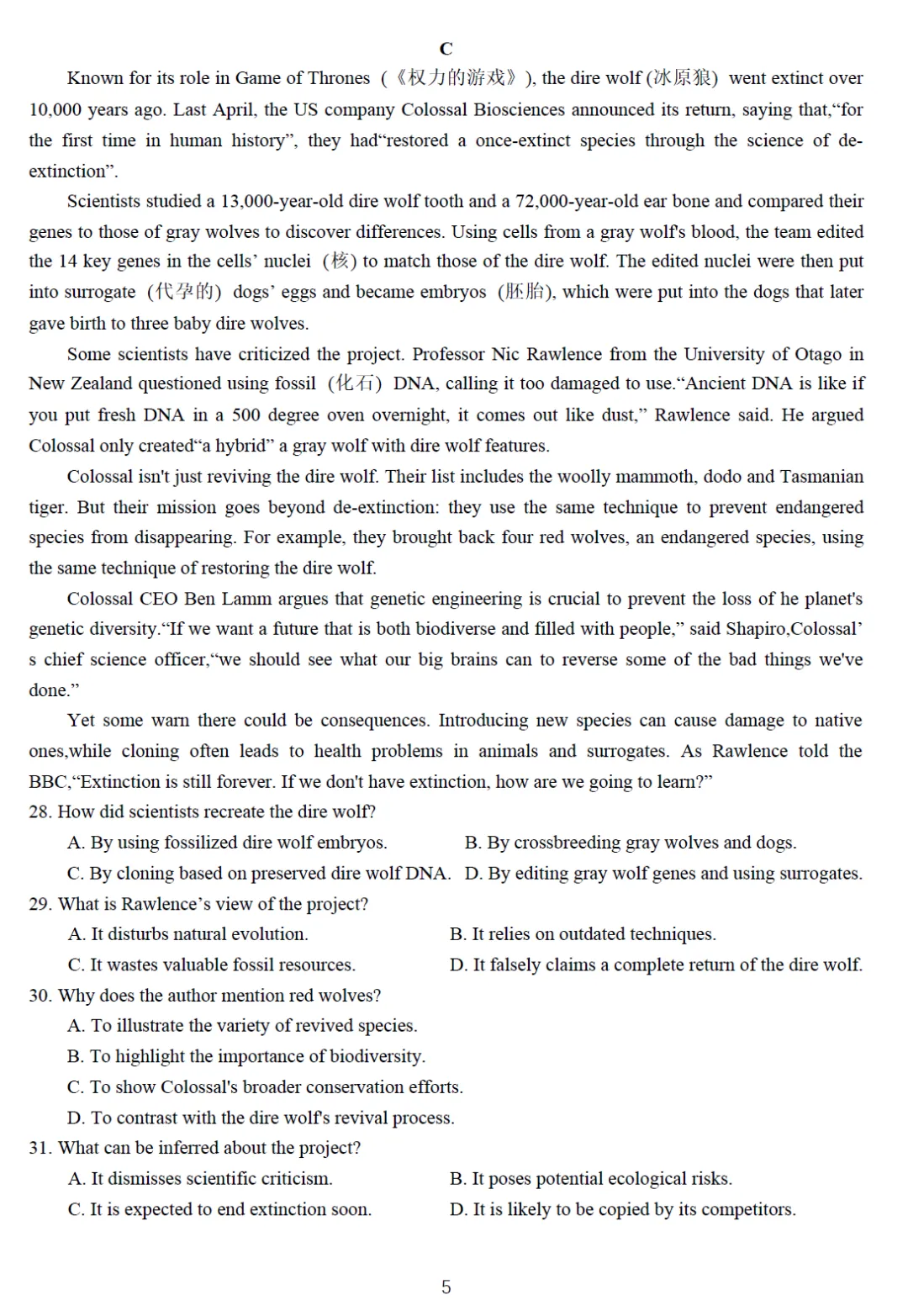
Known for its role in Game of Thrones(《权力的游戏》), the dire wolf (冰原狼)went extinct over 10,000 years ago. Last April, the US company Colossal Biosciences announced its return, saying that,“for the first time in human history”, they had“restored a once-extinct species through the science of de-extinction”.
Scientists studied a 13,000-year-old dire wolf tooth and a 72,000-year-old ear bone and compared their genes to those of gray wolves to discover differences. Using cells from a gray wolf's blood, the team edited the 14 key genes in the cells’ nuclei(核) to match those of the dire wolf. The edited nuclei were then put into surrogate(代孕的)dogs’ eggs and became embryos(胚胎), which were put into the dogs that later gave birth to three baby dire wolves.
Some scientists have criticized the project. Professor Nic Rawlence from the University of Otago inNew Zealand questioned using fossil(化石)DNA, calling it too damaged to use.“Ancient DNA is like if you put fresh DNA in a 500 degree oven overnight, it comes out like dust,” Rawlence said. He arguedColossal only created“a hybrid” a gray wolf with dire wolf features.
Colossal isn't just reviving the dire wolf. Their list includes the woolly mammoth, dodo and Tasmanian tiger. But their mission goes beyond de-extinction: they use the same technique to prevent endangered species from disappearing. For example, they brought back four red wolves, an endangered species, using the same technique of restoring the dire wolf.
Colossal CEO Ben Lamm argues that genetic engineering is crucial to prevent the loss of he planet's genetic diversity.“If we want a future that is both biodiverse and filled with people,” said Shapiro,Colossal’ s chief science officer,“we should see what our big brains can to reverse some of the bad things we've done.”
Yet some warn there could be consequences. Introducing new species can cause damage to native ones,while cloning often leads to health problems in animals and surrogates. As Rawlence told the BBC,“Extinction is still forever. If we don't have extinction, how are we going to learn?”
28. How did scientists recreate the dire wolf?
A. By using fossilized dire wolf embryos.B. By crossbreeding gray wolves and dogs.
C. By cloning based on preserved dire wolf DNA.D. By editing gray wolf genes and using surrogates.
29. What is Rawlence’s view of the project?
A. It disturbs natural evolution.B. It relies on outdated techniques.
C. It wastes valuable fossil resources.D. It falsely claims a complete return of the dire wolf.
30. Why does the author mention red wolves?
A. To illustrate the variety of revived species.
B. To highlight the importance of biodiversity.
C. To show Colossal's broader conservation efforts.
D. To contrast with the dire wolf's revival process.
31. What can be inferred about the project?
A. It dismisses scientific criticism.B. It poses potential ecological risks.
C. It is expected to end extinction soon.D. It is likely to be copied by its competitors.
D
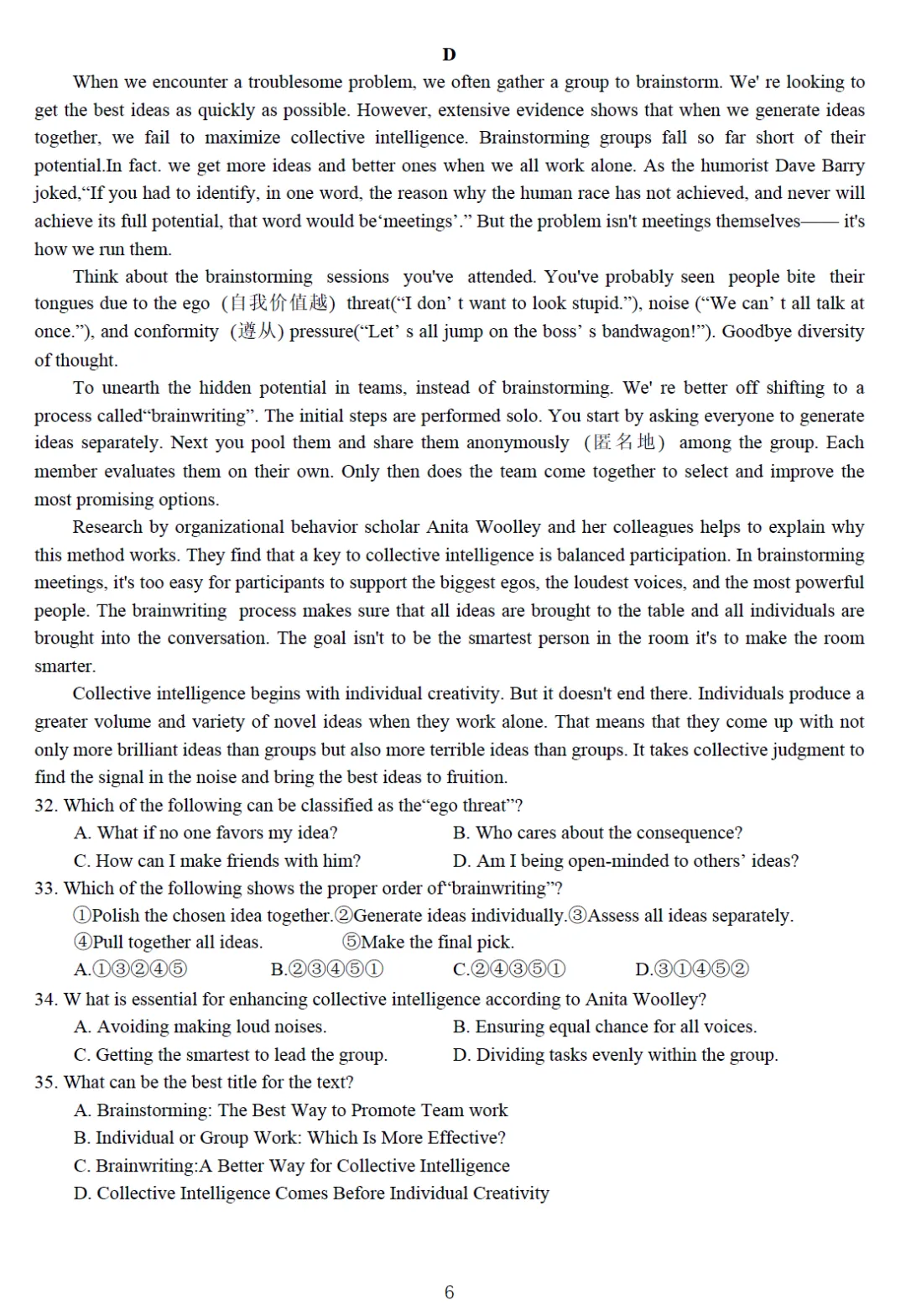
When we encounter a troublesome problem, we often gather a group to brainstorm. We' re looking to get the best ideas as quickly as possible. However, extensive evidence shows that when we generate ideas together, we fail to maximize collective intelligence. Brainstorming groups fall so far short of their potential.In fact. we get more ideas and better ones when we all work alone. As the humorist Dave Barry joked,“If you had to identify, in one word, the reason why the human race has not achieved, and never will achieve its full potential, that word would be‘meetings’.” But the problem isn't meetings themselves—— it's how we run them.
Think about the brainstormingsessionsyou'veattended. You've probably seenpeople bitetheir tongues due to the ego(自我价值越)threat(“I don’ t want to look stupid.”), noise (“We can’ t all talk at once.”), and conformity(遵从) pressure(“Let’ s all jump on the boss’ s bandwagon!”). Goodbye diversity of thought.
To unearth the hidden potential in teams, instead of brainstorming. We' re better off shifting to a process called“brainwriting”. The initial steps are performed solo. You start by asking everyone to generate ideas separately. Next you pool them and share them anonymously(匿名地)among the group. Each member evaluates them on their own. Only then does the team come together to select and improve the most promising options.
Research by organizational behavior scholar Anita Woolley and her colleagues helps to explain why this method works. They find that a key to collective intelligence is balanced participation. In brainstorming meetings, it's too easy for participants to support the biggest egos, the loudest voices, and the most powerful people. The brainwritingprocess makes sure that all ideas are brought to the table and all individuals are brought into the conversation. The goal isn't to be the smartest person in the room it's to make the room smarter.
Collective intelligence begins with individual creativity. But it doesn't end there. Individuals produce a greater volume and variety of novel ideas when they work alone. That means that they come up with not only more brilliant ideas than groups but also more terrible ideas than groups. It takes collective judgment to find the signal in the noise and bring the best ideas to fruition.
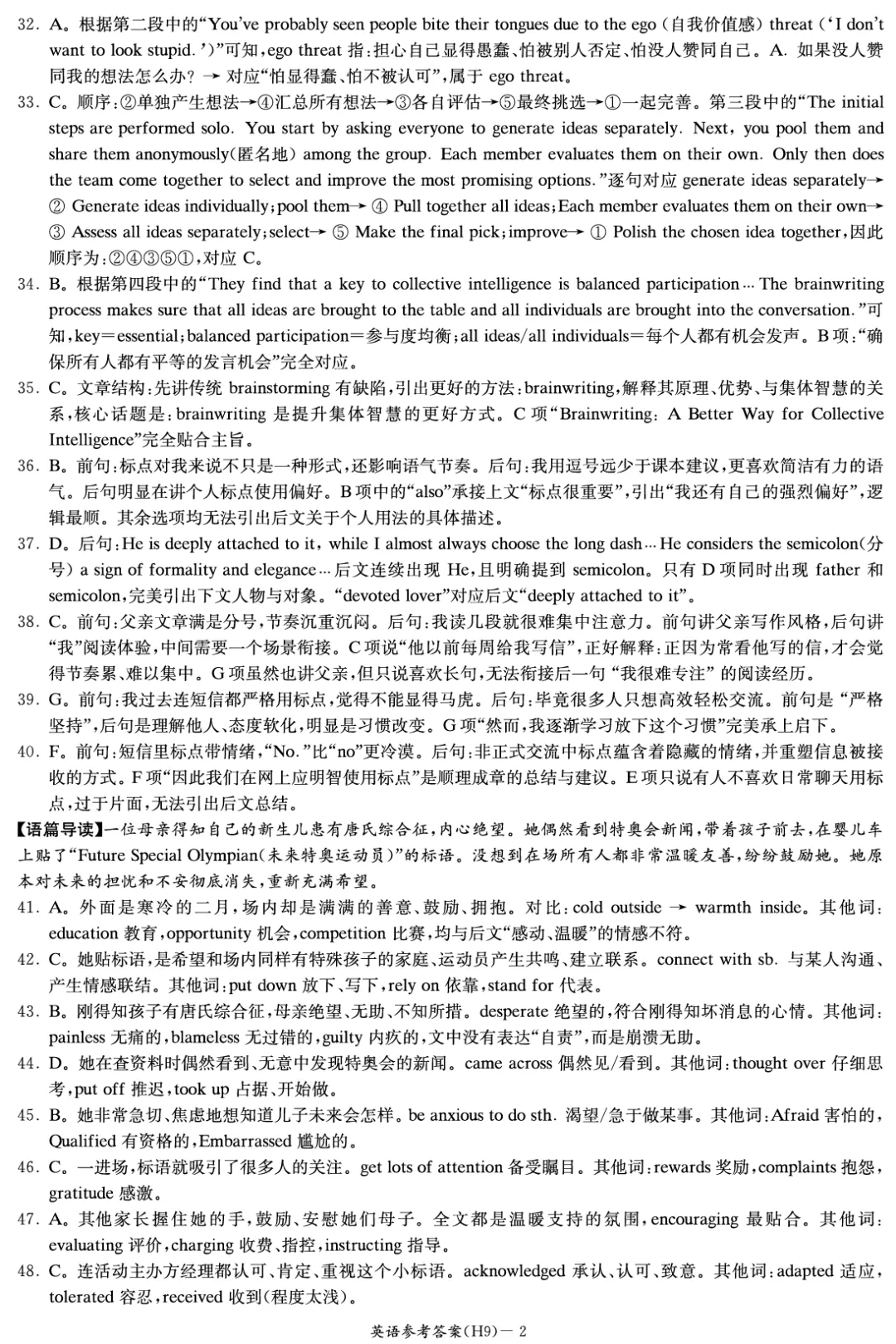
32. Which of the following can be classified as the“ego threat”?
A. What if no one favors my idea?B. Who cares about the consequence?
C. How can I make friends with him?D. Am I being open-minded to others’ ideas?
33. Which of the following shows the proper order of“brainwriting”?
①Polish the chosen idea together.②Generate ideas individually.③Assess all ideas separately.
④Pull together all ideas.⑤Make the final pick.
A.①③②④⑤B.②③④⑤①C.②④③⑤①D.③①④⑤②
34. W hat is essential for enhancing collective intelligence according to Anita Woolley?
A. Avoiding making loud noises.B. Ensuring equal chance for all voices.
C. Getting the smartest to lead the group.D. Dividing tasks evenly within the group.
35. What can be the best title for the text?
A. Brainstorming: The Best Way to Promote Team work
B. Individual or Group Work: Which Is More Effective?
C. Brainwriting:A Better Way for Collective Intelligence
D. Collective Intelligence Comes Before Individual Creativity
第二节 七选五 (共5小题;每小题2.5分、满分12.5分)
阅读下面短文,从短文后的选项中选出可以填人空白处的最佳选项。选项中有两项为多余选项
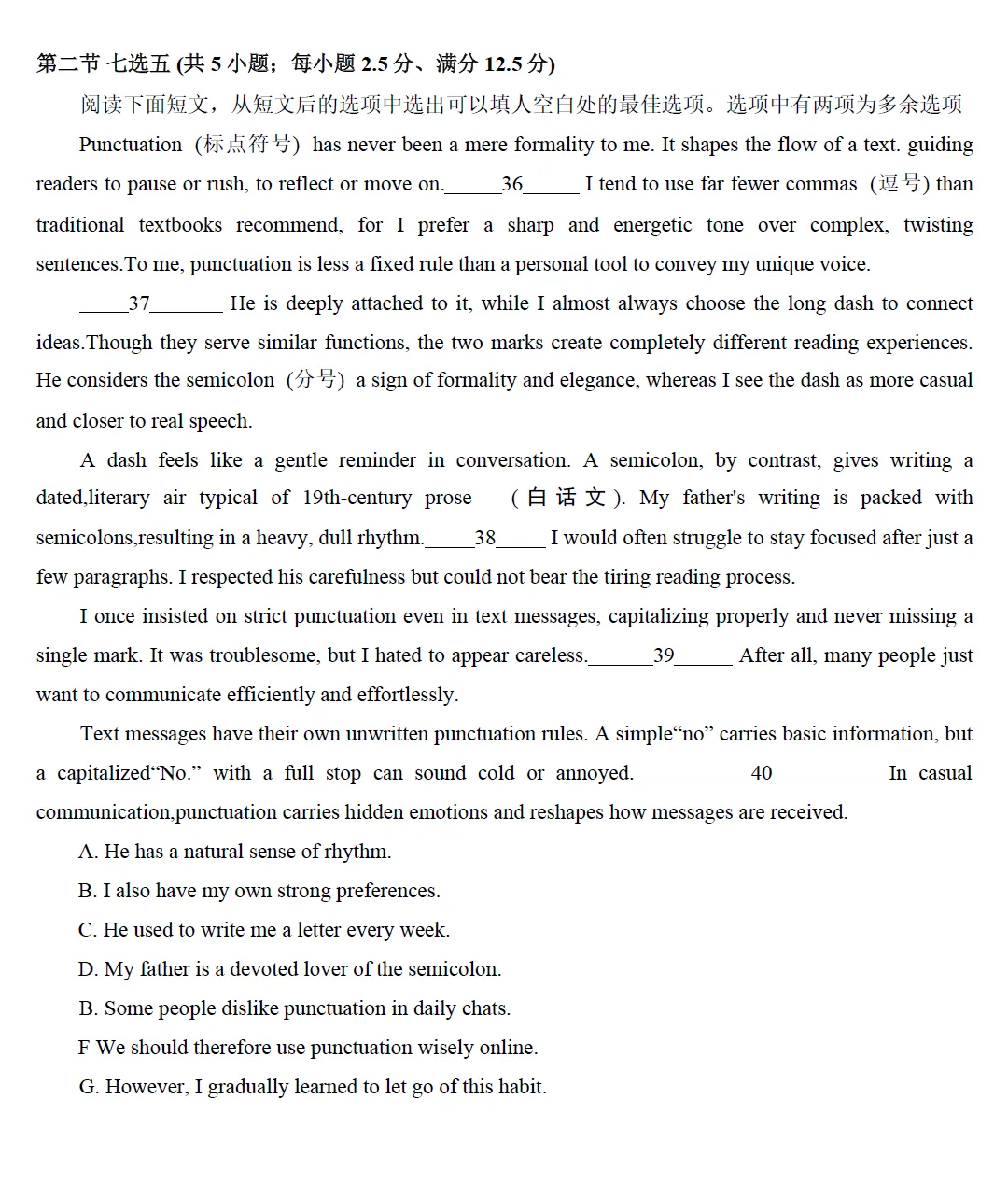
Punctuation(标点符号)has never been a mere formality to me. It shapes the flow of a text. guiding readers to pause or rush, to reflect or move on.36 I tend to use far fewer commas(逗号) than traditional textbooks recommend, for I prefer a sharp and energetic tone over complex, twisting sentences.To me, punctuation is less a fixed rule than a personal tool to convey my unique voice.
37 He is deeply attached to it, while I almost always choose the long dash to connect ideas.Though they serve similar functions, the two marks create completely different reading experiences. He considers the semicolon(分号)a sign of formality and elegance, whereas I see the dash as more casual and closer to real speech.
A dash feels like a gentle reminder in conversation. A semicolon, by contrast, gives writing a dated,literary air typical of 19th-century prose(白话文). My father's writing is packed with semicolons,resulting in a heavy, dull rhythm.38 I would often struggle to stay focused after just a few paragraphs. I respected his carefulness but could not bear the tiring reading process.
I once insisted on strict punctuation even in text messages, capitalizing properly and never missing a single mark. It was troublesome, but I hated to appear careless.39 After all, many people just want to communicate efficiently and effortlessly.
Text messages have their own unwritten punctuation rules. A simple“no” carries basic information, but a capitalized“No.” with a full stop can sound cold or annoyed.40 In casual communication,punctuation carries hidden emotions and reshapes how messages are received.
A. He has a natural sense of rhythm.
B. I also have my own strong preferences.
C. He used to write me a letter every week.
D. My father is a devoted lover of the semicolon.
B. Some people dislike punctuation in daily chats.
F We should therefore use punctuation wisely online.
G.However, I gradually learned to let go of this habit.
第三部分语言运用(共满节,满分30分)
第一节 完型(共15小题;每小趟1分,满分15分)
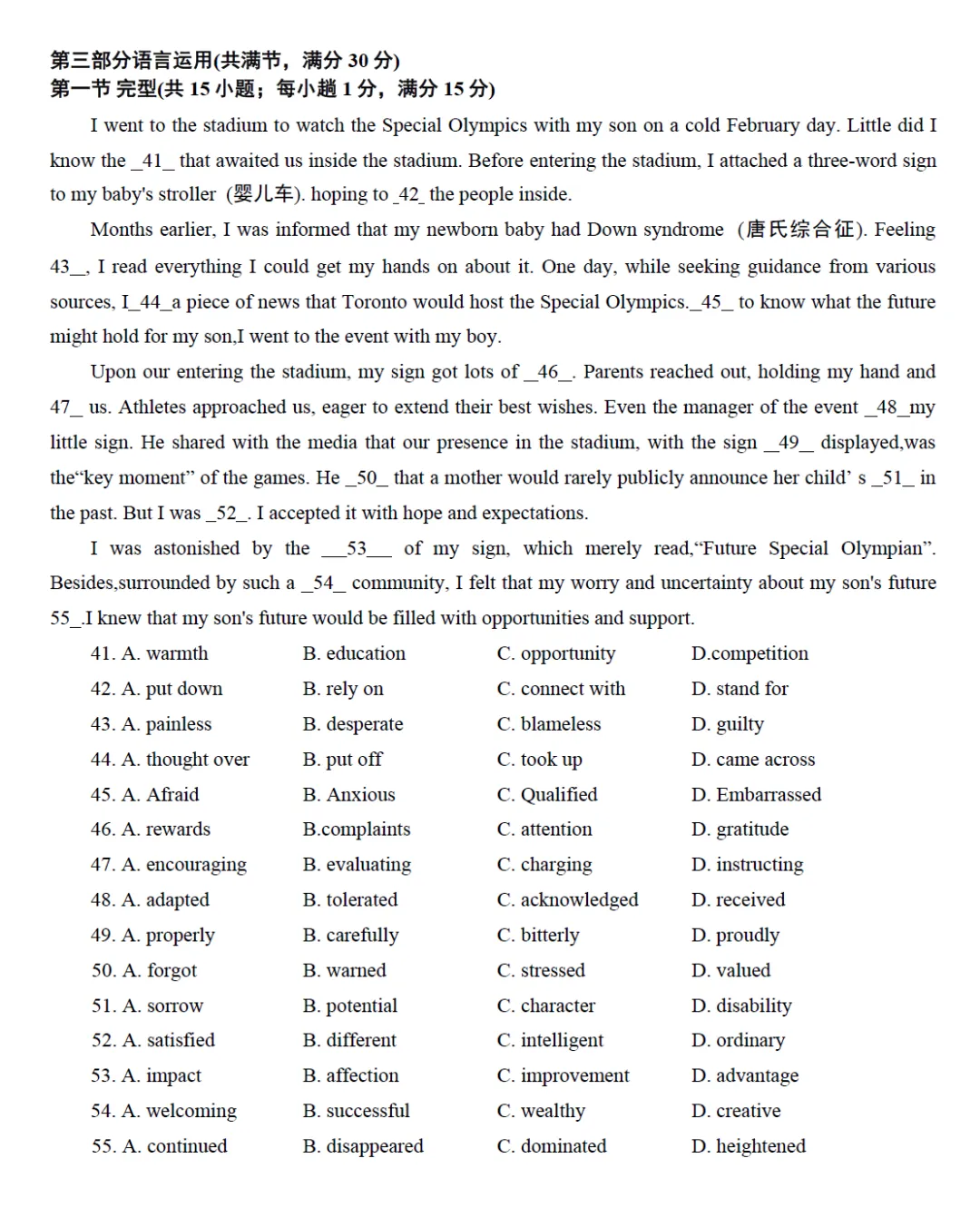
I went to the stadium to watch the Special Olympics with my son on a cold February day. Little did Iknow the 41 that awaited us inside the stadium. Before entering the stadium, I attached a three-word sign to my baby's stroller(婴儿车). hoping to 42 the people inside.
Months earlier, I was informed that my newborn baby had Down syndrome(唐氏综合征). Feeling 43, I read everything I could get my hands on about it. One day, while seeking guidance from various sources, I44a piece of news that Toronto would host the Special Olympics.45 to know what the future might hold for my son,I went to the event with my boy.
Upon our entering the stadium, my sign got lots of 46. Parents reached out, holding my hand and 47 us. Athletes approached us, eager to extend their best wishes. Even the manager of the event 48my little sign. He shared with the media that our presence in the stadium, with the sign 49 displayed,was the“key moment” of the games. He 50 that a mother would rarely publicly announce her child’ s 51 in the past. But I was 52. I accepted it with hope and expectations.
I was astonished by the 53 of my sign, which merely read,“Future Special Olympian”. Besides,surrounded by such a 54 community, I felt that my worry and uncertainty about my son's future 55.I knew that my son's future would be filled with opportunities and support.
41. A. warmthB. educationC. opportunityD.competition
42. A. put downB. rely onC. connect withD. stand for
43. A. painlessB. desperateC. blamelessD. guilty
44. A. thought overB. put offC. took upD. came across
45. A. AfraidB. AnxiousC. QualifiedD. Embarrassed
46. A. rewardsB.complaintsC. attentionD. gratitude
47. A. encouragingB. evaluatingC. chargingD. instructing
48. A. adaptedB. toleratedC. acknowledgedD. received
49. A. properlyB. carefullyC. bitterlyD. proudly
50. A. forgotB. warnedC. stressedD. valued
51. A. sorrowB. potentialC. characterD. disability
52. A. satisfiedB. differentC. intelligentD. ordinary
53. A. impactB. affectionC. improvementD. advantage
54. A. welcomingB. successfulC. wealthyD. creative
55. A. continuedB. disappearedC. dominatedD. heightened
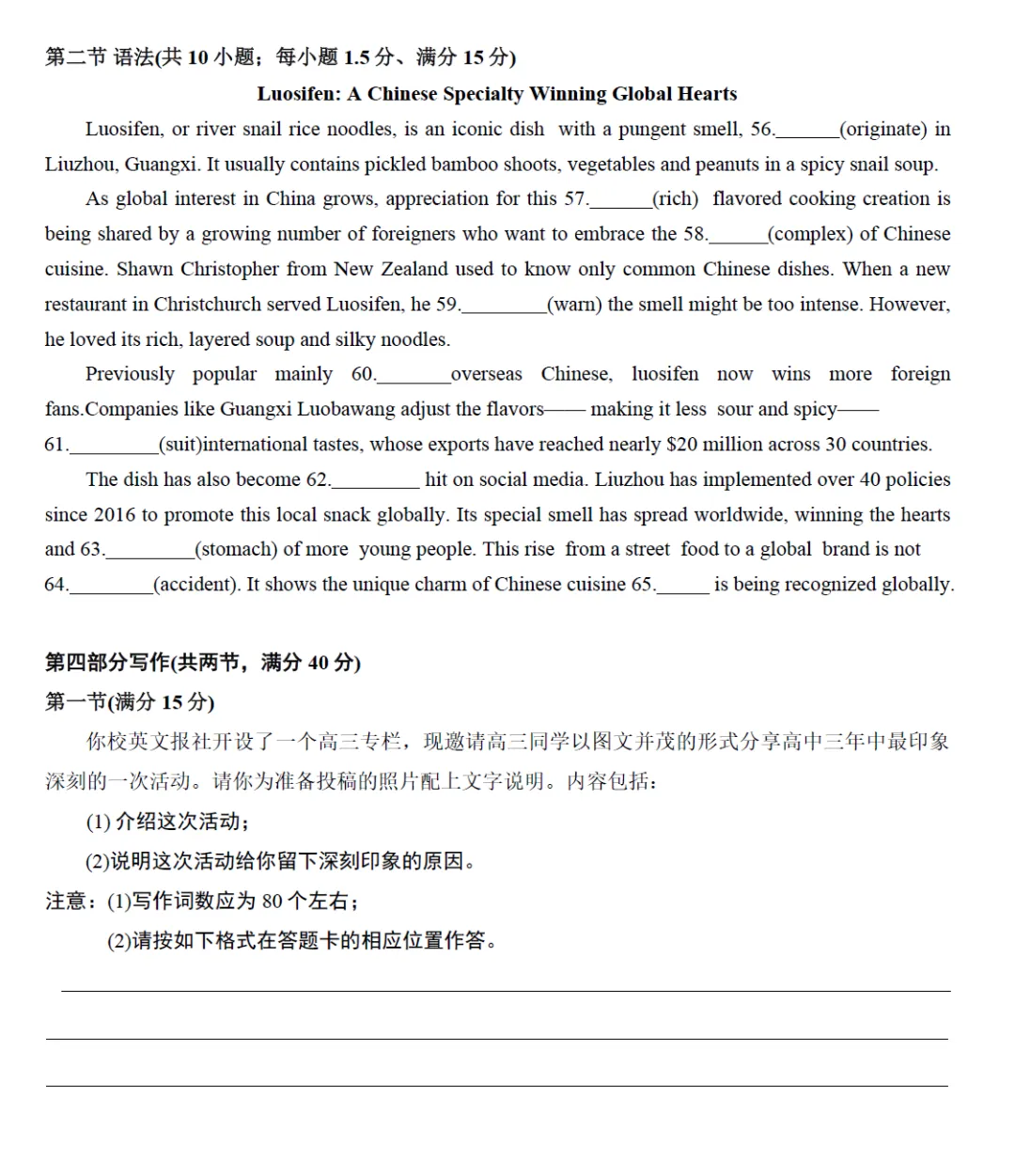
第二节 语法(共10小题;每小题1.5分、满分15分)
Luosifen: A Chinese Specialty Winning Global Hearts
Luosifen, or river snail rice noodles, is an iconic dishwith a pungent smell, 56.(originate) inLiuzhou, Guangxi. It usually contains pickled bamboo shoots, vegetables and peanuts in a spicy snail soup.
As global interest in China grows, appreciation for this 57.(rich)flavored cooking creation is being shared by a growing number of foreigners who want to embrace the 58.(complex) of Chinese cuisine. Shawn Christopher from New Zealand used to know only common Chinese dishes. When a new restaurant in Christchurch served Luosifen, he 59.(warn) the smell might be too intense. However, he loved its rich, layered soup and silky noodles.
Previouslypopularmainly60.overseasChinese,luosifennowwinsmoreforeignfans.Companies like Guangxi Luobawang adjust the flavors—— making it lesssour and spicy——
61.(suit)international tastes, whose exports have reached nearly $20 million across 30 countries.
The dish has also become 62. hit on social media. Liuzhou has implemented over 40 policies since 2016 to promote this local snack globally. Its special smell has spread worldwide, winning the hearts and 63.(stomach) of moreyoung people. This risefrom a streetfood to a globalbrand is not
64.(accident). It shows the unique charm of Chinese cuisine 65. is being recognized globally.
第四部分写作(共两节,满分40分)
第一节(满分15分)
你校英文报社开设了一个高三专栏,现邀请高三同学以图文并茂的形式分享高中三年中最印象深刻的一次活动。请你为准备投稿的照片配上文字说明。内容包括:(1)介绍这次活动;(2)说明这次活动给你留下深刻印象的原因。
注意:(1)写作词数应为80个左右;(2)请按如下格式在答题卡的相应位置作答。
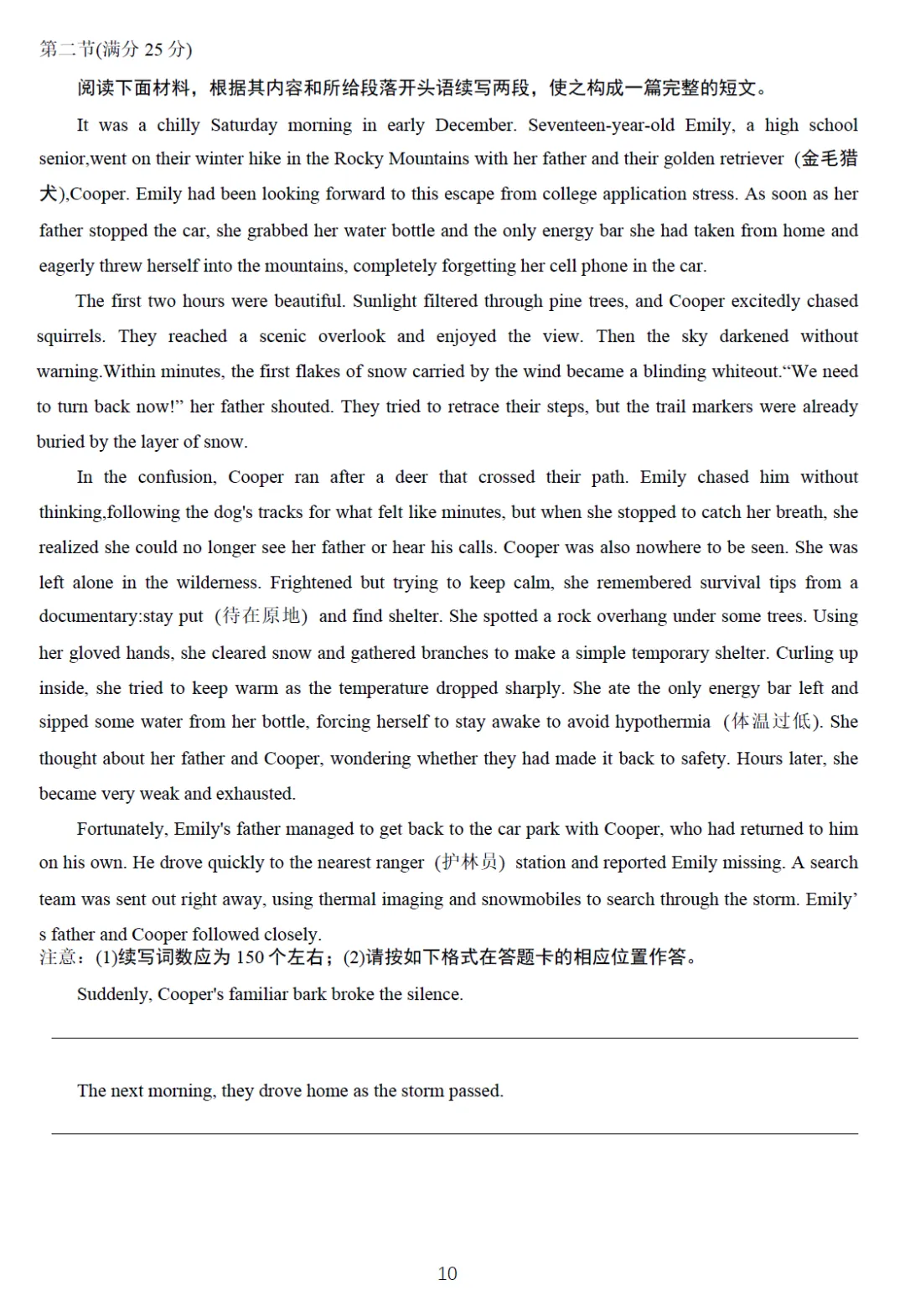
第二节(满分25分)阅读下面材料,根据其内容和所给段落开头语续写两段,使之构成一篇完整的短文。
It was a chilly Saturday morning in early December. Seventeen-year-old Emily, a high school senior,went on their winter hike in the Rocky Mountains with her father and their golden retriever(金毛猎犬),Cooper. Emily had been looking forward to this escape from college application stress. As soon as her father stopped the car, she grabbed her water bottle and the only energy bar she had taken from home and eagerly threw herself into the mountains, completely forgetting her cell phone in the car.
The first two hours were beautiful. Sunlight filtered through pine trees, and Cooper excitedly chased squirrels. They reached a scenic overlook and enjoyed the view. Then the sky darkened without warning.Within minutes, the first flakes of snow carried by the wind became a blinding whiteout.“We need to turn back now!” her father shouted. They tried to retrace their steps, but the trail markers were already buried by the layer of snow.
In the confusion, Cooper ran after a deer that crossed their path. Emily chased him without thinking,following the dog's tracks for what felt like minutes, but when she stopped to catch her breath, she realized she could no longer see her father or hear his calls. Cooper was also nowhere to be seen. She was left alone in the wilderness. Frightened but trying to keep calm, she remembered survival tips from a documentary:stay put(待在原地)and find shelter. She spotted a rock overhang under some trees. Using her gloved hands, she cleared snow and gathered branches to make a simple temporary shelter. Curling up inside, she tried to keep warm as the temperature dropped sharply. She ate the only energy bar left and sipped some water from her bottle, forcing herself to stay awake to avoid hypothermia(体温过低). She thought about her father and Cooper, wondering whether they had made it back to safety. Hours later, she became very weak and exhausted.
Fortunately, Emily's father managed to get back to the car park with Cooper, who had returned to him on his own. He drove quickly to the nearest ranger(护林员)station and reported Emily missing. A search team was sent out right away, using thermal imaging and snowmobiles to search through the storm. Emily’ s father and Cooper followed closely.
注意:(1)续写词数应为150个左右;(2)请按如下格式在答题卡的相应位置作答。Suddenly, Cooper's familiar bark broke the silence.
The next morning, they drove home as the storm passed.
0520周测核心考点与重难点
1.词汇:招聘、基因、灭绝复活、集体智慧、标点、特奥会、螺蛳粉等高频主题词。
2.语法:非谓语、时态语态、词性转换、定语从句、名词复数。
3.能力:细节查找、推理判断、主旨大意、观点态度、篇章逻辑、故事续写。
4.话题:职场招聘、科技伦理、网络善意、团队协作、饮食文化、特殊人群关怀。

三、试卷特点
选材贴近现实与热点:基因技术、中国美食出海、特奥会、网络善意。
题型标准高考模式,分值分布、难度梯度与高考一致。
侧重人文素养与思辨能力,传递温暖、包容、积极的价值观。

一、听力高频词
1.device /dɪˈvaɪs/n. 装置,设备equipment,apparatus
2.troublesome /ˈtrʌblsəm/adj. 麻烦的
3.labor-saving /ˈleɪbə seɪvɪŋ/adj. 省力的
4.worthless /ˈwɜːθləs/adj. 无用的futile,useless
5.reliance /rɪˈlaɪəns/n. 依赖rely/depend on sb
6.packaged /ˈpækɪdʒd/adj. 包装的 package tour包价旅游
7.receptionist /rɪˈsepʃənɪst/n. 接待员receive接收,reception接收,信号,receipt(收据)
8.marriage /ˈmærɪdʒ/n. 婚姻=matrimony,matrimonial
9.saleswoman /ˈseɪlzmən/n. 女销售员
10.pay raise /peɪ reɪz/n. 加薪get a ~~

二、阅读核心词
招聘类(A 篇)
1.capital /ˈkæpɪtl/n. 资本,大写字母capitalize使(将)...大写
2.shareholder /ˈʃeəhəʊldə(r)/n. 股东
3.financial /faɪˈnænʃl/adj. 金融的
4.automation /ˌɔːtəˈmeɪʃn/n. 自动化automate,automatic
5.flexible /ˈfleksəbl/adj. 灵活的flex,flexibility:flex muscles秀肌肉
6.acknowledge /əkˈnɒlɪdʒ/v. 承认,感谢admit,recognize
社会善意类(B 篇)
1.fungus /ˈfʌŋɡəs/n. 真菌
2.vomit /ˈvɒmɪt/v. 呕吐throw up, puke
3.poisonous /ˈpɔɪzənəs/adj. 有毒的poison,venomousvenom毒液
4.reassure /ˌriːəˈʃʊə(r)/v. 使安心
5.negativity /ˌneɡəˈtɪvəti/n. 消极negate否认(定),negative反:positive
6.hardship /ˈhɑːdʃɪp/n. 困难
科技基因类(C 篇)
1.extinct /ɪkˈstɪŋkt/adj. 灭绝的extinction
2.gene /dʒiːn/n. 基因 genetic
3.nucleus /ˈnjuːkliəs/n. 细胞核
4.surrogate /ˈsʌrəɡət/adj. 代孕的surrogacy
5.embryo /ˈembriəʊ/n. 胚胎
6.fossil /ˈfɒsl/n. 化石fossilize
7.hybrid /ˈhaɪbrɪd/n. 杂交种 ~rice
8.endangered /ɪnˈdeɪndʒəd/adj. 濒危的~species
9.genetic /dʒəˈnetɪk/adj. 基因的~engineering
10.diversity /daɪˈvɜːsəti/n. 多样性diverse多元(样)的,diversify使多元化
团队协作类(D 篇)
1.brainstorm /ˈbreɪnstɔːm/vt. 头脑风暴 ~ a plan
2.collective /kəˈlektɪv/adj. 集体的collect, -ion, -ive, collectivity互联互通
3.intelligence /ɪnˈtelɪdʒəns/n. 智慧
4.ego /ˈiːɡəʊ/n. 自我egoist自大狂,egoism自大
5.conformity /kənˈfɔːməti/n. 遵从conform to=comply with遵守(从)
6.anonymous /əˈnɒnɪməs/adj. 匿名的
7.participation /pɑːˌtɪsɪˈpeɪʃn/n. 参与participate in doing sth
标点符号类(七选五)
1.punctuation /ˌpʌŋktʃuˈeɪʃn/n. 标点punctuate打标点
2.semicolon /ˌsemiˈkəʊlən/n. 分号colon冒号
3.casual /ˈkæʒuəl/adj. 随意的
4.elegant /ˈelɪɡənt/adj. 优雅的graceful,
5.convey /kənˈveɪ/v. 传达get sth arcoss

三、完形填空高频词
1.stadium /ˈsteɪdiəm/n. 体育场
2.stroller /ˈstrəʊlə(r)/n. 婴儿车
3.syndrome /ˈsɪndrəʊm/n. 综合征
4.desperate /ˈdespərət/adj. 绝望的in desperate need of sth,despair vi绝望
5.anxious /ˈæŋkʃəs/adj. 焦虑的anxiety
6.encourage /ɪnˈkʌrɪdʒ/v. 鼓励反:discourage
7.acknowledge /əkˈnɒlɪdʒ/v. 认可
8.disability /ˌdɪsəˈbɪləti/n. 残疾disable=incapacitated=handicapped残疾的
9.impact /ˈɪmpækt/n. 影响influence,effect,vt.affect
10.welcoming /ˈwelkəmɪŋ/adj. 友好的amicable, affable, amiable

四、语法填空(螺蛳粉)
1.iconic /aɪˈkɒnɪk/adj. 标志性的 icon图标mouse鼠标cursor光标
2.pungent /ˈpʌndʒənt/adj. 刺鼻的~smell
3.originate /əˈrɪdʒɪneɪt/v. 起源origin
4.pickled /ˈpɪkld/adj. 腌制的~vegetable
5.complex /ˈkɒmpleks/n. 复杂(性)
6.cuisine /kwɪˈziːn/n. 美食,菜肴
7.intense /ɪnˈtens/adj. 强烈的
8.export /ˈekspɔːt/n. 出口
9.implement /ˈɪmplɪment/v. 实施 implementation accidental /ˌæksɪˈdentl/adj. 偶然的snowmobile /ˈsnəʊməbiːl/n. 雪地摩托

五、写作高频词
1.chilly /ˈtʃɪli/adj. 寒冷的 chill out放松,别紧张take it easy
2.filter /ˈfɪltə(r)/v.过滤, 透过hypothermia /ˌhaɪpəˈθɜːmiə/n. 体温过低
3.temporary /ˈtemprəri/adj. 临时的反:permanent永(长)久的
4.blinding /ˈblaɪndɪŋ/adj. 刺眼的~sunlightthermal /ˈθɜːml/adj. 热的