

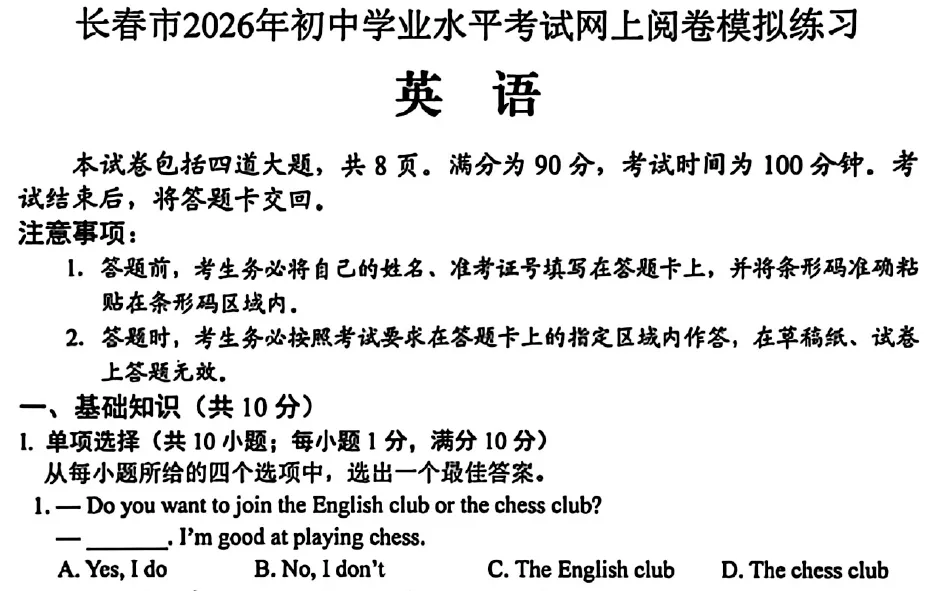
一、基础知识(共10分)
I. 单项选择(共10小题;每小题1分,满分10分)
第1题
— Do you want to join the English club or the chess club?— ____. I'm good at playing chess.
A. Yes, I do B. No, I don't C. The English club D. The chess club ✅
【答案】D
【解析】这是一道选择疑问句的回答题。题目问"你想参加英语俱乐部还是国际象棋俱乐部?",后半句提示"I'm good at playing chess(我擅长下棋)",因此回答应选后者"The chess club"。选择疑问句(either...or...)不能用 Yes/No 回答,应从所给选项中选一个。
【知识点】选择疑问句(Alternative Question)
结构:Do you want A or B? 回答规则:不用 Yes/No,直接选择其中一项回答。 例:— Do you like tea or coffee? — Coffee, please.
第2题
____ less time on your phone at night, or you will find it hard to fall asleep.
A. Spend B. Spending C. To spend D. Spent
【答案】A
【解析】"____..., or you will..."是祈使句 + or 的固定句式,表示"做……,否则……"。祈使句开头用动词原形。故选 A. Spend。
【知识点】"祈使句 + and/or + 陈述句"结构
"祈使句 + and + 句子" = "如果……,就……" "祈使句 + or + 句子" = "如果不……,就……" 例:Study hard, or you'll fail the exam.(努力学习,否则你会不及格。) 祈使句用动词原形开头,表命令、建议或警告。
第3题
Helen likes watching TV shows ____ can make her laugh.
A. who B. whose C. whom D. which ✅
【答案】D
【解析】先行词是"TV shows"(电视节目),是物,关系词应用 which(不用 who/whom/whose)。从句中 which 作主语(can make her laugh),故选 D。
【知识点】定语从句关系代词的选用
先行词为物→用 which 或 that 先行词为人→用 who/whom/that
第4题
— Mom, can I make my bed tomorrow?— Better not, dear. Don't ____ what you can do today till tomorrow.
A. put up B. put off C. get up D. get off
【答案】B
【解析】句意:不要把今天能做的事拖到明天。"put off"意为"推迟、拖延",符合语境。
put up:张贴;举起 put off:推迟 get up:起床 get off:下车;离开
【知识点】动词短语辨析(put的常用搭配)
第5题
— Whose toy truck is this?— It ____ be Eric's. He is the only kid at the picnic.
A. must B. can C. mustn't D. can't
【答案】A
【解析】句意:"这是谁的玩具卡车?——一定是Eric的,他是野餐中唯一的孩子。"表示"有充分理由推断"用 must(肯定推测)。can/can't 用于"可能/不可能"的推测,mustn't 表"禁止",均不符合语境。
【知识点】情态动词的推测用法
第6题
____ comfortable it is to drink tea in the pocket park on Xinmin Street!
A. What B. What a C. How D. What an
【答案】C
【解析】感叹句中,修饰形容词/副词用 How;修饰名词(可数/不可数)用 What (a/an)。此处 comfortable 是形容词,故用 How。结构:How + adj + 主语 + 谓语!
【知识点】感叹句结构
How beautiful the flower is! What a beautiful flower it is!
第7题
Look! My grandma is busy ____ flowers in the garden.
A. to grow B. grew C. growing D. grows
【答案】C
【解析】"be busy doing sth."是固定搭配,意为"忙于做某事",空白处填动名词(-ing形式),故选 C. growing。
【知识点】be busy doing sth. 固定搭配
结构:be busy + doing(动名词) 例:She is busy preparing for the exam.(她正忙于准备考试。) 类似结构: be worth doing(值得做) have fun/trouble doing(做……很开心/困难) spend time doing(花时间做)
第8题
— Excuse me, Tom. ____ are the Olympic Games held? — Every four years.
A. How long B. How often C. How many D. How much
【答案】B
【解析】回答"Every four years(每四年)"表示频率,提问频率用 How often(多久一次)。
How long:多长时间(问时间段,答 for.../ since...) How often:多久一次(答 every.../ twice a week 等) How many:多少(可数) How much:多少钱/多少(不可数)
【知识点】How 引导的特殊疑问句辨析
第9题
— It's too late. I am leaving now.— Oh, it's raining heavily outside. You have to stay here ____ it stops.
A. because B. if C. until D. though
【答案】C
【解析】句意:"你得待在这里,直到雨停。" "until"表示"直到……为止",符合语境。because(因为)、if(如果)、though(虽然)均不符合。
【知识点】时间/条件状语从句连词辨析
第10题
Fengle Theater has been open in Changchun. I wonder ____— You can buy a ticket online.
A. how we can visit it B. when we can visit it C. how can we visit it D. when can we visit it
【答案】A
【解析】"I wonder"后接宾语从句,宾语从句用陈述句语序(主语 + 谓语),排除 C、D(疑问句语序)。根据语境,对方回答"可以在线购票",说明问的是"如何参观",故选 A. how we can visit it。
【知识点】宾语从句(Noun Clause as Object)
连接词:that / if / whether / 疑问词(what, when, where, how等) 语序规则:宾语从句一律用陈述句语序(主语 + 谓语) 错误示例:I wonder when can we go. ❌ 正确示例:I wonder when we can go. ✅ 时态一致:主句一般过去时 → 从句也用相应过去时态
二、阅读(共50分)
II. 完形填空(第11-25题,每题1分,共15分)
短文大意: 一位志愿者教师讲述他在贫困村庄任教的经历。八岁男孩Frank帮他扫房间,发现老师在备考大学。老师讲述教育的重要性,Frank深受影响,决心也要上大学。文章揭示:教师的一言一行对学生有深远影响。
第11题
He __ some thick books on my table.
A. heard B. smelled C. noticed D. tasted
【答案】C
【解析】Frank在扫房间时"注意到/看到"桌上的书,用noticed(注意到)符合视觉发现的语境。
【知识点】感官动词辨析
第12题
He was __ because in this poor village even a computer was not known.
A. nervous B. interested C. worried D. lonely
【答案】B
【解析】在贫困村庄里连电脑都不知道,Frank看到那么多书自然是"感兴趣的"。interested(感兴趣)符合语境。
【知识点】形容词辨析(情绪/状态)
第13题
I told him that those were books I needed to __ for an important exam.
A. wish B. write C. study D. wait
【答案】C
【解析】老师告诉Frank那些是他为"备考重要考试"需要学习的书,study(学习/备考)符合语境。
【知识点】动词辨析
study for an exam:备考(固定搭配) prepare for an exam:备考 wish for:希望得到 wait for:等待
第14题
He was __. "But, sir, you are a volunteer teacher. Why do you have to study?"
A. surprised B. bored C. relaxed D. afraid
【答案】A
【解析】Frank感到"吃惊"——一个老师还需要继续学习?语境是意外/困惑,surprised(惊讶的)最符合。
【知识点】表示情绪的形容词(-ed 与 -ing 的区别)
-ed形容词:描述人的感受(主语是人) surprised(感到惊讶的)、bored(感到无聊的)、excited(感到兴奋的) -ing形容词:描述事物/情况的特点 surprising(令人惊讶的)、boring(令人无聊的)、exciting(令人兴奋的)
第15题
He took one of my __ and asked, "There are millions of words."
A. exams B. books C. lessons D. pictures
【答案】B
【解析】结合上文,桌上放的是books(书),Frank拿起其中一本书查看,选B。
第16题
How can you __ finish reading it?
A. quietly B. safely C. possibly D. suddenly
【答案】C
【解析】"有那么多词,你怎么可能读完它?"possibly(可能地)与 How can you 搭配,表示"怎么可能……"的疑问语气。
【知识点】副词辨析
第17题
When the other students __ that Frank always helped to sweep my room...
A. knew B. agreed C. decided D. hoped
【答案】A
【解析】其他同学"得知"Frank帮老师扫房间,knew(知道)符合语境。agree/decide/hope后一般接to do或that从句,但语境中是"得知某一事实",故用knew。
第18题
Frank would never __ to read the books for others.
A. plan B. need C. refuse D. order
【答案】C
【解析】Frank从不"拒绝"为别人朗读书籍,refuse(拒绝)符合语境。never refuse = 总是愿意。
【知识点】动词辨析
refuse to do sth.:拒绝做某事 plan to do sth.:计划做某事 need to do sth.:需要做某事 order sb. to do sth.:命令某人做某事
第19题
I did not realize the influence my __ had on him.
A. problems B. actions C. chances D. games
【答案】B
【解析】老师的"行为/举动"对Frank产生了影响,actions(行为)符合语境,且与结尾处"Simple actions sometimes can have far reaching influences"呼应。
第20题
I was __ into a boat going back.
A. changed B. knocked C. thrown D. sent
【答案】D
【解析】老师因受伤被"送/运"上回程的船,sent(被派/被送)符合语境。被动语态:was sent into a boat(被送上船)。
第21题
The whole __ came over to the riverside to say goodbye.
A. factory B. school C. college D. store
【答案】B
【解析】老师是志愿者教师,所有人来送别,应是全体"学校"师生,故选B. school。
第22题
Frank __ to me.
A. swam B. flew C. hurried D. drove
【答案】C
【解析】Frank"急忙跑"向老师,hurried(急忙赶来)符合语境和情感氛围(依依不舍、急切)。
第23题
Sir, are you coming __?
A. out B. down C. up D. back
【答案】D
【解析】"您还会回来吗?" come back = 回来,是固定短语。
【知识点】come 的常用短语
第24题
His words __ me from my sadness.
A. freed B. greened C. lasted D. dried
【答案】A
【解析】Frank的话把老师从悲伤中"解救/释放"出来,free sb. from sth. = 使某人从……中解脱,freed(解脱)符合语境。
【知识点】free 的用法
free作动词:free sb. from sth. 使某人从……中解脱/自由 free作形容词:免费的;自由的 例:His kind words freed her from worry.
第25题
__ actions sometimes can have far reaching influences on them.
A. Funny B. Stupid C. Polite D. Simple
【答案】D
【解析】文章结尾的主旨句:"简单的行动有时能对孩子产生深远影响。" Simple(简单的)符合全文主旨,与文中老师用普通行为影响Frank的故事相呼应。
阅读理解
(A) 城市漫步(City Walk)
第26题
People usually do city walks ____ around city streets.
A. in small groups B. in large groups C. with heavy bags D. with strict plans
【答案】A
【解析】原文:Usually people do city walks in very small groups.(通常人们以很小的群体做城市漫步。)故选A。
第27题
According to the chart, people ____ enjoy city walks most.
A. under 16 B. over 34 C. from 24 to 28 D. from 29 to 33
【答案】C
【解析】根据图表,24-28岁年龄段占比28%,为最高。故选C. from 24 to 28 years old。
第28题
One popular reason for city walking is to ____
A. keep the mind closed B. stay away from people C. travel in a cheap but busy way D. walk slowly and know more of a city
【答案】D
【解析】原文四个理由之一:To slow down to learn a city better(放慢脚步更好地了解一座城市),D选项是对此的同义改写。
第29题
We can know that ____ from the text.
A. a guide is needed B. men like city walks better C. many young people in China enjoy city walks D. covered 3.2 km in 2025
【答案】C
【解析】原文:In 2025, city walkers in China covered over 3.2 million kilometers in total.(320万公里,非3.2公里,排除D);女性占82%,排除B;无需导游,排除A;C项"许多中国年轻人喜欢城市漫步"与全文内容一致。
第30题
This text is probably from ____
A. a storybook B. a life magazine C. a movie guide D. a shopping list
【答案】B
【解析】文章介绍了一种生活方式(城市漫步),含数据图表和生活建议,最可能来自生活类杂志。
【知识点】阅读理解——推断文章出处
故事书:叙事性强,有人物情节 生活杂志:介绍生活方式、趋势、调查数据 广告/购物清单:有价格、商品信息 电影指南:有影片简介、评分
(B) 创造性思维
第31题
Where did the story happen?
【答案】B. In a summer camp.
【解析】 原文:I met a little boy in a summer camp.(第一句直接点明地点)
第32题
What is the correct order of the events?①作者做完纸飞机 ②男孩把纸揉成球扔出去 ③孩子们嘲笑男孩 ④老师要求制作纸飞机
【答案】D. ④①③②
【解析】事件顺序:④老师布置任务→①作者最先做完飞机→③其他孩子来嘲笑男孩→②男孩扔出纸球赢了比赛。
【知识点】阅读理解——事件排序题
方法:找文中时间词(First, Then, After that, Finally, Minutes later等) 本题关键词:We began at once → I was the first to finish → Then a boy ran → Minutes later, he made a ball
第33题
Why did some children get angry with the boy?
【答案】A. Because they thought the boy cheated.
【解析】原文:Some of the children got angry and said that was unfair.(不公平),说明他们认为男孩的做法不合规则,即认为他"作弊/耍赖"。
第34题(原文第34题题干部分缺失,依答案推断)
根据答案 A. To build something new,推断题目考查"creative thinking的目的"
【答案】A. To build something new.
【解析】根据文章主旨,creative thinking(创造性思维)就是打破常规、创造新事物。
第35题
Which is the best title for the passage?
【答案】A. Think Outside the Box
【解析】文章通过男孩用纸球赢得比赛的故事,说明要打破常规思维,"think outside the box"(跳出固有思维框架)正是全文主旨。
【知识点】阅读理解——主旨标题题
标题应概括全文核心思想,不能只反映局部细节 "Think Outside the Box" = 创新思维,贯穿全文 排除B(只是背景)、C(只是细节)、D(与主旨相反)
(C) 扎染艺术(Tie-dye)
第36题
Which of the following is RIGHT about tie-dye?
【答案】D. It is a skill to make colorful clothes.
【解析】原文第一段:Tie-dye was a way to do this(使衣服变彩色的方式),即一种制作彩色布料的技艺。
第37题
When did tie-dye become popular in the US?
【答案】B. In the 1960s.
【解析】原文:In the 1960s, tie-dye became popular in the US.(直接原文信息)
第38题
Why is tie-dye like a test according to Chiuri?
【答案】C. Because its result is hard to guess.
【解析】原文:You can't guess the result, right until the very end.(直到最后你都猜不到结果),所以像考试一样充满不确定性。
第39题
What does the word "one" in the last paragraph refer to?
【答案】A. A piece of cloth.
【解析】最后一段:use imagination to make a piece of white cloth turn into a colorful one——"one"代替前面的"a piece of cloth",是不定代词替代可数名词单数。
【知识点】代词指代(Pronoun Reference)
one/ones:替代前文出现的可数名词(避免重复) it:替代特指的那个名词 例:I lost my pen. Do you have one?(one = a pen,泛指) 例:I found my pen. It was under the desk.(it = my pen,特指)
第40题
How does the writer organize the passage?
【答案】D. By telling the history and development of tie-dye.
【解析】文章按时间顺序介绍:古代→1960年代美国→2019年时装秀→当代年轻人,是历史发展脉络的写法。
【知识点】文章写作结构分析
(D) 艺术与健康(Art and Health)
第41题
A study finds art is good for people's mind and body.
【答案】T(正确)
【解析】原文:art not only relaxes your mind but also improves your physical health.(艺术不仅放松心情,还改善身体健康)✓
第42题
Signs of illnesses increased for people seeing real paintings.
【答案】F(错误)
【解析】原文:signs of illnesses in their bodies went down(疾病迹象下降),题目说"增加",故错误。
第43题
Scientists have different ideas about what makes art work.
【答案】T(正确)
【解析】原文:Scientists have different ideas.(科学家们有不同的看法)✓
第44题(原文第44题题干缺失,答案序列41-45为TFTFF,第44题为F)
依答案为F,推断题目内容与原文不符
【答案】F(错误)
第45题
Mary Grace saved over 650 million people in the world.
【答案】F(错误)
【解析】原文:art therapy has helped over 650 million people(艺术疗法帮助了6.5亿人),主语是art therapy(艺术疗法),而非Mary Grace个人。
(E) 友谊(Friendship)— 选句填空
第46-50题
答案:C B E A D
【知识点】选句填空解题策略
通读全文,把握各段主题 关注空格前后的逻辑关系(转折/递进/举例/总结) 注意代词指代和关键词呼应 先排除明显不符合的选项
(F) 天鹅的故事(主观题)
第51题
Where did Mike and his father find a young swan?
【答案】At their door. / Mike found a young swan standing alone at their door.
【解析】原文:Mike found a young swan standing alone at their door.(Mike发现一只幼天鹅独自站在门口)
第52题
Why did the swan make a noise and try to fly away?
【答案】Because the swan got separated from its own group.
【解析】原文:His father told him the reason: The swan got separated from its own group.(天鹅与同伴失散了)
第53题
How did Mike make some nests around the lake?
【答案】He used the plants and sticks (to make some nests around the lake).
【解析】原文:He used the plants and sticks to make some nests around the lake.
第54题
When did Mike and his father go home that evening?
【答案】At six (o'clock). / At six (o'clock) in the/that evening.
【解析】原文:It was already six o'clock in the evening. Mike and his father went home.
第55题
What did Mike see the next morning?
【答案】He saw the lake was full of swans swimming and playing happily.
【解析】原文:he saw the lake was full of swans swimming and playing happily.
【知识点】主观题答题规范
用完整句子回答(除非题目只要求简短回答) 句首大写,句末加句号 时态与题干保持一致 尽量用原文词句,避免主观臆造 常见句型: Where → "At/In + 地点" Why → "Because + 原因" How → "By doing sth. / With sth." When → "At + 时间" What → 直接陈述内容
三、语言运用(共10分)
IV. 短文填空(第56-65题,每题1分)
短文大意: 介绍沈长高铁(沈阳-长白山高速铁路),2025年通车,连接沈阳、抚顺、通化、白山和长白山,为沿线居民带来便利,同时开创"高铁+冰雪"特色旅游。
第56题
It is one of __ most eastern high-speed rail lines in our country.
【答案】the
【解析】"the most eastern"是形容词最高级结构,最高级前加定冠词 the。
【知识点】形容词最高级的用法
结构:the + 形容词最高级(+ 名词)+ 范围状语 例:She is the tallest girl in the class. 规则变化:long → the longest;easy → the easiest 不规则:good → the best;bad → the worst;far → the farthest/furthest
第57题
In 2025, this new line __ (put) into use.
【答案】was put
【解析】时间状语"In 2025"表明是过去时;主语"this new line"与put为被动关系(线路被投入使用),故用一般过去时被动语态:was put。
【知识点】被动语态(Passive Voice)
结构:be + 过去分词(+by...) 一般过去时被动:was/were + 过去分词 例:The book was written in 2020. 常用于:主语不知道或不重要时、强调动作承受者时
第58题
It brings the road home __ (close) than before.
【答案】closer
【解析】"than before"是比较状语,close 变比较级为 closer(close→closer,单音节规则变化)。
【知识点】形容词/副词比较级
单音节:直接 + er(close→closer, fast→faster) 双音节以 -y 结尾:变 y 为 i + er(easy→easier, busy→busier) 多音节:more + 原级(comfortable→more comfortable) 不规则:good/well→better;bad/badly→worse;far→farther/further
第59题
And __ is believed that the new line brings its special advantage.
【答案】it
【解析】"It is believed that..."是固定句型,it作形式主语,that从句为真正主语。
【知识点】形式主语 it
常见结构: It is + adj + to do sth.(做某事是……的) It is + adj + that 从句 It is believed/said/reported that...(据信/据说/据报道……) It takes sb. + 时间 + to do sth.
第60题
Travelers can __ (easy) enjoy beautiful scenery or use phones in the comfortable trains.
【答案】easily
【解析】修饰动词 enjoy 需用副词形式,easy → easily。
【知识点】形容词变副词规则
第61题
I had to take different trains and buses to go home in the past, __ now it is so convenient.
【答案】but
【解析】前后是转折关系:过去很麻烦,但现在很方便。but(但是)表转折,符合语境。
【知识点】并列连词辨析
第62题
She added it was her __ (five) time of going back home this year.
【答案】fifth
【解析】"her _ time"需要序数词,five的序数词是fifth(不规则变化)。
【知识点】序数词(Ordinal Numbers)不规则变化
第63题
She looks forward __ going home more often next year.
【答案】to
【解析】"look forward to doing sth."是固定搭配,"to"是介词,后接动名词(-ing形式)。
【知识点】look forward to 的用法
结构:look forward to + doing sth.(期待做某事) 注意:此处 to 是介词,不是不定式符号,后面接名词或动名词,不接动词原形 例:I'm looking forward to seeing you. 同类:be used to doing(习惯于做)、object to doing(反对做)
第64题
__ (solve) the problem of carrying snow gear, the government has provided the service.
【答案】To solve
【解析】句首表目的(为了解决……),用不定式 to solve 作目的状语。
【知识点】不定式作目的状语
结构:To do sth., 主句(为了做某事,……) 例:To save time, he took a taxi.(为了节省时间,他打了出租车。) 也可用 in order to do / so as to do,语气更正式
第65题
Many __ (passenger) don't need to take heavy bags with them.
【答案】passengers
【解析】Many后接可数名词复数。passenger(乘客)的复数为passengers(规则变化:直接加s)。
【知识点】名词的复数变化规则
四、书面表达(共20分)
V.(A) 环保倡议书(满分5分,不少于40词)
题目要求:
活动目的 一至两项环保行动 发出倡议
【参考范文】
Hello everyone,
Our community will hold an "Environmental Protection" theme week. The purpose of this activity is to call on everyone to protect the environment and build a green home together.
To protect our environment, we can do the following: First, we should use less plastic and bring our own bags when shopping. Second, we can save water and electricity in our daily life.
Let's take action together to make our community cleaner and greener. Every small step counts!
Yours,Li Hua
【写作知识点】倡议书格式与要点
常用表达:
It's our duty to protect the environment.(保护环境是我们的责任。) We should... / We can... / Let's... Every small step counts.(每一小步都很重要。) Together we can make a difference.(共同努力能带来改变。)
V.(B) 校园故事写作(满分15分,不少于80词)
题目要求: 以"A Memory in School"为题,讲述一个校园故事,并谈谈感悟。
【参考范文】
A Memory in School
It was a rainy afternoon in my second year of middle school. I had been practicing for a speech competition for weeks, but on the day of the contest, I suddenly forgot my lines on stage.
I stood there, my mind went blank. Just then, my English teacher smiled at me from the audience and gave me a thumbs-up. That warm smile helped me calm down, and I started again from the beginning. In the end, I didn't win, but I finished my speech with confidence.
Looking back, I realize that encouragement can be more powerful than victory. My teacher's kindness taught me that what matters most is not winning, but the courage to try again.
【写作知识点】叙事作文结构
常用表达:
It was a ... day when...(那是……的一天,当……) I will never forget...(我永远不会忘记……) Looking back, I realize that...(回想起来,我意识到……) This experience taught me that...(这次经历教会了我……) From this memory, I learned...(从这段记忆中,我学到了……)
知识点汇总表
如果你想要这套 《2026英语长春二模》完整版整理资料,包括更完整的逐题解析内容,可以按下面方式领取:
第一步:关注公众号第二步:私信发送:长春二模
如果你身边也有正在备战中考的孩子,欢迎把这篇文章转给他。很多时候,真正拉开差距的,不是刷了多少卷,而是有没有把一套卷子真正吃透。
本文由 公众号:有点东西语数英 出品|仅供学习参考使用


