山东省济南市2026届高三第二次模拟考试英语试题 答案 简介 详解 2026.04.17
济南市2026届高三第二次模拟考试
英语 试 题
温馨提示:学研资料,方便学研,转载注明,勿商用!
感谢江苏省海安高级中学景苏华老师
研习感悟:一份立意高远、设计精良、难度颇高的优质模拟题。它成功地将语言能力考查置于真实、复杂、前沿的语境之中,充分体现了高考评价体系“基础性、综合性、应用性、创新性”的要求,对学生的认知挑战更大,更接近高考命题中区分高分段学生的要求。对考生而言,它是一次极佳的能力诊断和思维训练,在阅读和写作部分,选材前沿、话题深刻,对学生的信息处理、逻辑分析和批判性思维能力提出了显著挑战;对教师而言,它提供了明确的备考导向:必须超越单纯的语言知识教学,转向培养学生面对复杂文本的深度解读能力、跨学科知识整合能力以及基于价值观的批判性与创造性表达能力。
本试卷满分150分。考试用时120分钟。
注意事项:
1.答卷前,考生务必将自己的姓名、考生号答填写在答题卡和试卷指定位置上。
2.回答选择题时,选出每小题答案后,用铅笔把答题卡上对应题目的答案标号涂黑。如需改动,用橡皮擦干净后,再选涂其他答案标号。回答非选择题时,将答案写在答题卡上。写在本试卷上无效。
3.考试结束后,将答题卡交回。
第一部分听力 (共两节, 满分30分)
做题时,可先将答案标在试卷上。录音内容结束后,必须将答案转涂到答题卡上。
第一节(共5小题; 每小题1.5分, 满分7.5分)
听下面5段录音。每段录音后有一个小题,从题中所给的A、B、C三个选项中选出最佳选项。听完每段录音后,你都有10秒钟的时间来回答有关小题和阅读下一小题。每段录音播放两遍。
1.What is the woman looking for?
A. Her handbag.B. Herboarding pass.C. Herpassport.
2.What time is it now?
A. 10:50am.B.11:00am.C. 11:10am.
3.What are the speakers talking about?
A. Two fellow workers.B. The man'sjob.C. A marketingproject.
4.What does the man suggest?
A. Catching the bus.B.Changing the flight.C. Goingto the airport by taxi.
5.What does the man offer to do for the woman?
A. Review her writing.B. Helpemail her resume.C. Finish the coverletter.
第二节(共15小题;每小题1.5分,满分22.5分)
听下面5段录音。每段录音后有几个小题,从题中所给的A、B、C三个选项中选出最佳选项。听每段录音前,你将有时间阅读各个小题,每小题5秒钟;听完后,每小题都有5秒钟的作答时间。每段录音播放两遍。
听下面的录音,回答第6和第7小题。
6.Why does Peter make the call?
A. To arrange a visit.B. Toextend an invitation.C. To confirm anappointment.
7.Where will the speakers meet on Tuesday evening?
A. At the theater.B. AtDelia's office.C. At asnack bar.
听下面的录音,回答第8至10小题。
8.How did Sam feel about the online quiz at first?
A. Nervous.B.Assured.C.Curious.
9.How did Sam perform in the online quiz?
A. He gave up halfway.
B. He needed more time to finish it.
C. He did worse than he had expected.
10.Which question did Sam answer correctly?
A. How long is a moon day?
B. What materials are found on the moon?
C. Who is the first man landing on the moon?
听下面的录音,回答第11至13小题。
11.How many people will stay at the hotel?
A. 4.B.6.C.12.
12.When will the man check in?
A. In late November.B. Inmid-November.C. In earlyNovember.
13.What will the man do next?
A. Confirm the check-out date.
B. Ask about the golf sessions.
C. Offer his personal information.
听下面的录音,回答第14至17小题。
14.What is the probable relationship between thespeakers?
A. Trainer and trainee.B. Bossand advisor.C. Host andguest.
15.Why does the women mention losing weight?
A. To show her ways to achieve a goal.
B. To stress the importance of healthy food.
C. To express her wish to improve her health.
16.What can friends do to help in goat setting?
A. Tell the truth.B. Give support.C. Find problems.
17.What makes most people do badly at reachinggoals?
A. Failing to keep focused. B.Losing their way. C. Aimingtoo high
听下面的录音,回答第18至20小题,
18.What did the speaker think of the hotel'sadvertisement?
A. Misleading.B.Creative.C.Traditional.
19.What can we learn about the speaker's room?
A. Its shower wasn't working.
B. Its door couldn't be cloned.
C. Its maintenance wasn't timely.
20.What did the speaker imply in the end?
A. The hotel fitted budget travelers.
B. The quality mismatched the expense.
C. The location justified the roomprice.
第二部分 阅读 (共两节,满分50分)
第一节(共15小题; 每小题2.5分,满分37.5分)
阅读下列短文,从每题所给的A、B、C、D四个选项中选出最佳选项。
A
Tree-planting projects are becoming increasingly popular worldwide, led bycompanies, nonprofits, governments, and communities. This raises the questionof how investors or donors can choose which projects to support and assesstheir effectiveness. To address this, researchers of the Mongabay. app createda database to organize information on what reforestation projects publiclydisclose. It is based on a comprehensive set of expert-identified criteriagrouped into five categories-context, ecological, economic, social, andinstitutional-and assists users to identify suitable projects and ask informedquestions.
●Why use the Mongabay. app
High standards: Our list of criteria was primarily drawn from the ForestLandscape Restoration (FLR) approach, widely recognized as the gold standardacross the restoration sector.
Transparency (透明度): Rather than make an assessment of the quality ofthe projects, the Mongabay. app reveals how much information is publiclydisclosed by an organization.
A growing catalog (目录): The community is encouraged to share newprojects and update information about existing projects to make this catalogthe best available resource.
●How it works
To find a reforestation project that matches your interests, sort throughthe catalog using indicators from five key categories.
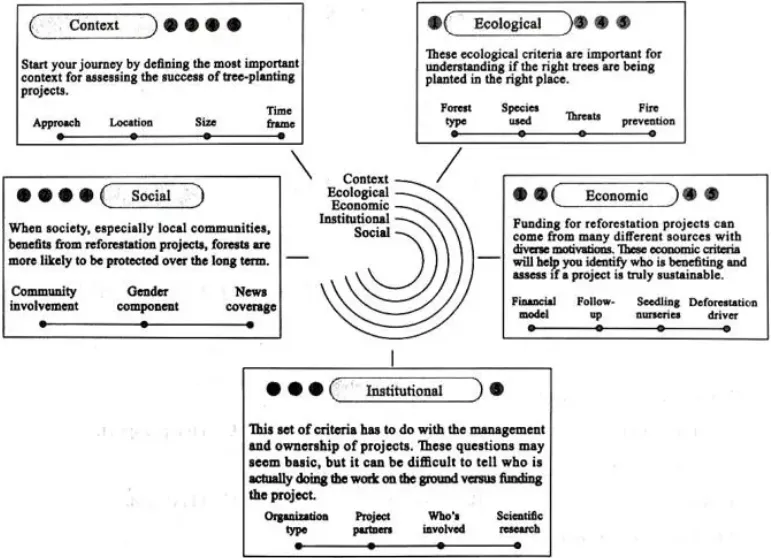
Once you have a list of potential projects, examine the circular diagramnext to each one-this represents its transparency level: the more complete thecircle, the more information is disclosed. Click on the diagram to dig into thedetailed project chart, so you can make an informed decision on which projectto support.
21.What is the main purpose of the researchers bycreating a database?
A. To finance projects.B.To set up standards.
C. To launch initiatives.D.To help make choices.
22.What is the first step to find a suitableproject?
A. Make an in-depth study of projects.
B. Outline a list of candidate projects.
C. Examine project charts in a diagram.
D. Assess a project’s transparency level.
23.Which project would interest an investor seekingclear information on forest type?

ABCD
B
Maya Martinez, a high school senior living in a fog-covered coastal villagein North California, noticed that the community garden was gradually drying upduring the driest summer on record. Whilethe villagers remained helpless, Maya chose to spend her afternoons carefullyobserving the thick mist that rolled in from the sea.
Maya had already identified a critical faultin traditional fog-collecting mesh nets (网状网): theyfrequently became blocked by the very water drops they caught, which severelyreduced their effectiveness. Digging deeper into solutions, Maya found a noveldevice designed by two scientists—the “Fog Harp(竖琴)”.
Maya decided to use the handy materials to create her own “Fog Harp”. Atfirst, neighbors watched the process with doubt as she strung hundreds of thin,upright wires across a solid wooden frame. To them, the setup looked no morethan “a giant musical instrument” that only produced useless sounds in the coldcoastal wind. Little did they know this simple-looking setup would soon provesurprisingly effective.
The remarkable efficiency of Maya’s Fog Harp lies in its clever use ofgravity. In a traditional mesh net, tiny water drops get easily trapped withinthe small square gaps, which stop further collection. This occurs because thesurface tension-the invisible, stretchy “skin”of liquid water—is too strong for the small drops to overcome. In Maya’s FogHarp, by contrast, water drops hit the wires and slowly combine into largerdrops. Most importantly, with no cross wires to hold these larger drops inplace, gravity easily overcomes surface tension, allowing the water to slideeffortlessly down the wires and collect in a tank below.
Of course, the project faced its share of setbacks. During one severecoastal storm, the extreme wind tore through the wooden frame. Yet, instead ofgiving in to despair, she immediately set out to fix the problem by reinforcing the entire structure with durable steel wires. By the time autumn arrived,Maya’s “Fog Harps” were reliably producing plenty of fresh water every day,partly meeting the daily water needs of the village.
24.Why did Maya observe the thick mist in herafternoons?
A. To predict the weather conditions.
B. To clarify the reasons for drought.
C. To check the efficiency of the mesh nets.
D. To work out a solution to water shortage.
25.What can we know about Maya’s “Fog Harp”?
A. It was a musical instrument.B.It invited villagers’ acid words.
C. It presented an inborn fault.D.It featured a solid metal frame.
26.What is the key for Maya’s Fog Harp to functionwell?
A. Its upright-wire design.B.Its mesh-net structure.
C. Its weak surface tension.D.Its resistance to gravity.
27.What can we learn from Maya’s story?
A. Look before you leap.B.Better late than never.
C. Think outside the box.D.Time waits for no man.
C
On a snowy morning in Stockholm, the Candela C-8 looks like a standard speedboat. Once it picks up speed, somethingextraordinary happens: the hull (船体) lifts entirely out of the water, “flying” half ameter above the surface. This is the new generation of electric hydrofoils(水翼船).
They are ideal for urban transport, says Gustav Hasselskog, the founder ofCandela technology company. They are quiet, emission-free and cheap to run—theC-8’s cost per mile is about 5% of that of a traditional speedboat. In manycities, to reduce the disturbance caused by large waves, boats are usuallyspeed-limited. Hydrofoils, however, cause almost no wake and thus travelfaster. Hasselskog believes they could reshape urban transport by shiftingtraffic from blocked roads to underused waterways, which he terms “bluehighways”.
The Candela C-8 is supported by three thin, red struts(支柱), which are linked to two underwater wings that turn forward motion intolift. By lifting the hull out of the water, the boat reduces drag by as much as80 percent, saving a huge amount of energy. Sensors around the boat measurewaves and control systems adjust the wings 100 times a second, providing such a solid, smooth ride that the boat feels as thoughit is on rails.
The power needed to drive a hydrofoil varies directly with its mass, sominimizing a hull’s overall weight is also of importance. The wings must besmall enough to reduce drag and strong enough to bear the boat’s weight. Thesolution is to borrow from aerospace and motor racing, and use carbon fiber. Asfor motors, Candela now has a partnership with makers of electric vehicles,allowing electric boats to use standard fast-chargers designed for cars.
The potential impact is significant with nearly half of the world’spopulation living in coastal regions where cities are often stuck in traffic.While large traditional public boats will still be needed for heavy routes, onshort passenger-only routes in cities, electric hydrofoils may be about to takeoff.
28.What does Gustav Hasselskog expect the CandelaC-8 to do?
A. Boost coastal tourism.B.Remodel urban traffic.
C. Lower travel expenses.D.Promote road building.
29.Which part of the Candela C-8 plays a vital rolein its high energy efficiency?
A. Its type of drive.B.Its power source.
C. Its control systems.D.Its underwater wings.
30.What does the author think of the largetraditional public boats?
A. They are out of date.B.They show huge potential.
C. They are irreplaceable.D.They need to be improved.
31.What can be a suitable title for the text?
A. Electric Hydrofoils: A New Solution to City Traffic
B. Traditional Speedboats: Features and Cost Analysis
C. The Candela C-8: Reshaping Heavy-route Transport
D. Carbon Fiber: Equipping the Candela C-8 with Wings
D
You leave an hour of online surfing with the sense that the world isfalling apart. In the real world, however, a neighbor you disagree withpolitically helps you start your car. The dissonance is no accident. Itis how today’s Internet works.
To better understand this gap, researchers surveyed 1,090 adults and foundthat people dramatically overestimate how common harmful behavior on theInternet is. On Reddit, participants thoughtharmful commenters were 13 times more common, estimating 43% of users postharmful content, while the actual figure is just 3%. Most offensive posts come froma small group of highly active users, whose outsizedposts shape public beliefs, creating the “majority illusion” that makes thisminority seem like the norm, drowning out the silent majority.
Our brains are wired to notice threats and moral breaks—negative contentsticks in our minds. Additionally, social media algorithms(算法) prioritize content that causes strong reactions to keep users engaged,with falsehoods spreading faster than truth. Bot networks(僵尸网络) add to the noise: it has been reported that bad bots make up roughly athird of global web traffic, misleading what trends and who appears popular.
Measuring online harmful content is tricky, as automated tools often missunobvious aggressive remarks. But what matters more is not “how harmful is theInternet,” but what ordinary users perceive as normal. Social psychologistscall this dynamic “pluralistic ignorance”: people privately reject harmfulnorms but go along with them publicly. This misconception formed online createsa dangerous gap, fueling public distrust, preventing public participation, andlowering moral standards—if we think “everyone is awful,” we’re less likely tobe kind.
While there is no silver bullet, practical steps—rooted in policy andpersonal awareness—can narrow the gap. The key lies in recognizing onlineengagement doesn’t equal approval: skip “most engaging” feeds and ground ourviews in actual world connections. Imagine a public square where the loudestfew don’t seize the microphone—disagreement remains, but the air resounds withdaily life: neighbors helping start cars, strangers holding doors. Online, wecan make that reality visible again.
32.What does the underlined word “dissonance” inParagraph 1 probably mean?
A. Disorder.B.Prejudice.C. Contrast.D.Debate.
33.What does the “majority illusion” refer to inthe text?
A. A false impression.B.A harmful behavior.
C. An overestimated post.D.A minority of commenters.
34.What is Paragraph 3 mainly about?
A. Why global web traffic misleads people.
B. Why the minority feels like the majority.
C. How we identify online harmful content.
D. What harm online misconception causes.
35.What is the author’s suggestion in the lastparagraph?
A. Acting like the loudest few.B.Improving moral standards.
C. Avoiding online engagement.
D.Valuing real-life interactions
第二节(共5小题; 每小题2.5分,满分12.5分)
Why struggle with an essay when AI can generate one on your behalf inseconds? Why personally respond to an email when AI can instantly produceautomatic replies filled with all the typical greetings and talking-points?36Nevertheless, the ease is notnecessarily a good thing. Writing still can’t be replaced even in the AI-drivenera.
Writing serves as a fundamental cognitive(认知的)exercise through which we realize what we truly understand, acknowledge thelimits of our knowledge, and develop structured reasoning. More crucially, itis precisely by the very act of writing that we individuals ultimately make newsense of the world around us and arrive at a deeper understanding of who weare.37
Paul Graham, a well-known computer scientist, once observed, “Good writersdo not simply think and then record thoughts casually.38” Writing helps us generateideas we have never had before.
Another critical but often overlooked function of writing is thecompression (凝练) of ideas.39When done poorly, this process loses preciousinsights. When done well, it generates the insights and removes the unnecessaryparts. Compression requires thinking, which is one reason why writing is sodifficult.
AI can write for us, but it won’t help us learn to think or understand aproblem with deep fluency. And we need deep fluency to solve hard problems. Aworld of common thinking available on demandwill encourage people to outsource theirthinking and reward people who don’t. 40Original thinking will onlybecome more valuable in the future.
A. It bridges the gap between ideas.
B. Many people depend heavily on AI.
C. AI has made writing surprisingly effortless.
D. They always uncover insights in the act of writing.
E. Those who can think and write independently will stand out.
F. This journey of self-discovery is in essence a vital form of learning.
G. Writing requires us to keep to a point and organize our ideas logically.
第三部分 语言运用 (共两节,满分30分)
第一节(共15小题; 每小题1分,满分15分)
阅读下面短文,从每题所给的A、B、C、D四个选项选出可以填入空白处的最佳选项。
Sometimes a rescue is more than training and duty. Sometimes, it’s about41, care and sympathy—for animals and humans alike.
Milton Fire’s Technical Large Animal Emergency Rescue (TLAER) team 42all of that when they helped a 30-year-oldhorse named Misty who had gotten 43near a river. That Wednesdaymorning, the crew 44an emergency call from alocal farm, where Misty had45after heavy rain left the ground muddy. Whenfirefighters arrived, she was motionless, lying on the wet river bank.
For one firefighter, Vincent Rosenberger, the rescue was deeply 46. He was barely ten when he first 47Misty and had no idea about anything 488. He remembered holding onto thesaddle(马鞍)49since he was afraid. Misty seemed to sense hisanxiety and gradually eased his fear with her unhurried grace.
Decades later, it was Vincent that gently 50her head and whispered comforting words whilethe team waited for a veterinarian(兽医) toarrive with calming medication. With patience, care, and steady 51, the TLAER team moved Misty to saferand higher ground. Food and water provided, she was able to stand on her ownsoon. Vincent 52at her side all the time.
Misty’s53are reported to be good, and she’s likely torecover well. Beyond the medical facts, the rescue highlighted somethingbigger: the connection between humans and animals, the 54that shape us, and the ways firefighters55their communities beyond traditional emergencies.
41.A. skill B. bond C. rule D. logic
42.A. faced B. displayed C. valued D. listed
43.A. stuck B. lost C. hidden D. hit
44.A. laughed offB. longed for C. reflected on D. responded to
45.A. wandered B. escaped C. slipped D. survived
46.A. casual B. brief C. remote D. personal
47.A. saved B. identified C. mounted D. claimed
48.A. horsey B. special C. practical D. serious
49.A. hesitantly B. tightly C. humbly D. elegantly
50.A. covered B. struck C. touched D. tied
51.A. voices B. eyes C. feet D. hands
52.A. collapsed B. sighed C. rested D. remained
53.A. feeds B. vitals C. attitudes D. habits
54.A. memories B. promises C. challenges D. chances
55.A. witness B. develop C. serve D. teach
第二节(共10小题; 每小题1.5分,满分15分)
阅读下面短文,在空白处填入1个适当的单词或括号内单词的正确形式。
Architecture studio Penda has released visualizations of its“Yin-YangHouse”—a home designed for a tiny plot near the German city of Kassel. Foundedby architects Chris Prrecht and Dayong Sun, the studio created this home for ayoung family56(target) a self-sufficientlifestyle in the countryside.
Given the site’s compact (紧凑的) nature, the only space available57(grow) fruit, vegetables and herbs is the roof. Penda thereforedesigned the roof as a series of terraces(露台) thatcreate a 58(function) garden. “Wheneverarchitects design a building, they take59area away that used to belong to nature,” saidthe studio, “and we try to give this space back.”
The building’s form consists of two interlocking sections based on thesymbol for Yin-Yang-a Chinese philosophy that describes how 60(seeming) opposing forces can combine to create a 61(balance) and strong whole. The unique roof features stepped levelsgoing up from the center, like the way mountains rise on either side of avalley.
The sloping(倾斜的) roof ensures that rainwater 62(channel) towards a tank below for 63(store) to water the plants. Throughout the year, the plants willchange 64the seasons, varying the building’sappearance.
The “Yin-Yang House” integrates living and working spaces, architecture andnature, creating a truly self-sufficient home,65timeless wisdom meets thefuture of green design.
第四部分写作(共两节,满分40分)
第一节(满分 15分)
每年5月8日为世界微笑日。假定你是李华, 你校英文报现征集相关庆祝活动的标识图案, 请你投稿, 内容包括:
(1)图案描述;
(2)设计解读。
注意:
(1)写作词数应为80个左右;
(2)若有需要,请在答题卡指定区域使用2B铅笔或黑色签字笔做图;
(3)请按如下格式在答题卡的相应位置作答。
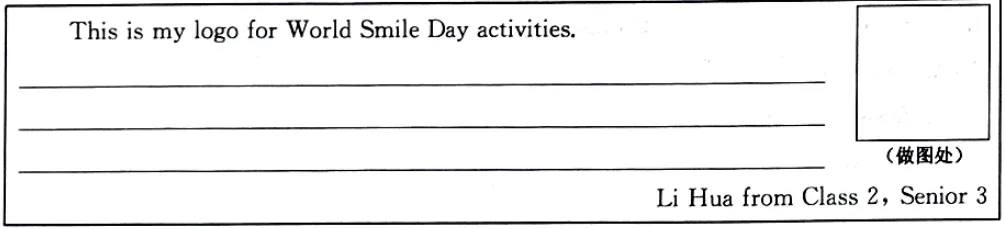
第二节(满分25分)
阅读下面材料,根据其内容和所给段落开头语续写两段,使之构成一篇完整的短文。
When Mum told me to stay with Grandpa for a couple of hours, I wasextremely unwilling deep down. “He doesn’t like me,” I said. “Oh, of course helikes you. He’s just sad since Grandma passed away,” Mum replied. We drovestraight to Grandpa’s in an uncomfortable silence.
After dropping me off at Grandpa’s apartment, Mum headed to herappointment, promising to come to pick me up soon. Spotting me, Grandpamotioned for me to sit. We glanced up at each other now and then but didn’t sayanything. “Want to watch television?” he asked. I nodded. But nothing was on.Two minutes later, he turned the TV off. We sat there, Grandpa patting his legsrestlessly, and me trying to find a comfortable position on his old, softcouch.
Suddenly, I felt something hard on the floor beneath the couch. I reacheddown and pulled it out. It was a wooden box with fancy designs carved into thesides. “Chess?” I said, surprised. “Yeah, I used to play. Do you play?” Grandpaasked. “Never,” I answered. Grandpa fell quiet for a moment, staring at thewindow and still tapping his legs. Then he suggested that since we had time, hecould teach me how to play. I agreed casually.
Grandpa opened the box, a smell of wood polish rising from inside. Hetaught me about all the pieces and showed me how they moved: the king couldmove one square in any direction, and the game was won by trapping him; pawns (兵) moved straight forward; knights(马) movedin an L-shape and could leap over other pieces... I was amazed at how patienthe was.
We practiced a bunch of times. He just corrected me and had me try again.Finally, when he was satisfied that I knew what to do with all the pieces, hesaid we were ready to play for real.
注意:
(1)续写词数应为 150个左右;
(2)请按如下格式在答题卡的相应位置作答。
Our first game began and I played with full attention. We were really enjoying ourselves when Mum returned. |
济南市 2026届高三第二次模拟考试
英语试题答案
第一部分听力(共两节,满分30分)
1-5 BAACA6-10 BBBCC 11-15 CACCA 16-20 BAACB
注意: 每小题1.5分,凡是与答案不符者,不给分。
第二部分阅读 (共两节,满分50分)
第一节(共15小题;每小题2.5分,满分37.5分)
21-23 DBA 24-27DBAC 28-31 BDCA 32-35 CABD
第二节(共5小题; 每小题2.5分,满分12.5分)
36-40CFDGE
注意: 每小题2.5分,凡是与答案不符者,不给分。
第三部分语言运用(共两节,满分30分)
第一节(共15小题; 每小题1分,满分15分)
41-45 BBADC 46-50 DCABC 51-55 DDBAC
注意: 每小题1分,凡是与答案不符者,不给分。
第二节(共10小题; 每小题1.5分,满分15分)
56.targeting 57.to grow 58. functional 59. an 60.seemingly
61.balanced 62.is channel(l)ed 63. storage 64. with 65.where
注意:1.每小题1.5分,单复数、词型不正确均不给分。
2.如有其它形式,意义通顺,合乎上下文意义,可以给分。
第四部分写作(共两节,满分40分)
第一节(满分 15分)
World Smile Day Logo Submission
The proposed logo features a stylized sun,whose radiant beams cleverly form the shape of a smiling face. Encircling this central image is the bilingualmotto: “Share a Smile, Spread the Sunshine” in both English and Chinese.
More than just a cheerful symbol, thisdesign conveys profound messages. The sun, universallyrecognized as a source of life and warmth, symbolizes the positiveenergy and hope a genuine smile can bring. The integration of the two languagesemphasizes our school’sglobalvisionand cultural inclusivity, emphasizing that kindness and joy transcendall borders. This logo serves as a perfect reminder for us to actively createand share happiness, makingevery day a little brighter for ourcommunity and beyond.
第二节(满分25分)
Version 1
Our first game began and I played with full attention. I considered each move carefully, recalling Grandpa’s instructions. Hewatched, occasionally guiding me, “Look ahead.” When I sacrificed a pawn tocreate an opening, he nodded slowly. My knight slid forward. “Check,” I said softly. A glimmer lit his eyes, followed by a gentle smile. Thiswas more than a game; it was a silent language we were learning to share, aconnection quietly rebuilt over the board.
We were really enjoying ourselves when Mum returned. She paused in the doorway, observing us—heads close, a bishop poised in myhand. Grandpa’s restless leg was finally still. “Mum, look!” I whispered,grinning. Her worried expression softened into a knowing smile. Grandpa simplysaid, “She learns fast,” his voice warm. The heavy silence of the apartmenthad lifted, replaced by the light focus of a shared challenge, and the unspokenpromise of many more games to come.
Version 2
Our first game began and I played with full attention. Every move I made was deliberate, and I tried to recall Grandpa’s patientteachings. He would occasionally point at the board, his voice low and steady,saying, “Think ahead. Consider what your opponent will do next.” I sacrificed a pawn, a move that felt bold, and suddenly saw a chance. “Check,” I said tentatively, moving my knight into position. Grandpa’s eyes widened slightly, a flicker of surprise followed by a slow,approving smile. Not only had I grasped the rules, but I was also beginning tosee the strategy beneath them. This was no longer just a lesson; it was a realconversation, silent yet profound, happening over sixty-four squares.
We were really enjoying ourselves when Mum returned. She stood in the doorway, her initial look of concern melting into quietamazement. There we were, heads bent close over the chessboard, my fingerhovering above a bishop as Grandpa whispered, “That’s the spirit.” I looked up, beaming. “Mum, Grandpa is teaching me chess!” I announced. A softness filled Grandpa’s eyesas he met her gaze, the restless tapping of his legs completely stilled. Mumsmiled, seeing the unspoken connection that had bridged the quiet afternoon.From that day on, the old wooden box waited not under the couch, but on thecoffee table, a silent promise of games and conversations yet to come.
简介:整体难度较高:
试题核心亮点与素养导向
1.阅读选材紧扣时代脉搏,极具思辨性:
A篇(植树项目数据库):引入“Mongabay app”这一真实工具,考查信息检索与决策支持,体现信息素养与实证精神。
B篇(少女发明“雾竖琴”):讲述高中生运用科学知识解决社区干旱问题的真实故事,弘扬创新精神、动手能力与社会责任感。
C篇(电动水翼船):介绍前沿绿色交通工具,探讨城市交通革新,融合了科技、环保与城市发展议题。
D篇(网络认知偏差):深入分析“多数错觉”、“多元化无知”等社会心理学现象,直击网络时代的认知困境,要求考生进行深刻的批判性思考,区分网络表象与现实。此篇难度和深度尤为突出。
2.试题设计强调深度理解与逻辑链条:
•阅读理解题目不仅考查细节定位(如24、28题),更侧重因果推断(如24题Maya观察雾的原因)、功能作用分析(如26题“雾竖琴”的关键)、作者观点态度(如30题对传统公共船只的看法)以及概念理解(如33题“多数错觉”的含义)。
•七选五围绕“AI时代写作的不可替代性”展开,逻辑严密,要求考生把握文章论证结构,区分核心论点与支撑论据。
3.语言运用与写作体现育人价值与综合能力:
•完形填空:讲述消防员救援一匹与他有童年渊源的老马的故事,情感真挚,考查在叙事语境中准确运用词汇的能力,并传递了生命关怀、人与动物情感纽带的价值观。
•语法填空:介绍融合中国“阴阳”哲学与绿色建筑理念的“阴阳屋”,将传统文化、生态设计、语法知识巧妙结合,具有国际视野和文化自信。
•应用文:为“世界微笑日”设计标识并投稿,形式新颖,融合了视觉描述、意义阐释和创意表达,考查学生的跨模态沟通能力。
•读后续写:情境是隔代亲情通过象棋教学与对弈得以修复和深化。故事线清晰,情感基点明确,要求续写时能合理发展情节、刻画人物心理、体现情感升华,对细节描写和情感把控能力要求高。
试题的突出特点与教学启示
1.真实性(Authenticity):多篇阅读材料源自真实世界的科技、环境、社会心理研究,引导教学关注真实语境下的语言运用。
2.跨学科性(Interdisciplinary):试题涉及环境科学、工程学、社会学、心理学、建筑学、传统文化等多个领域,要求学生具备宽广的知识面和融会贯通的能力。
3.高阶思维(Higher-order Thinking):试题普遍要求进行分析、评价、创新(如阅读D篇对网络生态的反思,写作中的标识设计),单纯依靠语言知识记忆难以取得高分。
4.价值引领(Value Orientation):贯穿了创新解决社区问题、科技向善、绿色生活、理性对待网络信息、珍视亲情与传统智慧等积极向上的主题,实现了学科育人。
部分详解
一、阅读理解
整体特点:选材前沿、跨学科性强、思辨性高,对信息处理、逻辑分析和批判性思维能力要求高。
A篇(21-23题)
主题:介绍一款名为Mongabay的App数据库,旨在帮助投资者/捐赠者筛选和评估全球植树造林项目的透明度与信息。
核心信息:数据库基于专家制定的五类标准建立,用于组织项目公开信息。其优势在于遵循森林景观恢复(FLR)黄金标准、强调信息透明度而非质量评估、鼓励社区更新以建立最佳资源目录。使用方式是用户根据兴趣指标筛选项目,通过查看每个项目旁边的圆形图表(完整度代表信息透明度)来深入了解详情,从而做出明智决定。
21题 (D):主旨题。题干问“研究人员创建数据库的主要目的是什么?” 根据开篇“how investors or donors can choose which projects to support...researchers... created a database...” 及后文对其功能的描述,核心目的是辅助决策,故选D (To help make choices)。
22题 (B):细节/步骤题。题干问“找到合适项目的第一步是什么?” 根据“How it works”部分:“To find a reforestation project... sort throughthe catalog... Once you have a list of potential projects, examine the circulardiagram...” 第一步是“筛选目录得到一个潜在项目列表”,即B选项 (Outline a list of candidate projects)。
23题 (A):例证/推理题。题干问“哪个项目会吸引寻求森林类型清晰信息的投资者?” 文档中图表示例显示,一个项目在“Ecological”维度的“Forest type”指标上信息完全公开(扇形全满)。因此,寻求此类清晰信息的投资者会对这个项目感兴趣。答案对应图表中“Forest type”信息完整的项目。
B篇(24-27题)
主题:记叙文。讲述高中生Maya Martinez观察大雾,创新改进传统集雾网,发明“Fog Harp”为干旱社区解决缺水问题的故事。
核心信息:背景:社区花园因干旱干涸,村民束手无策。问题:传统网状网易被水滴堵塞,效率低。创新:Maya借鉴“Fog Harp”概念,用直立平行线代替交叉网,利用重力使水滴合并下滑,克服表面张力。过程:遭遇质疑和风暴破坏,但她坚持改进(用钢丝加固)。结果:成功为村庄提供部分日常用水。
24题 (D):细节/因果题。题干问“Maya下午观察浓雾的原因?” 首段指出她发现花园干涸,村民无助,于是她选择花时间观察雾。这显然是为了找出解决缺水问题的方法,故选D (To work out a solution to water shortage)。
25题 (B):细节/推断题。题干问“关于Maya的‘Fog Harp’我们知道什么?” 第三段提到邻居最初带着“doubt”观看,认为它看起来像“a giant musical instrument”且只产生无用的声音。这种怀疑和略带嘲讽的看法对应B选项中的“acid words”(尖刻的话)。A项是邻居的误解;C项是传统网的问题;D项与文中“solid wooden frame”不符,后期加固用的是钢丝,并非整个框架是金属。
26题 (A):细节/因果题。题干问“Maya的‘Fog Harp’高效工作的关键是什么?” 第四段详细解释了其原理:关键在于其“upright wires”(直立线)设计,没有横向交叉线,使得水滴能合并并在重力作用下顺畅流下。因此关键是其直立线的设计,选A。
27题 (C):主旨/推断题。题干问“从Maya的故事我们能学到什么?” 整个故事展现了Maya不局限于传统方法,通过观察、研究和创新性实践解决问题的过程。这体现了“跳出框框思考”(Think outside the box)的精神。A(三思后行)、B(迟到总比不到好)、D(时间不等人)均不契合故事核心。
C篇(28-31题)
主题:说明文。介绍新一代电动水翼船Candela C-8,及其作为城市交通解决方案的潜力。
核心信息:特点:船体可升出水面“飞行”,安静、零排放、运行成本极低(约为传统快艇的5%),几乎不产生尾流,因此可在限速城市水域高速行驶。原理:通过水下机翼产生升力,减少80%阻力;传感器和控制系统实时调整以保持平稳;使用碳纤维减轻重量;电机可与电动汽车充电器兼容。前景:有望将交通从拥堵道路转移至未充分利用的“蓝色公路”,重塑城市交通。在短途客运路线上潜力巨大,但大型传统公共船只仍在重型路线上不可替代。
28题 (B):细节题。题干问“Gustav Hasselskog期望Candela C-8做什么?” 第二段末尾明确提到“Hasselskog believes they could reshape urban transport by shiftingtraffic... to underused waterways”,即重塑城市交通,选B(Remodel urban traffic)。
29题 (D):细节题。题干问“Candela C-8的哪个部分对其高能效至关重要?” 第三段首句说明,船体被抬出水面减少了80%的阻力,而这是通过“two underwater wings that turn forward motion into lift”实现的。因此,水下机翼是关键,选D。
30题 (C):观点态度题。题干问“作者如何看待大型传统公共船只?” 最后一段提到“While large traditional public boats will still be needed for heavyroutes”,即在重型路线上仍然需要它们,这意味着它们是“不可替代的”,选C (They are irreplaceable)。
31题 (A):主旨题。题干问“本文最适合的标题是什么?” 全文围绕电动水翼船作为解决城市交通问题的新方案展开,A项准确概括了这一核心。B项偏离重点;C项“重塑重型路线交通”与文末观点相反;D项只提到材料这一个细节。
D篇(32-35题)
主题:议论文。探讨网络有害行为被高估的现象,分析其社会心理成因(如“多数错觉”、“多元化无知”)及危害,并提出回归现实连接的建议。
核心信息:现象:人们严重高估网络有害行为的普遍性(如认为43%用户发有害内容,实际仅3%),这是少数活跃用户制造的“多数错觉”。成因:大脑关注威胁;算法优先推送引发强烈反应的内容;僵尸网络制造噪音。危害:导致“多元化无知”(私下反对但公开顺从),加剧不信任,阻碍公众参与,降低道德标准。建议:认识到网络参与不等于认可,跳过“最吸引人”的内容,将观点建立在现实世界连接上。
32题 (C):词义推测题。题干问第一段划线词“dissonance”的可能含义。第一句说上网一小时后觉得世界要崩塌,第二句说现实中政见不同的邻居却帮你发动汽车。这是一种强烈的对比或反差,故选C (Contrast)。
33题 (A):概念理解题。题干问“多数错觉”指什么。第二段解释,少数高度活跃用户的超大音量帖子塑造了公众信念,制造了一种让这个少数群体看起来像是常态的“幻觉”。因此,它是一种错误的印象,选A (A false impression)。
34题 (B):段落主旨题。题干问第三段主要关于什么。第三段从大脑机制、算法推送、僵尸网络三个角度解释了为什么少数人的声音会让人觉得像多数,即“为什么少数感觉像多数”,选B。A、C、D项均非本段核心。
35题 (D):细节/建议题。题干问作者在最后一段的建议。最后一段提出的实际步骤包括“ground our views in actual world connections”(将我们的观点建立在现实世界的联系上),并想象一个现实中的公共广场场景。因此,作者建议重视现实互动,选D (Valuing real-life interactions)。A项与作者主张相反;B项是解决危害的目标,非具体建议;C项“避免网络参与”过于绝对。
二、七选五(36-40题)
主题:在AI时代,写作的不可替代价值。
文章脉络:
1.引入现象:AI让写作变得轻松,但这是好事吗?(36题)
2.论点1:写作是根本的认知练习,是自我发现的学习过程。(37题)
3.引用论证:好作家在写作中发现见解。(38题)
4.论点2:写作的关键但常被忽视的功能是凝练思想。(39题)
5.结论:AI无法帮助我们学会深度思考,能独立思考和写作的人将脱颖而出。(40题)
36题 (C):空后是“Nevertheless, the ease...”表示转折,指出这种“轻松”不一定是好事。因此,空前应描述这种“轻松”。C项“AI has made writing surprisingly effortless.”(AI让写作变得异常轻松。)完美引出下文转折,符合逻辑。
37题 (F):空前论述写作是认知练习,让我们理解世界,更深刻地认识自己。空后是Paul Graham的引语。因此,此处需要一个承上启下的句子,总结或深化“自我认识”这一过程。F项“This journey of self-discovery is in essence a vital form of learning.”(这种自我发现的旅程本质上是一种至关重要的学习形式。)是对前文内容的完美总结和升华,并为下文引用作家观点做了铺垫。
38题 (D):本题是引言中的空白。引语是“Good writers do not simply think and then record thoughts casually. ____” 引语强调的是好作家不是在思考后随意记录,暗示写作本身是思考过程的一部分。D项“They always uncover insights in the act of writing.”(他们总是在写作的行为中发现见解。)与引语前半句形成对比,具体说明了他们在写作中做什么,使引语完整且有力。
39题 (G):本段主旨是写作的“压缩”功能。空后说“当做得不好时,会丢失宝贵的见解;做得好时,则能产生见解并去除不必要部分”。因此,空前应解释什么是“压缩”。G项“Writing requires us to keep to a point and organize our ideas logically.”(写作要求我们紧扣重点并有逻辑地组织思想。)这正是对“思想凝练”过程的具体描述,符合语境。
40题 (E):空前说“一个能按需提供普通思维的世界将鼓励人们外包自己的思考,并奖励那些不思考的人。” 空后是“原创思维在未来只会变得更有价值。” 因此,此处需要一个转折或对比,说明什么样的人不会受此影响或反而受益。E项“Those who can think and write independently will stand out.”(那些能够独立思考和写作的人将会脱颖而出。)与前后文形成完美的“问题-(特定人群的)对策-结果”逻辑链。
三、完形填空(41-55题)
主题:一篇温情叙事文。讲述消防队救援一匹被困河边的老马Misty,其中一名消防员Vincent与这匹马有着跨越数十年的个人情感纽带。
故事脉络:首句定调:救援有时超越训练和职责,关乎“连接”(41. bond)、关爱和同情。
救援启动:消防队的TLAER团队“展现”(42. displayed)了这一切,当他们帮助一匹“被困”(43. stuck)河边的马。队伍“响应”(44. responded to)求救电话,马在泥泞中“滑倒”(45. slipped)了。
个人回忆:对Vincent来说,这次救援是高度“个人的”(46. personal)。他十岁时第一次“骑上”(47. mounted)Misty,对“马术”(48. anything horsey)一无所知。他“紧紧地”(49. tightly)抓住马鞍,Misty的从容缓解了他的恐惧。
当前救援:几十年后,正是Vincent温柔地“抚摸”(50. touched)它的头,低声安慰。团队用耐心和稳定的“双手”(51. hands)将Misty移到高处。Vincent一直“守候”(52. remained)在它身边。
结局与升华:Misty的“生命体征”(53. vitals)良好。救援凸显了更深层的东西:人与动物的连接、塑造我们的“记忆”(54. memories),以及消防员“服务”(55. serve)社区的不同方式。
考查重点:在连贯叙事中考查名词、动词、形容词、副词的精准运用,尤其侧重语境逻辑、词汇搭配和情感色彩(如bond, personal, touched, remained, vitals, memories, serve)。
四、语法填空(56-65题)
主题:介绍建筑工作室Penda设计的、融合中国阴阳哲学的自给自足住宅“阴阳屋”。
56. targeting:非谓语动词。a youngfamily 与 target 之间是主动关系,用现在分词作后置定语,意为“追求自给自足生活方式的年轻家庭”。 江苏省海安高级中学景苏华 QQ:771515126
57. to grow:非谓语动词。the onlyspace available to do sth.,不定式作后置定语,修饰space。
58. functional:词性转换。空格后是名词garden,需形容词修饰。function - functional(功能性的)。
59. an:冠词。area为可数名词单数,且以元音音素开头,表示“一块区域”,用an。
60. seemingly:词性转换。空格后是形容词opposing,需副词修饰。seeming - seemingly(看似)。
61. balanced:词性转换。与strong并列,共同修饰whole,需形容词。balance - balanced(平衡的)。
62. is channel(l)ed:动词时态语态。rainwater与channel之间是被动关系(雨水被引导),且是客观事实,用一般现在时的被动语态。
63. storage:词性转换。介词for后接名词。store - storage(储存)。
64. with:介词。changewith the seasons 意为“随着季节而变化”。
65. where:定语从句关系词。先行词是a trulyself-sufficient home,在从句中作地点状语,用where引导,意为“在这个家中,永恒的智慧与绿色设计的未来相遇”。
来源:转自网络