The diagram below shows how energy is produced from household waste. Summarise the information by selecting and reporting the main features, and make comparisons where relevant.
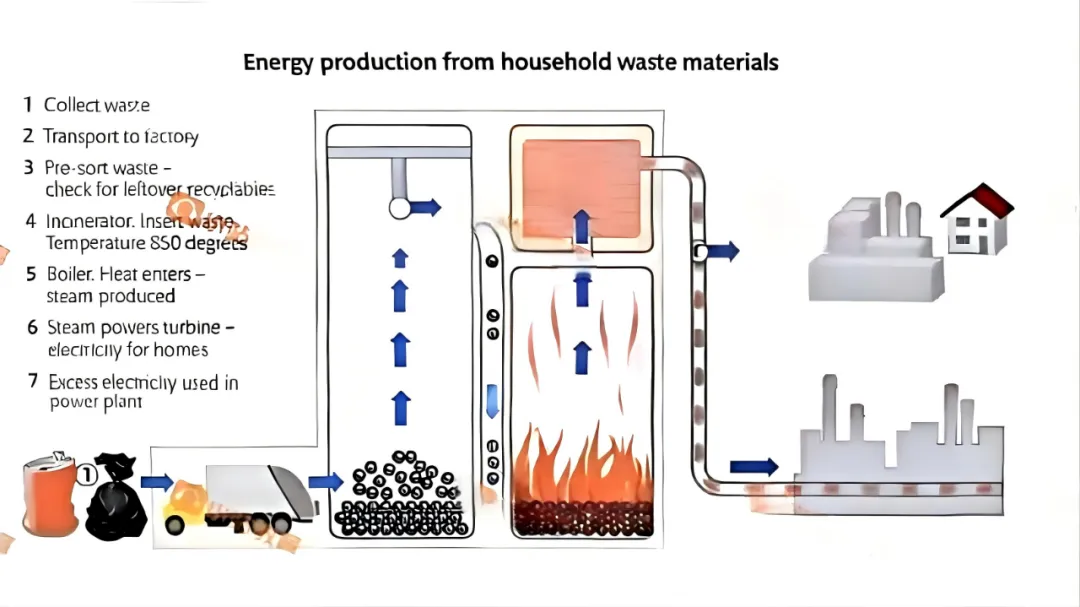
The flowchart illustrates the process of generating electricity from household waste, outlining a series of steps from waste collection to energy production.
流程图展示了利用家庭垃圾发电的过程,概述了从垃圾收集到能源生产的一系列步骤。
The first step, as shown in the flowchart, is the collection of household waste, which is then transported by truck to a processing facility. Upon arrival, the waste is sorted to remove any remaining recyclable materials. After that, the sorted non-recyclable waste is transferred to an incinerator, where it is burned at a temperature of 850 degrees Celsius. The heat from the incineration is used to boil water in a boiler, producing steam. This steam then drives a turbine to generate electricity. The final step is that the electricity generated is supplied to homes, with any surplus used to power the plant itself.
如流程图所示,第一步是收集家庭垃圾,随后用卡车运至处理厂。到达后,垃圾经过分选以去除所有剩余可回收材料。之后,经过分类的不可回收垃圾被送入焚烧炉,在850摄氏度的高温下燃烧。焚烧产生的热量用于加热锅炉中的水,产生蒸汽。这些蒸汽随后驱动涡轮机发电。最后一步是将产生的电力输送至家庭,剩余电力则用于工厂自身供电。
To sum up, the process transforms household waste into electricity through a series of steps including sorting, incineration, and power generation, with excess electricity used internally.
总之,该过程通过分选、焚烧和发电等一系列步骤将家庭垃圾转化为电能,并将多余电力用于内部消耗。
雅思线上课咨询或需要雅思资料请加微信:sydney20101114