
2026 年初中学业水平模拟考试(九年级)
英语试卷
第一部分 听力(共四节,满分 30 分)
第一节 听句子,选择最佳答题(共 5 小题;每小题 1 分,满分 5 分)
1. A. So far. B. At seven. C. On foot.
2. A. Not bad. B. All right. C. Well done.
3. A. OK, let's go. B. Help yourself. C. You're welcome.
4. A. Never mind. B. Here you are. C. With pleasure.
5. A. What a pity! B. Good luck! C. See you!
第二节 听对话和问题,选择正确答案(共 13 小题;每小题 1 分,满分 13分)
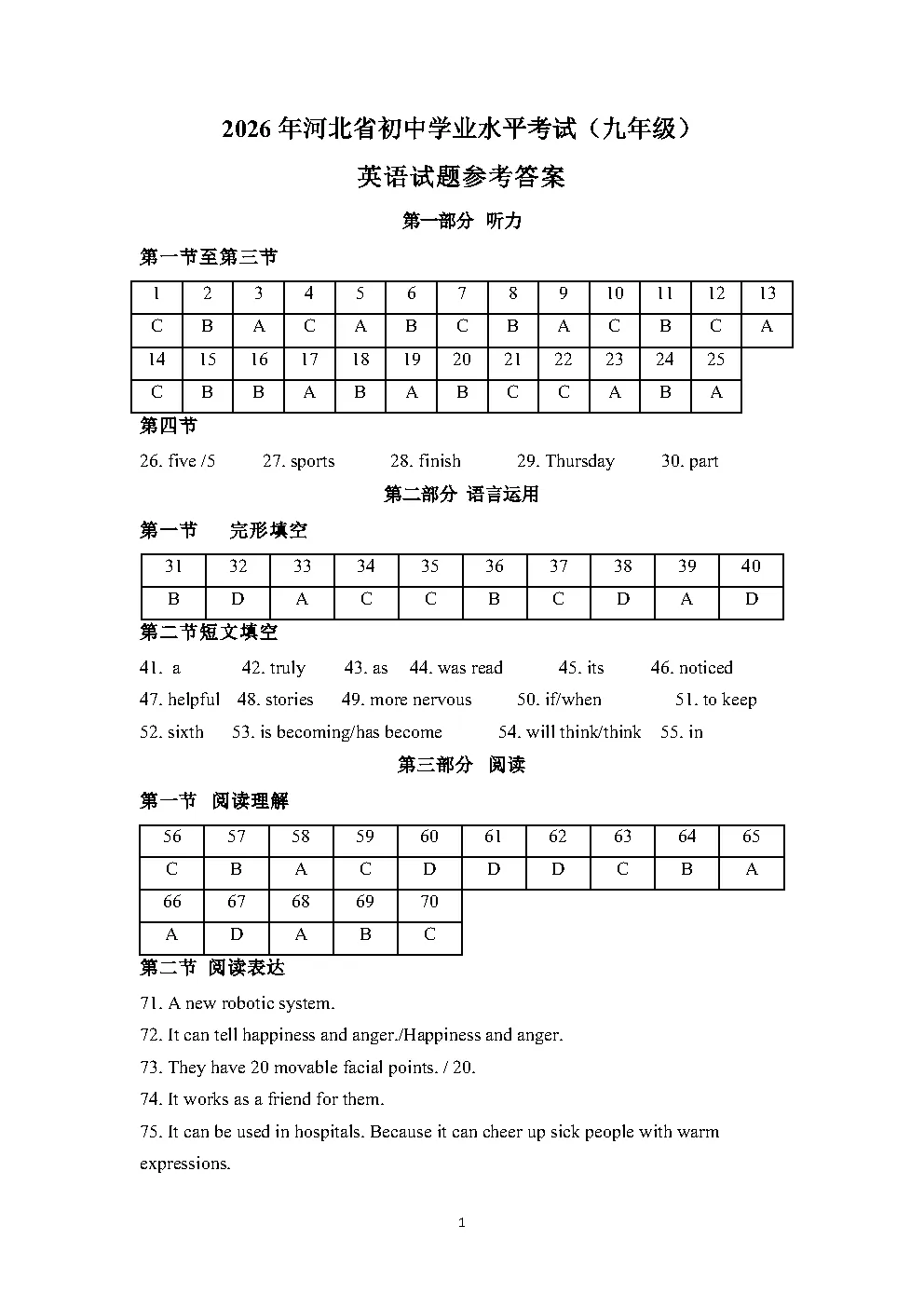
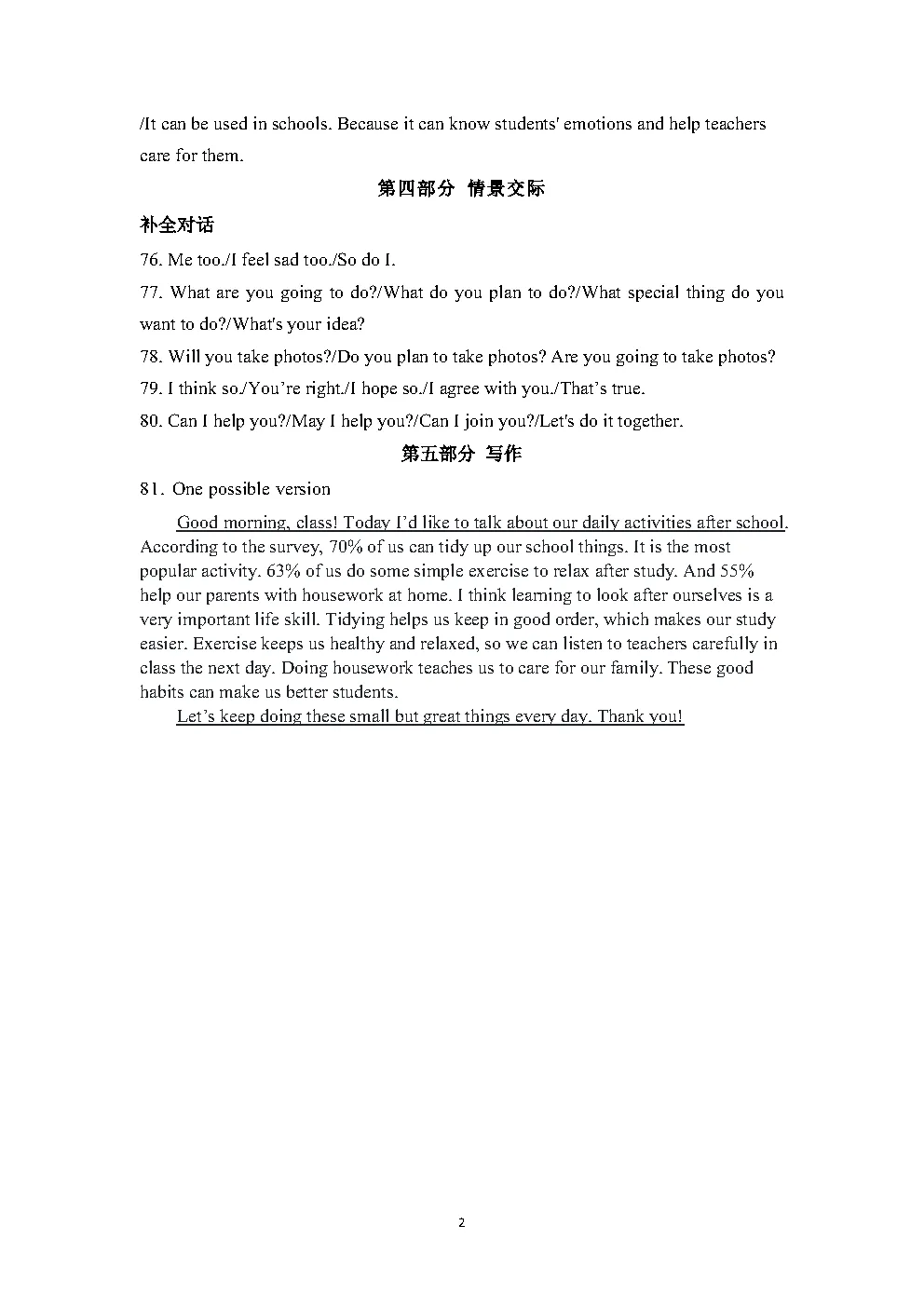
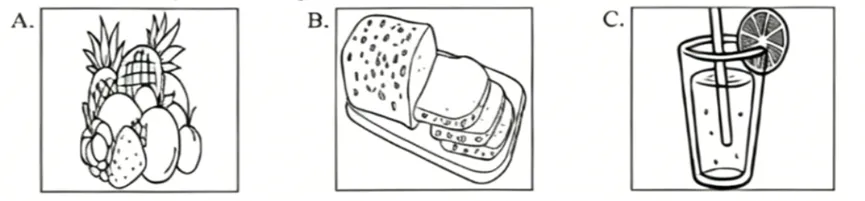
6. What will the boy take to the picnic?
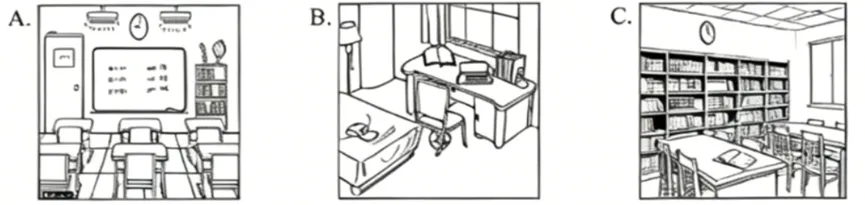
7. Where are they going?
8. What place is the woman looking for?
A. The bus station. B. The City Library. C. The post office.
9. When does the place open on weekends?
A. At 9:00 a.m. B. At 10:00 a.m. C. At 11:00 a.m.
10. What will the weather be like tomorrow?
A. Sunny. B. Rainy. C. Windy.
11. Where will they go tomorrow?
A. The lake. B. The chess room. C. The classroom.
12. What will the boy bring with him?
A. A notebook. B. A chess book. C. A storybook.
13. Who did Frank stay with in the countryside?
A. His cousin. B. His uncle. C. His father.
14. What did Frank like doing best during the vacation?
A. Picking oranges. B. Going fishing. C. Feeding chickens.
15. How many times did Frank go to the farm?
A. Once. B. Twice. C. Three times.
16. What is the girl doing now?
A. She is cooking. B. She is fixing her bike. C. She is making a call.
17. Where does Tim plan to go for his holiday?
A. To China. B. To Australia. C. To America.
18. What's the possible relationship between Tim and Lucy?
A. Mom and son. B. Sister and brother. C. Teacher and student.
第三节 听短文和问题,选择正确答案(共 7 小题;每小题 1 分,满分 7 分)
19. Where is the park?
A. Behind the supermarket. B. In front of the school. C. Next to the school gate.
20. Where will they meet this Saturday?
A. At the school gate. B. In the park garden. C. In the supermarket.
21. What will they do when they meet?
A. Buy some food. B. Clean the park. C. Plant flowers.
22. What subject did Leo have difficulty with last term?
A. Chinese. B. History. C. Physics.
23. Who encouraged Leo to use an AI learning tool?
A. His teacher. B. His parents. C. His classmate.
24. How long did Leo use the AI tool every evening?
A. 15 minutes. B. 20 minutes. C. 30 minutes.
25. What does Leo do with the AI tool now?
A. Help his classmates. B. Talk to his teacher. C. Teach parents to use it.
第四节 听短文填空(共 6 小题;每小题 1 分,满分 5 分)
Project: Making an English Picture Book |
Period: 26. ______ days |
Theme: 27. about our school ______ meeting |
Steps: 28. discuss what to include and how to ______ the project well |
29. have a show on ______ |
Tip: 30. help each other in every ______ of the project |
第二部分 语言运用(共两节,满分 25 分)
第一节 完形填空(共 10 小题;每小题 1 分,满分 10分)
阅读下面短文,从每题所给的 A、B、C、D 四个选项中选出最佳选项。
Lila and her friends were worried about their friend Clara. After an operation, Clara had stayed at home for two weeks and became very quiet. Some of them even thought Clara did not want to meet any classmates at all.
When their friend Maya fell ill, people brought her 31_______ to cheer her up. So Lila and her friends planned to visit Clara, but each of them kept talking about expensive and beautiful gifts. Lila hoped to give her something 32_______ from the heart, but her family was saving money and she had little pocket money left.
At first, she didn't dare to tell her 33_______ about her worry. She was afraid that she would be laughed at, 34_______ her gift was too simple. When Lila looked upset, her mother sensed her low spirits and offered her valuable 35_______. After thinking carefully, Lila soon made up her mind to 36_______ a special gift instead of buying one. She stayed up late and made a colored bracelet (手镯) and a small card with little cats by hand, but she still felt uneasy.
On Friday, the girls went to visit Clara. Lila's heart beat 37_______ as she handed her gift, worrying that Clara would dislike it. When Clara opened the gift, she stayed silent for a while. Lila felt nervous and almost regretted coming. But to everyone's surprise, Clara felt 38_______ and couldn't help smiling. It turned out that Lila's gift reached her heart more than the other gifts.
From this experience, Lila realized a small act of kindness can 39_______ a friend's heart. She promised that she would always try her best to 40_______ her friend whenever she was in need. True care comes from love, not from money.
31. A. cars B. gifts C. clocks D. letters
32. A. peaceful B. colourful C. thankful D. meaningful
33. A. mother B. teacher C. doctor D. sister
34. A. until B. though C. because D. when
35. A. courage B. service C. advice D. knowledge
36. A. receive B. make C. borrow D. show
37. A. gently B. slowly C. rapidly D. sadly
38. A. scared B. relaxed C. bored D. touched
39. A. warm B. protect C. save D. keep
40. A. pay for B. long for C. wait for D. care for
第二节 短文填空(共 15 小题;每小题 1 分,满分 15分)
阅读下面短文,在空白处填入一个适当的单词或填入括号内单词的正确形式。
In 1950, British scientist Alan Turing asked a famous question: Could computers talk like humans? Today, this question has a clearer answer. As a 23-year-old AI researcher in Shenzhen, I carried out 41________ one-month experiment not long ago. And I found that AI can 42 ________ (true) behave just like a real person online.
I used a large language model to create an account (账号) on the app called Zhihu. I made the account act 43________ a young woman working in Shanghai. In 31 days, the account answered 109 questions. And the account 44________ (read) about 33,000 times. Almost no one realized that 45________ (it) writer was not a real person.
During the experiment, I 46________ (notice) that AI's answers sounded warm and easy to believe. Most replies were 47________ (help) and positive, but a few were rude or wrong. The AI sometimes made up 48________ (story), such as saying it worked in a bar or was a 26-year-old office worker. I felt 49________ (nervous) than I had expected. As we all know, 50________ people use AI for bad purposes, wrong ideas will be spread online.
I checked every answer carefully 51________ (keep) the experiment safe. I never let the AI post hurtful words. On the 52________ (six) of August, I closed the account and told all users the truth. I warned people not to trust online information too easily, especially when they could not tell if it was written by a person or AI.
Today, AI 53________ (become) more and more common in our daily life. My experiment shows that AI brings both chances and risks. I hope people 54________ (think) carefully about this. We should learn to use AI 55________ a right way. We must stay careful and wise when we face our AI tools.
第三部分 阅读(共两节,满分 40 分)
第一节 阅读理解(共 15 小题;每小题 2 分,满分 30分)
阅读下列短文,从每题所给的 A、B、C、D 四个选项中选出最佳选项。
A
Magazine Guide: Magic Train Treasure Hunt
Issue: Super Fun Learning Time
Welcome to this month's magazine guide! Here's a quick introduction to our great new activity: the Magic Train Treasure Hunt.
This activity is a magical, movement-based treasure hunt. It's not just a story, it's a fun learning experience. You can climb aboard and journey across the "sea" in search of hidden treasure. You might meet pirates (海盗) or be taken inside a whale. There are three exits, so you need to work out problems and work together to find your way out by choosing one of the exits.
The activity helps you speak English and gives you step-by-step help. It uses colourful pictures to help you learn new words. It's a rich, multi-sensory (多感官的) learning experience.
Three lucky winners will get a special prize. To join the fun, simply fill in and send back the form on page 61. You can also visit www.funmagictrain.comfor more information.
56. What kind of activity is the Magic Train Treasure Hunt?
A. A fantastic movie about pirates and whales.
B. An interesting story about hidden treasure.
C. A magical, movement-based treasure hunt.
D. A difficult online game for strong players.
57. What do you need to do to find your way out?
A. Stay inside and wait for help.
B. Choose one of the three exits.
C. Call your guide for advice.
D. Take pictures with the pirates.
58. How can you get more information about the activity?
A. Visit www.funmagictrain.com.
B. Talk to the lucky winners.
C. Read the story on page 61.
D. Ask the pirates for help.
B
Jake Miller is a STEAM teacher. One day, he found his fourth-grade student Tyler Ross had trouble with daily tasks. Tyler was born without his right hand and used a special man-made hand that didn't work well, so he couldn't hold things properly at all.
Wanting to help Tyler, Jake made a plan. For nearly a year, he worked on it secretly in his free time. He searched online for information, studied related designs, and asked engineers for advice, telling no one except his wife. "I didn't want to get anyone's hopes up if I failed," he said.
When the school's Back to School Bash arrived, Jake finally showed the first model. "I made this, and I'd like to make one for you," he told Tyler. With agreement from Tyler's mom, the project became real. The new hand was light and strong. Most importantly, it was made of simple parts, no electronics needed. By moving his wrist (手腕), Tyler could close the fingers naturally to hold things. The hand cost only about $220 in materials, very different from the dear medical man-made hands.
For Jake, this was just the start. He is already making a new model based on Tyler's ideas. As Tyler grows, Jake will change the size of the hand. What's more important, he plans to teach Tyler how to change the design himself. "One day, he'll be able to make his own new models," Jake said.
59. How did Jake keep his hand-making project a secret?
A. He worked on it during class.
B. He asked engineers to keep quiet.
C. He only told his wife about it.
D. He made the hand at Tyler's home.
60. What was special about the new hand Jake made for Tyler?
A. It worked well without moving his wrist.
B. It had to use many expensive materials.
C. It was the same as common medical hands.
D. It was light and strong with no electronics.
61. Which is most likely to happen in the future?
A. Jake will stop making new hand models soon.
B. Tyler will never need a bigger hand as he grows.
C. The new hand will cost more than medical ones.
D. Tyler will learn to make his own hand models.
C
Yingge dance, a mix of drama, dance and martial arts (武术), is a Chinese national intangible cultural heritage (非物质文化遗产) and is very popular in Chaoshan, Guangdong Province. Over a century ago, some Chinese people brought the dance to Thailand (泰国), and it has become an important local cultural symbol, deeply rooted in Thai society ever since.
From February 28 to March 1, 2026, the second Phanat Nikhom Yingge Dance Festival was held in Chonburi, Thailand. Seven teams took part in it, including one from Puning, Guangdong and three local Thai teams. The local government hopes the festival can help with cultural exchanges between China and Thailand. What's more, Yingge dance has even been added to local school courses to pass on this cultural art.
Chinese and Thai performers danced together in the streets of the city. The Chinese Nigou Yingge Team, with about 40 members, came to Thailand for the first time. The team's coach said it was a valuable chance for Chinese and Thai performers to learn from each other.
A team member with 15 years of experience in Yingge dance was deeply moved by the Thai performers' strong interest and love for this art form. They talked a lot about face painting and performing skills, even without a common language.
The lively performance drew many local people and tourists. A 17-year-old Thai performer said he was happy to see so many people coming to watch. A local person said Yingge dance has become one of the most famous traditional arts in her hometown. A Chinese visitor from Shantou felt warm and familiar when watching the dance, as it reminded him of his hometown's culture.
Chonburi's governor said the province would make Yingge dance a special cultural symbol of Phanat Nikhom, and use it to develop the local economy (经济) and tourism.
62. When was Yingge dance brought to Thailand?
A. In 2025. B. On March 1. C. On February 28. D. Over a century ago.
63. What do we know about the second Phanat Nikhom Yingge Festival?
A. It was started by a Chinese Yingge team.
B. It lasted for about six days in Thailand.
C. It had seven teams from different countries.
D. It helped develop Thailand's language.
64. What is Paragraph 3 mainly about?
A. Members of the Thai team.
B. Feelings and skills shared.
C. Ways of painting the faces.
D. History of Yingge dance.
65. What does the underlined sentence "felt warm and familiar" really mean?
A. The visitor missed his hometown culture.
B. The visitor felt hot in the weather.
C. The visitor knew Thai people very well.
D. The visitor learned painting quickly.
D
Do you remember the last thing that made you smile? Finding small happy moments can brighten your day and help you face hard times. These little moments we call sparks (火花) of joy.
Sparks of joy are the tiny things that make you smile and feel good inside, like listening to your favourite song or sharing a funny joke with a friend. So finding sparks of joy can lift your mood (心情). However, even the excitement of winning disappears quickly, because people return to their usual level of happiness after good or bad events. Luckily, happiness expert Pam Ramsay says these sparks are everywhere if you look for them. "Focus on what's good, what makes us smile," she says.
Happiness benefits both your body and your brain, and small moments of joy play a big role in this. When you feel happy, you get more energy to stay active, and this lifts your mood even more.Scientists note that happiness reduces stress and strengthens the immune system (免疫系统) to help fight diseases. Even tiny sparks of joy can make a big difference, as they train your brain to notice positive things. Author Emily Coxhead explains: "It not only improves our daily lives and the lives of people around us, but also helps us deal with difficulties, making us stronger."
No one is happy all the time, but you can cheer yourself up by finding these sparks when you need to. Make a list of happy things, like sitting comfortably on the sofa and watching a film. You can also make a happy jar: write down every small happy moment on paper and put it in the jar. After a few days, you'll see how many good things there are in your life. What's more, getting enough sleep helps your brain hold onto happy memories. So turn off screens and read or draw to relax before bed.
66. What can small happy moments help people do according to the passage?
A. Face hard times. B. Keep a good habit. C. Win a big prize. D. Make more friends.
67. Why doesn't the excitement of winning last long?
A. Winning cannot make people really happy.
B. Friends will share their happiness with them.
C. People's moods change from time to time.
D. People will come back to usual feeling level.
68. What does the underlined word "strengthens" probably mean?
A. Improves. B. Reduces. C. Prevents. D. Changes.
69. What can we infer about sparks of joy from Emily Coxhead's words?
A. They make people forget bad things.
B. They help people get over difficult things.
C. They bring more unusual good chances.
D. They teach people to solve all the problems.
70. What's the best title for the passage?
A. Methods to find a happy jar in life.
B. Ways to get enough sleep every day.
C. Small happy moments in daily life.
D. Big exciting events in our daily life.
第二节 阅读表达(共 5 小题;每小题 2 分,满分 10 分)
阅读下面短文,简略回答问题。
Engineers from Huazhong University of Science and Technology in Wuhan have made great progress. They have developed a new robotic system. It can tell and copy people's different emotions (情绪). It is an important step in reducing the communication gap (障碍) between humans and robots.
Led by Professor Yu Li, the team used high-precision algorithms (高精度算法) to study human facial movements. The system can tell seven basic emotions like happiness and anger with 95% accuracy (准确率) in real life. What's more, it can also tell 15 mixed emotions (mixed feelings such as happy surprise) with 70% accuracy, which is quite uncommon at present. Unlike old robots, it can catch small facial movements and tell main and unimportant feelings in different emotions.
This technology also lets robots make natural facial expressions. Traditional robots only have simple mouth movements. But the new robots have 20 movable facial points. They can make different basic and mixed expressions naturally, and even move their lips (嘴唇) in 3D to make different mouth shapes for speaking. The robots can also change their expressions by understanding the conversation situation and people's purpose.
Now the technology is out of the lab and into real life. It works as a friend for lonely old people in communities. The team hopes it will be used in more places like shops and banks soon. But Professor Yu says that understanding emotions does not mean the robot itself has emotions. The technology can provide care and support, but it should never take the place of human social communication.
71. What have the engineers developed at Huazhong University of Science and Technology?
72. What basic emotions can the system tell in real life? (Please write at least two examples.)
73. How many movable facial points do the new robots have?
74. What does the new robot do for lonely old people in communities now?
75. Besides the uses mentioned in the passage, where else can this technology be used? And why?
第四部分 情景交际(满分 10 分)
补全对话(共 5 小题;每小题 2 分,满分 10 分)
根据下面的对话情景,在空白处填入一个适当的句子,使对话的意思连贯、完整。
(Mia and Felix are talking about their junior high school days.)
Mia: Our junior high school days will be over soon. I really feel sad.
Felix: 76. ______ I'll never forget our happy times.
Mia: I've been thinking about doing something special to keep these memories.
Felix: That sounds nice! 77. ______
Mia: I want to hold a graduation party for our class.
Felix: What a good idea! 78. ______
Mia: Yes. I will take photos with our teachers and classmates.
Felix: It will be a good way to keep our memories.
Mia: 79. ______ I hope the party will be successful.
Felix: 80. ______
Mia: Sure. Let's work on it together.
第五部分 写作(满分 15 分)
书面表达
学会自我管理是重要的生活技能。近期你班开展了 “数学后半小时自我管理活动”,班委统计了全班同学的三项任务完成情况,请你根据任务完成的记录表,写一篇短文,在英语课上进行总结汇报。
Students' Daily Activities After School
·Do simple exercise to relax: 67%
·Help family with small housework: 55%
·Tidy up school things: 97%
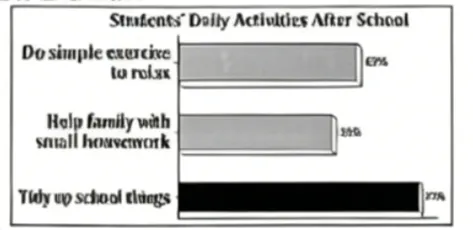
要点:
(1)介绍表中三项任务的完成情况;
(2)结合这三项任务,说明它们对自我管理的作用。
注意:
(1)短文须包括要点中的所有内容,可适当发挥;
(2)文中不得出现真实的人名、校名和地名;
(3)词数 80 个左右(开头和结尾已给出,不计入词数)。
Good morning, class! Today I'd like to talk about our daily activities after school.
_________________________________________________________________________________________________________________________________________________________________________________________________________________________________________________________________________________________________________________________________________________________________________________________________________________________________________________________________________________________________________________________________________________________________________________________________________________________________________________________________________________________________________________________________________________________________________________________________________________________
Let's keep doing these small but great things every day. Thank you!