

试卷类型:A
惠州市 2026 届高三模拟考试
英语
本试卷共8页考试时间:120分钟满分:120分
第一部分阅读(共两节,满分50分)
第一节(共15小题;每小题2.5分,满分37.5分)
阅读下列短文,从每题所给的 A 、B 、C 、D四个选项中选出最佳选项。
A
Wuzhen, located in Zhejiang Province, is a famous water town known for its picturesque canals, traditional wooden houses, and rich cultural heritage. In recent years, it has successfully combined rural tourism with smart technologies to improve both visitor experience and local life.
DataMiningTechniquesApplied
To better understand tourists, the local government uses data mining methods. Information is collected from social media, booking platforms, and visitor surveys. By studying the data, Wuzhen finds out what visitors really enjoy—such as cultural shows and local food. Based on these findings, the town develops better tourism services and marketing plans. Data mining has made an impact on tourist engagement and satisfaction in Wuzhen.
Indicator | Beforedatamining | Afterdatamining | Change |
Tourist engagement rate | 15% | 35% | 20% |
Visitor satisfaction rate | 70% | 85% | 15% |
SmartHomeIntegration
Smart home technologies have also been introduced to improve daily lifefor residents. IoT(物联网) devices monitor energy use, water use, and air quality in real time. The information collected helps the town manage resources more efficiently. For example, smart meters allow households tocheck theirelectricity usage.Smart homeintegration has madeanimpacton energy use and sustainability in Wuzhen.
Indicator | Beforesmarthomeintegration | Aftersmarthomeintegration | Change |
Averagehouseholdelectricity consumption (kWh) | 300 kWh/month | 255 kWh/month | -15% |
Participationinenergy-saving programs (%) | 25% | 55% | 30% |
ReductioninCO2emissions (tons/year) | 50 tons/year | 42.5 tons/year | -15% |
Byemployingbothdata-driveninsightsandsmarttechnologysystems,Wuzhenhas demonstrated measurable improvements in environmental sustainability, economic growth, and community involvement. As a result, the success of Wuzhen serves as a model for other rural areas seeking to use technology for sustainable development.
21. What is data mining’s impact on Wuzhen’s tourism?
A. The improvement of local food quality.
B. The reduction of tourism management costs.
C. The attraction of more visitors to cultural shows.
D. The rise in visitor participation and travel fulfillment.
22. How much household electricity is saved yearly in Wuzhen by smart homes?
A. 45 kWh.B. 300 kWh.C. 540 kWh.D. 750 kWh
23. What lessons does Wuzhen offer rural areas?
A. Digital-based approaches promote balanced local progress.
B. Local sightseeing contributes to regional economic growth.
C. Analytical methods influence local development planning.
D. Environmental progress accompanies native economic expansion.
B
During my years at Stanford University, I was the only deaf undergraduate on campus and AmericanSignLanguage(ASL)helpedmeparticipateinmyclassesandmyfavorite extracurricular activity: riding with the Stanford equestrian(马术) team.
Initially, I felt unsure about how I’d fit into such a hearing-centric world. When I visited the Stanford Red Barn, I had an urge to try out for the team. There, I discovered that the head coach, Vanessa Bartsch, had taken ASL during her own student years.She was completely calm by meetingadeaf riderandseemedexcitedtopracticeherASLagain.Ileftfeelingthrilled, realizing there was a place for me here.
OnceImadetheteam,thattrainingfieldbecomemysecondhome.Ibeganteaching Bartsch and my teammates some horsey vocabulary in ASL. During practice, I’d fix my gaze between my horse’s ears, then glance sideways at my ASL interpreter as she signed the coach’s instructions. She’d be jogging to stay within my viewing range, interpreting while also trying to stay clear of oncoming hurt from horses. I was amazed at how many forms of communication were happening at once, spoken and signed, human and horse.
Beyond the riding, the routine chores at the barn taught me that our horses were far more thansporting equipment. Being an equestrian athlete is different from other sports, not least because of the bonds that can stir from this shared love for the smell of horses. My Stanford teammatesand I did not always understand each other perfectly—but my timeon the team showed me that human language isn’t always essential for experiencing a deep connection with another living being.
Today,Iamanauthor.Goodwritingfeelslikeridingahorse—eachsentencemoves forward with rhythm and power. Sometimes, crafting my written works reminds me of Red Barn, which shaped my thoughts just as much as any literature class ever did.
24. Why did the author feel it possible to join the Stanford Red Barn?
A. The team favored disabled riders.B. She had rich equestrian experience.
C. The coach reacted positively to her.D. She’s involved in many school subjects.
25. What contributed to the author’s successful horse riding practice?
A. Extra training from the coach.B. The improvement of her hearing.
C. Her self-taught horsey vocabulary.D. The assistance from the interpreter.
26. What makes equestrian special to the author?
A. It brings more daily chances.B. It fits deafpeople very well.
C. It builds bonds through love for horses.D. It depends much on spoken language.
27. What message does the author intend to convey through her experience?
A. Practice makes perfect.B. ASL is key to team success.
C. Connection exists beyond words.D. Sports inspire writing career.
C
Almost one in five adults in the US lives with a mental illness. A number of scientific studies have shown that nature experiences may benefit people’s psychological well-being and cognitive(认知的) function. Experts are starting to recognize interacting with nature as one way to improve mental health. But it has been difficult to find ways to quantify these benefits in a useful manner for cities or organizations that want to integrate nature to improve mental health.
“Thinking about the direct mental health benefits that nature contact provides is important to take into account when planning how to conserve nature and integrate it into our cities,” says Greg Bratman, an assistant professor at the University of Washington, offering a conceptual model for this in his study.
The study outlines how city planners, landscape architects, developers, and others could eventually anticipate the mental health impacts of decisions related to the environment. Many governments already consider this with regard to other aspects of human health. For example, trees planted in cities improve air quality or reduce urban heat island effects, and parks built in specificneighborhoodsencouragephysicalactivity.Buttheseactionsdon’tusuallydirectly factor in the mental health benefits that trees or a restored park might provide.
Thenresearchersbuiltamodeltohelpmakemeaningful,informeddecisionsabout environmentalprojectsandhowtheymayimpactmentalhealth.Itincludesfourstepsfor planners to consider: elements of nature included in a project, say at a school or across the whole city; amount of contact people will have with nature; how people interact with nature; and how people may benefit from those interactions, based on the latest scientific evidence.
“If the evidence shows that nature contact helps to buffer(缓冲) against negative impacts from other environmental predictors of health, then access to these landscapes can be considered a matter of environmental justice. We hope this framework will contribute to this discussion,” Bratman says. “Eventually, it could be developed and potentially used to help address health disparities in underserved communities.”
28. What challenges planners in using nature to improve mental health?
A. The high cost of green space projects.
B. The difficulty in measuring the benefits.
C. The lack of scientific studies on nature.
D. The low awareness of mental illnesses.
29. What is the purpose of Bratman’s conceptual model?
A. To help decide on environmental issues.
B. To show benefits of nature for mental health.
C. To seek medical treatment for mental illnesses.
D. To replace traditional urban planning methods.
30. What should the government consider in environmental projects according to the model?
A. Increasing the number of urban communities.
B. Simplifying natural elements in the community.
C. Giving people advice on how to interact with nature.
D. Calculating the frequency of people’s nature contact.
31. Which of the following is the best title for the passage?
A. Mental Health Crisis: More Green Spaces Needed
B. Mental Illness Treatment: A Global Challenge
C. Happiness Measurement: Studies in Urban Parks
D. Nature and Well-being: ANew Tool for City Planners
D
For people with Alzheimer’s or other forms of dementia( 痴 呆 症 ), home can become a dangerous place.Simpleactslikecookingcanleadtofires,andtheriskof fallsincreases significantly. As the number of dementia patients in the U.S. is projected to double by 2060, researchers are asking: What if homes were “smarter” and less deadly? Increasingly, AI is being used to improve safety for patients and reduce the crushing burden on caregivers.
George Demiris, a researcher at the University of Pennsylvania, is leading projects like “Sense4Safety.” Unlike traditional cameras that might invade privacy, this system uses depth sensors to extract human shapes. It analyzes a person’s gait(步态)—measuring step length and speed—to predict fall risks. “Current care systems are unfortunately reactive; we wait for a fall to happen,” Demiris explains. “AI allows us to be proactive, intervening when it detects subtle changes in daily routines or movement patterns before an accident occurs.”
While the technology shows tremendous promise, it also raises complex ethical concerns. Tiffani Bright, an expert in AI fairness, warns about data bias. If an AI model is trained on data that doesn’t reflect the diversity of the patient population, it could provide inaccurate advice for certain groups. Furthermore, there is the issue of access. “Research goes where the dollars go,” Bright notes. Ironically, those who need this technology the most-often in rural or lower-income areas—might be the last to access it, exacerbating the digital divide in healthcare.
Moreover, experts emphasize that technology has limits. Regina Shih, an epidemiologist, argues that one cannot “app their way” out of hands-on care. “There is no way to replace the human interaction and empathy required in family caregiving,” she says. AI can monitor safety and provide peace of mind, but it cannot replace the human touch needed to help someone eat, bathe, or dress.
Ultimately, smart homes represent a powerful tool, not a replacement. The challenge lies not justindevelopingthetechnology,butinensuringitisusedresponsibly,justlyasa complement to human compassion.
32. How does Sense4Safety improve safety according to the text?
A. By offering medical help after accidents.
B. By predicting possible dangers in advance.
C. Bycontrolling patients ’ daily movements.
D. By recording real-time behaviors with cameras.
33. What does the underlined word “exacerbating” in paragraph 3 probably mean?
A. Bridging.B. Worsening.C. Identifying.D. Ignoring.
34. Why is AI unable to replace human care?
A. It lacks necessary human warmth.
B. It fails to ensure the safety of the elderly.
C. It is far too expensive for most families.
D. It causes potential risks to personal information.
35. Which ofthe following would the author probably agree with?
A. AI benefits patients equally across the areas.
B. AI should be used appropriately in care giving.
C. AI is the final solution to health care problems.
D. AI can independently deal with health care issues.
第二节(共5小题;每小题2.5分,满分12.5分)
阅读下面短文, 从短文后的选项中选出可以填入空白处的最佳选项。选项中有两项为多余选项。
HowtoWriteanArgumentativeResearchPaper
An argumentative essay requires you to make a convincing argument about a specific issue withreliableevidencefromprimaryandsecondarysources.36Byfollowingsome standard steps, you can learn to write an effective argumentative essay.
UnderstandtheBasicFeatures
Argumentative essays share several essential features that you should always include. You must support your argument using clear logic and reliable evidence from your research.37This strengthens your credibility and avoid plagiarism(剽窃). However, you must read instructions carefully. Understanding the assignment fully will save you time and prevent mistakes later.
38
Before choosing a topic, take time to explore your thoughts through invention activities. Once you have explored your ideas, you should write a tentative thesis(论文) statement. A tentative thesis statement can help you move forward with your ideas while reminding yourself that you are open to changes to the thesis statement.39A good thesis clearly states your paper’s main claim. Besides, your thesis should explain why you take this position clearly, what makes it problematic and who would benefit from the proposed change.
OrganizeYourEssay
Finally,developaroughoutlinebasedonyour research notes.Organizinginformation before drafting helps you write more effectively and ensures logical flow between paragraphs. Your outline can be detailed or brief according to your preference.40
By following these steps carefully—from understanding requirements through generating ideas,craftingathesis,andoutlining—youwillbuildastrongfoundationforanexcellent argumentative essay.
A. Choose a Proper Topic
B. Generate and Develop Ideas
C. A good outline follows a standard format.
D. In other words, the statement is not set in stone.
E. Additionally, you should always cite your sources properly.
F. This type of essay is a common assignment in academic settings.
G. However, more detail means more material to expand upon afterwards.
H.
41.A.fearB.joyC.angerD.pride
42.A.practicedB.discussedC.avoidedD.challenged
43.A.planB.mistakeC.guidanceD.method
44.A.move onB.step asideC.make a switchD.keep a secret
45.A.changedB.extendedC.approachedD.passed
46.A.familiarB.awkwardC.differentD.ridiculous
47.A.recordB.predictC.hideD.explain
48.A.projectB.examC.decisionD.competition
49.A.requestB.messageC.callD.question
50.A.classB.processC.experimentD.invention
51.A.numbersB.wordsC.detailsD.actions
52.A.nervousB.curiousC.proudD.calm
53.A.openlyB.narrowlyC.carefullyD.slightly
54.A.socialB.analyticalC.sensitiveD.expressive
55.A.acceptedB.forgottenC.ignoredD.discovered
第二节(共10小题:每小题1.5分,满分15分)
阅读下面短文,在空白处填入 1 个适当的单词或括号内单词的正确形式。
Beijing is actively bringing AI into its education system. AI tools are now widely used in primary and secondary schools across the city56(help) students learn better and support teachers in their work.
Significant progress has been made. The city has developed intelligent platforms and an AI57(apply) marketplace, making a variety of tools for schools. These tools offer teachersinformation,likestudentattendanceandtimespentononlinestudying,58 teachers can use to offer each student more personalized help.So far, more than 60 schools59(benefit) from these AI-powered tools.
Ren Weidong, a principal in Beijing, says AI education is not just about using technology, and students and teachers should learn how to use AI in creative ways. He sees AI60a helpful assistant for teachers. For example, when a student seems less61(focus) in class, AI can quickly provide useful information to help the teacher better understand the student and offer the right support.
Still,Renpointsoutthathumanconnection62(matter)most.Hesays,“We encourage teachers to use AI technology to improve teaching, but we must not forget63 importance of human care and personalized guide.”
AI should support teachers, not replace them. To make sure AI is used64(proper), schools are setting clear rules. Beijing is also working to keep student data safe65make sure AI is used in the right way.
第三部分写作(共两节,满分40分)
第一节(满分15分)
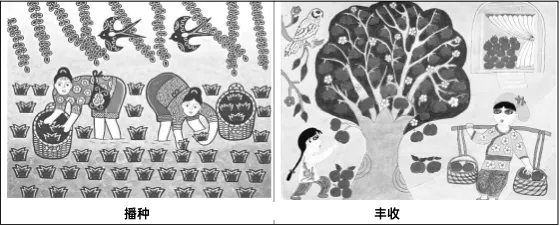
假定你是李华,你的外教 Peter对中国农民画很感兴趣,来信请你推荐一幅你喜欢的画 。请你从下面两幅画中选择一幅,结合画面内容和你对画的理解, 回复他的邮件。
注意:
1.词数 80 左右;
2.请在答题卡的相应位置作答。
Dear Peter, Glad to hear that you’re interested in Chinese farmer paintings. Yours, Li Hua |
第二节(满分25分)
阅读下面材料,根据其内容和所给段落开头语续写两段,使之构成一篇完整的短文。
As a member of the school swim team, I know all about competition. Our Coach never lets us forget that winning isn’t everything. “Good sportsmanship makes a true athlete.” I was proud of understanding this lesson. But another contest challenged me.
It started in science class. After a month studying the solar system, some of us were chosen for Planetary Playoff, a game-show-style contest. Our opponent was Lynwood School. The week before the competition, our team met to practice. “My sister said Lynwood’s team will beat us easily. Everyone calls them the ‘genius school’,” Leo spoke up. “I heard they cheat on tests,” I whispered, “and they are all unfriendly.” Leo tried tostop it, “We don’t have proof.” But I argued, “We don’t have proof it’s not true, either.” As the words left my mouth, my stomach twisted. I’d always hated rumors(谣言), yet here I was, spreading them.
Soon, the talk turned mean.The more we badmouthed Lynwood, the more confident we felt. Putting them down felt like building ourselves up. Finally we were convinced we were the better team.
The competition day arrived. As we gathered in the school hall, I noticed some Lynwood team members glancing at us and whispering. A knot( 结) tightened in my stomach—had they heardwhatIsaid?Whenthecontestended,welostbadly.Ifeltmyfaceburnwith embarrassment—we’d been so sure we’d win, and we’d been so mean about them. Lynwood school answered questions we had never even heard of. Without doubt, they easily took home the prize—pizza and cakes.
Then something shocking happened. Zack, a Lynwood student, approached with a warm smile. “Great job out there,” he said. His team soon joined,sharing their pizza. “We were so nervous we could barely breathe!” one admitted. Leo laughed. “Same here.” As Zack handed me aslice,mythroattightened.Theyweren’tunfriendlygeniuses—justkids,likeus.Inthat moment, all our rumors felt stupid.
注意:
1.续写词数应为 150 左右;
2.请按如下格式在答题卡的相应位置作答。
Leo noticed my unease, leaned in and whispered, “That’s true sportsmanship.” “Zack”, I called, and he turned with a surprised look. |


