

在教学中,老师们常会用到以往高考卷中的阅读理解题,或是为了教授语言知识,或是为了拓展学生的话题知识,还有的老师会利用它们来让学生了解高考真题的命题思路、把握高考阅读理解的命题规律。相较于教辅资料、模拟卷上的试题,高考真题因其命题水平高、命题组织严密而成为了教学中的珍贵资源。那么,高考真题该怎么用才能更有利于学生把握高考阅读理解命题规律呢?要达到这一目的,有没有比单纯的“做题—讲解”更好的训练方式?如果有学生因为读过题中的语篇而对题目不感兴趣,我们该怎么办?
我将通过本期推送与大家分享我曾使用过的四种真题阅读理解训练方式:
1. 学生自己写答案,比较自己的回答与正确答案的差距
我认为阅读理解题的本质是读写测试,是考查学生通过阅读获取信息和处理信息的能力。之所以采用避开干扰项、选择正确项而非写出正确答案的测试方式来呈现对信息处理的结果是因为想要通过测试的“标准化”来提高评价的“有效性”。
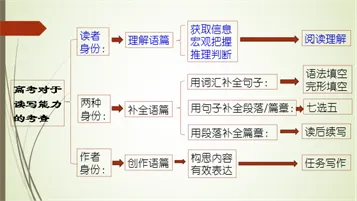
对于英语水平高的学生来说,做真题时如果长期阅读后自己写一个答案,然后比较自己的回答和出题人提供的正确答案之间的差距,他们将逐步提高获取信息的准确性,概括信息的恰当性和思维的水平。
2. 明晰能力考查点
高考阅读理解一般从三方面考查学生:语篇宏观意识、逻辑思维能力、获取信息能力,而学生在得出答案时一般运用了以下策略:常识、数字计算、联系信息、比较信息、分析结构或关系、归纳概括、推理判断等。
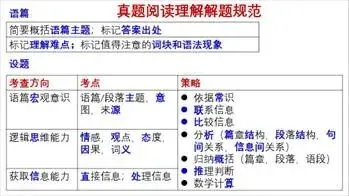
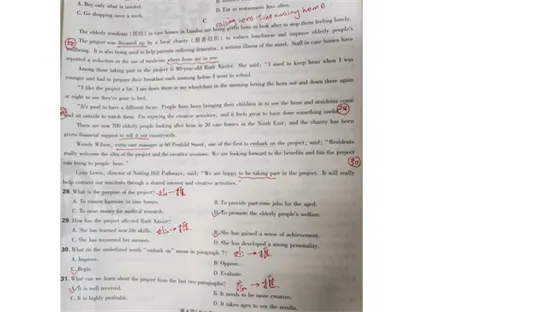
如果学生在长期的真题训练中能熟悉命题人设计的能力考查目标和应该采用的解题策略,在高考考场上便会在一定程度上感受到与命题者之间的默契,从而有利其于水平的发挥。
3. 理清语篇宏观结构与题目的关系
语篇分析是阅读测试命题的第一步。高考阅读理解题目的设计与语篇的宏观结构关系十分密切。
以下试以2023年全国一卷B文章为例说明:
When John Todd was a child, he loved to explore the woods around his house, observing how nature solved problems. A dirty stream, for example, often became clear after flowing through plants and along rocks where tiny creatures lived. When he got older, John started to wonder if this process could be used to clean up the messes people were making.
After studying agriculture, medicine, and fisheries in college, John went back to observing nature and asking questions. Why can certain plants trap harmful bacteria (细菌)? Which kinds of fish can eat cancer-causing chemicals? With the right combination of animals and plants, he figured, maybe he could clean up waste the way nature did. He decided to build what he would later call an eco-machine.
The task John set for himself was to remove harmful substances from some sludge (污泥). First, he constructed a series of clear fiberglass tanks connected to each other. Then he went around to local ponds and streams and brought back some plants and animals. He placed them in the tanks and waited. Little by little, these different kinds of life got used to one another and formed their own ecosystem. After a few weeks, John added the sludge.
He was amazed at the results. The plants and animals in the eco-machine took the sludge as food and began to eat it! Within weeks, it had all been digested, and all that was left was pure water.
Over the years, John has taken on many big jobs. He developed a greenhouse-like facility that treated sewage (污水) from 1,600 homes in South Burlington. He also designed an eco-machine to clean canal water in Fuzhou, a city in southeast China.
“Ecological design” is the name John gives to what he does. “Life on Earth is kind of a box of spare parts for the inventor,” he says. “You put organisms in new relationships and observe what’s happening. Then you let these new systems develop their own ways to self-repair.”
该语篇宏观结构如下:
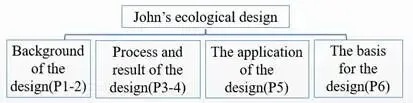
该语篇的问题设计如下:
24. What can we learn about John from the first two paragraphs?
A. He was fond of traveling.B. He enjoyed being alone.
C. He had an inquiring mind.D. He longed to be a doctor.
25. Why did John put the sludge into the tanks?
A. To feed the animals.B. To build an ecosystem.
C. To protect the plants.D. To test the eco-machine.
26. What is the author’s purpose in mentioning Fuzhou?
A. To review John’s research plans.B. To show an application of John’s idea.
C. To compare John’s different jobs.D. To erase doubts about John’s invention.
27. What is the basis for John’s work?
A. Nature can repair itself.B. Organisms need water to survive.
C. Life on Earth is diverse.D. Most tiny creatures live in groups.
我们可以观察到这四道题与语篇结构的关系:
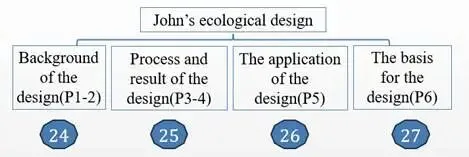
由此可见,学生如果经过长期训练从而善于把握语篇宏观结构,便有利于快速地定位答题所需信息的来源,从而对选项进行更准确的判断。
4. 简要概括语篇
高考阅读理解考查学生获取语篇重要信息的能力。宏观规则能帮助人们排除与主题无关或对主题不那么重要的信息的干扰,步步接近重要内容和主题(钱敏汝)。面对理解难度大的文章,如果教师能经常引导学生在理解语篇的基础上,利用自己的分析思维,对语篇进行总结概括,则有利于他们准确把握文章主题内容,有利于他们获取重要信息。
The notion that we live in someone else's video game is irresistible to many. Searching the term“simulation hypothesis”(模拟假说)returns numerous results that debate whether the universe is a computer simulation — a concept that some scientists actually take seriously. Unfortunately, this is not a scientific question. We will probably never know whether it's true. We can, instead, use this idea to advance scientific knowledge.
The 18th-century philosopher Kant argued that the universe ultimately consists of things-in-themselves that are unknowable. While he held the notion that objective reality exists, he said our mind plays a necessary role in structuring and shaping our perceptions. Modern sciences have revealed that our perceptual experience of the world is the result of many stages of processing by sensory systems and cognitive(认知的)functions in the brain. No one knows exactly what happens within this black box. If empirical(实证的)experience fails to reveal reality, reasoning won't reveal reality either since it relies on concepts and words that are contingent onour social, cultural and psychological histories. Again, a black box.
So, if we accept that the universe is unknowable, we also accept we will never know if we live in a computer simulation. And then, we can shift our inquiry from“Is the universe a computer simulation?”to“Can we model the universe as a computer simulation? ” Modelling reality is what we do. To facilitate our comprehension of the world, we build models based on conceptual metaphors(隐喻)that are familiar to us. In Newton's era, we imagined the universe as a clock. In Einstein's, we uncovered the standard model of particle(粒子)physics.
Now that we are in the information age, we have new concepts such as the computer, information processing, virtual reality, and simulation. Unsurprisingly, these new concepts inspire us to build new models of the universe. Models are not the reality, however. There is no point in arguing if the universe is a clock, a set of particles or an output of computation. All these models are tools to deal with the unknown and to make discoveries. And the more tools we have, the more effective and insightful we can become.
It can be imagined that comparable to the process of building previous scientific models, developing the“computer simulation” metaphor-based model will also be a hugely rewarding exercise.
28. What does the author intend to do by challenging a hypothesis?
A. Make an assumption. B. Illustrate an argument.
C. Give a suggestion.D. Justify a comparison.
29. What does the phrase “contingent on” underlined in Paragraph 2 probably mean?
A. Accepted by. B. Determined by. C. Awakened by. D. Discovered by.
30. As for Kant’s argument, the author is _________.
A. appreciative B. doubtful C. unconcerned D. disapproving
72. It is implied in this passage that we should _________.
A. compare the current models with the previous ones
B. continue exploring the classical models in history
C. stop arguing whether the universe is a simulation
D. turn simulations of the universe into realities up.
以上为2024年高考英语北京卷的C文章。因为语篇内容抽象,对目标读者的英语水平要求较高,所以理解难度大,学生对于第28题和31题的答案尤其没有把握,于是我鼓励他们用25个左右单词概括语篇大意,随后我也提供了自己写的概要。
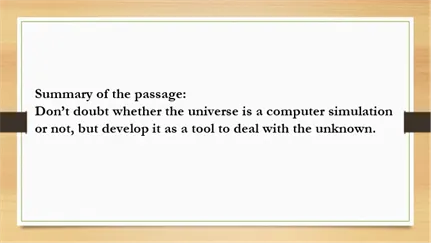
当概括完该语篇,并参考我的概要之后,学生对如何回答28题和31题有了更大的把握。概括完该语篇后,我们可以理解作者通过该语篇提出了自己的建议(28题),建议的内容是:对于宇宙是否是一个计算机模型这一问题,我们无需争论,只需发展这个工具,以供我们更好地探索未知世界(31题)。
以上我分享了四种阅读理解真题的训练方式,目的是让学生更好地把握高考命题规律,建立与命题思路之间的默契,从而在高考中有更好的发挥。
您如果您对这一话题也感兴趣,对真题训练也有自己的独特做法,欢迎您在评论区分享经验,让更多同行受益于我们的交流。
From: A read-write teaching lab on the ponds


