

第一部分 阅读(共两节,满分40分)
第一节(共15小题;每小题2分,满分30分)
阅读下列短文,从每题所给的A、B、C三个选项中选出最佳选项。
A
Summer Camp at Mount Tai
Looking for an unforgettable summer experience? Join our “Culture & Nature” camp at the foot of Mount Tai!
Activities:
Morning: Hike along the ancient paths, learn about the history of the 72 Emperors who visited the mountain.
Afternoon: Calligraphy (书法) workshop. Try writing Confucius’ famous sayings with a brush.
Evening: Campfire stories about the legends of Mount Tai.
Details:
Dates: July 15 – July 20, 2025
Age: 12-15 years old
Price: ¥2,500 (includes meals, accommodation, and all activities)
Contact: Call Mr. Li at 0538-1234567 or visit our website www.taiShanCamp.com for registration.
What can campers do in the afternoon?A. Hike along the paths.B. Learn about ancient emperors.C. Practice calligraphy.
How much does the camp cost?A. ¥2,500B. ¥2,000C. ¥1,500
How can you get more information about the camp?A. Send an email.B. Visit the website.C. Write a letter.
B
Library Rules Update
To provide a better reading environment, the Shandong Provincial Library has updated its rules. Please read carefully.
Notice:
ID Required: You must show your ID card or library card to enter.
Quiet Zone: Mobile phones must be set to silent mode. No talking in the reading rooms.
Borrowing Limit: Each reader can borrow up to 5 books for 30 days. Books can be renewed (续借) online once for another 15 days.
Special Collections: The “Confucius Culture” section is for reference only and cannot be checked out.
Violation (违规) Rules:
First warning: A verbal reminder.
Second violation: Suspension (暂停) of borrowing rights for one month.
What should you do to enter the library?A. Show your student card.B. Show your ID card or library card.C. Register online first.
How long can a book be kept at most by renewing it?A. 30 days.B. 45 days.C. 60 days.
What will happen if you break the rules for the second time?A. You will get a verbal reminder.B. You cannot borrow books for a month.C. You will be asked to leave the library.
Which section of the library cannot be borrowed?A. The “Confucius Culture” section.B. The children’s book section.C. The magazine section.
C
The Rise of “Digital Humans” in Education
Imagine having a teacher who never gets tired, can speak 10 languages, and knows everything about the Yellow River’s ecosystem. This is not science fiction anymore. In 2024, several schools in Jinan, Shandong, introduced “digital human” teachers—3D animated figures powered by Artificial Intelligence (AI).
These digital teachers are not just fancy screens. They are interactive. Using AI, they can answer students’ questions in real time, provide personalized exercises based on each student’s weak points, and even use body language to explain difficult concepts.
For example, in a geography class about the Yellow River, the digital teacher can “travel” through the river’s history in seconds, showing how the ecosystem changed over thousands of years. It makes learning more visual and interesting. However, some parents worry that too much screen time might reduce the connection between real teachers and students.
Schools argue that these digital teachers are tools to help, not replace, human teachers. “They take care of repetitive tasks,” said a principal from a pilot school, “so our real teachers can focus more on emotional support and creative teaching.”
As AI technology grows, the Yellow River Delta (三角洲) ecology monitoring, another AI application, is also helping students learn about environmental protection through real-time data. The future of education is here, blending the digital and the human.
What is the main purpose of introducing digital human teachers?A. To replace all human teachers.B. To make classes more interesting and personalized.C. To show the latest technology.
How does the digital teacher help in a geography class about the Yellow River?A. By taking students on a field trip.B. By showing the river’s history visually.C. By inviting experts to give talks.
10. What is one concern that parents have? A. The digital teachers might make mistakes. B. The technology is too expensive. C. It might weaken the connection with real teachers.
11. The phrase “take care of repetitive tasks” in Paragraph 4 means that digital teachers can _____. A. do the same work again and again for teachers B. understand students’ emotions C. create new teaching methods
D
From Zero to Hero: Quan Hongchan’s Olympic Dream
At the 2024 Paris Olympics, a 17-year-old girl from Guangdong captured the world’s attention. Her name is Quan Hongchan, and she is the new star of diving (跳水). But behind her perfect dives is a story of hard work and a simple dream.
Quan was born in a small village. Her family was not rich, and her mother had been in a car accident, needing long-term medical care. When Quan was young, she had no idea what the Olympics were. “I just wanted to win a medal so I could earn money to help my mom,” she once said in an interview.
At 7, she started training at a sports school. The training was extremely hard. While other kids played, Quan spent hours jumping into the pool, practicing the same moves hundreds of times. She faced failures and felt homesick, but she never gave up. Her coach noted her strong will. “She is not afraid of pain. She just keeps jumping,” her coach said.
Her big break came in 2021 at the Tokyo Olympics, where she won a gold medal with record-breaking scores at just 14. However, the fame did not change her. She went back to training, focusing on new challenges. In Paris, she defended her title, winning two gold medals.
Quan’s story is not just about winning. It is about a daughter’s love, the courage to overcome difficulties, and the spirit of teamwork. She has become a role model, showing that with enough effort, even the biggest dreams can come true.
12. Why did Quan Hongchan want to win a medal at first? A. To become famous. B. To pay for her mother’s medical care. C. To prove she was the best.
13. What challenge did Quan face during her early training? A. She had no coach. B. She couldn’t swim. C. The training was very hard and she missed home.
14. Which word best describes Quan Hongchan’s character? A. Weak. B. Determined. C. Careless.
15. What does the author want to tell us through Quan’s story? A. Winning is everything in life. B. Fame can easily change a person. C. Hard work and strong spirit lead to success.
第二节(共5小题;每小题2分,满分10分)
阅读下面短文,从短文后的选项中选出可以填入空白处的最佳选项。选项中有一项为多余选项。
How to Beat Procrastination (拖延症)
Have you ever put off a task until the last minute? You are not alone. Procrastination is a common problem, especially among students. 16 Here are some effective ways to beat it.
1. Break tasks into small pieces.A big project can feel overwhelming. Instead of thinking “I have to write a whole report,” tell yourself “I will just write the introduction.” 17
2. Remove distractions (分心的事物).Turn off your phone or put it in another room. Close unnecessary websites on your computer. 18 You will be surprised how much more you can get done.
3. Set a timer.Try the “Pomodoro Technique.” Set a timer for 25 minutes and work only on one task. When the timer goes off, take a 5-minute break. 19 This method helps you focus without feeling burned out.
4. Reward yourself.Promise yourself a small treat for finishing a task. It could be watching an episode of your favorite show, eating a snack, or going out with friends. 20
A. It creates a sense of achievement and makes you want to move to the next step.B. Positive reinforcement (强化) can make you more motivated.C. It can lead to stress, low grades, and a loss of confidence.D. Make your study environment as quiet and focused as possible.E. Repeat this cycle four times, then take a longer break.
第二部分 语言运用(共两节,满分20分)
第一节 完形填空(共10小题;每小题1分,满分10分)
阅读下面短文,从每题所给的A、B、C三个选项中选出可以填入空白处的最佳选项。
I still remember that day. It was the school’s annual sports meet. I signed up for the 800-meter race, hoping to win for my class. I had practiced for weeks.
On the day of the race, my heart was beating fast. The gun went off, and I started running. For the first lap, I was in second place. I felt 21. But then, on the second lap, my foot caught a small stone. I fell hard onto the track. Pain shot through my knee. I saw blood. The other runners 22 me.
Lying on the ground, I wanted to give up. “Just stay here,” I thought. “The race is over for me.” Then I heard my friends shouting, “Come on, Li Ming! You can do it!” I looked up. The finish line was still far away, but so were the other runners.
I took a deep breath and 23 myself up. Every step sent pain through my leg, but I kept going. I was not running to win anymore. I was running to 24.
When I finally crossed the finish line, I was the last one. But the crowd 25. My friends ran to me, cheering and hugging me. I didn’t get a medal, but I felt like a champion.
That experience taught me a valuable 26. Winning isn’t always about being first. It’s about having the 27 to get back up when you fall. It’s about the people who 28 you. My friends’ support that day was my true 29. Sometimes, the greatest victory is not in winning the race, but in 30 to finish it.
21. A. nervous B. confident C. tired
22. A. passed B. helped C. waited for
23. A. gave B. picked C. put
24. A. rest B. finish C. win
25. A. cried B. left C. cheered
26. A. lesson B. skill C. tool
27. A. chance B. luck C. courage
28. A. believe in B. depend on C. care for
29. A. goal B. prize C. dream
30. A. refusing B. trying C. forgetting
第二节 语法填空(共10小题;每小题1分,满分10分)
阅读下面短文,在空白处填入一个适当的单词或括号内单词的正确形式。
Mount Tai, located in the central part of Shandong Province, 31 (know) as the first of the “Five Great Mountains”. It 32 (be) a place of worship for over 3,000 years. Emperors of ancient China would climb the mountain 33 (show) their respect to heaven and earth.
In recent years, the protection of Mount Tai’s ecological environment 34 (become) a top priority. The local government 35 (carry) out several projects to prevent soil erosion (水土流失) and protect the ancient trees. Thanks to these efforts, the forest coverage rate 36 (increase) to over 80% now.
For visitors, Mount Tai offers not only natural beauty but also rich culture. You can see many inscriptions (碑文) 37 (leave) by historical figures along the path. Climbing the 6,660 steps to the top is a challenge, 38 the sunrise view from the peak is worth every effort.
If you plan 39 (visit), autumn is the best season. The weather is cool, and the sky is clear. Remember 40(bring) a jacket because it can be cold at the top, even in summer.
第三部分 写作(共两节,满分30分)
第一节 阅读表达(共5小题;每小题2分,满分10分)
阅读下面的短文,根据短文内容回答问题。
The Yellow River Delta: A Land of Life and Challenge
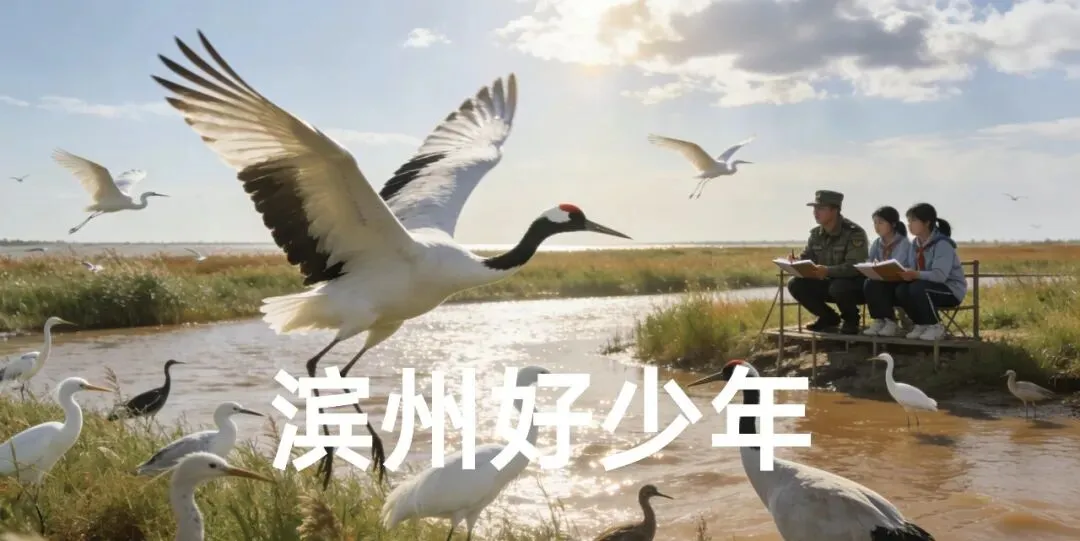
In recent years, the Shandong government has made great efforts to protect this natural treasure. New laws have been passed to control industrial pollution. Wetland restoration projects have helped bring back native plants and animals. As a result, the delta has seen a remarkable recovery. Bird populations have increased, and the area has become a popular destination for eco-tourists.
However, challenges remain. Water shortages in the Yellow River sometimes affect the delta’s wetland. Climate change also brings risks, such as rising sea levels. Local scientists are working hard to monitor these changes and find solutions.
For students, the delta offers a living classroom. Schools in Dongying often organize field trips where students can learn about wetland ecology. Some students have even started projects to reduce plastic waste in the area. “It’s our home,” said one student, “and we want to protect it.”
The story of the Yellow River Delta shows that with care and effort, nature can heal. It also reminds us that everyone has a role to play in environmental protection.
41. Where is the Yellow River Delta located?
42. Are wetland restoration projects helpful to the delta’s ecosystem?
43. What does the delta face?
44. How do students in Dongying help protect the delta?
45. What does the story of the Yellow River Delta remind us?
第二节 书面表达(满分20分)
假设你是李华,你所在的学校正在开展“节约用水,保护黄河”的主题活动。请你根据以下提示,用英语写一封倡议书,号召全体同学积极参与。
内容要点:
黄河的重要性(母亲河,对山东农业、生活的重要性);
存在的问题(部分河段水位下降、浪费现象);
倡议内容(列举2-3个节约用水的具体做法,如随手关水龙头、一水多用等);
发出呼吁。
注意:
词数80词左右;
可适当增加细节,以使行文连贯;
开头和结尾已给出,不计入总词数。
Dear fellow students,
The Yellow River, known as the “Mother River”, is of great importance to us, especially in Shandong. ________________________________________________________________________________
Let’s take action now!
Yours sincerely,Li Hua
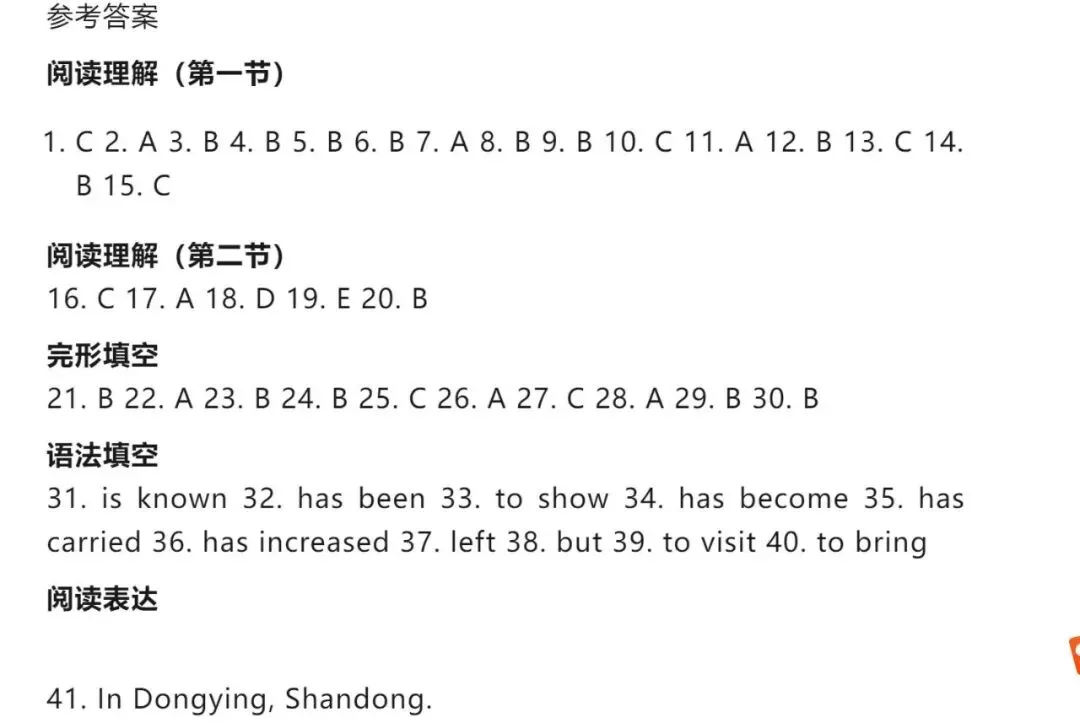
42. Yes, they are. / Yes.
43. Water shortages and climate change.
44. They learn about wetland ecology on field trips and start projects to reduce plastic waste.
45. It reminds us that everyone has a role to play in environmental protection. / With care and effort, nature can heal, and everyone has a role.
书面表达(略)


