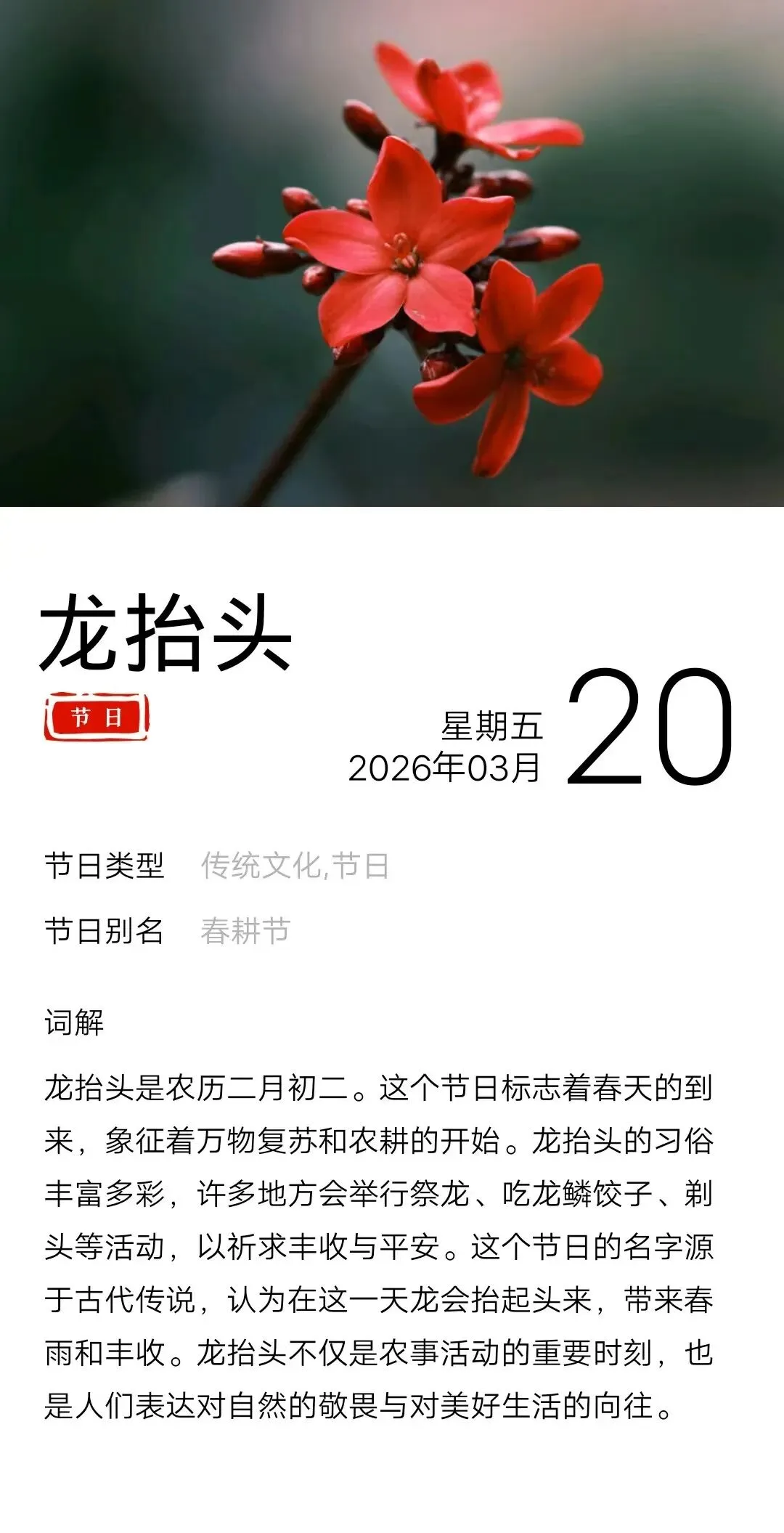
中考英语时文・二月二龙抬头 专项练习
一、阅读理解 A(文化细节类)
Dragon Head-Raising Day is a special traditional Chinese festival. It comes on the second day of the second lunar month every year. This festival has a long history. People believe that on this day, the "dragon" (a symbol of good luck in Chinese culture) wakes up from its winter sleep and brings rain for the spring planting. So, it marks the beginning of the busy farming season.The most famous tradition of this day is getting a haircut. Many people think that having a haircut on Dragon Head-Raising Day can wash away bad luck and bring good fortune for the new year. Besides, people also eat special food. Dragon beard noodles are a must—they look like the beard of a dragon. People also eat dragon scale pancakes, which are like the hard skin of a dragon. Jiaozi, the Chinese dumpling, is called "dragon teeth" on this day. All these foods carry people's hope for a healthy life and a good harvest.Today, Dragon Head-Raising Day is still popular in China. It not only keeps people's love for traditional culture but also lets them have a chance to express good wishes for the new year.题目
When is Dragon Head-Raising Day?
A. On February 2nd in the solar calendar.
B. On the second day of the second lunar month.
C. On the first day of spring.
D. On the first day of the second lunar month.
Why do people get a haircut on Dragon Head-Raising Day?
A. Because it can make them look beautiful.
B. Because it can bring good luck and keep bad luck away.
C. Because it’s a rule from ancient kings.
D. Because it can help them sleep well.
What food is called "dragon teeth" on this day?A. Dragon beard noodles. B. Dragon scale pancakes.C. Jiaozi. D. Rice cakes.
What does the passage mainly talk about?
A. The history of Chinese dragons.
B. How to celebrate Dragon Head-Raising Day and its meaning.
C. The best time to get a haircut in China.
D. Different kinds of traditional Chinese food.
答案
B 2. B 3. C 4. B
二、阅读理解 B(习俗对比类)
In different parts of China, people celebrate Dragon Head-Raising Day in different ways. In North China, women usually stop doing needlework (针线活) on this day. They believe that if they do needlework, they will hurt the "dragon’s eyes" and bring bad luck. In South China, many families will put a basket of rice and vegetables on the table. They think this can let the dragon take the food to the sky and bless the family with a good harvest.Some people also like to hang red lanterns in front of their houses. The red color stands for joy and good luck. In some rural areas, children will wear little dragon-shaped ornaments (饰品) made of cloth. Their parents hope these ornaments can protect them from bad things.Although the customs are different, the core wish of all people is the same: they all want to have a happy and lucky new year.题目
What do women in North China usually do on Dragon Head-Raising Day?
A. They get their hair cut.
B. They stop doing needlework.
C. They eat dragon beard noodles.
D. They hang red lanterns.
Why do families in South China put rice and vegetables on the table?
A. To let the dragon take them to bless the harvest.
B. Because it’s a healthy dinner.
C. To show respect to the dragon’s teeth.
D. Because it’s a traditional dinner.
What do children wear in some rural areas?
A. Cloth dragon-shaped ornaments.
B. Red paper lanterns.
C. Special shoes with dragon patterns.
D. Jackets with "good luck" written on them.
What’s the core wish of people celebrating this festival?
A. To have a big dinner.
B. To show their love for their parents.
C. To have a happy and lucky new year.
D. To make more friends.
答案
B 2. A 3. A 4. C
三、阅读理解 C(文化传承类)
Dragon Head-Raising Day is not just a festival for celebration, but also a carrier of Chinese traditional culture. For thousands of years, people have passed down this festival from generation to generation. It reflects the wisdom of ancient people. They created these customs to express their hope for a better life and respect for nature.In modern times, many young people still celebrate this festival. They not only follow the traditional customs like getting a haircut and eating special food but also share the stories of Dragon Head-Raising Day on social media. This helps more young people understand the charm of Chinese traditional culture.Teachers often use stories of Dragon Head-Raising Day as teaching materials. They let students write articles about the festival or draw pictures of the traditions. Through these activities, students can learn about Chinese culture while improving their language skills.题目
What does Dragon Head-Raising Day reflect according to the passage?A. The modern life of Chinese people.B. The wisdom of ancient people and respect for nature.C. The development of Chinese technology.D. The changes of Chinese food culture.
How do young people celebrate the festival in modern times?
A. Only by getting a haircut.
B. By following traditional customs and sharing stories online.
C. By traveling to other countries.
D. By buying new clothes only.
What do teachers do with Dragon Head-Raising Day stories?A. They keep them as secrets.B. They use them as teaching materials for students.C. They sell them to publishers.D. They change them into new stories.
What’s the best title for this passage?
A. Dragon Head-Raising Day: A Festival of Culture and Hope
B. The History of Chinese Dragons
C. How to Celebrate Festivals on Social Media
D. Traditional Food in Chinese Festivals
答案
B 2. B 3. B 4. A
四、完形填空
Dragon Head-Raising Day is a traditional Chinese festival. It falls on the second day of the second lunar month. People 1 it to celebrate the start of spring farming and express good wishes for the new year.On this day, the most 2 tradition is getting a haircut. People believe that a haircut can 3 bad luck and bring good fortune. Many barbershops are very 4 on this day.People also eat special food. Dragon beard noodles are a popular 5 . They look like the beard of a dragon. Eating them means people hope for a 6 life and a good harvest. Other food like dragon scale pancakes and "dragon teeth" jiaozi are also 7 .In some places, people hang red lanterns. The red color stands for 8 and good luck. Children may wear small dragon-shaped ornaments. Their parents hope these ornaments can 9 them.Today, Dragon Head-Raising Day is still loved by Chinese people. It helps us 10 our traditional culture and keep our good wishes for the future.选项
A. celebrate B. find C. miss D. forget
A. expensive B. popular C. difficult D. boring
A. take away B. put on C. look for D. give up
A. empty B. quiet C. busy D. small
A. drink B. game C. book D. choice
A. healthy B. busy C. hot D. cold
A. cheap B. strange C. common D. terrible
A. sadness B. joy C. luck D. fear
A. protect B. save C. help D. love
A. change B. lose C. learn D. keep
答案
A 2. B 3. A 4. C 5. D 6. A 7. C 8. B 9. A 10. D
五、书面表达
假设你是李华,你的英国笔友 Tom 对中国传统节日 Dragon Head-Raising Day(龙抬头节)很感兴趣。请你给他写一封电子邮件,介绍这个节日,内容包括:节日时间和起源;
主要习俗(理发、吃特色食物等);
节日的意义。
写作要求
词数 80-100;
语句通顺,逻辑清晰;
文中不得出现真实姓名和学校名称。
参考范文
I’m glad to tell you something about Dragon Head-Raising Day. It’s a traditional Chinese festival on the second day of the second lunar month. It comes from ancient times and is related to the dragon, a symbol of good luck in Chinese culture.On this day, people have many interesting customs. The most popular one is getting a haircut. People think it can wash away bad luck. Also, they eat special food like dragon beard noodles and "dragon teeth" jiaozi, which carry hope for a good harvest and healthy life.This festival not only lets us keep our traditions but also expresses our good wishes for the new year. I hope you can learn more about it.评分标准(参考)
内容完整(包含时间、起源、习俗、意义):4 分
语句通顺、语法正确:3 分
词数符合要求:2 分
书写规范、逻辑清晰:1 分
声明:素材源于网络,经整理分享,仅供交流学习,未经同意,禁止商用、转载或修改,特此说明!