文章出处题(常见题干:Where is the text most probably taken from? / Where does this text probably come from?)本质是推理判断题,考查你对文章主题、文体、语言风格的综合判断。
一、常见的出处及特征
出处类型 | 典型特征 | 关键词/结构 |
Newspaper / News report | 时效性强,报道事件,开头常含时间、地点、通讯社 | date, place, agency, “According to…” |
Popular science magazine | 科普知识,语言通俗,面向大众 | science, discovery, research, “Scientists found…” |
Research paper | 学术性强,专业术语多,有实验 / 数据 | experiment, data, analysis, hypothesis |
Travel guide / Brochure | 介绍景点、行程、住宿、交通 | attraction, route, accommodation, “Best time to visit…” |
Advertisement | 推销产品 / 服务,有价格、优惠、联系方式 | price, discount, “For more information…” |
Website / Internet page | 有超链接、点击提示,内容更新快 | click, link, “Visit our website…” |
课程计划 / 大纲讲课程要求、评分、作业、分数构成 | course, grading, requirements, assignments, marks, essays, participation |
二、试题来源
应用文/说明类:
2022年新高考全国I卷(第21题):关于“文学概论课程评分办法”的文本,出处为课程计划(A course plan)。
2019年全国卷I(第31题):关于“智能键盘”新技术介绍的文章,出处为杂志(A magazine)。
2021年全国甲卷(第23题):介绍摄影比赛及获奖作品的文章,出处为艺术杂志(An art magazine)。
记叙/自传类:
2020年浙江卷(1月,第23题):包含作者个人读书感悟及母亲影响的叙事文本,出处为自传(An autobiography)。
书评类:
2022年浙江卷(1月,第6题):评价《The Power Makers》一书对蒸汽与电力革命叙述的文章,出处为书评(A book review)。
2022年全国乙卷(第7题):简要介绍并评价Dorothy Wickenden书籍内容的文章,出处为书评(A book review)。
2020年新高考全国II卷(第11题):对《To Forgive Design》一书进行内容陈述与评价的文章,出处为书评(A book review)。
议论/学术类:
2023年全国乙卷(第15题):探讨通过物品讲述世界历史的文本,出处推断为书籍《100件物品中的世界史》(A History of the World in 100 Objects)。
三、试题分析
二、试题分析(命题逻辑与特征)
分类归属:此类题目通常被归类为推理判断题或主旨大意题,要求考生对全文进行整体理解后得出结论。
选项特征:常见选项包括Magazine(杂志,常细分为科技/艺术类)、Book review(书评)、Autobiography(自传)、Course plan(课程计划)、Guidebook(指南)、News report(新闻报道)及 Academic article(学术文章)。
判定依据:
标题与格式:如出现“Grading Policies”多关联教学文档;出现具体书名及作者评价多关联书评。
内容属性:介绍最新科研成果(如智能键盘、AI技术)的文章多出自科普杂志。
人称与情感:第一人称叙述且带有深刻人生反思的文本多出自自传或个人回忆录。
四、备考启示(解题技巧)
关注“评价性语言”识别书评: 如果在文章中看到类似“This absorbing new book by...”、“Wickenden is a very good storyteller”或对特定章节内容的概述及推荐,应首选 Book review。 通过“专业领域”锁定杂志类型: 阅读时注意文中涉及的领域。如果是关于摄影、画作等艺术形式,出处多为 Art magazine;如果是新技术或自然科学研究,则多为 Science/Technology magazine。 识别“社会情境”区分应用文: 考生应思考:这篇文字是给谁看的?如果是给学生看的规则(如评分、借阅制度),出处可能是 Course plan 或 Library guide。如果是给游客看的活动介绍,则可能是 Guidebook。 寻找“身份线索”判断自传: 若文中包含大量“I”的经历,且这种经历不仅是简单的叙事,还包含对成长、家庭或价值观的感悟,通常指向 Autobiography。 警惕“以偏概全”: 干扰项往往会选择文中提到的某一个细节(如提到历史事件就选 History book),但正确答案必须涵盖全文的写作目的与受众对象。
附历年真题:
(一)
(二)
【2019年全国卷 Ⅰ】As data and identity theft becomes more and more common, the market is growing for biometric(生物测量)technologies—like fingerprint scans—to keep others out of private e-spaces. At present, these technologies are still expensive, though.
Researchers from Georgia Tech say that they have come up with a low-cost device(装置)that gets around this problem: a smart keyboard. This smart keyboard precisely measures the cadence(节奏)with which one types and the pressure fingers apply to each key. The keyboard could offer a strong layer of security by analyzing things like the force of a user's typing and the time between key presses. These patterns are unique to each person. Thus, the keyboard can determine people's identities, and by extension, whether they should be given access to the computer it's connected to—regardless of whether someone gets the password right.
It also doesn't require a new type of technology that people aren't already familiar with. Everybody uses a keyboard and everybody types differently.
In a study describing the technology, the researchers had 100 volunteers type the word“touch”four times using the smart keyboard. Data collected from the device could be used to recognize different participants based on how they typed, with very low error rates. The researchers say that the keyboard should be pretty straightforward to commercialize and is mostly made of inexpensive, plastic-like parts. The team hopes to make it to market in the near future.
31.Where is this text most likely from?
A.A diary. B.A guidebook
C.A novel. D.A magazine.
(三)
【2021年全国甲卷】A Take a view, the Landscape(风景)Photographer of the Year Award, was the idea of Charlie Waite, one of today's most respected landscape photographers.Each year, the high standard of entries has shown that the Awards are the perfect platform to showcase the very best photography of the British landscape.Take a view is a desirable annual competition for photographers from all comers of the UK and beyond.
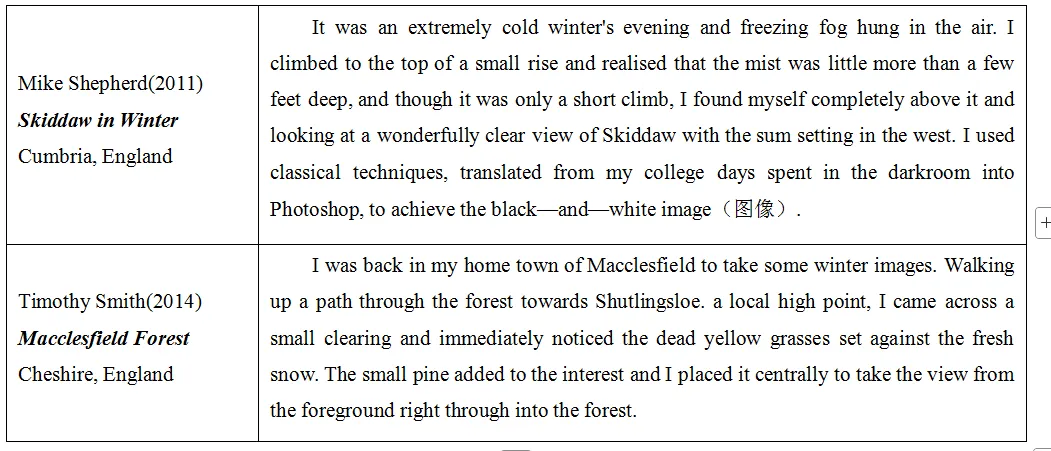
3. Where can the text be found?
A. In a history book. B. In a novel.
C. In an art magazine. D. In a biography.
(四)
【2020年浙江卷1月】I never knew anyone who’d grown up in Jackson without being afraid of Mrs. Calloway our librarian. She ran Jackson’s Carnegie Library absolutely by herself. SILENCE in big black letters was on signs hung everywhere. If she thought you were dressed improperly, she sent you straight back home to change your clothes. I was willing;I would do anything to read.
My mother was not afraid of Mrs. Calloway. She wished me to have my own library card to check out books for myself, She took me in to introduce me. “Eudora is nine years old and has my permission to read any book she wants from the shelves, children or adults,” Mother said.
Mrs. Calloway made her own rules about books. You could not take back a book to the library on the same day you`d taken it out;it made no difference to her that you’d read every word in it and needed another to start. You could take out two books at a time and two only. So two by two, I read library books as fast as I could go, rushing them home in the basket of my bicycle. From the minute I reached our house, I started to read. I knew this was extreme happiness, knew it at the time.
My mother sharedthis feelingof mine. Now, I think of her as reading so much of the time while doing something else. I remember her reading a magazine while taking the part of the Wolf in a game of "Little Red Riding Hood" with my brother's two daughters. She'd just look up at the right time, long enough to answer– in character –"The better to eat you with, my dear," and go back to her place in the magazine article.
23. Where is the text probably from?
A. guidebook. B. an autobiography.
C. a news report. D. book review.
(五)
【2022年全国乙卷】In 1916, two girls of wealthy families, best friends from Auburn, N. Y.—Dorothy Woodruff and Rosamond Underwood—traveled to a settlement in the Rocky Mountains to teach in a one-room schoolhouse. The girls had gone to Smith College. They wore expensive clothes. So for them to move to Elkhead, Colo. to instruct the children whose shoes were held together with string was a surprise. Their stay in Elkhead is the subject ofNothing Daunted: The Unexpected Education of Two Society Girls in the Westby Dorothy Wickenden, who is a magazine editor and Dorothy Woodruff’s granddaughter.
Why did they go then? Well, they wanted to do something useful. Soon, however, they realized what they had undertaken.
They moved in with a local family, the Harrisons, and, like them, had little privacy, rare baths, and a blanket of snow on their quilt when they woke up in the morning. Some mornings, Rosamond and Dorothy would arrive at the schoolhouse to find the children weeping from the cold. In spring, the snow was replaced by mud over ice.
In Wickenden’s book, she expanded on the history of the West and also on feminism, which of course influenced the girls’ decision to go to Elkhead.A hair-raising section concerns the building of the railroads,which entailed (牵涉) drilling through the Rockies, often in blinding snowstorms. The book ends with Rosamond and Dorothy’s return to Auburn.
Wickenden is a very good storyteller. The sweep of the land and the stoicism (坚忍) of the people move her to some beautiful writing. Here is a picture of Dorothy Woodruff, on her horse, looking down from a hill top: “When the sun slipped behind the mountains, it shed a rosy glow all around them. Then a full moon rose. The snow was marked only by small animals: foxes, coyotes, mice, and varying hares, which turned white in the winter.”
7.What is the text?
A.A news report. B.A book review.
C.A children’s story. D.A diary entry.
(六)
【2020年新高考全国Ⅱ卷(海南卷)】In May 1987 the Golden Gate Bridge had a 50th birthday party. The bridge was closed to motor traffic so people could enjoy a walk across it. Organizers expected perhaps 50,000 people to show up. Instead, as many as 800, 000 crowded the roads to the bridge. By the time 250,000 were on the bridge, engineers noticed something terrible:the roadway was flattening under what turned out to be the heaviest load it had ever been asked to carry. Worse, it was beginning to sway(晃动). The authorities closed access to the bridge and tens of thousands of people made their way back to land. A disaster was avoided.
The story is one of scores in To Forgive Design:Understanding Failure, a book that is at once a love letter to engineering and a paean(赞歌)to its breakdowns. Its author, Dr. Henry Petroski, has long been writing about disasters. In this book, he includes the loss of the space shuttles(航天飞机)Challenger and Columbia, and the sinking of the Titanic.
Though he acknowledges that engineering works can fail because the person who thought them up or engineered them simply got things wrong, in this book Dr. Petroski widens his view to consider the larger context in which such failures occur. Sometimes devices fail because a good design is constructed with low quality materials incompetently applied. Or perhaps a design works so well it is adopted elsewhere again and again, with seemingly harmless improvements, until, suddenly, it does not work at all anymore.
Readers will encounter not only stories they have heard before, but some new stories and a moving discussion of the responsibility of the engineer to the public and the ways young engineers can be helped to grasp them.
"Success is success but that is all that it is," Dr. Petroski writes. It is failure that brings improvement.
11. What is the text?
A. A news report B. A short story.
C. A book review D. A research article.
(七)
【2022年浙江卷1月】The United States rose to global power on the strength of its technology, and the lifeblood that technology haslong been electricity.By providing long-distance communication and energy, electricity created the modem world. Yet properly understood, the age of electricity is merely the second stage in the age of steam, which began a century earlier.
"It is curious that no one has put together a history of both the steam and electric revolutions.*' writes Maury Klein in his book The Power Makers, Steam, Electricity, and the Men Invented Modem America. Klein, a noted historian of technology, spins a narrative so lively that at times it reads like a novel.
The story begins in the last years of the 18th century in Scotland, where Watt perfected “the machine that changed the world”. Klein writes, "America did not invent the steam engine, but once they grasped its passwords they put it to more uses than anyone else."
Meanwhile, over the course of 19th century, electricity went from mere curiosity to a basic necessity. Morse invented a code for sending messages over an electromagnetic circuit. Bell then gave the telegraph a voice. Edison perfected an incandescent bulls that brought electric light into the American home.
Most importantly, Edison realized that success depended on mass electrification, which he showed in New York City. With help from Tesla, Westinghouse's firm developed a system using alternating current, which soon became the major forms of power delivery.
To frame his story, Klein creates the character of Ned, a fictional witness to the progress brought about by the steams and electric revolutions in America during one man's lifetime. It's a technique that helps turn a long narrative into an interesting one.
6.What is the text?
A.A biography B.A book review
C.A short story D.A science report
(八)
【2023年全国乙卷】If you want to tell the history of the whole world, a history that does not privilege one part of humanity, you cannot do it through texts alone, because only some of the world has ever had texts, while most of the world, for most of the time, has not. Writing is one of humanity’s later achievements, and until fairly recently even many literate (有文字的) societies recorded their concerns not only in writing but in things.
Ideally a history would bring together texts and objects, and some chapters of this book are able to do just that, but in many cases we simply can’t. The clearest example of this between literate and non-literate history is perhaps the first conflict, at Botany Bay, between Captain Cook’s voyage and the Australian Aboriginals. From the English side, we have scientific reports and the captain’s record of that terrible day. From the Australian side, we have only a wooden shield (盾) dropped by a man in flight after his first experience of gunshot. If we want to reconstruct what was actually going on that day, the shield must be questioned and interpreted as deeply and strictly as the written reports.
In addition to the problem of miscomprehension from both sides, there are victories accidentally or deliberately twisted, especially when only the victors know how to write. Those who are on the losing side often have only their things to tell their stories. The Caribbean Taino, the Australian Aboriginals, the African people of Benin and the Incas, all of whom appear in this book, can speak to us now of their past achievements most powerfully through the objects they made: a history told through things gives them back a voice. When we consider contact (联系) between literate and non-literate societies such as these, all our first-hand accounts are necessarily twisted, only one half of a dialogue. If we are to find the other half of thatconversation, we have to read not just the texts, but the objects.
15.Which of the following books is the text most likely selected from?
A.How Maps Tell Stories of the World
B.A Short History of Australia
C.A History of the World in 100 Objects
D.How Art Works Tell Stories