

第一节 听句子,选择最佳答语(共5小题;每小题1分,满分5分)
A. I’m fine.
B. I’m Tina.
C. I’m from Hebei.
2. A. It’s cute.
B. He has a cat.
C. The black one.
3. A. Me too.
B. Many thanks.
C. Good idea.
4. A. It’s sweet.
B. Beef noodles.
C. At 7 o’clock.
5. A. I think so.
B. Here it is.
C. Take it easy.
第二节 听对话和问题,选择正确答案(共13小题;每小题1分,满分13分)
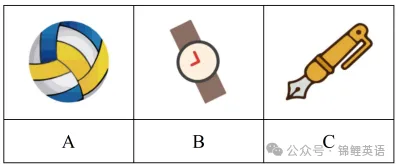
6. What does Cindy give to Peter?
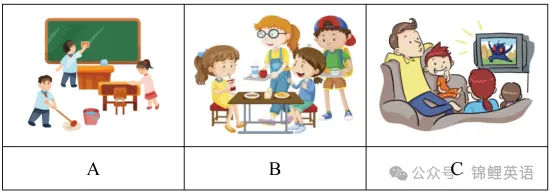
7. Where are the speakers?
8. What is Nancy’s dad repairing?
A. A bed.
B. A chair.
C. A table.
9. What does Nancy pass her dad?
A. A knife.
B. A ruler.
C. A stick.
10. What is in Tony’s hand?
A. A cap.
B. A magazine.
C. A picture.
11. How many kilometers was the bike race last month?
A. 20.
B. 30.
C. 40.
12. Why does Tony join in bike races?
A. To have fun.
B. To win prizes.
C. To make friends.
13 How is the weather today?
A. Windy.
B. Rainy.
C. Snowy.
14 What does John drink?
A. Tea.
B. Water.
C. Coffee.
15. What will Helen wear this afternoon?
A. A coat.
B. A sweater.
C. A scarf.
16. How did Mary’s family get to Qinhuangdao?
A. By car.
B. By plane.
C. By train.
17. How long did it take the family to get to Qinhuangdao?
A. About 1 hour.
B. About 2 hours.
C. About 3 hours.
18. What did Mary and her dad do on the beach?
A. They flew kites.
B. They played volleyball.
C. They picked up stones.
第三节 听短文和问题,选择正确答案(共7小题;每小题1分,满分7分)
19. What club will the school start?
A. A chess club.
B. A poem club.
C. An AI club.
20. Where will the club members meet?
A. In the computer room.
B. In the meeting room.
C. In the reading room.
21. Who will offer help in the club?
A. Some players.
B. Some coaches.
C. Some parents.
22. What is Wang Jun doing?
A Telling his story.
B. Introducing a painting.
C. Giving a party.
23. Who found Wang Jun’s talent for painting?
A. His friend.
B. His teacher.
C. His uncle.
24. Where did Wang Jun often paint on schooldays?
A. On the hill.
B. By the river.
C. In the park.
25. When will Wang Jun hold an art show?
A. In July.
B. In August.
C. In September.
第四节 听短文填空(共5小题;每小题1分,满分5分)
Role-play: Shopping
When to act in class: ____26____
How many members: ____27____
What to use: a big ____28____
Jane’s role: to ____29____ the fruits
Rules to follow: to speak ____30____
第二部分 语言运用 (共两节,满分25分)
第一节 完形填空(共10小题;每小题1分,满分10分)阅读下面短文,从每题所给的A、B、C、D四个选项中选出最佳选项。
Mr. Johnson was an excellent maths teacher. His students would never ____31____ their first class he gave them. He always wrote the numbers 2 and 4 on the blackboard in the first class to his ____32____ students, and asked them, “What is the answer?”
Whenever he asked this question, some of his students said 6 was the ____33____. Some others thought that 2 was more proper and some of them ____34____ 8 as the answer. Moreover, there were still others who were just ____35____ on their seats without a word.
While the students were discussing what the answer was, Mr. Johnson always ____36____ their reply patiently. Finally, he sighed (叹气) and said, “Your ____37____ is useless because none of you focused your attention on the point: What ____38____ the question is asked about. Did I ask you to do anything about the two ____39____? Were they asked to be added, subtracted (减) or to do some other calculations (计算)? If you don’t know the question exactly, how can you give a ____40____ answer?”
So let that be a lesson to all of us: It is important to know what the question is before we try to find out the key.
31. A. face B. accept
C. forget D. cancel
32. A. new B. wise
C. famous D. honest
33. A. ageB. keyC. timeD. score
34. A. caught B. chose
C. covered D. corrected
35. A. jumping B. landing
C. sitting D. walking
36. A. learned from B. dreamed of
C. believed in D. waited for
37. A. invention B. translation
C. collection D. discussion
38. A. usually B. exactly
C. directly D. suddenly
39. A. numbers B. lines
C. letters D. shapes
40. A. quickB. shortC. rightD. ready
第二节 短文填空(共15小题;每小题1分,满分15分)阅读下面短文,在空白处填入一个适当的单词或填入括号内单词的正确形式。
There is a special jug (罐) on our kitchen table. I put some small pieces of paper and a pen next ____41____ the jug. Anyone in my family is free to write down something good that has happened ____42____ (recent). With pieces of paper in it, the jug ____43____ (call)”Good Things Jug”.
Many good things happen in a year. At ____44____ end of the year, we get together to empty the jug. We take ____45____ (turn) to read the “Good Things” aloud. Some of the things are ____46____ (interest), some are serious, and some just give hope.
Over the past twelve ____47____ (month) there have been many difficult things in our family. Noticing the “Good Things” has helped us go through the hard time. Here ____48____ (be) a few things from the “Good Things Jug”:
“Jim ____49____ I went camping with our parents There we ____50____ (teach) my pet cat how to clap (拍) with his feet.”
“With my parents’ care, I was well again after a serious illness. I’m so ____51____ (thank) to my parents for their love. It’s the best thing on earth!”
“Dad got a better job today!”
Our “Good Things Jug” is full ____52____ love, hope and happiness. The little messages remind ____53____ (we) that we can always expect good things to come, even during difficult times. Therefore, I encourage you ____54____ (create) your “Good Things Jug” today. I am sure it ____55____ (make) a big difference in your future life.
第三部分 阅读(共两节,满分40分)
第一节 阅读理解(共15小题;每小题2分,满分30分) 阅读下列短文,从每题所给的A、B、C、D四个选项中选出最佳选项。
A
⏩⏩School News

Activity Day

Activity Day is coming. Different activities will be held. If you like doing kung fu, you can come to Ms. Liang in Room 201. If you love music, a concert is waiting for you. It will be held in Room 302. If you like films, you are lucky. Mr. Wang, a film director, will be invited to give a talk in Room 404. And you are welcome to the sports hall to see robots. Ms. Zhang will show you what robots can do.

School Guides Wanted

Next Tuesday some visitors from Tianjin will come to our school. We need six students to show them around our school and introduce the history of our school. If you want to be a guide, please go to Mr. Yang in Room 503 before Thursday afternoon.
56. Where will the concert be held?
A. In Room 201.
B. In Room 302.
C. In Room 404.
D. In Room 503.
57. What can students do in the sports hall?
A. Watch a film.
B. Give a talk.
C. Do kung fu.
D. See robots.
58. Who should you go to if you want to be a guide?
A. Mr. Yang.
B. Mr. Wang.
C. Ms. Zhang.
D. Ms. Liang.
B
Tim, a 13-year-old boy, got his idea from a TV show. It was about saving books for the community library.
Tim wanted to help children in their community to have more chances to read books. He started Saving Books Program. Its goal was to collect books for the local library. Tim went from door to door to get books from the people around. He ended up collecting 260 books. All the books went to the library. “I love to see where the books go, and how people are enjoying them,” Tim said.
With the help of his sister, Tim made the program a success. They put up posters (海报) to spread the word: saving books for the local library.
Now, Tim is in seventh grade. He has taken the program a step further. He helps in the library when he is free at weekends. His program has inspired (激励) other kids to do more service for their own community.
Joe, the librarian, knows how much Tim cares about community service. “In third grade, Tim started Smile Mail. It’s a program in which kids send cheerful gifts to the old. It’s still going strong. He is warm-hearted,” Joe said.
“I really like doing community service,” Tim said. “I’m proud of what I have done.”
59. What is the goal of Saving Books Program?
A. To find out where books go.
B. To send books to the people around.
C. To teach people how to read books.
D. To collect books for the local library.
60. What has Saving Books Program inspired other kids to do?
A. Become librarians.
B. Get better grades.
C. Write children’s books.
D. Do more community service.
61. Why does Joe mention Smile Mail?
A. To show kids’ love for gifts.
B. To give advice to the old.
C. To praise Tim for his kindness.
D. To explain the value of smile.
C
Have you ever visited Xiong’an Business Service Center? Do you know anything special about it? On top of the center’s six buildings, there are about 28,400 solar panels (太阳能板). They match perfectly with the traditional Chinese design of the buildings. If they were put together, the solar panels would cover an area of 1.4 standard football fields. These panels now can produce 5% of the electricity that is needed for the center.
Using local clean energy plays an important role in Xiong’an New Area’s progress. Solar panels which cover some buildings are used to provide electricity in the area. In the future, the solar panel project will produce more electricity. The electricity will first be used by companies in the area, and the rest will be shared.
The solar panel project is good for the environment and economy (经济). It not only helps to reduce greenhouse gases (温室气体), but also lowers electricity costs for companies in the area. The project is expected to produce nearly 3.5 million kWh of electricity. This means that about 3,000 tons of greenhouse gases will be avoided every year.
There are already a number of projects in the area. These projects use solar power and other clean energy. Two new projects will be started: an energy-saving lighting project and a green heating project. The purpose of the two new projects is to further cut pollution. Xiong’an New Area is on the way to becoming a green modern city.
62. What is on top of the center’s six buildings?
A. Solar panels.
B. Football fields.
C. A modern business office.
D. A traditional Chinese garden.
63. What is paragraph 3 mainly about?
A. The ways of saving electricity.
B. The advantages of the project.
C. The effects of greenhouse gases.
D. The costs of running companies.
64. What is the purpose of the two new projects?
A. To cut pollution.
B. To plant more trees.
C. To use more energy.
D. To produce electricity.
65. Where is the text most probably from?
A. A diary.
B. A newspaper.
C. A guidebook.
D. A storybook.
D
Some people see oysters (牡蛎) as delicious food. But some raise oysters to clean up the polluted seawater. Amy, a 15-year-old girl, is one of them. She has won a master oyster gardener prize this year. She thinks oysters are really helpful. They are environmental stars.
“I knew nothing about oyster gardening when I started in 2022. I learned all of this after I completed a free course about it. The course is about raising oysters in cages (笼子),” Amy says.
There used to be lots of oysters in coastal waters. But their numbers have diminished. This is mainly because of some natural disasters. Oyster gardening is a way to help. “Anyone can join,” an oyster gardening researcher Liz Black says.
“You don’t have to do a lot to take care of your oysters, but the influence they have on the environment is huge,” Amy says.
During the oyster gardening season, Amy and her mom go to the beach. There Amy has nine cages. “Once a week I go out there,” she says. She pulls the cages from the water to check conditions of the oysters.
This spring, Amy’s oysters will be big enough to be collected. Amy will go with Liz to pick them up. Oysters that are collected will then be “planted” on the reefs (珊瑚礁). So far, Amy has raised more than 1,500 oysters. She’s a great leader of oyster gardening and a great supporter, too.
66. What does Amy think of oysters?
A. Huge.
B. Clean.
C. Helpful.
D. Delicious.
67. When did Amy get to know about raising oysters?
A. After she joined a research team.
B. After she won a competition.
C. After she attended a free course.
D. After she cleaned up the seawater.
68. What does the underlined word “diminished” in paragraph 3 probably mean?
A. Grown.
B. Fallen.
C. Disappeared.
D. Remained.
69. Why does Amy pull the cages out of water weekly?
A. To feed the oysters.
B. To mix the oysters.
C. To check the oysters.
D. To name the oysters.
70. What is the best title for the text?
A. A Cage Maker
B. A Master Prize
C. An Oyster Festival
D. An Oyster Gardener
第二节 阅读表达(共5小题;每小题2分,满分10分)
阅读下面短文,简略回答问题。
We may have an interview for our volunteer work. And the following suggestions will help make the interview a success.
We should do some research on the volunteer work. We can call the organization or visit its website to find out some information about it. It’s also important for us to think about what questions the interviewers may ask. It will help us to keep the interview going smoothly.
When leaving for the interview, we must remember to take everything we need. And we’re supposed to be at the interview about 30 minutes early. It allows us to get ready for the interview.
Before we go into the interview room, we can take a deep breath to relax ourselves. When we hear someone ask us to go inside, we can enter the room. We should greet the interviewers with a smile and stand until they ask us to sit down.
In answering questions, we had better be confident to show our talent and skills. It’s important to look into the interviewers’ eyes even if we are very nervous and shy. If we can’t understand the interviewers’ questions, it’s OK to ask the interviewers to explain them further.
Before the interview is over, the interviewers usually invite us to ask some questions. We can ask a question about the work or the interview. For example, “What kind of training do you offer to volunteers?” We are supposed to thank the interviewers before we leave.
With these suggestions, we will have a good chance of getting volunteer work.
71. How can we do research on the volunteer work?
_____________________________
72. Why are we supposed to be at the interview early?
_____________________________
73. What can we do to relax ourselves before we go into the interview room?
_____________________________
74. What should we do if we can’t understand the interviewers’ questions?
_____________________________
75. What question do you want to ask the interviewers before the interview is over? (Your question should be different from the underlined one in the text.)
_____________________________
第四部分 情景交际(满分10分)
补全对话(共5小题;每小题2分,满分10分)
根据下面的对话情景,在空白处填入一个适当的句子,使对话的意思连贯、完整。
(Lin arrives at Bob’s home and knocks at the door.)
Bob: Who is it?
Lin: ______76______
Bob: (Opening the door) Hi, Lin! Come in, please.
Lin: Are you feeling better today, Bob?
Bob: ______77______ I’ll go to school this afternoon.
Lin: OK! I’m here to tell you some good news.
Bob: ______78______
Lin: Some famous actors will perform Beijing Opera in our school next Monday.
Bob: ______79______
Lin: And they’ll teach us to perform.
Bob: I can’t wait to attend it! Thank you for the news.
Lin: ______80______ Goodbye.
Bob: Bye!
第五部分 写作(满分15分)
书面表达
81. 假定你是校英文报记者冀方,外国学生Alice上周五在你校体验了一节体育课,请根据你对她的采访记录写一篇英语短文发给校报。
2018/4/9
Notes
What Alice did:
·learn about ping-pong
·practice ping-pong
·…
Alice’s feelings:
·about the PE teacher
·…
注意:
(1)短文须包括记录中所有信息(含需要补充的两处内容),可适当发挥;
(2)文中不得出现真实的人名、校名和地名;
(3)词数80个左右(开头已给出,不计入总词数)。
Alice, a student from abroad, had a PE class in our school last Friday.
_____________________________________________________________________________________________________________________________________________________________________________________________________________________________________________________________________________________________________________________________________________________________________________________________________________________
参
考
答
案
听力
1. A 2. C 3. C 4. B 5. A
6. B 7. C 8. B 9. C
10. C 11. B 12. A
13. C 14. A 15. A
16. C 17. B 18. A
19. A 20. B 21. C
22. A 23. B 24. B 25. A
26. tomorrow 27. five/5 28. card 29. sell 30. English
完形填空
31. C 32. A 33. B 34. B 35. C
36. D 37. D 38. B 39. A 40. C
短文填空
41. to 42. recently 43. is called
44. the 45. turns 46. interesting
47. months 48. are 49. and 50. taught
51. thankful 52. of 53. us
54. to create 55. will make
阅读理解
56. B 57. D 58. A
59. D 60. D 61. C
62. A 63. B 64. A 65. B
66. C 67. C 68. B 69. C 70. D
阅读表达
71. By calling the organization or visiting its website./ We can call the organization or visit its website./ …
72. Because it allows us to get ready for the interview./ It allows us to get ready for the interview./ …
73. Take a deep breath./ We can take a deep breath to relax ourselves./ …
74. Ask the interviewers to explain them further./ We should ask the interviewers to explain them further./ …
75. When can I get the result of the interview? / What should I do if I pass the interview?/ …
补全对话
76. It’s me, Lin!/ It’s Lin./ …
77. Yes, much better./ I’m feeling well./ I’m OK./ …
78. What is it?/ What’s the news?/ …
79. Really?/ Wonderful!/ Sounds good!/ That’s great!/ I’m glad to hear that./ …
80. That’s all right./ You’re welcome./ Not at all./ …
书面表达
Alice, a student from abroad, had a PE class in our school last Friday. She learned many things about ping-pong, for example, the history and rules of the game. Alice tried her best to learn skills and she practiced ping-pong for nearly 20 minutes. And then she shared her school life. At last, she said the PE teacher was very patient and she expressed her thanks to the teacher. She also said the students were very lovely and friendly. “I’m so lucky to have the chance to take the PE class,” she said excitedly.


