资讯 / 正文
高考英语应用文写作模板
高考英语应用文写作模板
基础薄弱学生专用版:背熟模板,填空成篇
一、四个必须先记住的规则
应用文得分首先取决于格式和要点,其次才是语言。基础薄弱的学生只要格式正确、要点齐、句子不出错,就能拿到及格以上的分数。动笔前把下面四件事做对。
第一,先审题再动笔。看清三样东西:写给谁(称呼)、写什么(要点几个、各是什么)、以什么身份写(署名)。题目给出的要点必须一条不漏,漏一条就丢一条的分。
第二,格式固定不变。书信开头写称呼,正文分两到三段,结尾写客套句,最后署名 Li Hua。题目没有要求写日期就不写日期,不要写真实姓名和真实地址。
第三,只填【】,不改句子。模板里的句子是改好的,学生只需把【】里的中文提示换成简单英文短语,其余一个词也不要动。宁可句子简单,也不要自己造长句。
第四,词数控制在80—100。模板本身约70—80词,填完空格刚好达标。写得太短会扣分,写得太长容易出错,也不必写满格。
二、体裁速查:看到题目先对号
高考应用文看似种类多,实际只有十二类。学生拿到题目,先判断属于哪一类,再直接调出对应模板,可以省去构思时间。
类别 | 体裁 | 题目常见情境 | 开头照抄句 | 署名 |
书信 | 建议信 | 给学校、社团或朋友提建议 | I'm writing to offer some suggestions on ... | Li Hua |
书信 | 求助信 | 请老师、朋友帮忙解决问题 | I'm writing to ask you for help. | Li Hua |
书信 | 感谢信 | 感谢帮助、招待、赠送 | I'm writing to say thank you for ... | Li Hua |
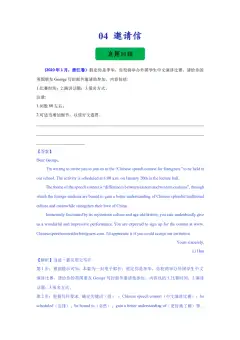
书信 | 邀请信 | 邀请外教、朋友参加活动 | I'm writing to invite you to ... | Li Hua |
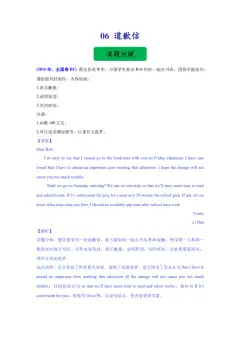
书信 | 道歉信 | 失约、迟到、弄坏东西 | I'm writing to say sorry to you for ... | Li Hua |
书信 | 告知信 | 介绍节日、习俗、学校、人物 | I'm glad to tell you something about ... | Li Hua |
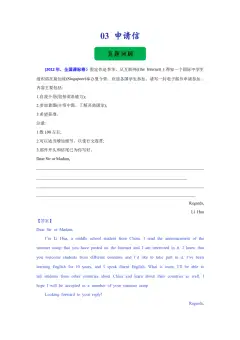
书信 | 申请信 | 申请志愿者、社团成员 | I'm writing to apply to be ... | Li Hua |
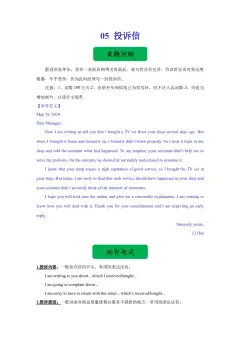
书信 | 投诉信 | 反映商品或服务问题 | I'm writing to complain about ... | Li Hua |
非书信 | 通知 | 校园活动、讲座、比赛安排 | In order to ..., our school will hold ... | The Students' Union |
非书信 | 演讲稿 | 班会发言、英语演讲比赛 | It's my great honour to speak here. | 不署名 |
非书信 | 倡议书 | 节约、环保、读书、运动倡议 | I'd like to call on everyone to ... | The Students' Union |
非书信 | 校报投稿 | 就某话题发表看法 | I'm writing to share my ideas about ... | Li Hua |
注:署名一栏中,书信与校报投稿统一写 Li Hua;通知、倡议书写发布单位,演讲不署名。
三、书信类模板(最高频,务必全会)
书信是高考应用文的主体。下面八个模板共用同一套骨架:称呼—写信目的—两到三个要点—客套结尾—署名。学生只需辨认题目属于哪一种,套用对应模板。
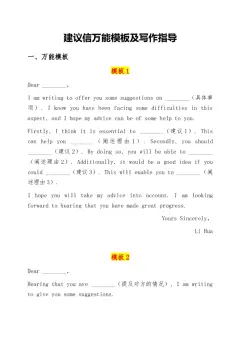
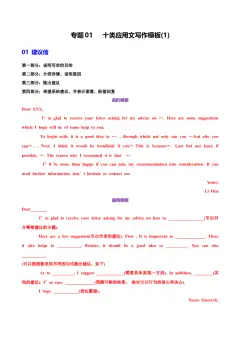
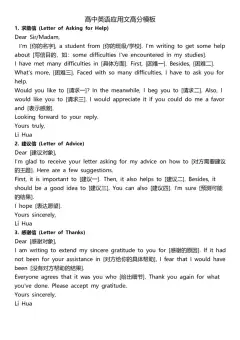
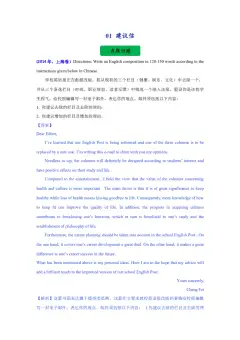
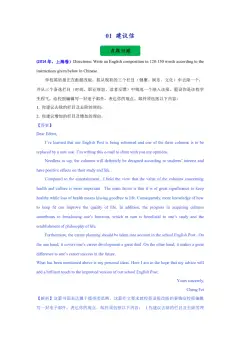
(一)建议信
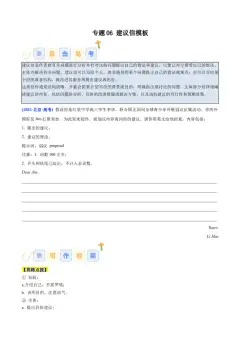
【模板】 Dear 【Tom / Sir or Madam】, I'm writing to offer some suggestions on 【主题, 如 the English club】. First of all, I think it is a good idea to 【建议一, 动词短语】. Besides, you'd better 【建议二】. What’s more, it will be helpful if you 【建议三】. I hope you will find my suggestions useful. Thank you for your time. Yours sincerely, Li Hua |
中文思路:点明写信目的,接着用 First of all/Besides/What’s more 摆出三条建议,最后表态并客套收尾。三条建议要写成“做什么”,不要写成“很重要”。
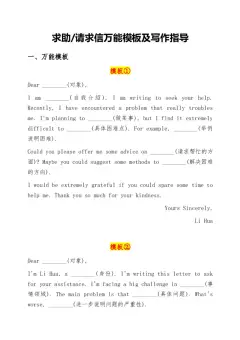
(二)求助信
【模板】 Dear 【Mr. Smith / Tom】, I'm writing to ask you for help. I have some trouble with 【问题, 如 my spoken English】. To begin with, I don't know how to 【困难一】. In addition, I find it hard to 【困难二】. Could you please give me some advice on 【需要帮助的点】? I would be grateful if you could help me. Looking forward to your reply. Yours sincerely, Li Hua |
中文思路:先说明写信求助,再具体讲两处困难,最后请求建议并盼回复。困难要写具体,如记不住单词、不敢开口、写不出长句。
(三)感谢信
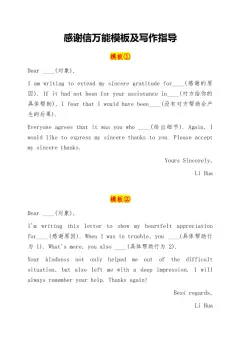
【模板】 Dear 【Tom / Miss Wang】, I'm writing to say thank you for 【事由, 如 your kind help】. Without your help, I could not have 【结果, 如 passed the exam】. Your help meant a lot to me, and I learned a lot from you. Thank you again from the bottom of my heart. Wish you all the best. Yours sincerely, Li Hua |
中文思路:感谢的事由要写清楚,接着用 Without your help 说明对方帮助的作用,最后再次致谢并祝福。
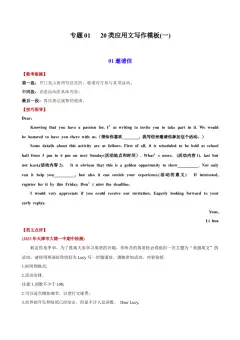
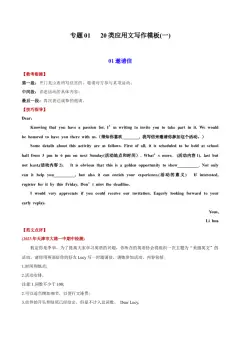
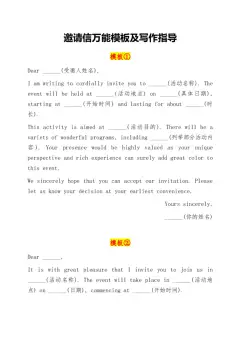
(四)邀请信
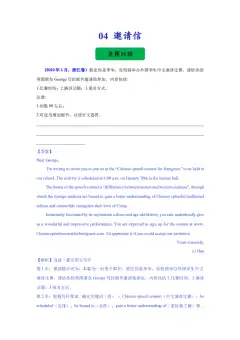
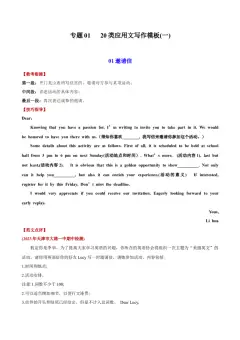
【模板】 Dear 【Tom】, How is everything going? I'm writing to invite you to 【活动, 如 our English evening】, which will be held in 【地点】 on 【时间】. During the activity, we will 【内容一】 and 【内容二】. I'm sure you will enjoy it. I hope you can come. Please tell me if you can make it. Yours sincerely, Li Hua |
中文思路:开头问好,一句话交代活动、地点、时间,再写活动内容,最后表达希望对方参加。时间地点必须写,缺一项就算漏要点。
(五)道歉信
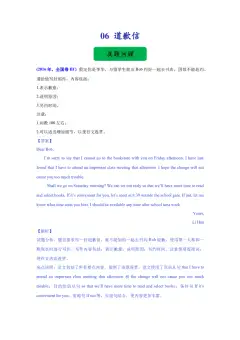
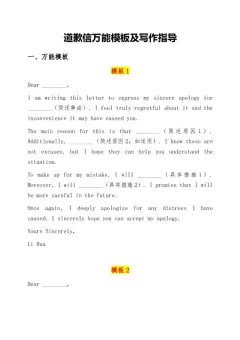
【模板】 Dear 【Tom】, I'm writing to say sorry to you for 【事情, 如 missing our meeting】. The reason is that 【原因, 如 I had to look after my mother】. I feel very sorry for the trouble I have caused you. Shall we 【补救方案, 如 meet next Monday】? I hope you can understand and forgive me. Yours sincerely, Li Hua |
中文思路:先道歉,再给一个合理原因,然后提出补救办法,最后请求谅解。原因只需一句,不要展开讲故事。
(六)告知信(介绍信)
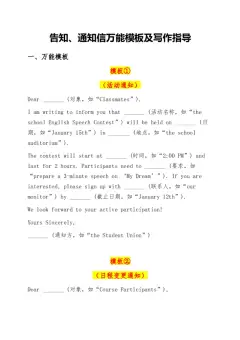
【模板】 Dear 【Tom】, I'm glad to tell you something about 【主题, 如 the Spring Festival】. 【主题】 is very popular in China. It usually falls on 【时间】. People often 【习俗一】 and 【习俗二】. By doing so, people can 【意义, 如 show their love to family】. I hope the information above is helpful to you. Yours sincerely, Li Hua |
中文思路:说明要介绍什么,接着给时间、两个习俗和意义。这一模板也用于介绍学校、社团、人物和传统艺术。
(七)申请信
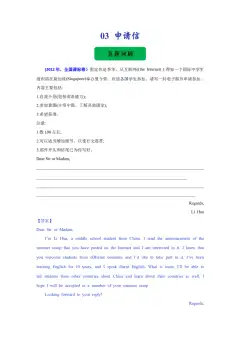
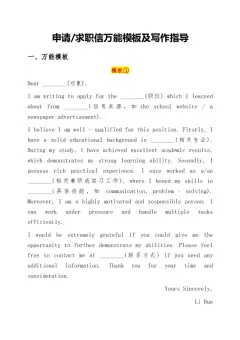
【模板】 Dear Sir or Madam, I'm writing to apply to be 【身份, 如 a volunteer for the sports meet】. I am good at 【能力一, 如 spoken English】, and I am friendly and ready to help others. Last year, I 【相关经历, 如 worked as a guide in the city museum】. I believe I am fit for the job. I would appreciate it if you could give me the chance. Yours sincerely, Li Hua |
中文思路:写清申请什么,再写能力和性格,用一段经历作证明,最后表态并请求录用。能力要与岗位相关。
(八)投诉信
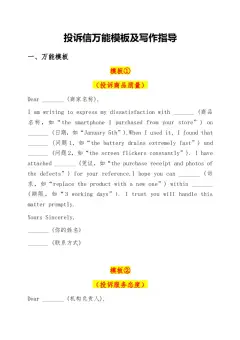
【模板】 Dear Sir or Madam, I'm writing to complain about 【投诉对象, 如 the shoes I bought last week】. To my disappointment, 【问题描述, 如 the colour is wrong and the size is too small】. It has brought me a lot of trouble. I hope you can 【要求, 如 give me a refund or change another pair】 as soon as possible. I would appreciate it if you could deal with it in time. Yours sincerely, Li Hua |
中文思路:说明投诉什么,具体写两处问题,说明带来的麻烦,最后提出明确要求(退款、换货、维修)。要求必须写,否则投诉没有落点。
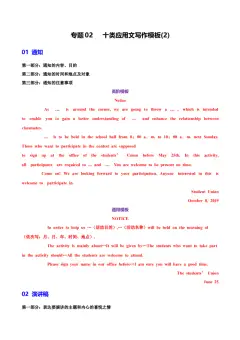
四、通知(Notice)
通知不是书信,格式最容易出错:第一行居中写 Notice,不写称呼,最后落款写发布单位,通常再写日期。这一步错了,分数直接掉一档。
【模板】 Notice In order to 【目的, 如 enrich our school life】, our school will hold 【活动】 in 【地点】 on 【时间】. During the activity, we will 【内容一】. Besides, we will 【内容二】. Everyone who is interested is welcome. If you want to join us, please 【报名方式】 before 【截止时间】. Come and join us! The Students' Union 【日期, 题目给了才写】 |
中文思路:一句交代目的、活动、地点、时间,一句交代内容,一句写报名方式与截止时间,最后号召并落款。
五、演讲稿(Speech)
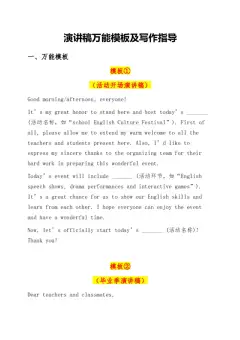
演讲稿开门见山问好,结尾一定要有 Thank you for listening,这是听众能感受到的完整收束。全篇使用 we、us,拉近与听众的距离。
【模板】 Good morning, everyone, It's my great honour to speak here. Today I'd like to talk about 【主题】. As we all know, 【现象或重要性】. In my opinion, we should 【做法一】. What’s more, it is necessary for us to 【做法二】. I hope my speech is helpful. Thank you for listening. |
中文思路:问好、说明主题、点出现象或重要性、给出两点做法、结尾致谢。若题目还要求“提出希望”,就把最后一句改成 Let’s take action together。
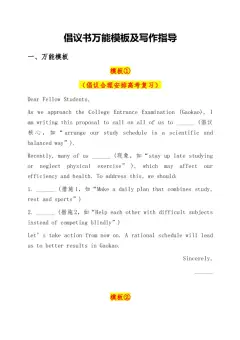
六、倡议书
倡议书写给同学,称呼用 Dear fellow students。三点做法用 First、Second、Also 分开,结尾必须有一句号召,否则倡议书失去功能。
【模板】 Dear fellow students, Nowadays, 【背景, 如 a lot of food is wasted in our school】. To 【目的】, I’d like to call on everyone to take action. First, we should 【做法一】. Second, we’d better 【做法二】. Also, let’s 【做法三】. Small actions can make a big difference. Let’s start right now! The Students' Union 【日期, 题目给了才写】 |
中文思路:先摆现状,再提出倡议,接着给三条具体做法,最后号召行动。做法要具体可做,不要写“提高意识”这类空话。
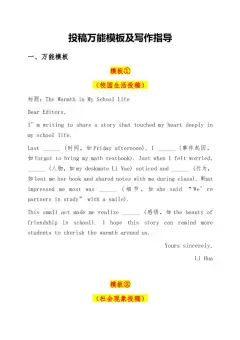
七、校报投稿(观点类短文)
投稿的读者是同学,话题多是校园生活、学习习惯、手机使用等。观点只需一个,理由两点,最后落到自己怎么做。不要两边都支持,观点含糊是这类题最常见的失分原因。
【模板】 Dear editor, I'm writing to share my ideas about 【话题, 如 using mobile phones in school】. In my opinion, 【观点, 一句话】. For one thing, 【理由一】. For another, 【理由二】. Therefore, we should 【做法】. I hope my ideas are useful to our readers. Yours, Li Hua |
中文思路:一个观点、两个理由、一个做法。理由用 For one thing/For another 分开,句式保持平行。
八、万能句与连接词(每个学生都要背)
下面的句子在任何一篇应用文里都能用,写不出来时优先用它们兜底。背的时候连同中文一起记,避免用错场合。
用途 | 万能句 | 中文 |
开头 | I'm writing to ... | 我写信是为了……(万能开头) |
开头 | I'm glad to tell you something about ... | 很高兴告诉你关于……的情况 |
开头 | How is everything going? | 近来一切都好吗?(给朋友写信) |
正文 | First of all, ... Besides, ... What’s more, ... | 首先……此外……而且……(三点并列) |
正文 | For one thing, ... For another, ... | 一方面……另一方面……(两点理由) |
正文 | play an important role in ... | 在……中起重要作用 |
正文 | It is + 形容词 + for us to do ... | 我们做……是……的(写建议、做法) |
结尾 | I would appreciate it if you could ... | 如果你能……我将不胜感激 |
结尾 | Looking forward to your reply. | 期待你的回复 |
结尾 | Wish you all the best. | 祝你一切顺利 |
结尾 | Thank you for your time. | 感谢你抽出时间 |
结尾 | I hope you can take my advice into consideration. | 希望你能考虑我的建议 |
九、十个最容易丢分的地方
这些错误与语言水平无关,只要提醒到位就能避免。考前用这份清单当面点一遍,比多讲一篇范文更有效。
1.称呼写错:给机构写 Sir or Madam,给朋友写对方名字,两者不能混。
2.称呼后面用逗号,正文每段开头不空格太多,段落之间空一行。
3.署名写成自己的中文名或拼音全名,应为 Li Hua。
4.题目没要求却自己加日期、地址、电话号码。
5.漏要点:题目给了三条要点,只写两条。
6.时态混乱:邀请、通知多用将来时,感谢、道歉多用过去时。
7.标题乱加:除 Notice 外,书信一般不写标题。
8.把提示里的中文直接抄进英文句子,出现汉字。
9.全篇只有一段,不分段,卷面层次不清。
10.字数明显不足80词,或写到140词以上,超出答题区域。
十、交卷前自检清单
留出两分钟,按顺序核对下表,每一条都要能打勾再交卷。
序号 | 项目 | 检查内容 |
1 | 格式 | 称呼、正文分段、客套结尾、署名 Li Hua 四项齐全 |
2 | 要点 | 题目给的要点逐条对照,没有遗漏,没有多加 |
3 | 词数 | 在80—100词之间,未超出答题区域 |
4 | 扣题 | 首段明确写出写信目的,与题目要求一致 |
5 | 语言 | 模板句子没有改动;【】全部填成英文,无汉字残留 |
6 | 书写 | 字迹清楚,涂改少,大小写与标点规范 |
相关文档
- 2025年冲刺高考英语黄金作文模板 专项复习 20类应用文写作模板(一)
- 2025年冲刺高考英语黄金作文模板 专项复习 20类应用文写作模板(一)
- 2026年高考英语应用文写作模板及写作指导(全国通用)专题13祝贺信万能模板及写作指导讲义
- 2026年高考英语应用文写作模板及写作指导 专题03建议信万能模板及写作指导清单 全国通用 高考专项复习
- 2026年高考英语应用文写作模板及写作指导 专题03建议信万能模板及写作指导清单 全国通用 高考专项复习
- 2024高考英语一轮复习应用文写作·申请信句式模板精练
- 高考英语专题52应用文写作分类模板教师版总复习2023
- 2024高考英语一轮复习应用文写作道歉信句式模板精练
- 2026年高考英语写作常考题型全面突破应用文写作专题06建议信模板(学生版)
- 2026年高考英语应用文写作模板及写作指导专题11倡议书万能模板及写作指导讲义(全国通用一二三轮复习)
- 2025年冲刺高考英语万能黄金作文模板专项复习专题02十类应用文写作模板
- 2025年冲刺高考英语万能黄金作文模板 专题01 十类应用文写作模板 专项复习
- 2024年高考英语考前45天写作备考特辑专题02:20类应用文写作模板(二)(全国通用)
- 2026年高考英语应用文写作模版及写作指导全国通用专题16投稿万能模板及写作指导讲义
- 2026届高考英语二轮复习写作专项:高中英语应用文高分模板清单(英语2)
- 01+建议信(句式+模板+精练)-2024年高考英语一轮复习应用文写作必备微技能
- 2024高考英语一轮复习应用文写作必备微技能建议信句式模板精练
- 2026年高考英语应用文写作模版及写作指导(全国通用)专题12咨询信万能模板及写作指导讲义
- 02+感谢信(句式+模板+精练)-2024年高考英语一轮复习应用文写作必备微技能+
- 求助信(句式+模板+练习)·2024年高考英语一轮复习应用文写作必备微技能(句式+模板+PPT)
- 祝贺信(句式+模板+练习)·2024年高考英语一轮复习应用文写作必备微技能(句式+模板+PPT)
- 道歉信句式模板精练2024年高考英语一轮复习应用文写作必备微技能
- 投诉信句式模板精练2024年高考英语一轮复习应用文写作必备微技能
- 邀请信句式模板精练2024年高考英语一轮复习应用文写作必备微技能
- 申请信句式模板精练2024年高考英语一轮复习应用文写作必备微技能
- 2026年高考英语应用文写作模版及写作指导:专题04邀请信万能模板及写作指导讲义(全国通用)
- 2026年高考英语应用文写作模版及写作指导:专题04邀请信万能模板及写作指导讲义(全国通用)
- 2026年高考英语应用文写作模版及写作指导(全国通用)专题10:演讲稿万能模板及写作指导讲义
- 2026年高考英语应用文写作模版及写作指导(全国通用)专题07推荐信万能模板及写作指导讲义
- 2026年高考英语应用文写作模版及写作指导(全国通用)专题06求助请求信万能模板及写作指导讲义
- 2026年高考英语应用文写作模版及写作指导专题09告知、通知信万能模板及写作指导讲义(全国通用)
- 2024高考英语一轮复习应用文写作必备微技能邀请信句式模板精练
- 2026年高考英语应用文写作模版及写作指导(全国通用):专题05 申请、求职信万能模板及写作指导讲义
- 2026年高考英语应用文写作模版及写作指导(全国通用)专题14 便条、留言条万能模板及写作指导讲义
- 2026年高考英语应用文写作模版及写作指导:专题15报道万能模板及写作指导讲义(全国通用,一二三轮复习)
- 通知类句式模板练习2024年高考英语一轮复习应用文写作必备微技能
- 日记类句式模板练习2024年高考英语一轮复习应用文写作必备微技能
- 咨询信句式模板练习2024年高考英语一轮复习应用文写作必备微技能
- 2026年高考英语应用文写作模版及写作指导(全国通用)专项复习:专题02感谢信万能模板及写作指导清单
- 2026年高考英语应用文写作指导讲义 专题08投诉信万能模板及写作指导 全国通用 高考一二三轮复习
- 2026高考英语专题01道歉信万能模板及写作指导清单
- 2024年高考英语满分作文考前必备 专题01 20类应用文写作模板(一)(全国通用)
- 2024年高考英语一轮复习应用文写作必备微技能 慰问信(句式+模板+练习)
- 2024年高考英语一轮复习应用文写作必备微技能:演讲稿(句式+模板+练习)
- 2024年高考英语一轮复习应用文写作必备微技能:咨询信句式模板与练习
- 倡议书句式模板练习2024年高考英语一轮复习应用文写作必备微技能
- 推荐信句式模板练习2024年高考英语一轮复习应用文写作必备微技能
- 演讲稿句式模板练习2024年高考英语一轮复习应用文写作必备微技能
- 慰问信句式模板练习2024年高考英语一轮复习应用文写作必备微技能
- 求助信句式模板练习2024年高考英语一轮复习应用文写作必备微技能