资讯 / 正文
高考英语听力模拟|2026年全国一卷
本套为原创听力模拟题,共20题,满分30分。建议先听录音完成试题,再核对文末的答案和听力原文。
音频
试题
第一节(共5小题,满分7.5分)
听5段录音,每段后有一个小题,从A、B、C三项中选出最佳选项,每段播放两遍。
1. Where should the printer be left?
A. At reception.B. In the office.C. In the store room.
2. Why does the man prefer a seat at the back?
A. He needs more leg room.B. He may leave early.C. He wants a better view.
3. What does the woman ask the man to get?
A. A travel adapter.B. A phone charger.C. A hotel booking.
4. How did the man get the winning photograph?
A. With special training.B. Through careful planning.C. By chance.
5. When will the book sale take place?
A. On the 14th.B. On the 16th.C. On the 15th.
第二节(共15小题,满分22.5分)
听第6段录音,回答第6至7题。
6. What are the speakers discussing?
A. Booking a train ticket.B. Reporting a closed road.C. Returning a hired car.
7. What will the woman do next?
A. Pay the company's service fee.B. Take a taxi to the station.C. Drive to another petrol station.
听第7段录音,回答第8至10题。
8. What does the exhibition need more of?
A. Objects used in everyday lessons.B. Prizes from school sports events.C. Photographs of famous graduates.
9. What misunderstanding does the man mention?
A. People believed the exhibition was canceled.B. People thought the school wanted gifts.C. People expected payment for their objects.
10. What will the woman do tonight?
A. Photograph valuable objects.B. Post an online notice.C. Arrange the exhibition displays.
听第8段录音,回答第11至13题。
11. What problem does Sam mention?
A. The recorded voices may be unclear.B. Some scenes may have been filmed twice.C. People may move unnaturally fast.
12. How does Sam check a suggested film speed?
A. By measuring the length of the film.B. By matching it to recorded music.C. By examining familiar movements.
13. Why does Sam return the original film?
A. Families may want to make their own copies.B. It may provide more detail in the future.C. He has limited storage space at his workshop.
听第9段录音,回答第14至16题。
14. Why is the team studying old houses?
A. To find ways to preserve their decoration.B. To compare the prices of building materials.C. To test the cooling effects of their design.
15. Why does the team record residents' habits?
A. To suggest a new daily schedule for residents.B. To separate their influence from that of design.C. To decide how many rooms families should use.
16. What is the team planning to do next?
A. Build a place with adjustable shade.B. Replace windows in the old houses.C. Start construction before winter.
听第10段录音,回答第17至20题。
17. What should participants do before contacting their partners?
A. Read the background information.B. Write a complete interview script.C. Visit the railway station together.
18. What should an interviewer do when an interesting event is mentioned?
A. Make a note to return to it at the end.B. Invite the speaker to explain it further.C. Save further questions for a second interview.
19. What must be recorded at the beginning?
A. Permission to use the interview.B. A list of all the planned topics.C. The partner's full employment record.
20. What must be submitted with the sound file?
A. A summary with topic starting times.B. A typed copy of every spoken word.C. A review of the partner's answers.
参考答案
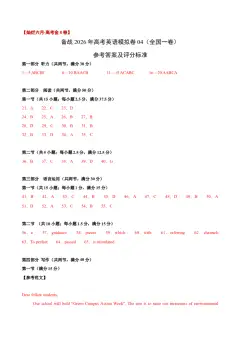
1. A 2. B 3. A 4. C 5. B6. C 7. C 8. A 9. B 10. B11. C 12. C 13. B 14. C 15. B16. A 17. A 18. B 19. A 20. A
听力原文
Text 1 送货地点
M:The delivery company says your new printer is here. Shall I put it in your office?
W:Leave it at reception for now. The electrician is still working in my office, and the store room is full.
Text 2 预订座位
W:I thought you wanted a seat near the stage.
M:Usually, yes. But this time I'd prefer the back row. I may have to leave before the concert finishes, and I don't want to disturb anyone.
Text 3 忘带物品
M:Have you packed your passport and the hotel booking?
W:Yes. My phone charger is here too. Oh, the travel adapter is still beside the kitchen socket. Could you get it while I close the suitcase?
Text 4 获奖照片
W:Your photo won first prize! You must have waited for hours to catch that bird.
M:Actually, I was photographing the empty beach. The bird landed just as I pressed the button. I couldn't believe my luck.
Text 5 活动日期
M:Is the school book sale on the fourteenth, as usual?
W:That's the last day to bring books in. The sale itself is two days later. We need the fifteenth to sort everything and put the prices on.
Text 6 退还租车
W:I'd like to return this rental car. I was told to fill the tank, but the petrol station on the corner is closed.
M:There's another one about two kilometers away. If we fill it for you, we charge a service fee as well as the petrol.
W:I still have half an hour before my train, so I'll do it myself. Could you mark the station on my map?
M:Certainly. It should only take you ten minutes to drive there and back.
Text 7 旧物展览筹备
M:We have plenty of objects for the school history exhibition, but most of them are sports cups.
W:Could we ask former students for something from ordinary lessons? An exercise book, perhaps.
M:Good idea. We should explain that we only want to borrow things. Some people thought last year's notice was asking for donations.
W:I'll write a new notice. What information should the owners include?
M:The year they attended the school and a short story about the object. We can photograph anything too valuable to lend.
W:I'll put the notice on the graduates' website tonight. Then on Friday we can start arranging the objects we've already got.
Text 8 修复家庭影片
W:Sam, you restore old home movies. Does that mean removing all the marks from the pictures?
M:That's only one part. With some films, we first have to work out the correct speed. Old cameras didn't always run at a steady rate, so people may appear to hurry across the screen.
W:Can a computer choose the speed?
M:It can suggest one, but we compare familiar movements, such as a person walking, before making a decision. I ask families for information too. A wedding date or a street name can tell us a lot.
W:What do families receive when the work is finished?
M:A digital copy for easy viewing. But I always return the original film as well. Digital formats change, and future equipment may recover details that we can't see today.
Text 9 建筑降温研究
M:Professor Lewis, your team studies how buildings stay cool. Why begin with old houses?
W:Because many were designed before electric air conditioning existed. Their builders used thick walls, shaded yards, and carefully placed windows. We want to measure how well those features work, rather than simply assume that old methods are better.
M:How do you make a fair comparison?
W:We place temperature sensors in several rooms, but indoor temperature alone isn't enough. We also record when residents open windows and how many people are at home. Otherwise, a difference caused by daily habits might be mistaken for an effect of the building.
M:Will your findings be used in new houses?
W:We hope so. Our next step is a small test building with movable screens. That will let us change the shade without changing the walls. We're still raising money for it, so construction won't begin this year.
Text 10 口述历史工作坊
M:Welcome to our oral history project. You'll be interviewing people who worked at the old railway station. Before you contact your partner, please read the information sheet in your folder. It lists basic facts about the station, so you won't spend the interview asking questions that can already be answered from records.
M:We provide a list of possible topics, but you don't have to follow it in order. If your partner mentions an interesting event, ask them to describe it before moving on. Avoid supplying details yourself. A pause may simply mean the person is searching their memory.
M:At the start, record your name, the date, and your partner's permission to use the recording. If they ask you to stop at any point, turn the recorder off immediately. You can discuss later whether they want any earlier part removed.
M:Afterward, upload the original sound file to our secure folder. We need a brief summary, too, with the starting time of each main topic. You don't need to type every word. Please complete both tasks within three days of the interview, while the details are still fresh.
相关文档
- 2026届高考英语听力训练第十三期 全国一卷
- 2026届高考英语听力训练第十七期 全国一卷 英语专项复习
- 2026届高考英语听力训练第十一期(全国一卷)
- 2026届高考英语听力训练第十八期(全国一卷)
- 2026届高考英语听力训练第十九期(全国一卷)
- 2026届高考英语听力训练第二十期(全国一卷)
- 2026届高考英语听力训练第三十五期 全国一卷 专项复习
- 2026届高考英语听力训练第三十六期(全国一卷)
- 2026届高考英语听力训练第九期 全国一卷
- 2026届高考英语听力训练第三十期(全国一卷)
- 2026届高考英语听力训练第三十二期(全国一卷)专项复习
- 2026届高考英语听力训练第三十三期(全国一卷)专项复习
- 2026年全国一卷高考英语听力真题(试题+答案+文本)
- 2026届高考英语听力训练第四期 全国一卷
- 2026届高考英语听力训练第六期(全国一卷)
- 2026届高考英语听力训练第二十六期(全国一卷)专项复习
- 2026届高考英语听力训练第二十五期(全国一卷)
- 2026届高考英语听力训练第三十七期(全国一卷)
- 2026届高考英语听力训练第二十三期全国一卷专项练习
- 东三省名校联盟2025届高考最后一卷联合模拟考试英语听力
- 2026年高考英语金8卷模拟卷 全国一卷 卷06 高考英语模拟卷(全国一卷)(考试版A4)
- 2025年高考英语全国I卷听力试题
- 2025年高考英语全国I卷听力试题
- 2025年高考英语全国I卷听力填空
- 2025年高考英语全国I卷听力填空
- 2025年高考英语全国I卷听力试题及原文(含听力填空改编训练)
- 2025年高考英语全国I卷听力试题及原文(含听力填空改编训练)
- 十年2015-2025高考英语听力合集 专题03 2025年全国一卷听力真题(试题+答案+文本)
- 19高考英语听力仿真模拟卷解析版 2025年高考英语听力仿真模拟训练
- 2026年高考英语金8卷模拟卷 全国一卷 卷05 高考英语模拟卷 教师版
- 2026年高考英语金8卷模拟卷 全国一卷 卷06(考试版A3)
- 2026年高考英语金8卷模拟卷全国一卷卷06教师版
- 2026年高考英语金8卷模拟卷 全国一卷 卷06 参考答案
- 2026年高考英语金8卷模拟卷全国一卷卷05参考答案
- 2026年高考英语金8卷模拟卷全国一卷卷04 教师版 高考一二三轮复习专项
- 2026年高考英语金8卷模拟卷全国一卷卷04 参考答案 高考一二三轮复习专项
- 2026年高考英语金8卷模拟卷(全国一卷)卷03-备战高考英语模拟卷(考试版A4)
- 2026年高考英语金8卷模拟卷(全国一卷)卷03-备战高考英语模拟卷(教师版)
- 2026年高考英语金8卷模拟卷全国一卷卷05考试版A4
- 2026年高考英语金8卷模拟卷全国一卷卷05考试版A3
- 2026年高考英语金8卷模拟卷全国一卷卷04备战高考英语模拟卷(考试版A4)
- 2026年高考英语金8卷模拟卷全国一卷卷04备战高考英语模拟卷(考试版A3)
- 2026年高考英语金8卷模拟卷全国一卷卷03备战高考英语模拟卷考试版A3
- 2026年高考英语金8卷模拟卷全国一卷卷03备战高考英语模拟卷参考答案
- 2026年高考英语模拟风向卷04 全国一卷 答题卡
- 2026年高考英语模拟风向卷03(全国一卷)教师版
- 2026年高考英语模拟风向卷03(全国一卷)参考答案
- 2026年高考英语模拟风向卷04(全国一卷)参考答案
- 2026年高考英语模拟风向卷03(全国一卷)答题卡
- 2026年高考英语模拟风向卷02 全国一卷 答题卡