

四个国家的催生政策摆在一起,我只算了一道除法。
最近的热搜:我国家庭规模持续缩小,单人户、两人户的比重在往上走。
一边是政策在发钱,一边是户口本越来越薄。
我先把四个国家的账摆出来,一个字不评价。
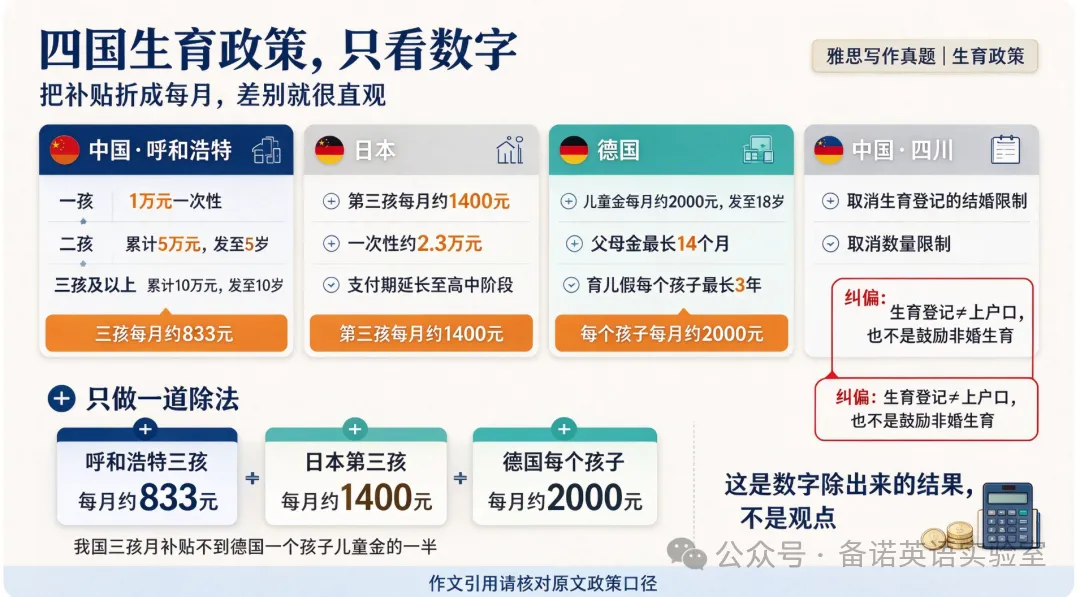
先看钱,只看数字
内蒙古呼和浩特(2025 年 3 月细则)
一孩:一次性 1 万元
二孩:累计 5 万元,每年 1 万,发到孩子满 5 周岁
三孩及以上:累计 10 万元,每年 1 万,发到孩子满 10 周岁
日本(2024 年 10 月起)
儿童手当取消收入限制,支付期延长到高中阶段
第三个孩子及以后:每月 3 万日元(约 1400 元)
另有出産育児一時金 50 万日元(约 2.3 万元),一次性
德国
儿童金 Kindergeld:每个孩子每月 255 欧元(约 2000 元),发到 18 岁,继续读书可延到 25 岁
父母金 Elterngeld:最长 14 个月,每月最高 1800 欧元(约原税后收入的 65%)
育儿假:每个孩子最长 3 年,职位保留
四川(2023 年 1 月)
《生育登记服务管理办法》取消生育登记的结婚限制,同时取消数量限制。
现在我只做一道除法
呼和浩特三孩的 10 万,分 10 年发,每年 1 万。
折成每月:833 元。
日本第三孩:每月约 1400 元。
德国每个孩子:每月约 2000 元。
我国给三孩的钱,折到每个月,不到德国一个孩子的儿童金的一半。
这不是我的观点,这是三个数字除出来的结果。
🚨 顺便纠一个正在到处传的说法:四川那条被讲成"私生子可以上户口"——不对。四川省卫健委当年明确回应过,生育登记不等于上户口,也不是鼓励非婚生育。你要是按"上户口"写进作文,同行一眼就能挑出来。
这事儿,雅思真考过
2021年3月6日 大陆 A 类(题库原件逐字核对,台账查过,此前没写过)
In many parts of the world men and women tend to have children later in life. What do you think are the causes for this? What impacts does this have on society and family life?
题型:Report 说明文(原因 + 影响)
三个审题坑,先排掉
坑一:这题不问"积极还是消极"
它问的是 causes + impacts。你可以对影响下判断,但不能把题干改写成 positive or negative——那是另一道题。很多人一看到"晚育"就自动套"好事坏事",直接偏题。
坑二:impacts 必须分两层
题干写了两处:on society AND on family life。只写社会(劳动力、养老金)不写家庭(代际变薄、养老压力),少一半分。
坑三:causes 不能只写"观念变了"
观念是结果,不是原因。真正能撑住论证的是成本结构和时间顺序——学费要交在前面,收入到账在后面。
我的答案:晚育不是"愿不愿意"的问题,是顺序的问题。
范文(397 词)
In much of the world, the age at which people have their first child has drifted upward, and in many large cities it now falls in the mid-thirties. This report considers why the shift has occurred, and what it means for households and society.
The first cause is arithmetic. Entering a profession now typically requires a degree and often a postgraduate qualification, so the years in which people become qualified to work are also the years in which they are least able to support a family. A young teacher who finishes training at twenty-four, rents in a city and repays a student loan has, on paper, a decade of childbearing years ahead; in practice those years go on building the very income a child would require. Delay here is less a preference than a consequence of sequence: housing and childcare must be paid for up front, while the earnings that cover them arrive years later.
A second cause is the changed position of women. Because an interruption to a career now costs far more than it once did, postponement functions as a form of insurance; a woman who waits until her position is secure is protecting the salary the household will depend on. Alongside this sits a cultural shift, in which adulthood is increasingly measured by self-development rather than by parenthood, and in which marriage itself is entered later or not at all.
The consequences run in two directions. Within families, generations thin: a child may grow up without cousins and, in later life, may support two parents and four grandparents with no sibling to share the burden. For society the arithmetic is blunter — a smaller working population funds a larger retired one, and the care families once absorbed unpaid passes to the state.
Governments have answered with money. Hohhot pays ten thousand yuan for a first child and one hundred thousand for a third; Japan pays thirty thousand yen a month from the third child onward; Germany pays 255 euros for every child until adulthood. Birth rates have not moved in step, which is the clearest evidence that the causes are structural rather than financial.
In short, later parenthood follows from longer training, costlier housing and the higher price of a career break, and its effects are felt in thinner families and an ageing society. Cash transfers ease the symptom; they do not change the sequence.
🕊 白鸟老师小课堂
三个词,一条链:先看结构 → 成本前置 → 补贴只治症状。
① structural —— 结构性的,来自条件本身而不是个人意愿。
大白话:不是你想不想,是条件不允许。
② up-front —— 前置的,要先付的钱。
大白话:钱得先掏,收入后到,这就是所有问题的起点。
③ symptom —— 症状,不是病根。
大白话:止疼药能让你不疼,但骨头没接上。
✍️造例
The cause is ==structural== rather than financial: housing and childcare are paid ==up-front==, while the earnings that cover them arrive a decade later. Cash transfers therefore treat the ==symptom==, not the sequence.
中文翻译:成因是结构性的,而不是缺钱:住房和托育要先付,能覆盖它们的收入却要十年后才到账。所以现金补贴治的是症状,不是那个先后顺序。
高分搭配:a consequence of sequence(顺序造成的结果)/function as a form of insurance(起保险作用)/move in step(同步变化)
🔗 延伸一组(社会类通用,考试直接搬)
opportunity cost 机会成本 → childbearing window 生育窗口 → dependency ratio 抚养比
Delay is rational once ==opportunity cost== is counted: each year of training narrows the ==childbearing window==, and a shrinking workforce then raises the ==dependency ratio== for everyone.
中文:一旦把机会成本算进去,推迟就变得理性:每多读一年书,生育窗口就窄一分;而劳动力缩水,又会把每个人的抚养比推高。
最后一句,说点不客气的
看完全篇,你可能会想:这不就是在说"钱不够,所以不生"吗?
不是。 这篇真正想说的是:钱不够只是表层,顺序不对才是底层。
补贴是在"事后"给钱,而住房、托育、教育是在"事前"收钱。一个家庭要先掏十年的钱,才等到国家补一年的钱——这个先后次序没变,补贴加到多少,都只是把疼往后推一点。
写作文也一样。你引用一个政策,不叫论证;你把"为什么这个政策不管用"拆出来,才叫论证。
三问,你挑一个回我
1. 上面那道除法——833 元一个月——你看完第一反应是什么?
2. 如果让你来定政策,你会把钱发在"生之前"还是"生之后"?为什么?
3. 你身边有没有人,是被"读研、买房、再要孩子"这个顺序拖到 35 岁以后的?
回在评论区,我挑几个明天拆。
身份分流:纸笔考生,把上面那三段原因的顺序感背下来(up-front → arrive later → sequence);机考考生,重点背 structural、up-front、symptom 这三个词的搭配;口语也用得上,part 3 问到家庭话题,直接搬。
通用模板(背走就能用):
The root cause is structural rather than financial: the cost is paid up-front, while the return arrives later — so any policy that pays afterwards treats the symptom, not the sequence.
雅思写作范文系列已经更了很久了,全是机考和纸笔的实考真题,一道没编;每道都逐字核过题库,先拆审题坑再动笔。关键词"范文",合集直接发你。
关注不迷路。 你的搭子下次还在。
—— 下期预告:早上我还想到一个更狠的——当工作本身变成奢侈品,年轻人得"付费上班",老人却被要求延迟退休。这道题题库里没有,但我找到了最贴的那两道。下一篇写它。
Grace 在努力 ♡


