

📖 每日一篇 | 第007篇
火星上有水吗?
体裁:科普说明文
难度:⭐⭐⭐(中等)
建议用时:6-7分钟
词数:约300词
题型侧重:细节题 + 词义猜测题
─────────────────────────────
📝 阅读原文
Is There Water on Mars?
For a long time, people have wondered: is there water on Mars? Scientists now believe the answer is yes — but most of it is not like the water we drink.
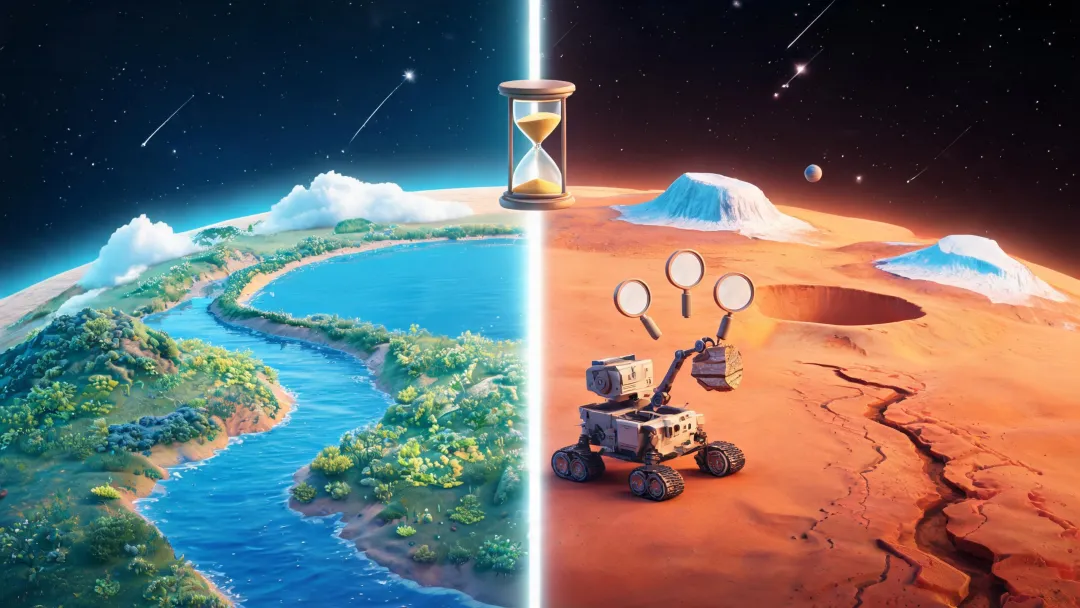
Mars is often called the "Red Planet" because its surface is covered with red dust. In the past, the climate on Mars was very different. Studies show that billions of years ago, Mars had rivers, lakes, and maybe even oceans. Today, those rivers are gone, but scientists have found dry riverbeds and special rocks that can only form in water.
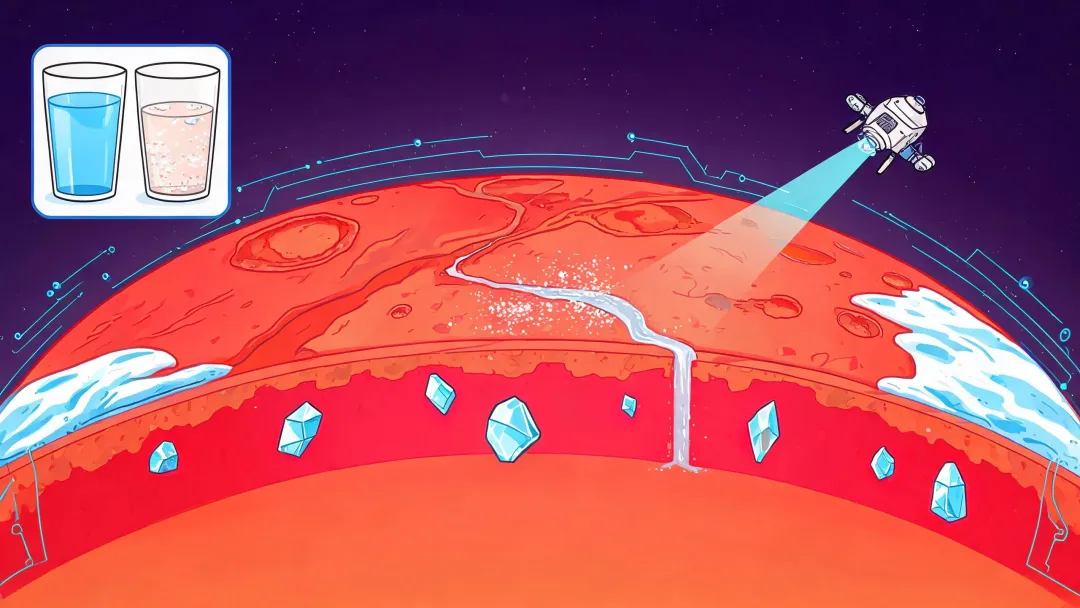
Where is the water now? Most of it is frozen. At the north and south poles of Mars, there is a lot of water ice. Some ice is also hidden under the ground. In 2015, a spacecraft found signs of salty liquid water flowing on the surface during warm seasons, though this is still being studied.
Why does this matter? First, water is necessary for life. If there was water, there might have been life on Mars long ago. Second, water will be useful for future astronauts. They could use it for drinking, growing food, and making fuel.
More missions are planned to explore Mars. Robots like the rover "Perseverance" are collecting rocks and soil. Someday, humans may walk on Mars and look for water themselves. The question "Is there water on Mars?" has opened a door to one of the greatest adventures in human history.
✏️ 阅读理解题目
1. Why is Mars called the "Red Planet"?(细节题)
A. Because it is very hot.
B. Because its surface is covered with red dust.
C. Because it has red water.
D. Because of its red sky.
2. What did scientists find that shows Mars had water in the past?(细节题)
A. Living animals.
B. Dry riverbeds and special rocks.
C. Blue oceans.
D. Green plants.
3. The word "frozen" in Paragraph 3 probably means ______.(词义猜测题)
A. 融化的
B. 冻结的
C. 沸腾的
D. 蒸发的
4. What is the main idea of the passage?(主旨题)
A. Mars is too far for humans to reach.
B. There may be water and the possibility of life on Mars.
C. Robots are better than humans at exploring.
D. The Red Planet has no water at all.
5. What can we infer about future Mars exploration?(推断题)
A. Humans will never go to Mars.
B. Water on Mars is useless.
C. More missions will study Mars more closely.
D. Mars has no ice at all.
💡 答案与详细解析
第1题:答案 B
【题型】细节题
【解析】根据第二段首句 "Mars is often called the 'Red Planet' because its surface is covered with red dust." 可知,火星被称为"红色星球"是因为表面覆盖着红色尘埃,选 B。
• A、C、D 选项:原文均未提及高温、红水或红色天空。
✅ 解题技巧:科普文——因果句定位
含 because 的句子是科普文高频考点,题干问 why,直接找 because 引导的原因。
本句 the Red Planet because ... red dust,原因一目了然。
第2题:答案 B
【题型】细节题
【解析】根据第二段最后一句 "scientists have found dry riverbeds and special rocks that can only form in water." 可知,科学家发现了干涸的河床和只能在水中形成的特殊岩石,这是火星曾经有水的证据,选 B。
• A选项错误:文中说"可能曾有生命",并未发现活着的动物。
• C、D选项:今天的火星已没有蓝色海洋和绿色植物。
✅ 解题技巧:科普文——找"证据词"
科普文常问"如何证明……",抓 found / show / evidence 等动词后的宾语。
dry riverbeds and special rocks 就是"火星曾有水"的直接证据。
第3题:答案 B
【题型】词义猜测题
【解析】frozen 是 freeze(结冰)的过去分词作形容词,字面意为"被冻住的"。结合语境 "Most of it is frozen... there is a lot of water ice"(大部分水结冰了,极地有大量水冰),可知 frozen 是"冻结的",选 B。
• A、C、D 都与"结冰/冰"的语境相反。
✅ 解题技巧:词义猜测——看派生词根
frozen 来自 freeze(冻结),-en 是形容词化后缀,过去分词 frozen 表"被冻的"。
再结合后文 water ice(水冰)验证,必为"冻结的"。
第4题:答案 B
【题型】主旨题
【解析】全文围绕"火星上是否有水"展开:先说过去有河流海洋的证据,再说现在水以冰的形式存在,最后说明水意味着生命的可能和未来探索价值。B 选项"火星上可能有水,也可能有生命"最全面地概括了全文,选 B。
• A、C 选项:只涉及局部细节。
• D 选项:与原文"有水"的事实相反。
✅ 解题技巧:主旨题——抓"全文都在回答的问题"
标题/首段抛出的问题(Is there water on Mars?)往往就是全文主线。
正确主旨项通常同时覆盖"水"和"生命/探索"两层,而非单一细节。
第5题:答案 C
【题型】推断题
【解析】根据最后一段 "More missions are planned to explore Mars." 以及探测车正在采集岩石土壤,可以推断未来会有更多任务更深入地研究火星,选 C。
• A选项错误:原文说 "Someday, humans may walk on Mars",并非永远不去。
• B选项错误:原文说水对宇航员"useful",并非无用。
• D选项错误:第三段明确提到极地有冰。
✅ 解题技巧:推断题——找"将来时/计划"信号
题干问 future,回原文找 will / be planned / someday 等表将来的表达。
More missions are planned 直接支持"更多任务将研究火星"。
📚 重点词汇积累
单词 | 音标 | 词性 | 中文释义 | 中考频度 |
Mars | /mɑːz/ | n. | 火星 | ⭐⭐⭐⭐⭐ |
planet | /ˈplænɪt/ | n. | 行星 | ⭐⭐⭐⭐⭐ |
surface | /ˈsɜːfɪs/ | n. | 表面 | ⭐⭐⭐⭐⭐ |
climate | /ˈklaɪmət/ | n. | 气候 | ⭐⭐⭐⭐ |
frozen | /ˈfrəʊzn/ | adj. | 冻结的;冷冻的 | ⭐⭐⭐⭐ |
pole | /pəʊl/ | n. | 极地;极点 | ⭐⭐⭐⭐ |
liquid | /ˈlɪkwɪd/ | n./adj. | 液体(的) | ⭐⭐⭐⭐ |
astronaut | /ˈæstrənɔːt/ | n. | 宇航员 | ⭐⭐⭐⭐⭐ |
mission | /ˈmɪʃn/ | n. | 任务;使命 | ⭐⭐⭐⭐ |
rover | /ˈrəʊvə(r)/ | n. | 巡视器;探测车 | ⭐⭐⭐ |
常用短语
1. wonder whether ...想知道是否……
2. be covered with被……覆盖
3. billions of years ago数十亿年前
4. dry riverbeds干涸的河床
5. under the ground在地下
6. be necessary for对……是必要的
7. open a door to ...为……打开大门
🔗 长难句分析
句子 1
Studies show that billions of years ago, Mars had rivers, lakes, and maybe even oceans.
【翻译】研究表明,数十亿年前,火星上有河流、湖泊,甚至可能还有海洋。
结构拆解
- 主语:Studies;谓语:show(表明)
- that 引导宾语从句,作 show 的宾语
- 从句主语:Mars;谓语:had(有)
- 宾语是三个并列名词 rivers, lakes, and oceans
- billions of years ago 是时间状语
【考点】that 引导的宾语从句;并列宾语。科普文常用 "Studies show that ..." 引出研究结论。
句子 2
If there was water, there might have been life on Mars long ago.
【翻译】如果(当时)有水,那么很久以前火星上可能就曾存在过生命。
结构拆解
- If there was water 是 if 引导的条件状语从句(表假设)
- 主句:there might have been life ... 是 there be 的过去可能推测结构(might have been)
- on Mars long ago 是地点/时间状语
【考点】if 条件状语从句 + might have been(对过去的可能推测),科普文表达"可能性"的高频句式。
─────────────────────────────
💬 今日小思考
科普文的"词义猜测题"最爱考派生词/分词形容词(如 frozen ← freeze)。
猜词三招:看构词 → 看上下文线索 → 代入验证。火星的线索已给出,中考阅读也从科学结论里出题,多读多积累!
关注「初三英语阅读理解」,每天一篇阅读训练,陪你冲刺中考!


