

前言:在接触到Hoey的语篇模式理论后,想尝试用语篇来作为横向支架支撑高考英文写作的骨架,弥补学生拿到文章题目后,对段落构架不清晰的问题,同时也采用微观组段方式的纵向支架,帮助填充内容“血肉”。在AI协助下,完成一份初期的指南,将分几次分享。
但是,在实施过程中,我也意识到横向支架和纵向支架看起来泾渭分明,实则在指导学生写作时,会产生横纵融合,并没有明确的一为骨架,二为血肉的区分度。
Anyway,先记录初期成果,再争取慢慢完善吧!欢迎各位共同探讨!
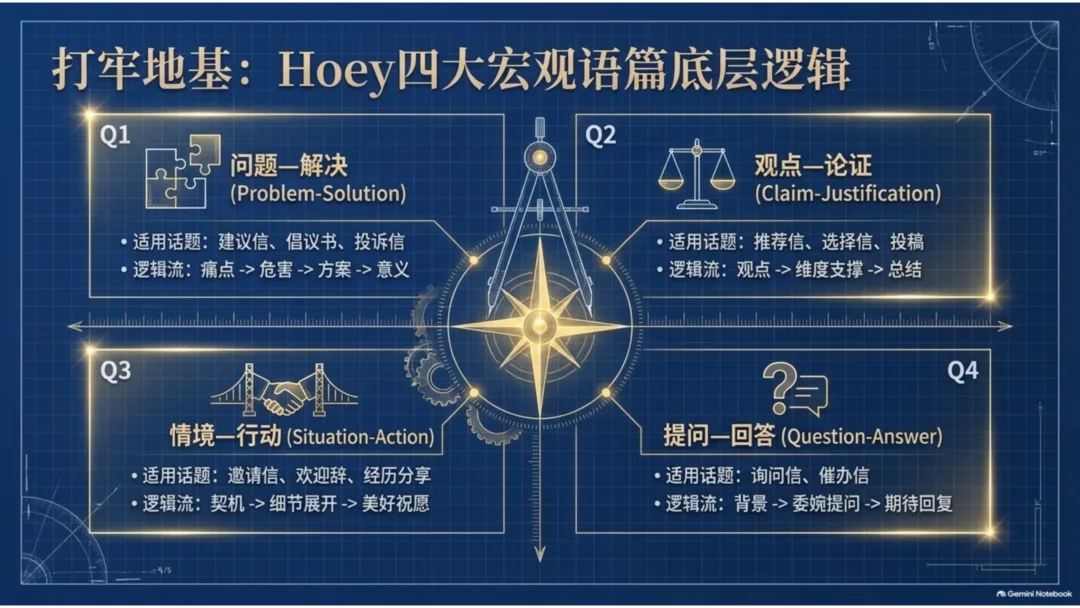
第一部分:底层逻辑—— Hoey 四大宏观语篇模式 (横向支架)
第一步必须是“定大类”。根据 Michael Hoey 的语篇模式理论,高考应用文无外乎以下四大底层逻辑:
一、问题—解决模式 (Problem-Solution):
适用话题:建议信(针对不良现象/不合理安排)、倡议书、投诉信、求助信。
纵向逻辑展开:交代情境/发现痛点→揭示问题及危害→提出解决方案→评估意义与呼吁。
1. 常用结构与逻辑衔接词
●揭示问题:However / Unfortunately / As a matter of fact / Recently, it has come to my attention that...
●分析危害:As a result / Consequently / If this situation continues / This may cause...
●提出解决:Therefore / Thus / In my opinion, a better way might be... / I strongly suggest...
●评估意义:Only in this way can we... / By doing so...
2. 核心词汇 (Vocabulary)
●负面/问题词汇:barrier (障碍), disadvantage (缺点) , inappropriate (不合适的) , pressure (压力) , unaware (未意识到的)
●解决/建议词汇:recommend (推荐), suggest (建议), solution (解决办法) , take measures (采取措施), effective (有效的).
3. 黄金句型 (Sentence Patterns)
●引出问题:
●I am writing to express my concern about... (我写信是想表达对……的担忧。)
●The current arrangement, however, has some problems. (然而,目前的安排存在一些问题。)
●分析危害:
●This can hinder the progress of students as the more advanced one may dominate the conversation... (这可能会阻碍学生的进步,因为水平较高的学生可能会主导对话……)
●Not only may it distract us from our studies..., but it might also cause... (它不仅可能分散我们学习的注意力……,还可能导致……)
●提出建议:
●My suggestion is that we are supposed to group students based on their language abilities... (我的建议是我们应该根据语言能力将学生分组……)
●评估意义:
●Such an inviting column... must expose everyone to others' characteristics, thus strengthening mutual understanding. (这样一个吸引人的栏目……必将让每个人了解他人的特点,从而增进相互了解。)
二、观点—论证模式 (Claim-Justification):
适用话题:推荐信、选择信、议论文性质的投稿。
纵向逻辑展开:提出核心观点/做出选择 →多维度论据支撑(递进或对比)→总结重申。
1. 常用结构与逻辑衔接词
●表达观点:Personally / As far as I am concerned / From my perspective...
●递进论证:To begin with / First of all / Furthermore / Besides / More importantly / In addition.
●对比论证:On the one hand... On the other hand... / By contrast.
●总结观点:In short / All in all / In conclusion.
2. 核心词汇 (Vocabulary)
●赞美/优势词汇:appealing / attractive (有吸引力的), fantastic (极好的) , beneficial (有益的), unique (独特的) , significant (有重大意义的) .
●论证词汇:enrich (丰富) , promote (促进) , provide a platform for (为...提供平台) , capture the atmosphere (捕捉氛围)
3. 黄金句型 (Sentence Patterns)
●亮明选择/主张:
●I’m writing to express that my predilection goes to "Guess who I am"... (我写信想表达我的偏爱是“猜猜我是谁”……)
●Opinions are divided on the question... On the one hand, … On the other hand, … (在这个问题上人们意见不一……一方面……另一方面……)
●递进提供理由:
●First of all, it is a better way to... Secondly, by doing so... In addition... (首先,这是……的更好方式。其次,这样做……此外……)
●More importantly, more friendships will be forged, since the column enables us to befriend someone on the same wavelength. (更重要的是,因为这个栏目能让我们结交志同道合的人,更多的友谊将会建立。)
●总结升华:
●I do hope that my suggestions will be taken into consideration. (我确实希望我的建议能被考虑。)
三、情境—行动/一般—特殊模式 (Situation-Action/General-Particular):
适用话题:邀请信、欢迎辞、感谢信、分享信、事物/经历介绍。
纵向逻辑展开:寒暄并点明契机→展开活动细节(时间、地点、内容、感受)→表达美好祝愿或期盼。
1. 常用结构与逻辑衔接词
●时间/流程推进:At first / As scheduled / After that / During the event / Throughout the weekdays.
●情感递进:To my delight / Surprisingly / Deeply moved by...
2. 核心词汇 (Vocabulary)
●活动/安排词汇:schedule (安排) , activity (活动), participate / get involved in (参与) , experience (经历/体验).
●情感/交际词汇:sincere welcome (诚挚的欢迎) , grateful / thankful (感激的), unforgettable / memorable (难忘的) , appreciate (欣赏/感激) .
3. 黄金句型 (Sentence Patterns)
●引出契机与目的:
●On behalf of our school, I would like to convey my sincere welcome for your visiting. (我代表我们学校,对你们的来访表示诚挚的欢迎。)
●I’m writing to invite you to come to my home to celebrate the Spring Festival... (我写信邀请你来我家过春节……)
●详述行动与细节:
●The activity is scheduled at 8:00 a.m. on January 20th in the lecture hall. (活动定于1月20日上午8点在报告厅举行。)
●We’ll make dumplings together and have a big dinner. We’ll also... (我们将一起包饺子吃大餐。我们还将……)
●The work depicts a path winding through a lush green forest, with dappled sunlight filtering through the trees. (这幅作品描绘了一条蜿蜒穿过郁郁葱葱的绿色森林的小路,斑驳的阳光透过树木。)
●祝愿与期待:
●May you have an unforgettable experience. (愿你有一段难忘的经历。)
●We all miss you very much and wish you a quick and complete recovery. (我们都非常想念你,祝你早日彻底康复。)
四、提问—回答模式 (Question-Answer):
适用话题:询问信、催办信、征求建议信。
纵向逻辑展开:交代自身背景/铺垫前提 →提出具体疑问或委婉催促→表达感谢并期待回复。
1. 常用结构与逻辑衔接词
●引入疑问:I wonder if... / Could you please... / Would you mind...
●补充追问:Also / In addition / Meanwhile.
●礼貌结束:Thank you in advance / I would appreciate it if... / Looking forward to...
2. 核心词汇 (Vocabulary)
●询问与进展词汇:inquire (询问) , progress (进展) , deadline (截止日期) , submission (提交) .
●请求与帮助词汇:advice / suggestion (建议), support (支持) , provide (提供), enrich (丰富) .
3. 黄金句型 (Sentence Patterns)
●交代背景与核心诉求:
●As you know, I’m writing to politely inquire about the progress of the article. (如你所知,我写信是想礼貌地询问这篇文章的进度。)
●My school is planning to hold class meetings about Chinese traditional culture... I am writing to ask you for help. (我们学校计划举办关于中国传统文化的班会……我写信向你寻求帮助。)
●委婉提问或提醒:
●Would you mind letting me know how it’s going? (你介意让我知道进展如何吗?)
●Also, could I remind you that the deadline for submission is this Friday, June 14th? (另外,我可以提醒你提交的最后期限是6月14日这个星期五吗?)
●Can you let me know which of the following options you and people around you would enjoy most? (你能告诉我以下哪个选项是你和你周围的人最喜欢的吗?)
●表达感谢与期待:
●Your insights into Canadian sports will surely enrich our readers’ understanding... Thank you again for your support! (你对加拿大体育的见解必将丰富我们的读者对……的理解。再次感谢你的支持!)
●Thank you for your help. Looking forward to hearing from you. (感谢你的帮助。期待你的回信。)
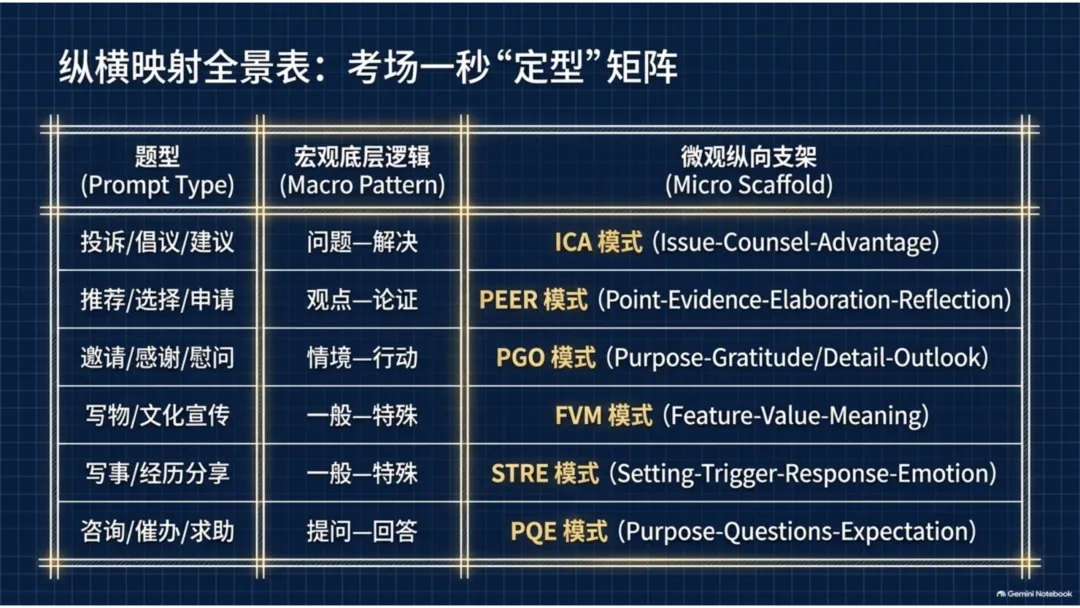
第二部分:微观组段—— 六大纵向逻辑支架与深度拓展
在确定了宏观方向后,我们需要用特定的“微观支架”来丰满段落的血肉。以下是核心支架及最新真题语境拓展:
1. ICA 模式 (Issue - Counsel - Advantage)
【适用语篇】问题解决类(建议信、倡议书、投诉信)
●I (Issue 痛点):客观陈述现状并分析危害。
●C (Counsel 建议):委婉或坚决地提出可操作的方案。
●A (Advantage 优势):描绘方案落地后的积极愿景。
【深度拓展:寻物求助信变体—— I-D-R 模式】针对如“航班遗失钱包求助” 的题型,ICA可变形为 IDR (Issue遗失背景 - Detail物品细节 - Request具体请求)。
●Issue:I took FL753 to London... the moment I stepped off the plane I found my purse gone.
●Detail:It is a blue leather purse with over $1000, my ID card and my passport in it.
●Request:If you find any clue, please phone my host family... I would greatly appreciate your timely help.
2. PEER 模式 (Point - Evidence - Elaboration - Reflection)
【适用语篇】观点论证类(推荐信、选择信、申请信)
●P (Point):直接亮明你的选择或主张。
●E (Evidence):给出具体的特征或事实。
●E (Elaboration):深入阐述这些特征带来的深层好处(高分关键)。
●R (Reflection):总结期盼。
【深度拓展:求职/申请信变体 —— P-Q-E 模式】针对如“应聘英语协会志愿者” 的题型,PEER可变形为 PQE (Position申请职位 - Qualifications资质论证 - Expectation期待)。
●Qualifications (高分展示):重点展示能力与该职位的匹配度。如:I have a good command of spoken English... which enables me to communicate with foreign students fluently.(我英语口语很好,这使我能流利地与外国学生交流。)
3. PGO 模式 (Purpose - Gratitude/Detail - Outlook)
【适用语篇】社交礼仪类(邀请信、感谢信、告别信、慰问信)
●P (Purpose):寒暄铺垫,点明写信契机。
●G/D (Detail):展开活动细节或过往经历。
●O (Outlook):表达未来祝愿。
【深度拓展:告别信/慰问信】
●告别感谢(致Alex):I still remember the days when you helped me with my English... I hope we can keep in touch often. Best wishes!
●生病慰问(致外教Peter):I am sorry to hear that you have gone back home on sick leave... We all miss you very much and wish you a quick and complete recovery.
4. FVM 模式 (Feature - Value - Meaning) & STRE 模式 (Setting - Trigger - Response - Emotion)
【适用语篇】事物介绍、文化宣传、经历分享(欢迎辞、新闻报道)
●FVM (写物):Feature(外观特征) -- Value(功能价值) -- Meaning(文化内涵/象征意义)。
●STRE (写事):Setting(背景) --Trigger(契机) -- Response(行动细节) -- Emotion(感悟升华)。
【深度拓展:欢迎辞(Welcome Speech)】欢迎辞常融合PGO与FVM模式。如“欢迎新西兰学生” :
●开场(Welcome):On behalf of our school, I would like to convey my sincere welcome for your visiting.
●安排(Value/Feature):As scheduled, all of you will visit the museum, which contains the splendid history of our school... you can appreciate the differences between Chinese and western teaching methods.
●祝愿(Meaning):May you have an unforgettable experience.
5. PQE 模式 (Purpose - Questions - Expectation)
【适用语篇】打破信息差类(咨询信、征求建议信、催办信)
●P (Purpose):交代身份或计划,破冰引出目的。
●Q (Questions):委婉地提出核心疑问(切忌生硬的祈使句)。
●E (Expectation):赋予对方回答的价值,表达感谢。
【深度拓展:催办信的委婉语气】如“催促外教Chris交稿” :
●委婉询问:I’m writing to politely inquire about the progress of the article. Would you mind letting me know how it’s going?
●礼貌提醒:Also, could I remind you that the deadline for submission is this Friday, June 14th?
●价值升华:Your insights into Canadian sports will surely enrich our readers’ understanding of global sports culture...
第三部分:冲刺高分—— 顶级词块与“降维打击”句型库
为了让学生在考场上能够将纵横支架完美填充,我从最新真题库中提炼了以下极具杀伤力的高级表达,按功能分类:
1. 高维动词词块 (Advanced Verbs)
摆脱make, do, get, 换用以下动词让文章瞬间专业:
●促进/增强 (取代 improve):enhancethe program effectiveness (提升项目效果) , promotecommunication (促进交流) , boostacademic performance (提升学业表现) .
●阻碍/破坏 (取代 stop/bad for):hinderthe progress of students (阻碍学生的进步) , disruptthe school order (破坏学校秩序) .
●体现/代表 (取代 show/mean):embodya time of abundance (体现富足的时代) , symbolizenourishment (象征滋养) .
●引起/激发 (取代 cause):sparka growing love for (激发对...的热爱) , stimulatetheir national pride (激发民族自豪感) .
2. 衔接与逻辑过渡词 (Logical Connectors)
●引出观点:From my perspective / As far as I can see / I firmly believe that...
●说明现状/背景:Recently, it has come to my attention that... / As scheduled...
●递进论证:To begin with / Furthermore / More importantly / Last but not least
●得出结论:Taking all these factors into account / To sum up...
3. 黄金加分句型矩阵 (Golden Sentence Patterns)
必杀技1:非谓语动词的灵活前置/后置(瞬间提升句法复杂度)
●过去分词作状语(表背景/原因):Located on the third floorbeside the online reading rooms, it can be accessible from 8 am till 9 pm... (它位于三楼,紧挨着在线阅览室……)
●现在分词作结果状语:This can hinder the progress of students..., leaving little roomfor the other students to improve. (这可能会阻碍学生的进步……让其他学生几乎没有提升的空间。)
●独立主格结构(画面感极强):The work depicts a path winding through a lush green forest, with dappled sunlight filtering through the trees. (这幅作品描绘了一条蜿蜒穿过郁郁葱葱森林的小路,斑驳的阳光透过树木洒下来。)
必杀技2:高级复合从句(定语从句与名词性从句嵌套)
●which引导的非限制性定语从句 (解释说明):My school is to hold theme-based class meetings to promote Chinese traditional culture, whichprovides a platform for them to explore the beauty of China.
●that引导的同位语/宾语从句:I am writing to express my predilection goes to "Guess who I am", whichcapitalizes on an object clause to signal its potential contents. (我写信想表达我更偏爱“猜猜我是谁”栏目……)
●how引导的宾语从句 (委婉语气):Would you mind letting me know how it’s going? (您介意让我知道进展如何吗?)
必杀技3:倒装句与强调句型(阅卷老师的最爱)
●Not only... but also (部分倒装):Not only may it distract usfrom our studies..., but it might also causeunnecessary comparisons. (它不仅可能让我们在学习中分心……还可能引起不必要的攀比。)
●Only in this way (部分倒装):Only in this way can wecreate a more harmonious campus. (只有这样我们才能创造更和谐的校园。)
●It is... that... (强调句):It is through the involvement thatstudents could efficiently remember historical facts instead of merely reciting them... (正是通过这种参与,学生们才能高效地记住历史事实,而不是死记硬背……)
结语:致学生的备考箴言
应用文写作不是盲目的词汇堆砌,而是一场“基于语境的精准逻辑搭建”。在考场上,请牢记这四个步骤:
1.看对象定基调:写给外教、长辈要用委婉的PQE 模式;写给平辈或校报要用激昂的 ICA 或 PEER 模式。
2.看题干选支架:提建议选ICA,做选择选 PEER,搞宣传选 FVM,发邀请选 PGO。
3.填骨架补细节:用高分动词替换低级词汇,确保每个步骤(P-E-E-R)都有话可说。
4.升华结尾保高分:永远记住在最后一句加上对未来的期盼、对双边关系的促进(strengthen mutual understanding)、或对个人成长的影响,这是让你的文章从12 分跨越到 14+ 分的“点睛之笔”。


