

第一部分 · C 篇(方向辨识能力研究 · 科普说明文)
句 1(C 篇 · 第 1 段)
原句
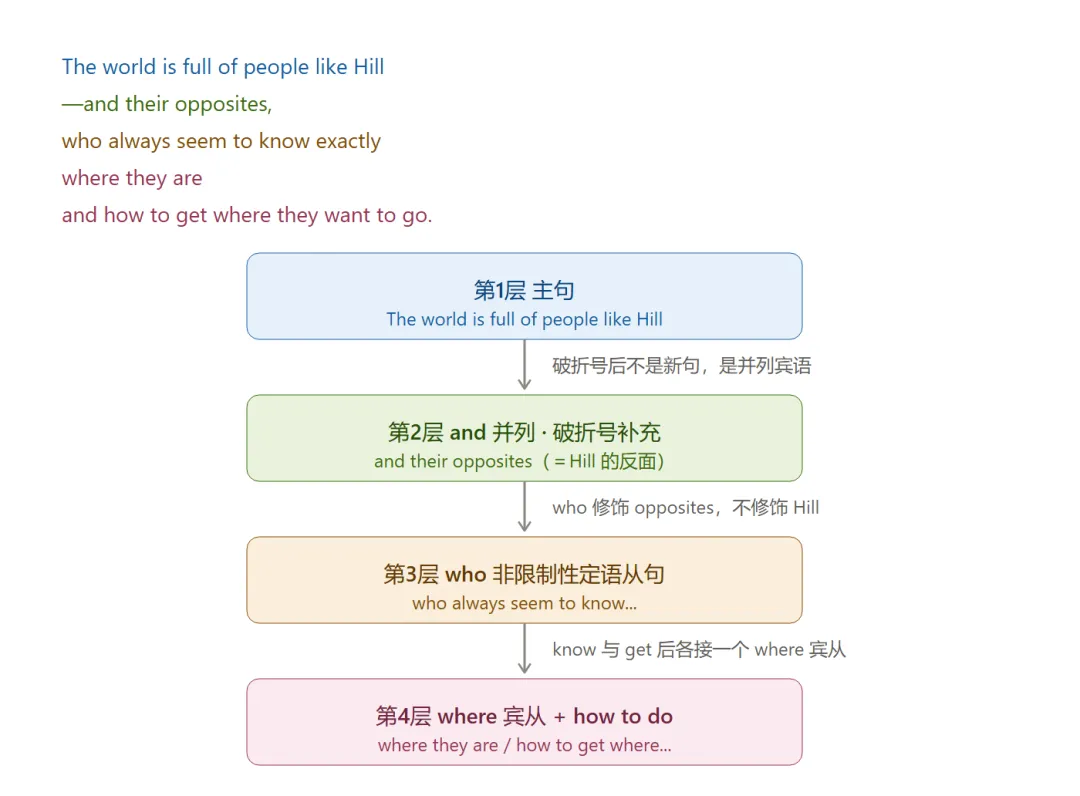
The world is full of people like Hill—and their opposites, who always seem to know exactly where they are and how to get where they want to go.
中文翻译
世界上到处都是像希尔这样的人——以及他们的反面:那些似乎永远清楚自己身在何处、知道怎么去想去的地方的人。
结构图
逐层拆解
▪ 第 1 层(主句):The world is full of people like Hill —— be full of"充满";like Hill 介词短语后置修饰 people
▪ 第 2 层(and 并列 + 破折号):and their opposites —— 破折号不是新句子的开始;their opposites 与 people like Hill 并列,同作 full of 的宾语
▪ 第 3 层(who 非限制性定语从句):who always seem to know exactly —— who 修饰 opposites(不修饰 Hill);前面有逗号,非限制性;seem to know"似乎知道"
▪ 第 4 层(where 宾从 + how to do):know 后接 where they are(宾语从句,陈述语序);and 并列 how to get...(疑问词 + 不定式);get 后又嵌一个 where they want to go
词汇卡
▪ opposite /ˈɒpəzɪt/ n. 相反的人(或事物);adj. 相反的
▪ exactly /ɪɡˈzæktli/ adv. 确切地(exact + -ly)
▪ seem to do /siːm/ 似乎……
易错处
1. 破折号误当句号——and their opposites 不是新句子,是并列宾语
2. 定语从句的先行词搞错,误认为who 修饰 Hill
巩固练习
1. I know exactly where ______ (the keys are / are the keys).(宾从语序)
2. She is one of those people who always know what they want and how ______ (get) it.(疑问词 + 不定式)
3. He always seems ______ (be) calm before exams.(seem to do)
句 2(C 篇 · 第 2 段)
原句
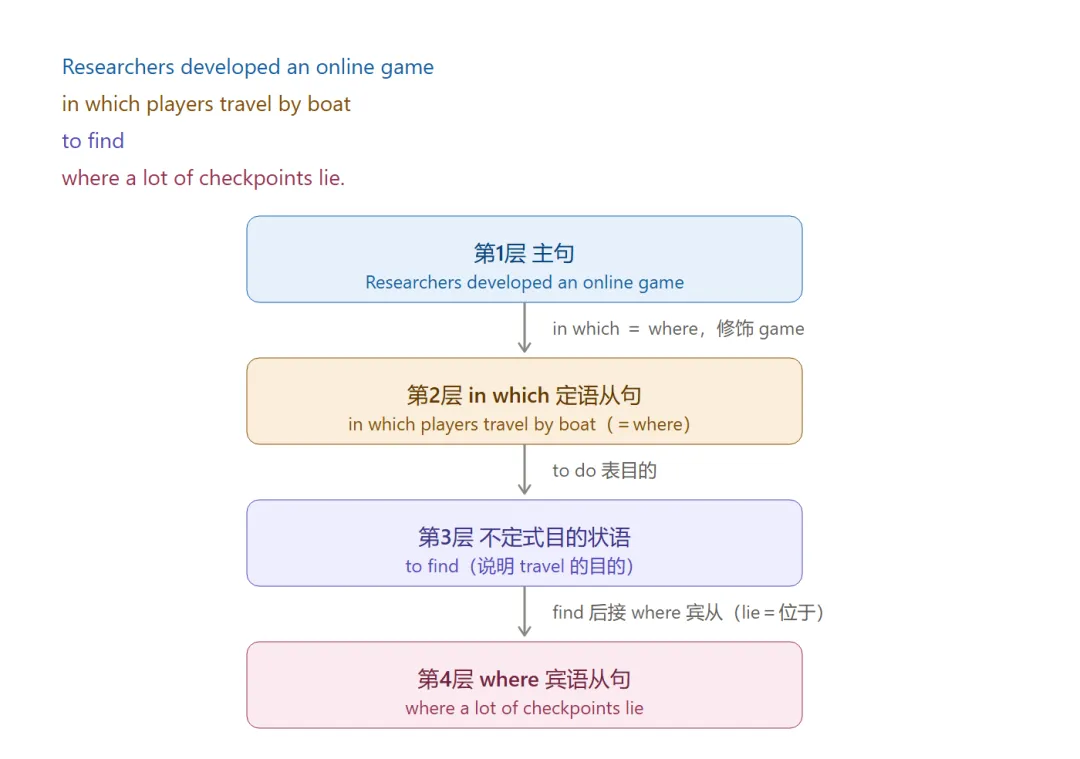
Researchers developed an online game in which players travel by boat to find where a lot of checkpoints lie.
中文翻译
研究人员开发了一款在线游戏,玩家在游戏中乘船寻找大量检查点所在的位置。
结构图
逐层拆解
▪ 第 1 层(主句):Researchers developed an online game
▪ 第 2 层(in which 定语从句):in which players travel by boat —— in which = where,修饰 game;"介词 + which"是 which 定语从句的升级形态,阅读理解高频
▪ 第 3 层(不定式目的状语):to find —— 说明 travel 的目的
▪ 第 4 层(where 宾语从句):where a lot of checkpoints lie —— find 的宾语;lie"位于"(lie-lay-lain),不是"说谎"(lie-lied-lied)
词汇卡
▪ checkpoint /ˈtʃekpɔɪnt/ n. 检查点(check + point 合成词)
▪ lie /laɪ/ v. 位于 → 过去式 lay,过去分词 lain;"说谎"→ lied, lied
▪ navigational /ˌnævɪˈɡeɪʃənl/ adj. 导航的(文中已给中文释义)
易错处
1. in which 不认识——遇到"介词 + which",直接替换成 where 理解,句子立刻通顺
2. lie 按"说谎"翻译,句子读不通——同形异义,靠语境判断:检查点"位于"某处
3. to find 误当将来时——不定式在此表目的
巩固练习
4. This is the school in ______ I studied for three years.(介词 + which)
5. The app tells you where the nearest hospital ______ (lie).(主谓一致)
6. 同义改写:The room where we had the meeting is on the second floor. → The room ______ ______ had the meeting...(用介词 + which)
句 3(C 篇 · 第 3 段)
原句
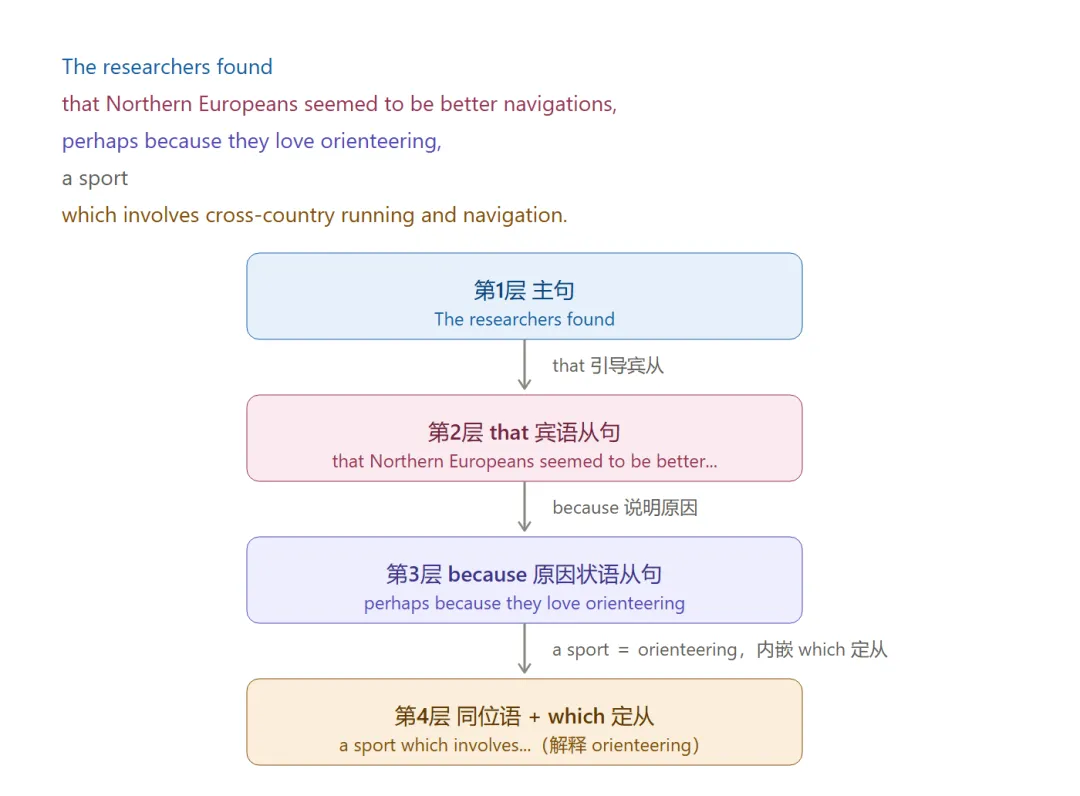
The researchers found that Northern Europeans seemed to be better navigations, perhaps because they love orienteering, a sport which involves cross-country running and navigation.
中文翻译
研究人员发现,北欧人似乎更擅长辨识方向,也许因为他们热爱定向越野——一项结合了越野跑与导航的运动。
结构图
逐层拆解
▪ 第 1 层(主句):The researchers found
▪ 第 2 层(that 宾语从句):that Northern Europeans seemed to be better navigations —— found 的宾语
▪ 第 3 层(because 原因状语从句):perhaps because they love orienteering —— 嵌在宾从内部,解释"北欧人强"的原因
▪ 第 4 层(同位语 + which 定语从句):a sport which involves cross-country running and navigation —— a sport 是 orienteering 的同位语;which 定从修饰 a sport,从句谓语 involves 三单
词汇卡
▪ navigation /ˌnævɪˈɡeɪʃ(ə)n/ n. 导航、航行
▪ orienteering /ˌɔːriənˈtɪərɪŋ/ n. 定向越野(文中已给释义)
▪ involve /ɪnˈvɒlv/ v. 包含;需要
易错处
1. involves 主语是 which(=a sport),单数动词
3. 原文 navigations 是 navigators 的用词瑕疵——考场上遇到明显讲不通的词,按讲得通的读法理解即可,不要死抠
巩固练习
7. She loves swimming, a sport ______ requires great patience.(定语从句)
8. He was late again, perhaps ______ the traffic was too heavy.(原因状从)
句 4(C 篇 · 第 4 段 · 29 题答案依据句)
原句
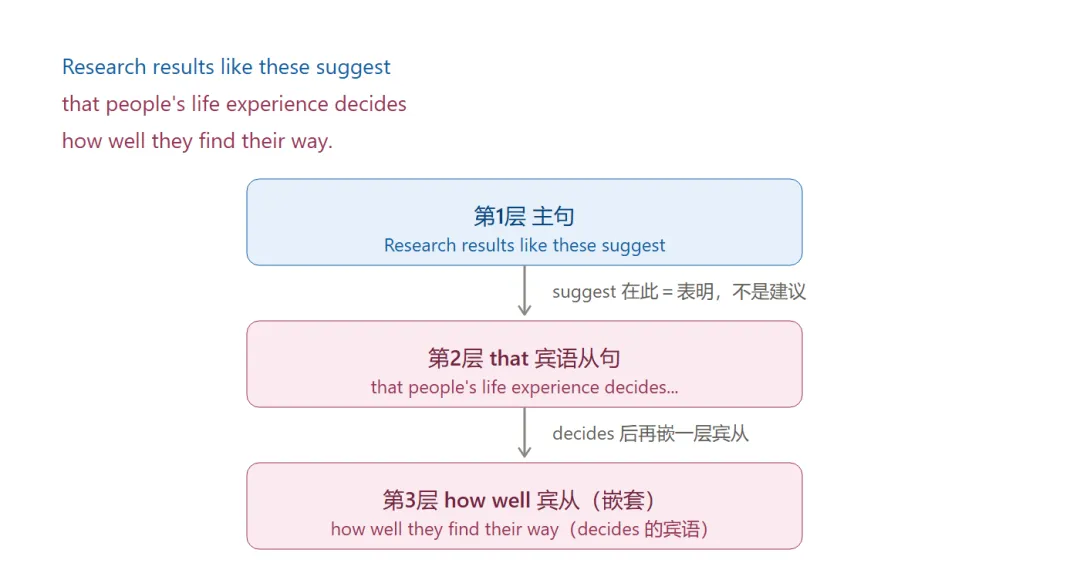
Research results like these suggest that people's life experience decides how well they find their way.
中文翻译
这样的研究结果表明,人的生活经验决定了他们辨路能力的高低。
结构图
逐层拆解
▪ 第 1 层(主句):Research results like these suggest —— like these 后置修饰 results;suggest 此处"表明"
▪ 第 2 层(that 宾语从句):that people's life experience decides
▪ 第 3 层(how well 宾从,嵌套):how well they find their way —— decides 的宾语;宾从套宾从,that 和 how 是两个切分点
▪ 考题关联:29 题"从文中可知什么"答案 Good navigators are mostly made, not born(好的导航者主要是后天练成的,不是天生的),直接对应本句
词汇卡
▪ suggest /səˈdʒest/ v. 表明(此处不接虚拟语气)
▪ life experience 生活经验
易错处
1. suggest 表"表明"还是"建议"——表建议时从句用 (should) do;本句 decides 是陈述语气,说明是"表明"
2. how well 误当感叹或疑问——此处是"程度如何",即"辨路能力的好坏"
3. 宾从嵌宾从找不到边界——两套主谓(experience decides / they find),用 that、how 切开
巩固练习
9. His smile suggests that he ______ (be) happy with the result.(suggest 表"表明")
10. The teacher suggested that we ______ (read) more English stories.(suggest 表"建议")
句 5(C 篇 · 第 4 段 · 28 题答案依据句)
原句
However, men do much better than women in places where women face cultural limits on exploring their environment on their own.
中文翻译
然而,在女性独自探索环境会受到文化限制的地方,男性的表现远远好于女性。
结构图
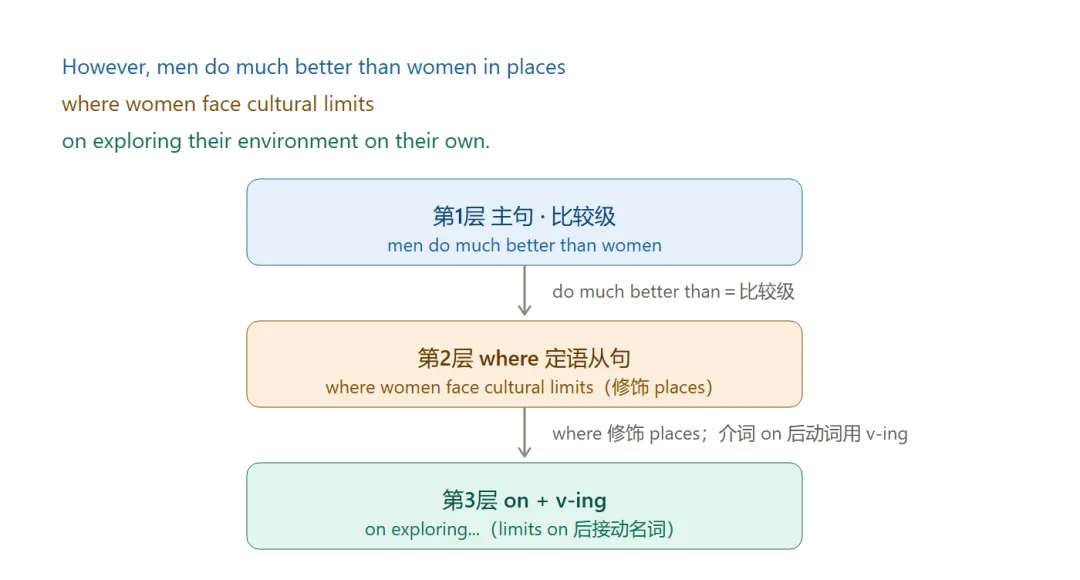
逐层拆解
▪ 第 1 层(主句 + 比较级):men do much better than women —— do much better than"表现远好于"
▪ 第 2 层(where 定语从句):where women face cultural limits —— 修饰 places;where 在从句中作地点状语
▪ 第 3 层(on + 动名词):on exploring their environment —— limits on sth./doing"对……的限制";介词后动词用 v-ing;on their own"独自"
▪ 考题关联:28 题选 A woman who often explores nature(经常探索自然的女性),依据正是本句与句 6——探索越多,辨路越强
词汇卡
▪ limit /ˈlɪmɪt/ n. 限制(limits on... 对……的限制);v. 限制
▪ explore /ɪkˈsplɔː(r)/ v. 探索 → explorer n. 探险家
▪ on one's own 独自;独立地
易错处
1. where 定从误当疑问词"哪里"——where women face... 是"女性受限制的那些地方"
2. exploring 用动词原形——介词 on 后必须接 v-ing
3. cultural limits on exploring 三连读断——"对探索的文化限制",on 把 limits 和 exploring 连起来
巩固练习
11. This is the small town ______ he spent his childhood.(定语从句)
12. There are some limits on ______ (use) phones in class.(介词 + v-ing)
句 6(C 篇 · 第 5 段末句 · 28 题答案依据句)
原句
Even children performed very well—a result, researchers think, of growing up in an environment that encourages children to explore the forest.
中文翻译
就连孩子也表现得非常出色——研究人员认为,这是他们在一种鼓励孩子探索森林的环境中长大的结果。
结构图
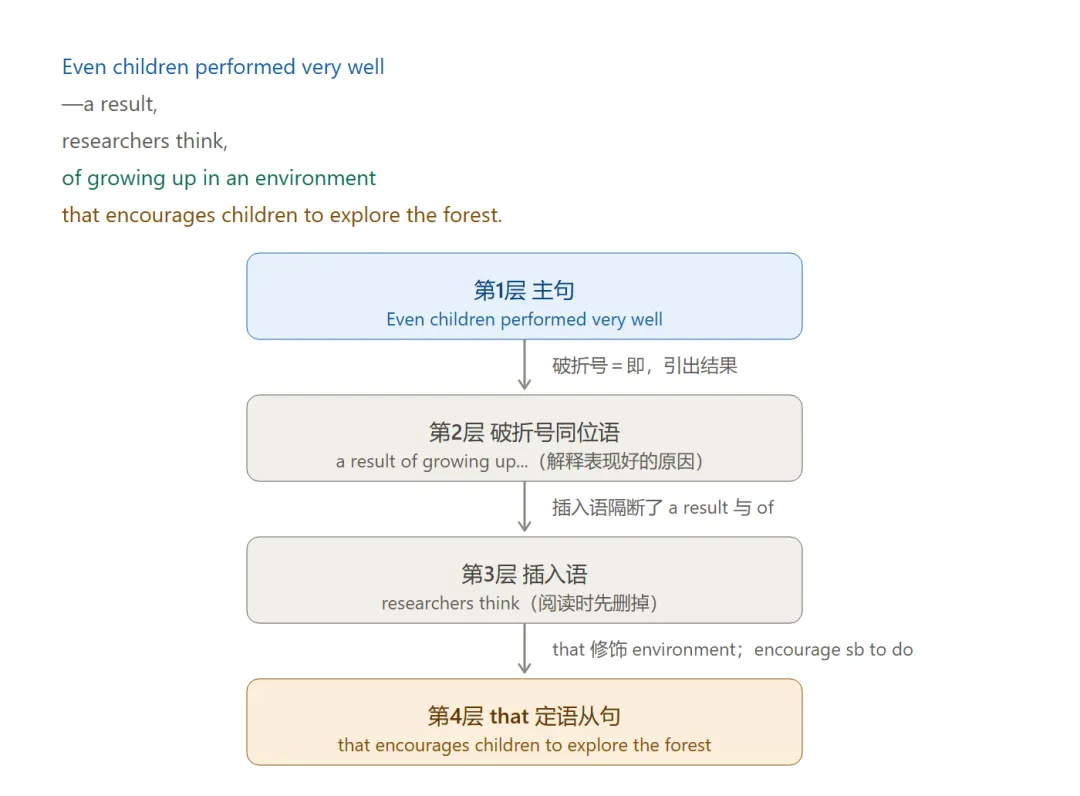
逐层拆解
▪ 第 1 层(主句):Even children performed very well —— Even"就连"加强意外感
▪ 第 2 层(破折号同位语):a result of growing up... —— a result 指代前面"表现出色"这件事,of growing up... 说明"是什么的结果"
▪ 第 3 层(插入语):researchers think —— 插在 a result 和 of 之间,阅读时先删掉,句子立刻通顺
▪ 第 4 层(that 定语从句):that encourages children to explore the forest —— 修饰 environment;encourage sb to do 固定搭配
词汇卡
▪ perform /pəˈfɔːm/ v. 表现;表演 → performance n.
▪ encourage sb to do /ɪnˈkʌrɪdʒ/ 鼓励某人做某事
▪ grow up 长大(与 grow"种植"区分)
易错处
1. researchers think 把 a result 和 of 隔开——插入语是长难句三大隔断手段之一(同位语、插入语、从句),先删后读
2. that 修饰 environment,不是 forest——encourage 的动作发出者是"环境"
3. Even 句首加强语气,不是副词乱用
巩固练习
13. 指出插入语并抄写删去后的句子:He is, I think, the best player in our team.
14. My parents encourage me ______ (speak) English every day.(encourage sb to do)
第二部分 · D 篇(价值观与行为不一致 · 心理议论文)
句 7(D 篇 · 第 1 段首句 · 主题句)
原句
Almost everyone has experienced the feeling of discomfort when their actions do not agree with their inner values.
中文翻译
几乎每个人都经历过这样一种不适感——当自己的行为与内心的价值观不一致的时候。
结构图
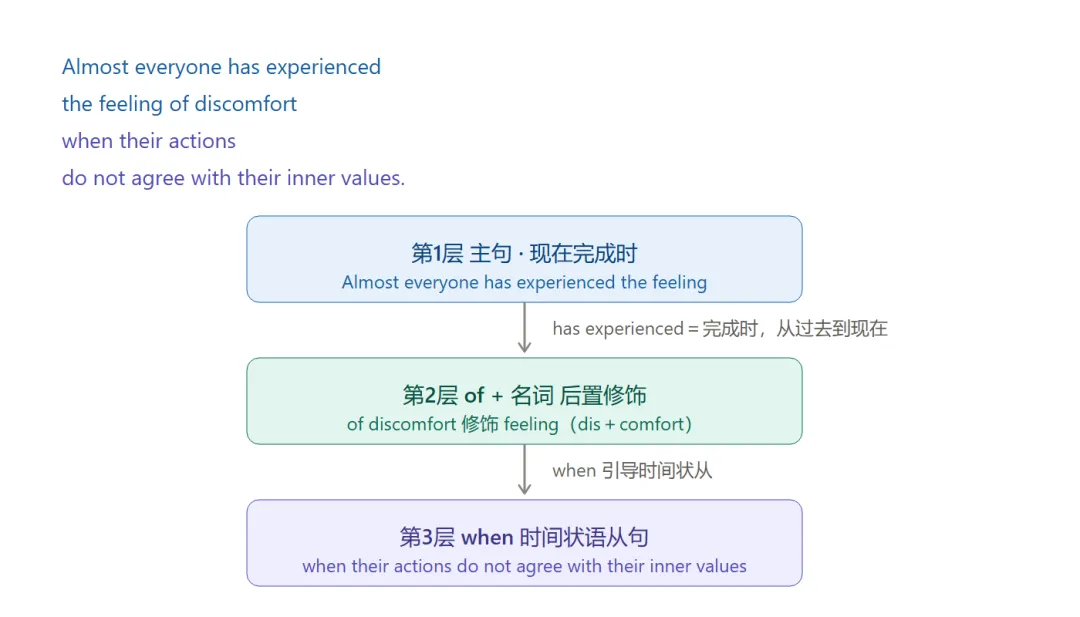
逐层拆解
▪ 第 1 层(主句 · 现在完成时):Almost everyone has experienced the feeling —— has experienced 从过去持续到现在;almost everyone 后动词单数
▪ 第 2 层(of + 名词后置修饰):of discomfort 修饰 feeling;discomfort = dis(否定前缀)+ comfort"舒适"
▪ 第 3 层(when 时间状语从句):when their actions do not agree with their inner values —— agree with 此处"与……一致",不是"同意某人"
▪ 考题关联:本句是 D 篇主题句;30 题问首段例子的作用,答案 To describe a common human experience(描述一种普遍的人类体验)——首段三个例子全是这句的实例
词汇卡
▪ discomfort /dɪsˈkʌmfət/ n. 不适(dis- + comfort,构词同 dislike、disagree)
▪ inner /ˈɪnə(r)/ adj. 内心的(反义词 outer)
▪ agree with 与……一致;(食物)适合;同意(某人的话)
易错处
1. agree with 只记"同意"——此处是"与……相符";一词三义靠语境选
2. values 加 s 是"价值观",不加 s 是"价值"
3. has experienced 完成时——"几乎每个人都经历过",从过去到现在
巩固练习
15. I ______ (experience) many changes since I came to this school.(完成时)
16. What he does doesn't agree ______ what he says.(介词搭配)
句 8(D 篇 · 第 1 段例证句 · 30 题考的就是这句 ★)
原句
Another example is a boy who holds his parents' love dear but gets angry at them in a moment of stress; or a woman who hopes to live healthily but gives in to the attraction of fast food during moments of weakness.
中文翻译
另一个例子是一个男孩,他珍视父母的爱,却在压力之下对他们发脾气;又或者一个女人,她希望健康生活,却在意志薄弱时向快餐的诱惑屈服。
结构图
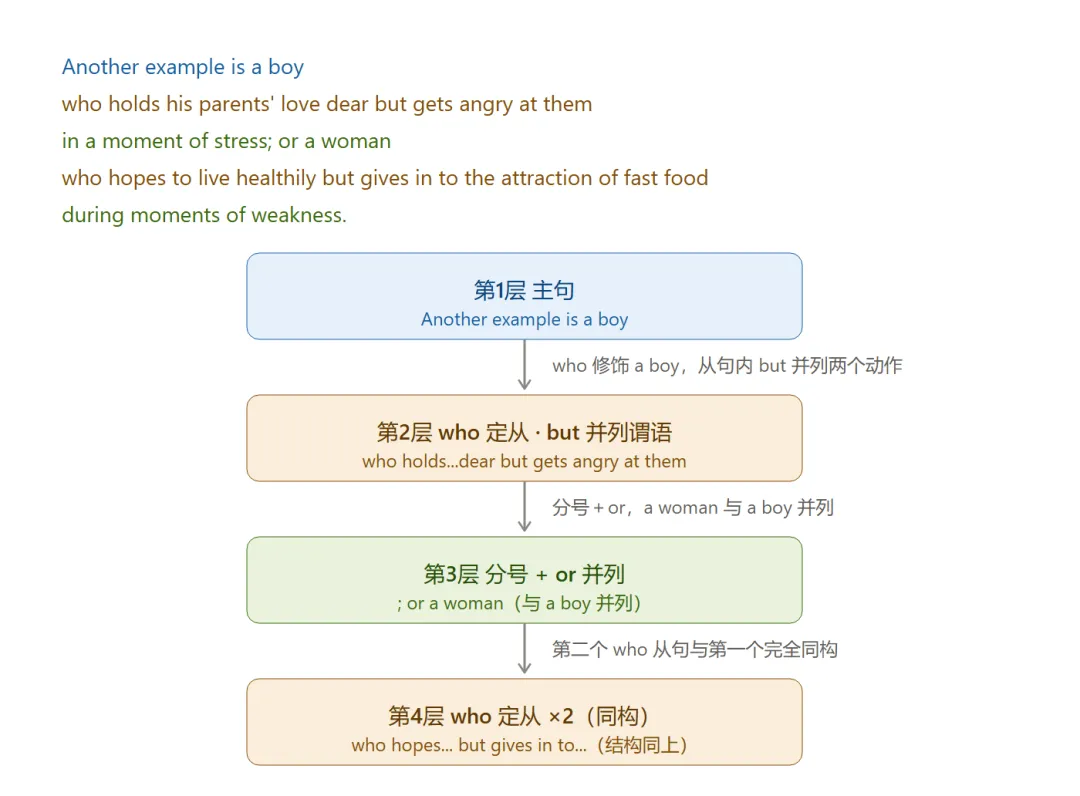
逐层拆解
▪ 第 1 层(主句):Another example is a boy
▪ 第 2 层(who 定从①):who holds his parents' love dear but gets angry at them —— hold... dear"珍视";but 在从句内并列两个谓语
▪ 第 3 层(分号 + or 并列):; or a woman —— 分号相当于逗号 + and,a woman 与 a boy 并列,都作 example 的内容
▪ 第 4 层(who 定从②,同构):who hopes to live healthily but gives in to the attraction of fast food —— 与第 2 层完全同构(hopes... but gives in...),读到后半句应产生"结构重复"的预期
▪ 考题关联:30 题问首段例子作用,本句与句 7 是"总—分"关系:例子印证主题句,不是新观点
词汇卡
▪ hold... dear 珍视……(dear 副词用法)
▪ give in to... /ɡɪv ɪn/ 向……屈服(to 不能丢,后接名词/v-ing)
▪ attraction /əˈtrækʃn/ n. 诱惑;吸引(attract + -ion)
易错处
1. 分号当句号——; or a woman 仍是 example 的内容,在这断句就把例证结构读散了
2. 两个 who 从句里的 but 都是从句内并列,不是主句转折
3. gives in 后丢 to——give in to the attraction 固定搭配
巩固练习
17. She is a girl who ______ (love) reading but ______ (hate) writing.(从句内并列谓语)
18. He never gives in to ______ (difficult).(give in to + 名词)
句 9(D 篇 · 第 2 段 · 全卷最嵌套)
原句
One reason for this silence might be that admitting to these behaviors can feel like showing a weakness or mistake that society tells us should be kept hidden.
中文翻译
这种沉默的一个原因可能是:承认这些行为,会让人感觉像在暴露一个社会告诉我们本该隐藏起来的弱点或错误。
结构图
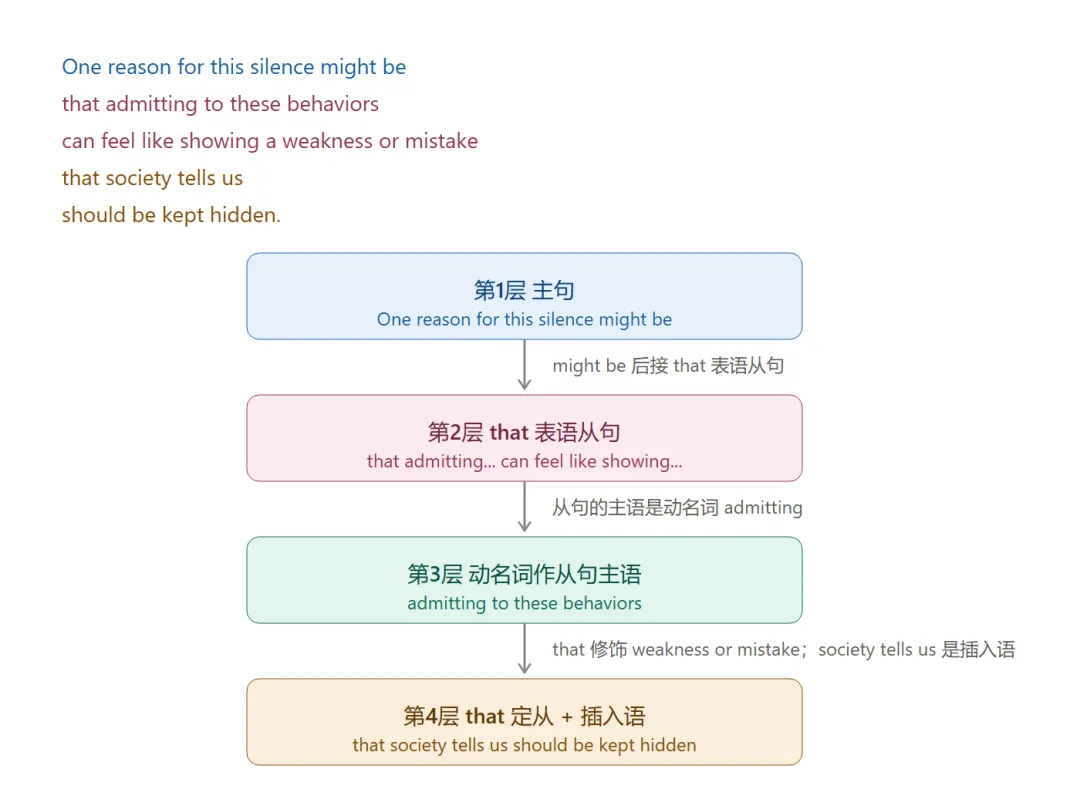
逐层拆解
▪ 第 1 层(主句):One reason for this silence might be
▪ 第 2 层(that 表语从句):that admitting to these behaviors can feel like showing a weakness or mistake —— 系动词 be 后面的从句是表语从句;that 只起引导作用,在从句中不充当成分
▪ 第 3 层(动名词作从句主语):admitting to these behaviors —— 从句主语是"承认这些行为"这件事,不是人
▪ 第 4 层(that 定从 + 插入语):that society tells us should be kept hidden —— that 修饰 weakness or mistake;society tells us 是插入语(还原:society tells us the weakness should be kept hidden);should be kept hidden 被动语态
▪ 本句两个 that 功能不同——第 2 层引导表语从句,第 4 层引导定语从句,全卷嵌套最深处
词汇卡
▪ admit to /ədˈmɪt/ 承认(后接名词/v-ing)
▪ be kept hidden 被隐藏起来(keep + 过去分词表状态)
▪ silence /ˈsaɪləns/ n. 沉默
易错处
1. 两个 that 混为一谈——区分法:去掉 that 后若从句完整,是表语从句/同位语从句;若缺成分,是定语从句
2. society tells us 是插入语,不删掉永远读不顺
3. 从句主语是 admitting(一件事)——动名词作主语
巩固练习
19. The problem is that ______ (spend) too much time online can hurt our eyes.(动名词主语)
20. He is the man that I think ______ (be) honest.(I think 是插入语)
21. 圈出本句的插入语,并抄写删去插入语后的句子。
句 10(D 篇 · 第 2 段末句)
原句
What's more, recognizing this disagreement requires coming face to face with uncomfortable truths about ourselves—a process that is as discouraging as it is necessary for growth.
中文翻译
而且,认识到这种不一致需要我们直面关于自身的、令人不适的真相——这个过程对成长而言,既令人气馁,又不可或缺。
结构图
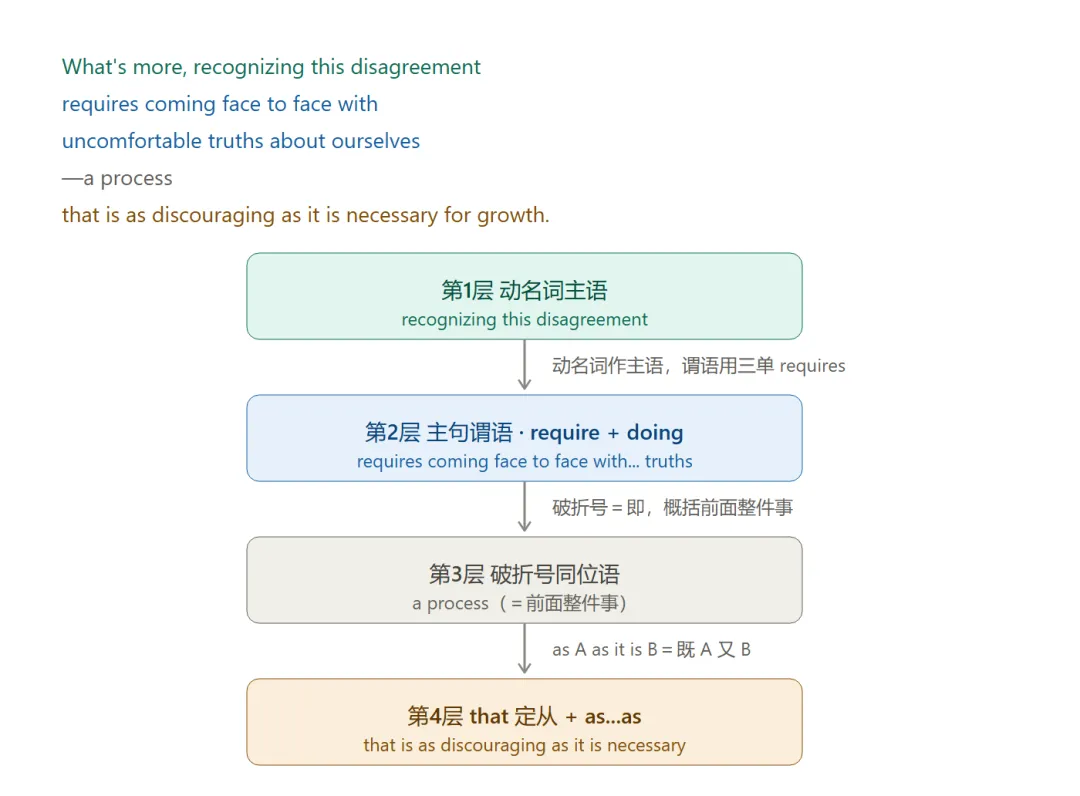
逐层拆解
▪ 第 1 层(动名词主语):recognizing this disagreement —— "认识到不一致"这件事作主语
▪ 第 2 层(主句谓语):requires coming face to face with... truths —— require + doing(不接 to do);come face to face with"直面"
▪ 第 3 层(破折号同位语):a process —— 概括"直面真相"这件事
▪ 第 4 层(that 定从 + as...as):that is as discouraging as it is necessary —— "as A as it is B"结构,=既 A又 B
词汇卡
▪ require /rɪˈkwaɪə(r)/ v. 需要(require doing,同类 need doing)
▪ come face to face with 直面……
▪ discouraging /dɪsˈkʌrɪdʒɪŋ/ adj. 令人气馁的(dis- + courage + -ing)
易错处
1. recognizing 主语 → 谓语三单 requires,漏 s 是写作高频错
2. as discouraging as it is necessary→as A as it is B= 既是 A,又是 B(A、B 多为相反 / 对比形容词)
巩固练习
22. The room requires ______ (clean).(require doing)
23. Learning a language ______ (require) practicing every day.(三单)
句 11(D 篇 · 第 3 段 · 32 题答案依据句)
原句
Research supports the idea that recognizing this disagreement, together with mindfulness and open communication, can help with this process.
中文翻译
研究支持这样一个观点:认识到这种不一致,再加上专注与开放的沟通,能有助于这一转变过程。
结构图
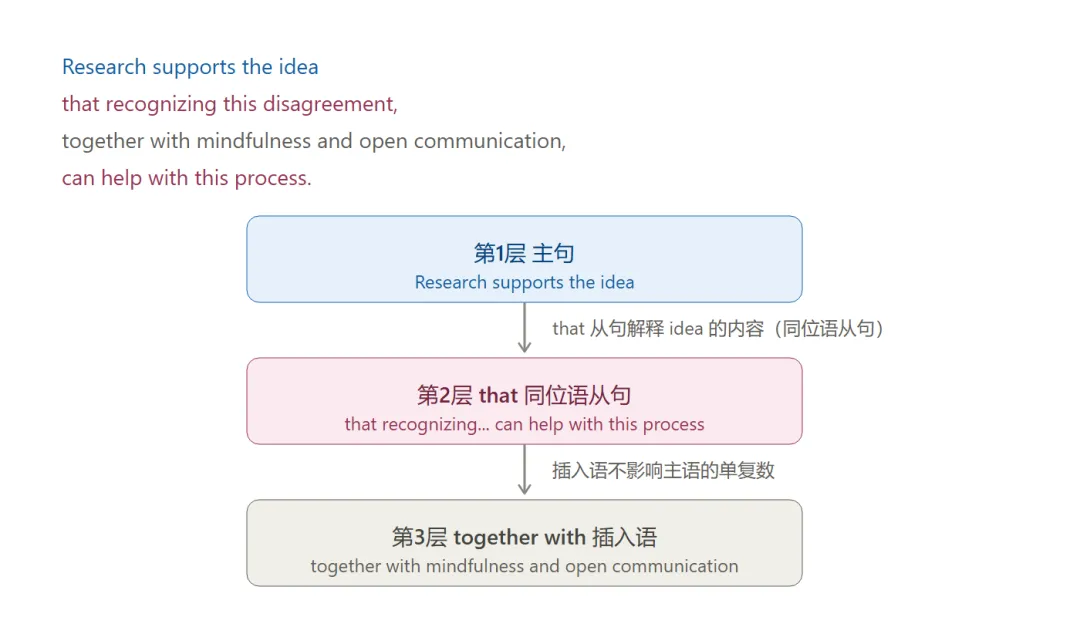
逐层拆解
▪ 第 1 层(主句):Research supports the idea
▪ 第 2 层(that 同位语从句):that recognizing this disagreement... can help with this process —— 解释 idea 的具体内容;that 不在从句中充当成分(与定语从句的区别)
▪ 第 3 层(together with 插入语):together with mindfulness and open communication —— 主语仍是 recognizing,谓语不受插入语影响
▪ 考题关联:32 题答案 Open communication makes it possible for us to change(开放的沟通让我们有可能改变),依据即本句 open communication + can help
词汇卡
▪ mindfulness /ˈmaɪndflnəs/ n. 专注(mind + -ful + -ness)
▪ support the idea that 支持……这一观点
▪ together with 连同;加上(插入语,不影响主谓一致)
易错处
1. 同位语从句与定语从句不分——idea that... 后是从句完整句(不缺成分)→ 同位语从句;that 作从句主语或宾语 → 定语从句
2. together with 后误改谓语
3. help with 固定搭配"有助于",help 后不填 to
巩固练习
24. The news ______ our team had won made us excited.(同位语从句)
25. The idea ______ he told me yesterday is useful.(定语从句,told 缺宾语)
句 12(D 篇 · 第 4 段 · 31 题考的就是这句 ★)
原句
By developing a culture of openness and by understanding the challenges of aligning behaviors with beliefs, we can begin to break down what prevents us from having conversation and change.
中文翻译
通过培养开放的文化、理解让行为与信念保持一致的种种挑战,我们才能开始打破那些阻碍我们对话与改变的东西。
结构图
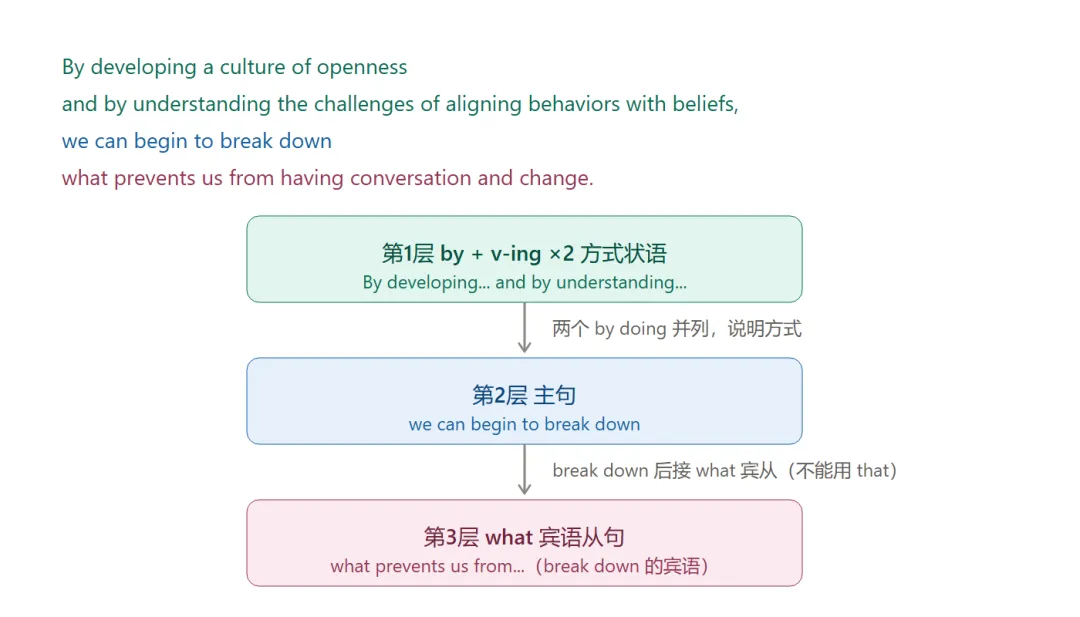
逐层拆解
▪ 第 1 层(by + v-ing ×2 方式状语):By developing a culture of openness and by understanding the challenges —— 两个方式状语并列,说明"怎么做"
▪ 第 2 层(主句):we can begin to break down —— begin to do;break down 此处"打破、消除"(一词多义)
▪ 第 3 层(what 宾语从句):what prevents us from... —— break down 的宾语;what 在从句中作主语;prevent... from doing 固定搭配
▪ 考题关联(31 题 aligning 词义猜测):align behaviors with beliefs"使行为与信念一致"——词义由上下文推出:behaviors 与 beliefs 对齐 → matching(A 项)。答案在句子里,不在词典里
词汇卡
▪ align /əˈlaɪn/ v. 使一致;对齐(31 题要猜的词)
▪ break down 打破;消除(另义:机器出故障、身体垮掉)
▪ prevent... from doing 阻止……做某事
易错处
1. 31 题不能靠背词——align 是"生词",线索全在句内:behaviors 与 beliefs 的关系"对齐"
2. what 不能换 that——break down 后的从句缺主语,只能用 what(that 从句必须成分完整)
3. 两个 by doing 并列易漏第二个 by——and 前后结构对称
巩固练习
26. Nothing can prevent us from ______ (learn) English well.(prevent... from doing)
27. We should face ______ is difficult in our life.(宾语从句缺主语)
28. 猜词练习:Parents should align their words with their actions. 句中 align 意为 ______。(match/使一致)
句 13(D 篇 · 第 5 段末句 · 33 题考的就是这句 ★)
原句
While the disagreement between our inner values and actions may be common, through reflection, understanding and purposeful practice, we can bridge the divide and set out on a journey of self-discovery.
中文翻译
尽管内心价值观与行动之间的不一致可能很常见,但通过反思、理解和刻意的练习,我们能够弥合这道鸿沟,踏上一段自我发现之旅。
结构图
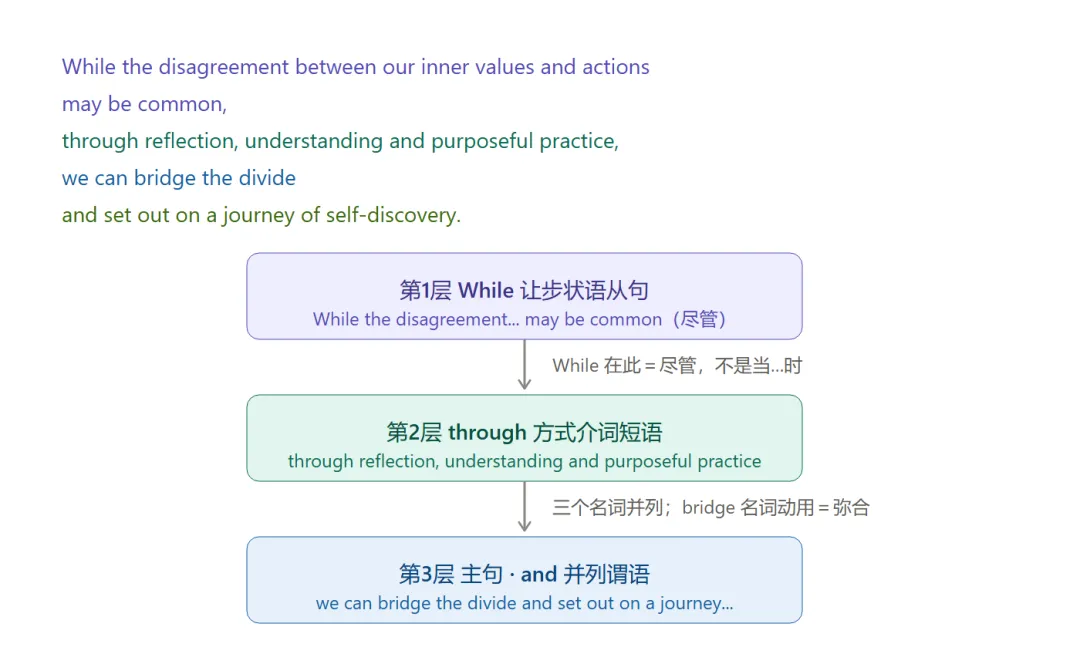
逐层拆解
▪ 第 1 层(While 让步状语从句):While the disagreement... may be common —— While 表"尽管"(不表"当……时");may be common 是状态不是动作,故为让步
▪ 第 2 层(through 方式介词短语):through reflection, understanding and purposeful practice —— 三个名词并列作 through 的宾语
▪ 第 3 层(主句 + and 并列谓语):we can bridge the divide and set out on a journey of self-discovery —— bridge 名词动用"弥合";and 并列 bridge 与 set out
▪ 考题关联:33 题作者写作目的 To encourage people to stay true to their beliefs(鼓励人们忠于自己的信念),结尾句给出正面路径
词汇卡
▪ bridge /brɪdʒ/ v. 弥合
▪ divide /dɪˈvaɪd/ n. 鸿沟;分歧
▪ set out on... 开启……(旅程)
▪ self-discovery /ˌself dɪˈskʌvəri/ n. 自我发现(self- 前缀合成词)
易错处
1. While 表"尽管"还是"当……时"——看从句:may be common 是状态 → 让步
2. bridge 当名词读不通——此处动词"弥合";名词动用近三年真题每年都考
3. 三个并列名词被拆散读——reflection, understanding, purposeful practice 同作 through 的宾语
巩固练习
29. ______ the problem is hard, we will try to solve it.(让步状从)
30. In "we can bridge the divide", the word bridge is used as a ______ (noun / verb).
巩固练习 · 参考答案与简析
1. the keys are —— 宾语从句用陈述语序,不倒装。
2. to get —— 疑问词 + 不定式(how to do)作 know 的宾语,与 what they want 并列。
3. to be —— seem to do 固定用法。
4. which —— in which = where,先行词是 school,介词 in 来自"在学校里学习"。
5. lies —— 主语 the nearest hospital 单数;app 告知的是常态,用一般现在时。
6. in which —— where 改写为介词 + which:The room in which we had the meeting...
7. which / that —— 先行词 a sport 指物,关系代词在从句中作主语。
8. because —— 或许因为堵车,原因状语从句。
9. is —— suggest 表"表明",从句用陈述语气。
10. (should) read —— suggest 表"建议",从句用虚拟语气 (should) + 动词原形;与第 9 题对照记。
11. where —— 先行词 small town 是地点,where 在从句中作状语(spent his childhood somewhere)。
12. using —— 介词 on 后接动名词。
13. 插入语是 I think;删去后:He is the best player in our team.
14. to speak —— encourage sb to do。
15. have experienced —— since I came... 是现在完成时标志。
16. with —— agree with"与……一致"。
17. loves; hates —— who 从句内 but 并列两个谓语,主语 a girl 三单。
18. difficulty —— give in to + 名词,to 不能丢。
19. spending —— 表语从句的主语是动名词"花太多时间上网这件事"。
20. is —— I think 是插入语,删掉后 that 从句 the man is honest 完整。
21. 插入语是 society tells us;删去后:...a weakness or mistake that should be kept hidden.
22. cleaning —— require doing = need to be done,主动形式表被动含义。
23. requires —— 动名词作主语,谓语用第三人称单数。
24. that —— 同位语从句,从句 our team had won 完整,that 不充当成分。
25. that / which —— 定语从句,told 后缺宾语,关系词作宾语。
26. learning —— prevent... from doing。
27. what —— 宾语从句中缺主语(face 的宾语从句),只能用 what。
28. matching/使一致 —— 与 behaviors with beliefs 的"对齐"关系同理。
29. While / Although —— 让步状语从句,"尽管问题很难"。
30. verb —— bridge 此处名词动用,"弥合"鸿沟。
— END —


