
今天给大家介绍一篇高考同源阅读,主角是秦腔名家李梅——她最近在北京中国国家话剧院上演新剧《红河谷》,演一个与秦腔西北根脉相去甚远的西藏女子丹珠。文章来自高考常考的人文艺术-戏曲与表演艺术主题,词数242,蓝思值640L,整体偏B1,难度适中,偏AB设题友好。我们已配好阅读5题、完形15空和高考超纲词预习单,生词标好了,讲起来顺,周测阅读直接进。
语篇分析
【What】 秦腔表演艺术家李梅在北京中国国家话剧院出演新剧《红河谷》,该剧是国家艺术节参演剧目。她舞台生涯超过40年,此次饰演1904年一场战役中命运改变的西藏女子丹珠。为贴近角色,她保留秦腔形式技巧,融入西藏生活化动作,并提出“形式是骨架,生活是血肉,地域是灵魂”。她11岁进戏校,练就吹火等绝技,现执掌陕西省戏曲研究院。
【Why】 本文属于“人与社会”主题语境下的人文艺术-戏曲与表演艺术,课标要求理解文化传承与创新。文章真正要证明的一点是:传统艺术并非静止,创新可以帮它触达新观众,同时守住核心身份。后文主旨和推断题会踩住“形式是骨架,生活是血肉,地域是灵魂”这个比喻,以及“古老但从未静止”的生存条件,理解它们才能把握李梅重塑传统的逻辑。
【How】 文章是新闻特写式说明文,段间逻辑为“事件—准备方法—成长与理念”:首段引出新剧与角色反差,第二段用“To prepare”和直接引语解释改编策略,末段由个人经历及物到秦腔传承。数字(40年、11岁、1904年)、人物身份(李梅、丹珠)、对比处(西北根脉vs西藏背景、传统vs创新)容易成为细节干扰,命题常在此设同义替换或推断支点。
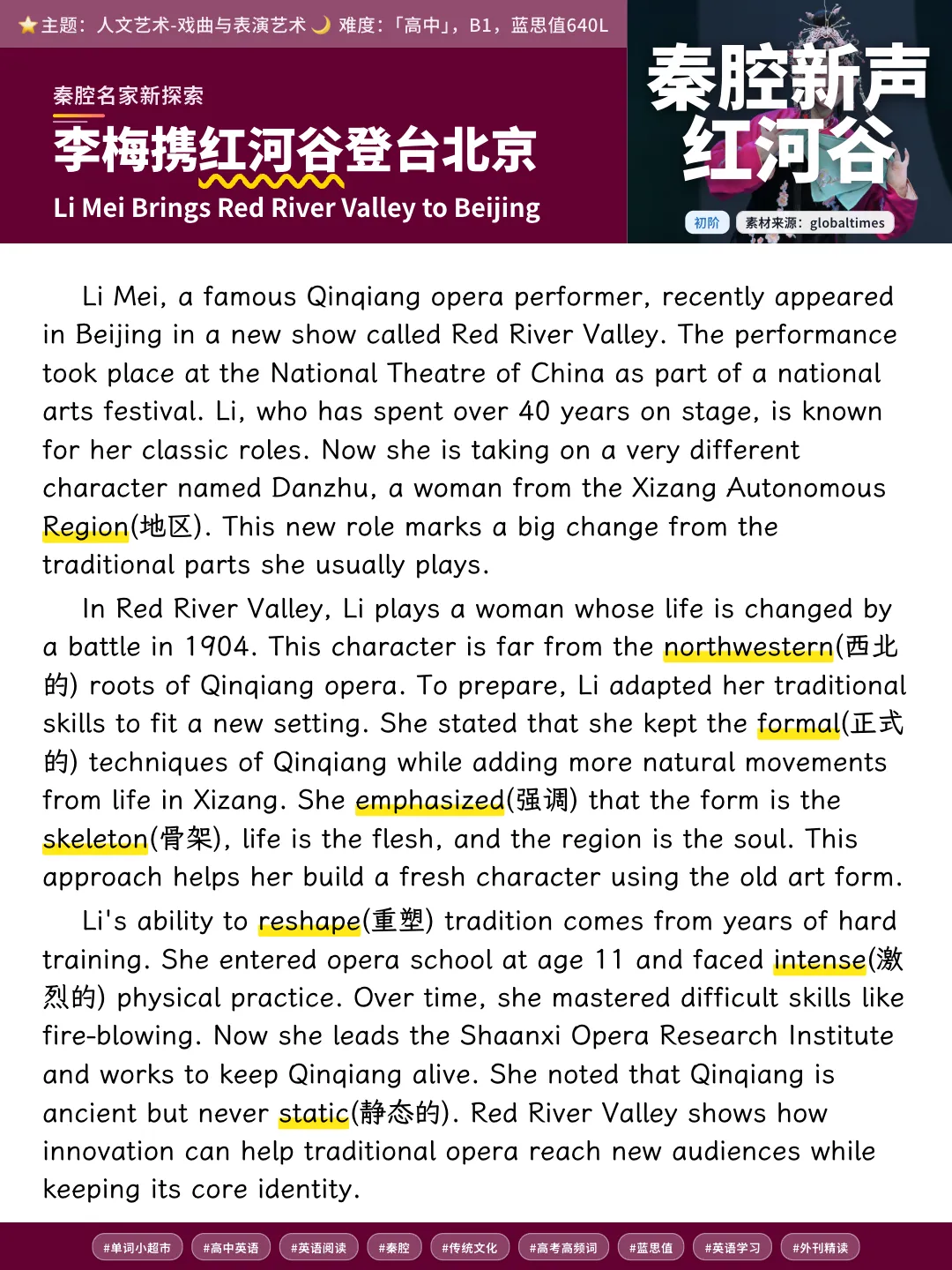
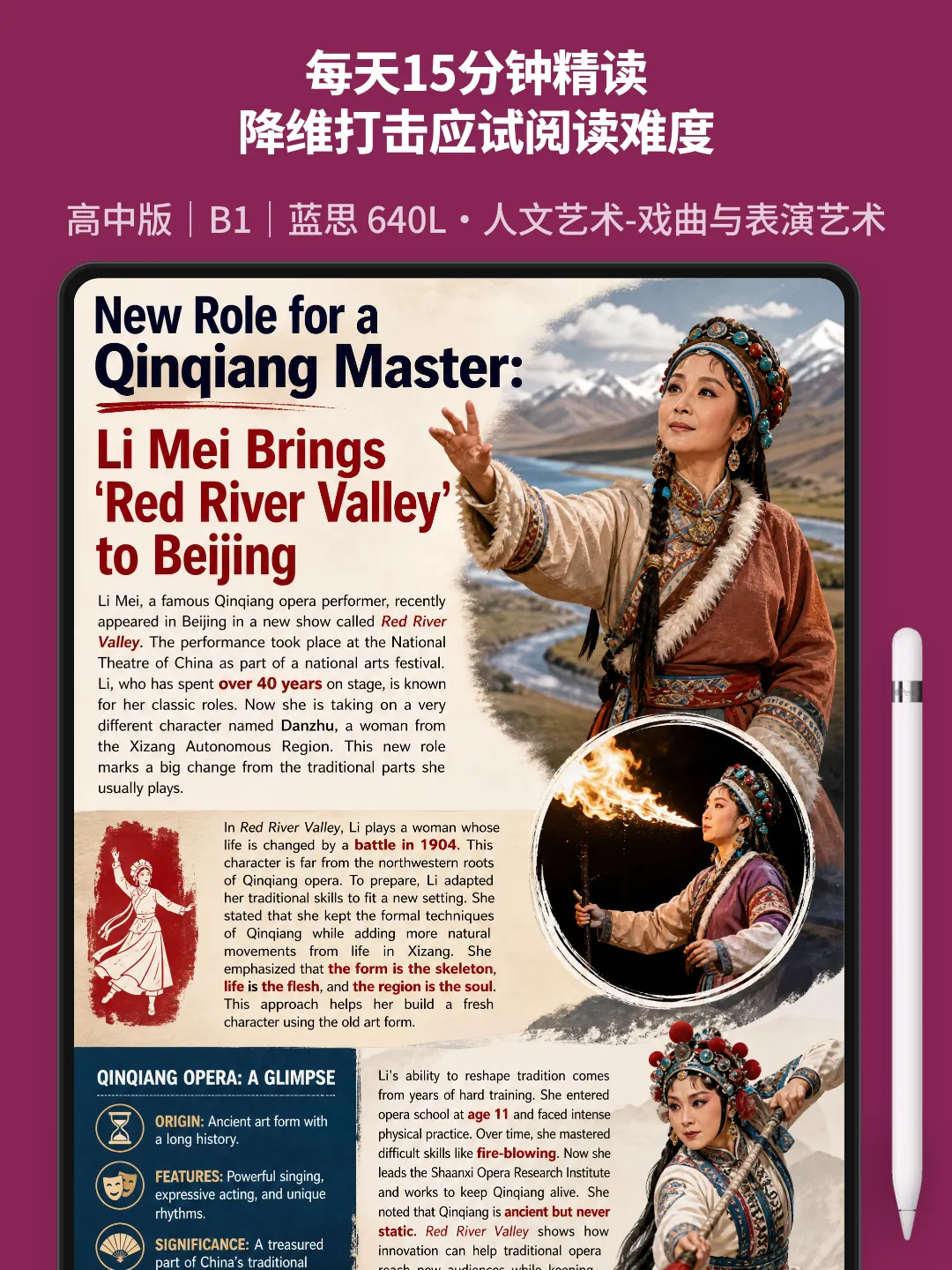
New Role for a Qinqiang Master: Li Mei Brings 'Red River Valley' to Beijing
Li Mei, a famous Qinqiang opera performer, recently appeared in Beijing in a new show called Red River Valley. The performance took place at the National Theatre of China as part of a national arts festival. Li, who has spent over 40 years on stage, is known for her classic roles. Now she is taking on a very different character named Danzhu, a woman from the Xizang Autonomous Region(地区). This new role marks a big change from the traditional parts she usually plays.
In Red River Valley, Li plays a woman whose life is changed by a battle in 1904. This character is far from the northwestern(西北的) roots of Qinqiang opera. To prepare, Li adapted her traditional skills to fit a new setting. She stated that she kept the formal(正式的) techniques of Qinqiang while adding more natural movements from life in Xizang. She emphasized(强调) that the form is the skeleton(骨架), life is the flesh, and the region is the soul. This approach helps her build a fresh character using the old art form.
Li's ability to reshape(重塑) tradition comes from years of hard training. She entered opera school at age 11 and faced intense(激烈的) physical practice. Over time, she mastered difficult skills like fire-blowing. Now she leads the Shaanxi Opera Research Institute and works to keep Qinqiang alive. She noted that Qinqiang is ancient but never static(静态的). Red River Valley shows how innovation can help traditional opera reach new audiences while keeping its core identity.
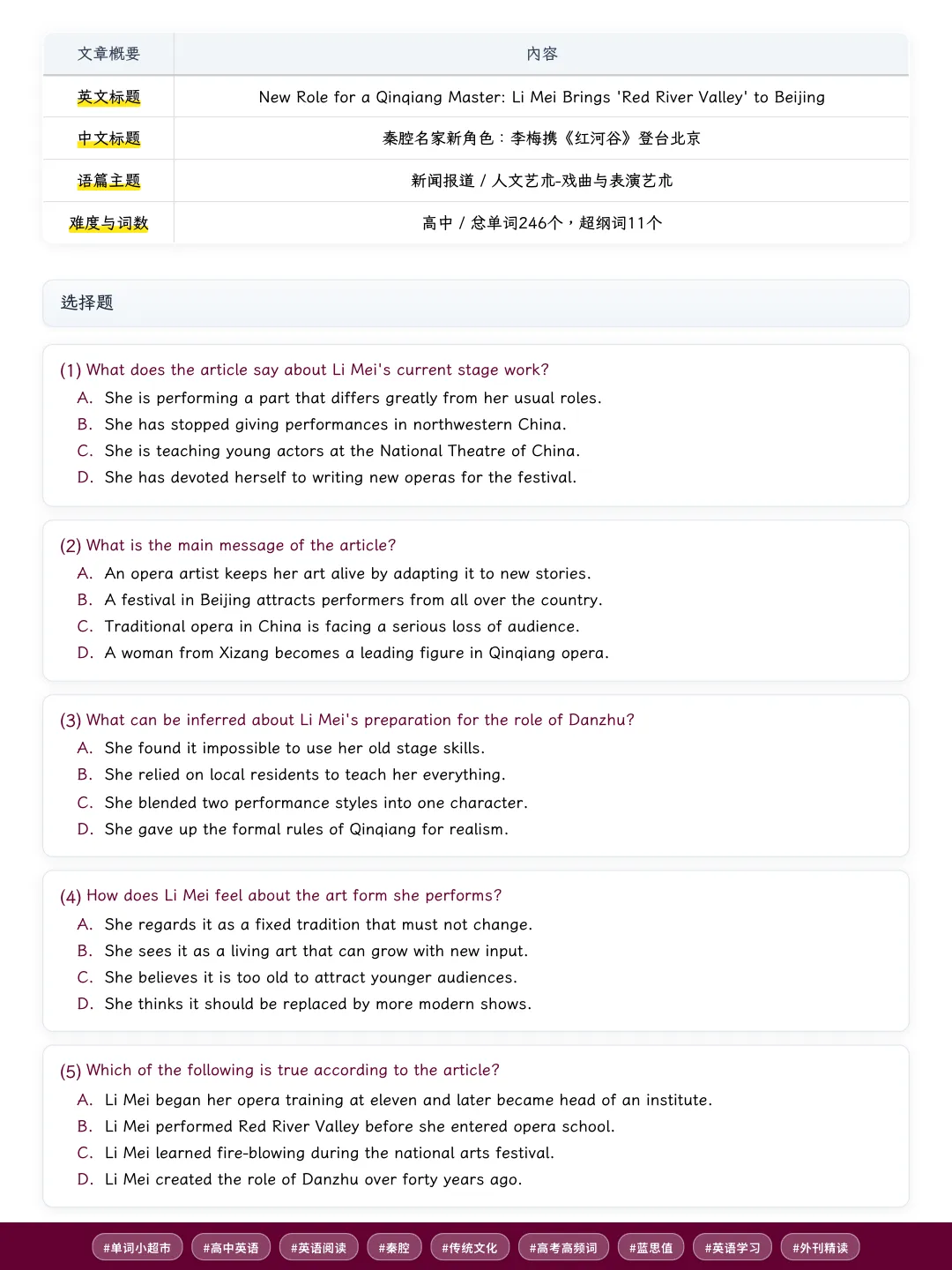
这篇语篇,可以怎么命题?
(1) What does the article say about Li Mei's current stage work?
A. She is performing a part that differs greatly from her usual roles.
B. She has stopped giving performances in northwestern China.
C. She is teaching young actors at the National Theatre of China.
D. She has devoted herself to writing new operas for the festival.
(2) What is the main message of the article?
A. An opera artist keeps her art alive by adapting it to new stories.
B. A festival in Beijing attracts performers from all over the country.
C. Traditional opera in China is facing a serious loss of audience.
D. A woman from Xizang becomes a leading figure in Qinqiang opera.
(3) What can be inferred about Li Mei's preparation for the role of Danzhu?
A. She found it impossible to use her old stage skills.
B. She relied on local residents to teach her everything.
C. She blended two performance styles into one character.
D. She gave up the formal rules of Qinqiang for realism.
(4) How does Li Mei feel about the art form she performs?
A. She regards it as a fixed tradition that must not change.
B. She sees it as a living art that can grow with new input.
C. She believes it is too old to attract younger audiences.
D. She thinks it should be replaced by more modern shows.
(5) Which of the following is true according to the article?
A. Li Mei began her opera training at eleven and later became head of an institute.
B. Li Mei performed Red River Valley before she entered opera school.
C. Li Mei learned fire-blowing during the national arts festival.
D. Li Mei created the role of Danzhu over forty years ago.
这组题为什么这样设计?
这组题在五道选择题里把理解具体信息、理解主旨要义、推断、理解观点态度、词义推断五项技能铺开,不挤在同一段刷细节,老师用它组卷可以同时覆盖学生从定位到概括再到推断的多层阅读能力。
本篇文章阅读理解的命题特点在于:五道题分别踩住角色反差、主旨概括、改编推断、艺术观评价和时间细节,干扰项多由原文信息错位或反向改写而成,能测出学生在同义替换、避免例证冒充中心、区分直说与推断等方面的能力缺口。老师组进人文艺术主题时,这组题既贴近高考同源语篇的命题逻辑,又能稳定暴露学生信息定位与观点推断的薄弱点,用于周测或限时训练都放心。
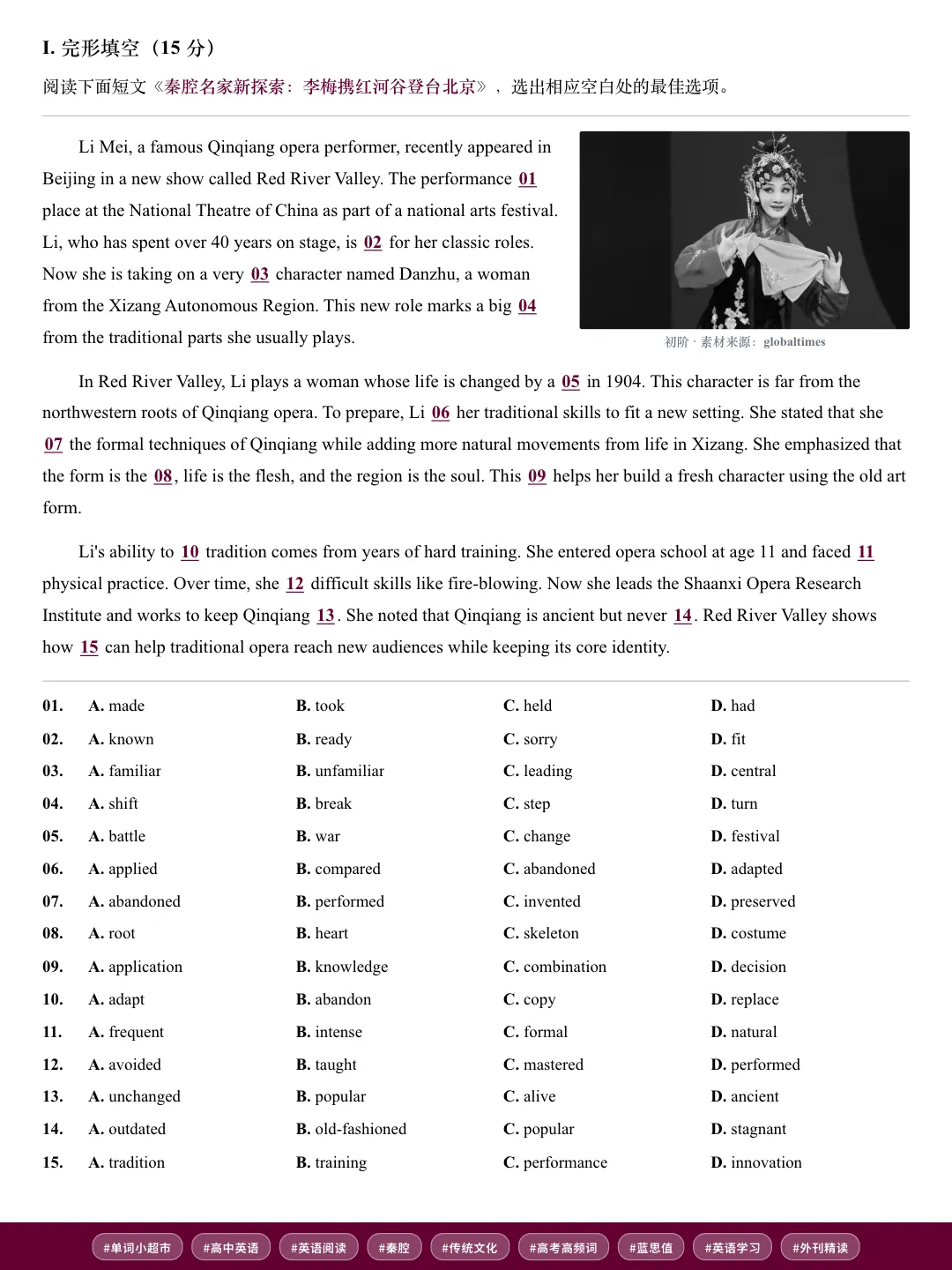
完型填空题目改编(15道)
Li Mei, a famous Qinqiang opera performer, recently appeared in Beijing in a new show called Red River Valley. The performance 1 place at the National Theatre of China as part of a national arts festival. Li, who has spent over 40 years on stage, is 2 for her classic roles. Now she is taking on a very 3 character named Danzhu, a woman from the Xizang Autonomous Region. This new role marks a big 4 from the traditional parts she usually plays.
In Red River Valley, Li plays a woman whose life is changed by a 5 in 1904. This character is far from the northwestern roots of Qinqiang opera. To prepare, Li 6 her traditional skills to fit a new setting. She stated that she 7 the formal techniques of Qinqiang while adding more natural movements from life in Xizang. She emphasized that the form is the 8, life is the flesh, and the region is the soul. This 9 helps her build a fresh character using the old art form.
Li's ability to 10 tradition comes from years of hard training. She entered opera school at age 11 and faced 11 physical practice. Over time, she 12 difficult skills like fire-blowing. Now she leads the Shaanxi Opera Research Institute and works to keep Qinqiang 13. She noted that Qinqiang is ancient but never 14. Red River Valley shows how 15 can help traditional opera reach new audiences while keeping its core identity.
1. A. made B. took C. held D. had
2. A. known B. ready C. sorry D. fit
3. A. familiar B. unfamiliar C. leading D. central
4. A. shift B. break C. step D. turn
5. A. battle B. war C. change D. festival
6. A. applied B. compared C. abandoned D. adapted
7. A. abandoned B. performed C. invented D. preserved
8. A. root B. heart C. skeleton D. costume
9. A. application B. knowledge C. combination D. decision
10. A. adapt B. abandon C. copy D. replace
11. A. frequent B. intense C. formal D. natural
12. A. avoided B. taught C. mastered D. performed
13. A. unchanged B. popular C. alive D. ancient
14. A. outdated B. old-fashioned C. popular D. stagnant
15. A. tradition B. training C. performance D. innovation
本篇文章完型填空的命题特点
本篇文章完型填空的命题特点,按语篇层次展开。开篇以人物身份与演出事件切入,空主要落在句内搭配与句际语义反差上,如演出举行的动词搭配、因经典角色闻名的介词搭配,以及新旧角色之间的方向性对比,选项多能构成表面通顺的短语,须回看同句宾语与上下句关系才能排除。转折段由事件转入准备方法,空集中在跨句复现与近义方向,受益对象、保留与调整的动词选择、骨架与血肉灵魂的比喻体系,都要求追踪前后句的同义与反义线索,而非孤立判断。收束由个人经历及物到秦腔传承,空落在情感基调与主题一致上,从高强度训练到掌握绝技,再到古老却不停滞、创新触达新观众,形成由个体到艺术门类的语义网。整体证据类型包括 from A to B 的升降、受益对象、care of 搭配等,考查学生在语篇约束下恢复信息的能力。
本篇文章完型填空的命题特点,收束到可测出的学生缺口:空上看选项、近义方向不核对数据、把搭配当充分条件。教师可将其与同主题阅读配套印发,用同一语篇检验学生在句内语法、句际逻辑、跨句复现、近义辨析与情感主题五层上的协调能力,从而判断其是真正读懂了语篇,还是仅凭单句语感与固定搭配作答。
文章中文翻译
秦腔名家新角色:李梅携《红河谷》登台北京
著名秦腔表演艺术家李梅最近在北京出演了一部名为《红河谷》的新剧。演出在中国国家话剧院举行,是国家艺术节的一部分。李梅已在舞台上度过四十余年,以经典角色闻名。如今她正扮演一个截然不同的角色——来自西藏自治区的女子丹珠。这个新角色与她通常扮演的传统角色有很大不同。
在《红河谷》中,李梅饰演一位生活因1904年的一场战役而改变的女性。这个角色与秦腔的西北根源相去甚远。为了准备,李梅调整了她的传统技巧以适应新的背景。她表示,她保留了秦腔的形式技巧,同时融入了更多来自西藏生活的自然动作。她强调,形式是骨架,生活是血肉,地域是灵魂。这种方法帮助她用古老的艺术形式塑造出新鲜的角色。
李梅重塑传统的能力源于多年的刻苦训练。她11岁进入戏校,经历了严格的体能训练。随着时间的推移,她掌握了吹火等困难技巧。如今她带领陕西省戏曲研究院,致力于让秦腔保持活力。她指出,秦腔古老但从未静止。《红河谷》展示了创新如何帮助传统戏曲在保持核心特色的同时触达新观众。
高考超纲词
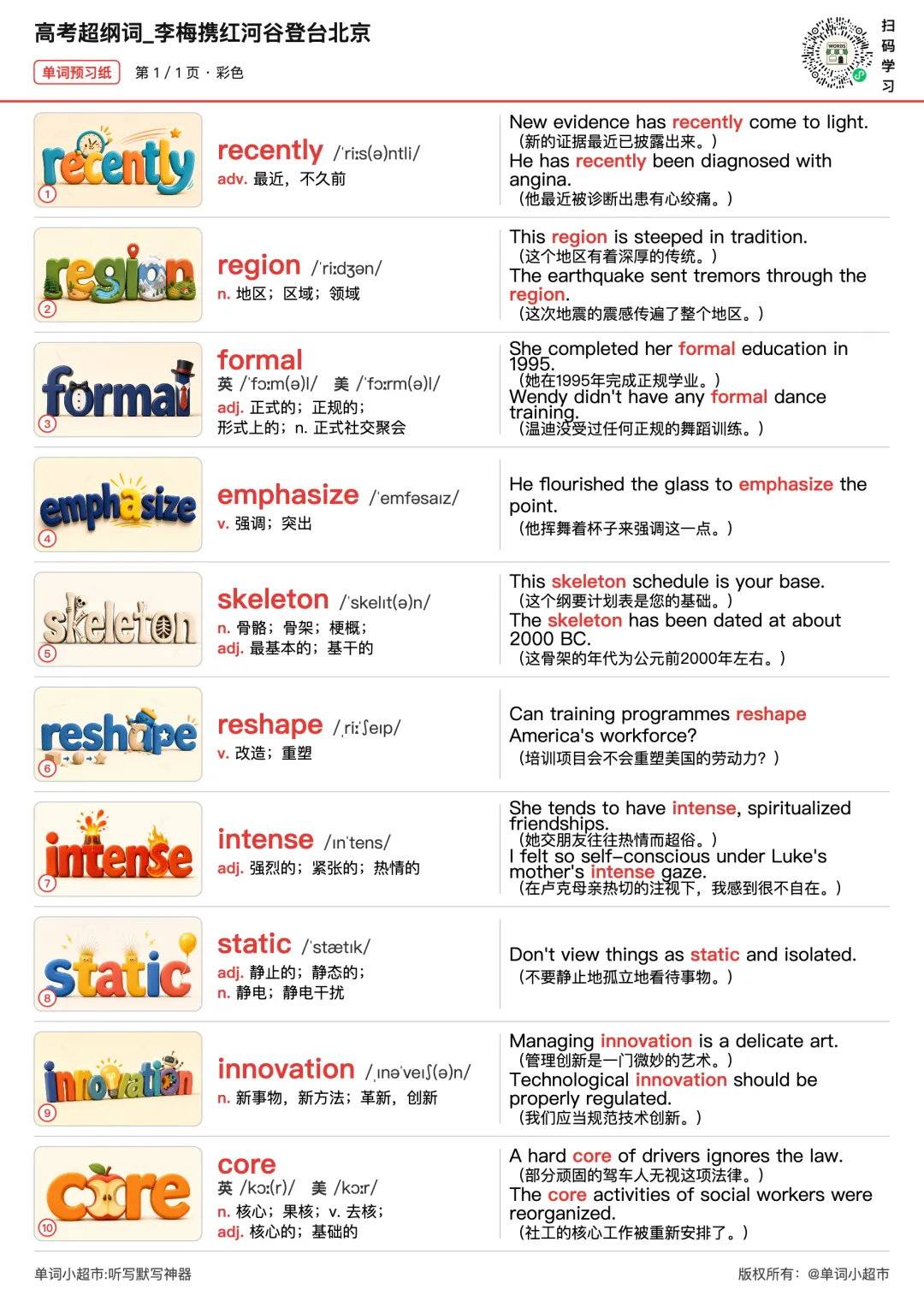
这份词表里,真正影响本文理解的是几个跟「传承与创新」这条主线绑在一起的词。我挑了 formal、skeleton、reshape、static、core 这五个,先盯住它们。
/ˈriːs(ə)ntli/ | ||
/ˈriːdʒən/ | ||
/ˈfɔːm(ə)l/ | ||
/ˈemfəsaɪz/ | ||
/ˈskelɪt(ə)n/ | ||
/ˌriːˈʃeɪp/ | ||
/ɪnˈtens/ | ||
/ˈstætɪk/ | ||
/ˌɪnəˈveɪʃ(ə)n/ | ||
/kɔː(r)/ |
超纲词名师点评
我是许乃夫老师,前新东方功勋教师,教了二十多年英语,习惯把词放回句子里看。这篇讲李梅和秦腔,词表里 formal、skeleton、reshape、static、core 最值得讲,因为它们直接支撑文章那句核心比喻和最后一段的结论。
先看 formal 和 skeleton。formal 在词表里是「正式的」,但原文说「kept the formal techniques of Qinqiang」,这里的 formal 不是「正式场合」那个意思,而是「形式上的、程式的」——指秦腔那些固定的表演规范。学生如果只记「正式的」,这句就会读成「她保留了秦腔的正式技巧」,意思偏了。紧接着的 skeleton 更关键:「the form is the skeleton, life is the flesh, and the region is the soul」。skeleton 词典给「骨架」,这里就是骨架,但学生要看出这是个比喻:形式是支撑,生活是血肉,地域是灵魂。这三个词一摆,李梅的创作逻辑就清楚了。
再看 reshape 和 static。reshape 是「重塑」,原文「Li's ability to reshape tradition comes from years of hard training」,重点不是「重新」这个前缀,而是她把旧传统改造成新角色的能力。static 出现在「Qinqiang is ancient but never static」,这个词学生容易只记「静态的」,但这里跟 ancient 对举,意思是「一成不变、停滞不前」。读懂了 static,最后一句「innovation can help traditional opera reach new audiences while keeping its core identity」就顺了。
core 在词表里是「核心」,原文「keeping its core identity」就是守住核心身份。它跟 static 形成对照:可以创新,但不能丢掉根本。老师讲这篇时,不妨让学生先在句子里画出这五个词,再回到「形式是骨架,生活是血肉,地域是灵魂」这句,看看它们怎么互相支撑。学生要做的,不是背中文释义,而是在上下文里验证词义——formal 是不是「正式的」,static 是不是「静态的」,一读句子就知道。
这些词在「单词小超市」里都有对应的听音和例句,可以配合本篇预习单和语境跟读音频,让学生在句子里多过几遍。