
今天给大家介绍一篇高考同源阅读,切口是景德镇:2026年,这座江西城市的瓷业遗址被列入联合国教科文组织《世界遗产名录》,制瓷家族、御窑博物院与外国驻留艺术家同时进入报道。文章属人文艺术-传统文化遗产主题,词数204,蓝思值约820L,难度定位B2,偏AB;已配阅读5题、完形15空和高考超纲词预习单,基础班可主练,提高班加一题刚好。
语篇分析
【What】 江西景德镇被称“瓷都”两千余年,2026年其瓷业遗址列入联合国教科文组织《世界遗产名录》。陈青家族约1860年起制瓷,一项技术或需近百年打磨;御窑博物院用人工智能匹配、重建古瓷片。大学项目与驻留计划吸引意大利艺术家马西等前来,中国艺术家黄琪认为申遗给艺术家信心。
【Why】 文章落在“文化遗产保护与传承”主题语境,真正要证明的不是申遗本身,而是这门手艺靠人活着:家族世代传技、博物院用技术复原、外来艺术家回到训练之根,三条线共同支撑“古老工艺仍在生长”。后文主旨与推断的支点,是“回到根”这一比喻和“人—技—城”的生存条件。
【How】 体裁为新闻说明,段间呈“荣誉—传承—创新—开放”的递进,末段由城及人。数字(2000年、1860年、近一个世纪)和人物身份(陈青、翁彦俊、马西、黄琪)密集,容易成为细节干扰;家族传承与人工智能复原、本地与外来艺术家的对比处,也常被用来设置推断题。
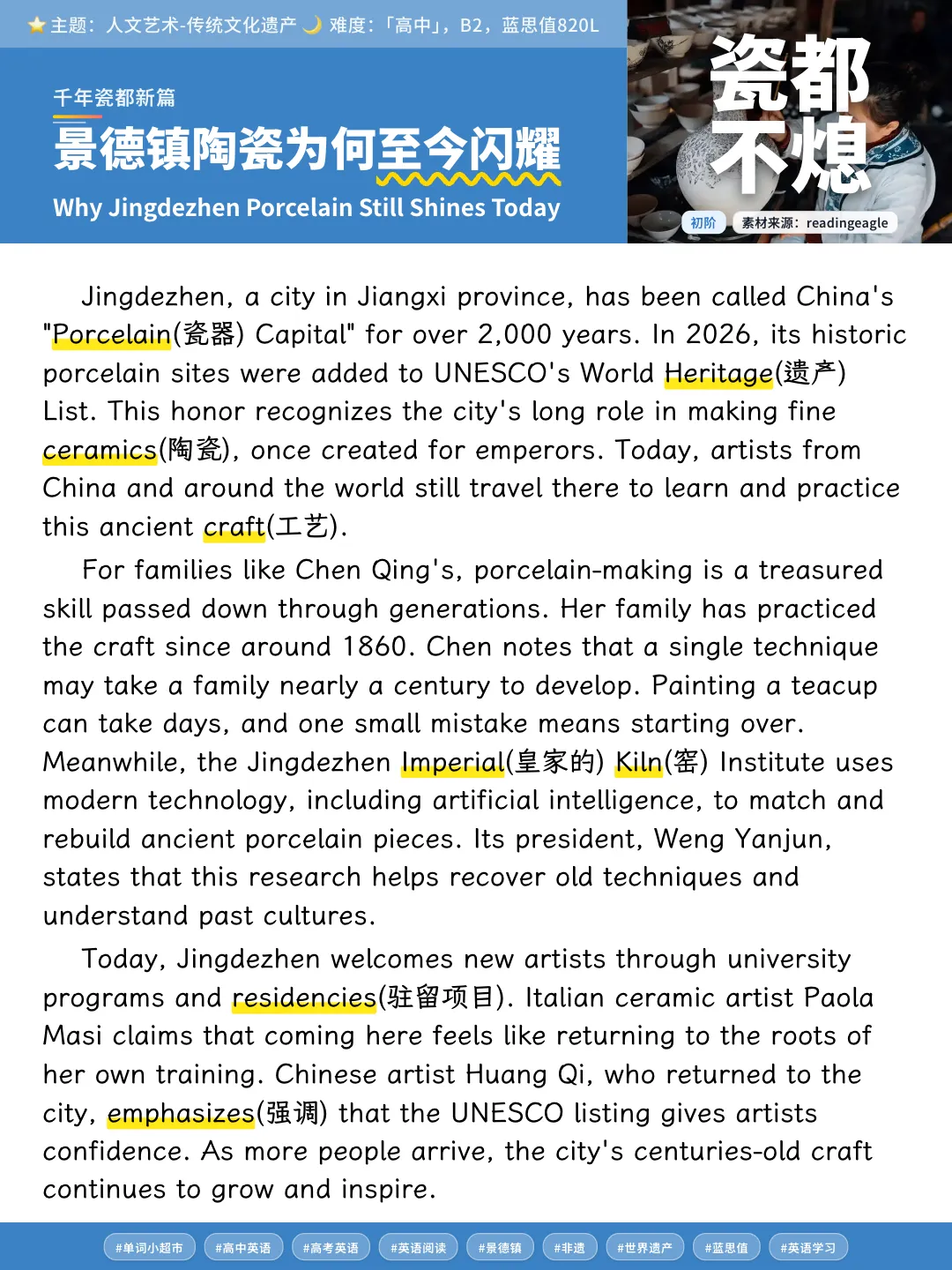
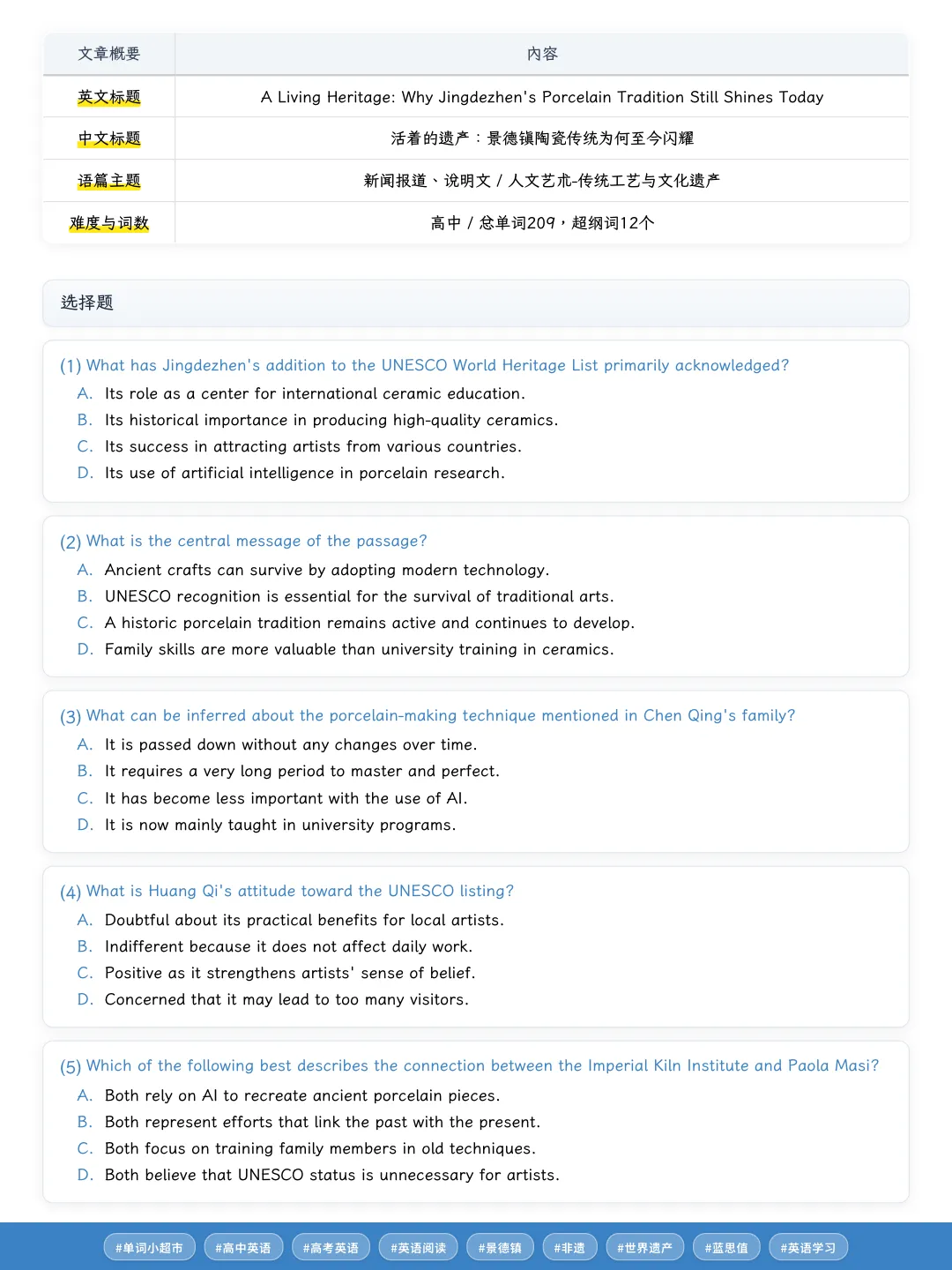
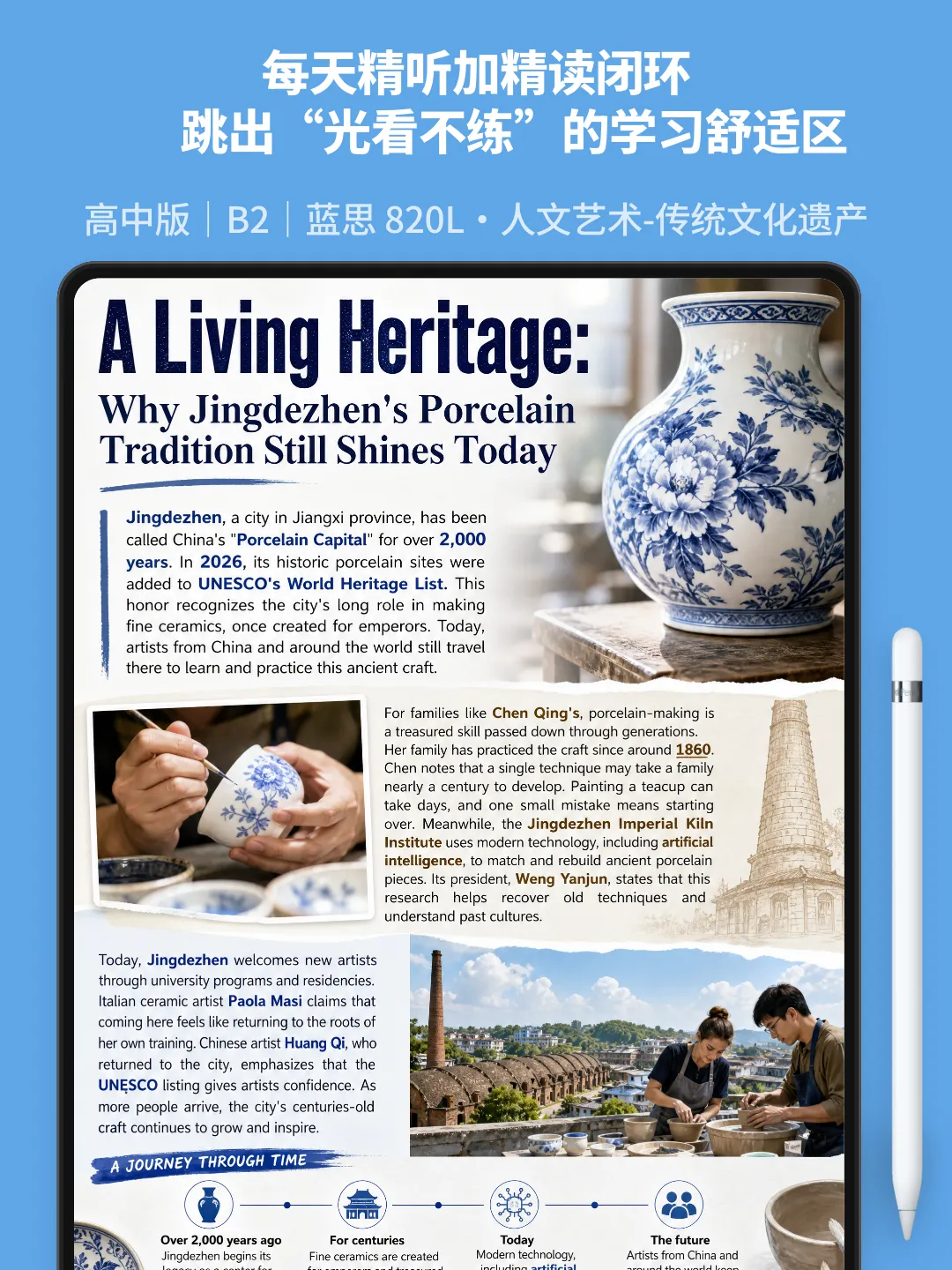
A Living Heritage: Why Jingdezhen's Porcelain Tradition Still Shines Today
Jingdezhen, a city in Jiangxi province, has been called China's "Porcelain(瓷器) Capital" for over 2,000 years. In 2026, its historic porcelain sites were added to UNESCO's World Heritage(遗产) List. This honor recognizes the city's long role in making fine ceramics(陶瓷), once created for emperors. Today, artists from China and around the world still travel there to learn and practice this ancient craft(工艺).
For families like Chen Qing's, porcelain-making is a treasured skill passed down through generations. Her family has practiced the craft since around 1860. Chen notes that a single technique may take a family nearly a century to develop. Painting a teacup can take days, and one small mistake means starting over. Meanwhile, the Jingdezhen Imperial(皇家的) Kiln(窑) Institute uses modern technology, including artificial intelligence, to match and rebuild ancient porcelain pieces. Its president, Weng Yanjun, states that this research helps recover old techniques and understand past cultures.
Today, Jingdezhen welcomes new artists through university programs and residencies(驻留项目). Italian ceramic artist Paola Masi claims that coming here feels like returning to the roots of her own training. Chinese artist Huang Qi, who returned to the city, emphasizes(强调) that the UNESCO listing gives artists confidence. As more people arrive, the city's centuries-old craft continues to grow and inspire.
这篇语篇,可以怎么命题?
(1) What has Jingdezhen's addition to the UNESCO World Heritage List primarily acknowledged?
A. Its role as a center for international ceramic education.
B. Its historical importance in producing high-quality ceramics.
C. Its success in attracting artists from various countries.
D. Its use of artificial intelligence in porcelain research.
(2) What is the central message of the passage?
A. Ancient crafts can survive by adopting modern technology.
B. UNESCO recognition is essential for the survival of traditional arts.
C. A historic porcelain tradition remains active and continues to develop.
D. Family skills are more valuable than university training in ceramics.
(3) What can be inferred about the porcelain-making technique mentioned in Chen Qing's family?
A. It is passed down without any changes over time.
B. It requires a very long period to master and perfect.
C. It has become less important with the use of AI.
D. It is now mainly taught in university programs.
(4) What is Huang Qi's attitude toward the UNESCO listing?
A. Doubtful about its practical benefits for local artists.
B. Indifferent because it does not affect daily work.
C. Positive as it strengthens artists' sense of belief.
D. Concerned that it may lead to too many visitors.
(5) Which of the following best describes the connection between the Imperial Kiln Institute and Paola Masi?
A. Both rely on AI to recreate ancient porcelain pieces.
B. Both represent efforts that link the past with the present.
C. Both focus on training family members in old techniques.
D. Both believe that UNESCO status is unnecessary for artists.
这组题为什么这样设计?
这组题按“荣誉—传承—创新—开放”四段推进,技能点分散铺开,不挤在同一段刷细节;老师用它组卷,可覆盖具体信息、主旨、推断、态度与跨段关联五类阅读能力。
这组题真正要测的是:学生能否在密集数字与人物身份中锁定核心信息,能否不被局部例证带偏主旨,能否由已知推未知,能否借评价性语言判态度,并跨段建立关联。命题把干扰集中在张冠李戴、例证冒充中心、直说冒充推断三处,正对基础班的常见失分点;提高班加一题即可拉满五技覆盖。老师把它组进文化遗产主题,测的是真阅读能力而非背景知识,用着放心。
完型填空题目改编(15道)
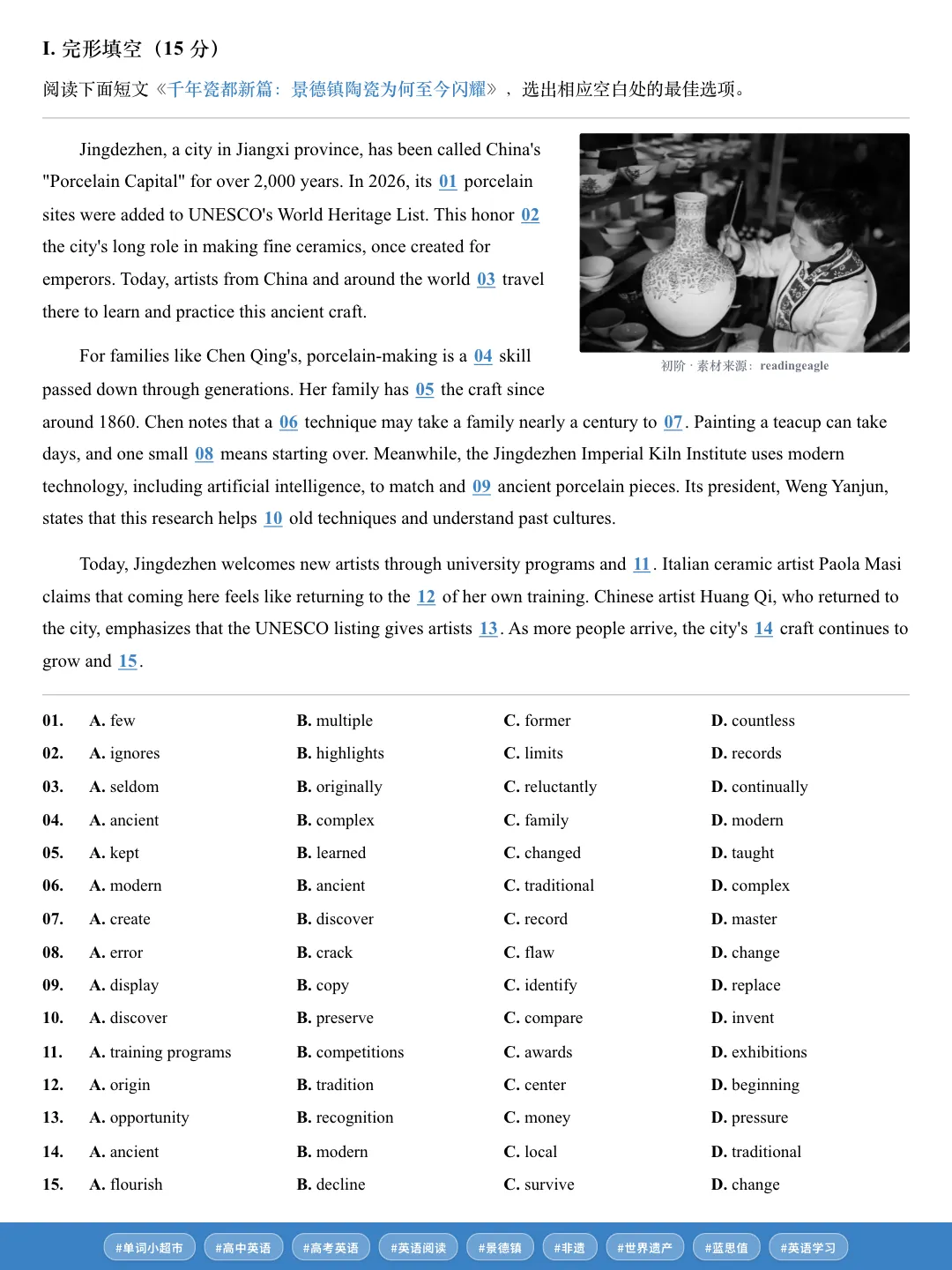
Jingdezhen, a city in Jiangxi province, has been called China's "Porcelain Capital" for over 2,000 years. In 2026, its 1 porcelain sites were added to UNESCO's World Heritage List. This honor 2 the city's long role in making fine ceramics, once created for emperors. Today, artists from China and around the world 3 travel there to learn and practice this ancient craft.
For families like Chen Qing's, porcelain-making is a 4 skill passed down through generations. Her family has 5 the craft since around 1860. Chen notes that a 6 technique may take a family nearly a century to 7. Painting a teacup can take days, and one small 8 means starting over. Meanwhile, the Jingdezhen Imperial Kiln Institute uses modern technology, including artificial intelligence, to match and 9 ancient porcelain pieces. Its president, Weng Yanjun, states that this research helps 10 old techniques and understand past cultures.
Today, Jingdezhen welcomes new artists through university programs and 11. Italian ceramic artist Paola Masi claims that coming here feels like returning to the 12 of her own training. Chinese artist Huang Qi, who returned to the city, emphasizes that the UNESCO listing gives artists 13. As more people arrive, the city's 14 craft continues to grow and 15.
1. A. few B. multiple C. former D. countless
2. A. ignores B. highlights C. limits D. records
3. A. seldom B. originally C. reluctantly D. continually
4. A. ancient B. complex C. family D. modern
5. A. kept B. learned C. changed D. taught
6. A. modern B. ancient C. traditional D. complex
7. A. create B. discover C. record D. master
8. A. error B. crack C. flaw D. change
9. A. display B. copy C. identify D. replace
10. A. discover B. preserve C. compare D. invent
11. A. training programs B. competitions C. awards D. exhibitions
12. A. origin B. tradition C. center D. beginning
13. A. opportunity B. recognition C. money D. pressure
14. A. ancient B. modern C. local D. traditional
15. A. flourish B. decline C. survive D. change
本篇文章完型填空的命题特点
本篇文章完型填空的命题特点,首先体现在以语篇层次统摄设空,而非在单句内做语法填空。开篇以景德镇两千余年的瓷都身份与申遗荣誉切入,设空落在对荣誉性质、遗址数量范围及当下吸引力的判断上,学生须把首段的时间跨度与积极基调作为约束,才能排除与事实或情感相悖的选项。转折段由家族传承转入技术复原,设空密集分布在传承主体、技艺属性、掌握过程与容错代价上,形成由人到技的语义链;其中家族延续与近百年打磨构成时间证据,绘制茶杯与重来构成因果证据,学生若只看搭配是否成立,容易忽略受益对象与动作承受者。收束段由物及人,设空转向开放途径、训练之根、申遗带来的心理效果与城市手艺的走向,要求学生把前文三条线索合并,在近义方向与情感主题之间做最后核对。整体上,句内搭配只是入口,句际逻辑、跨句复现、近义方向与情感基调才是区分层,尤其适合检验学生能否在语篇约束下恢复被删除的信息。
本篇文章完型填空的命题特点,还在于它能测出学生常见的几类缺口:只在空上看选项是否顺眼,不核对前后数据与受益对象;把近义方向当成同义替换,不检查动作主体、结果与评价是否一致;把搭配成立误当充分条件,忽略时间、逻辑与主题约束。正因如此,它适合与同主题阅读配套印发,让教师在同一语篇内同时观察学生恢复信息与理解主旨的能力,而不必另找材料。
文章中文翻译
活着的遗产:景德镇陶瓷传统为何至今闪耀
位于江西省的景德镇,两千多年来一直被誉为中国的“瓷都”。2026年,其历史悠久的瓷业遗址被列入联合国教科文组织《世界遗产名录》。这一荣誉认可了该城市在制作精美陶瓷方面的悠久角色——这些陶瓷曾为皇帝烧制。如今,来自中国和世界各地的艺术家仍然前往那里学习和实践这门古老的手艺。
对于像陈青这样的家庭来说,制瓷是一门代代相传的珍贵技艺。她的家族自1860年左右起就从事这门手艺。陈青指出,一项单一技术可能需要一个家族花费近一个世纪来发展。绘制一个茶杯可能需要数天,而一个小错误就意味着从头开始。与此同时,景德镇御窑博物院利用包括人工智能在内的现代技术来匹配和重建古代瓷器碎片。其院长翁彦俊表示,这项研究有助于恢复古老技术并理解过去的文化。
如今,景德镇通过大学项目和驻留计划欢迎新艺术家。意大利陶瓷艺术家保拉·马西声称,来到这里感觉就像回到她自己训练之路的起点。重返这座城市的中国艺术家黄琪强调,联合国教科文组织的列入给艺术家们带来了信心。随着越来越多的人到来,这座城市的百年手艺继续成长并激发灵感。
高考超纲词
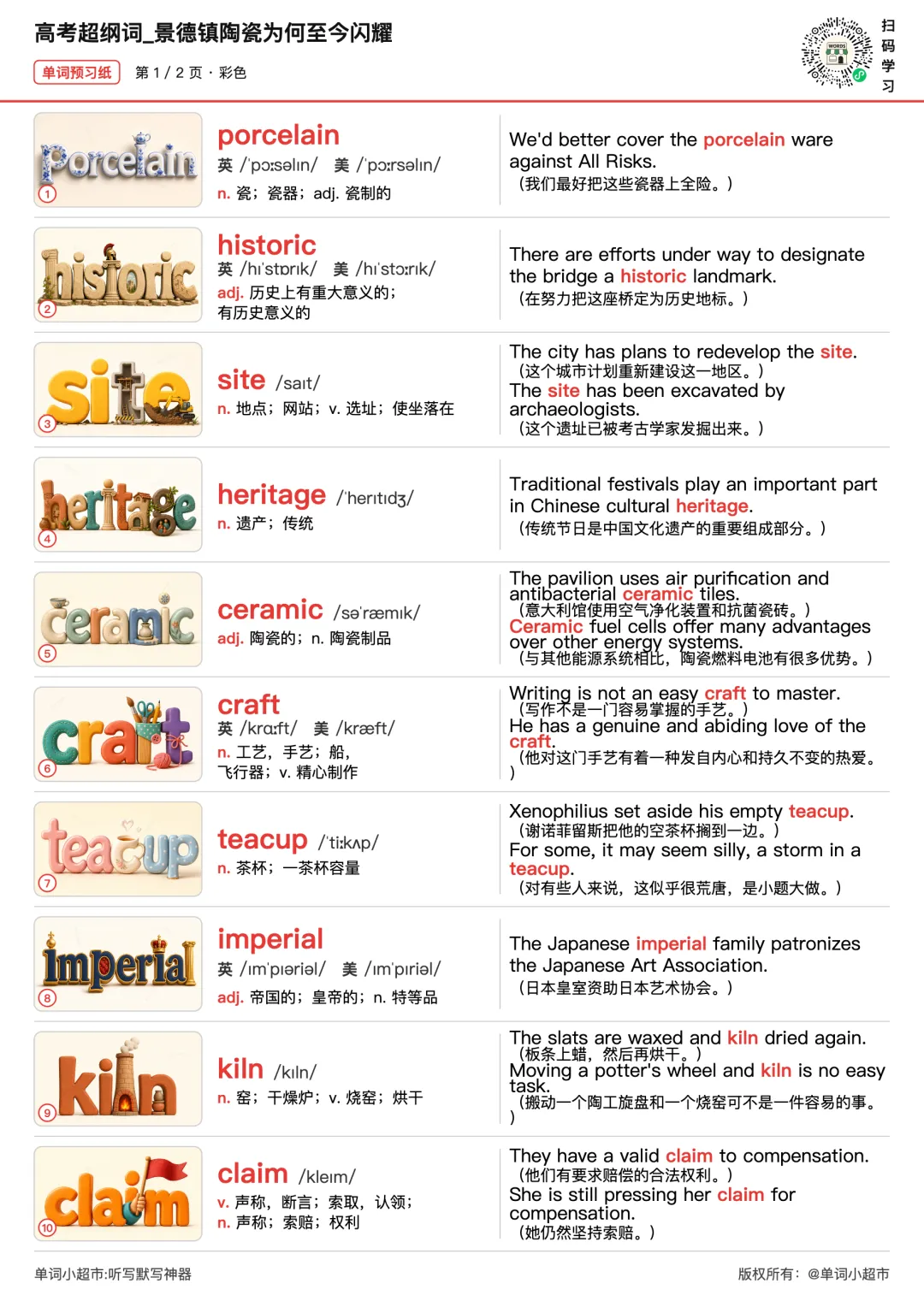
这份词表里,真正会卡住学生理解本文的,其实就那几个:porcelain、heritage、craft、imperial、kiln。其余的词要么学生已经眼熟,要么不影响读句子。咱们把力气花在刀刃上。
/ˈpɔːsəlɪn/ | ||
/hɪˈstɒrɪk/ | ||
/saɪt/ | ||
/ˈherɪtɪdʒ/ | ||
/səˈræmɪk/ | ||
/krɑːft/ | ||
/ˈtiːkʌp/ | ||
/ɪmˈpɪəriəl/ | ||
/kɪln/ | ||
/kleɪm/ | ||
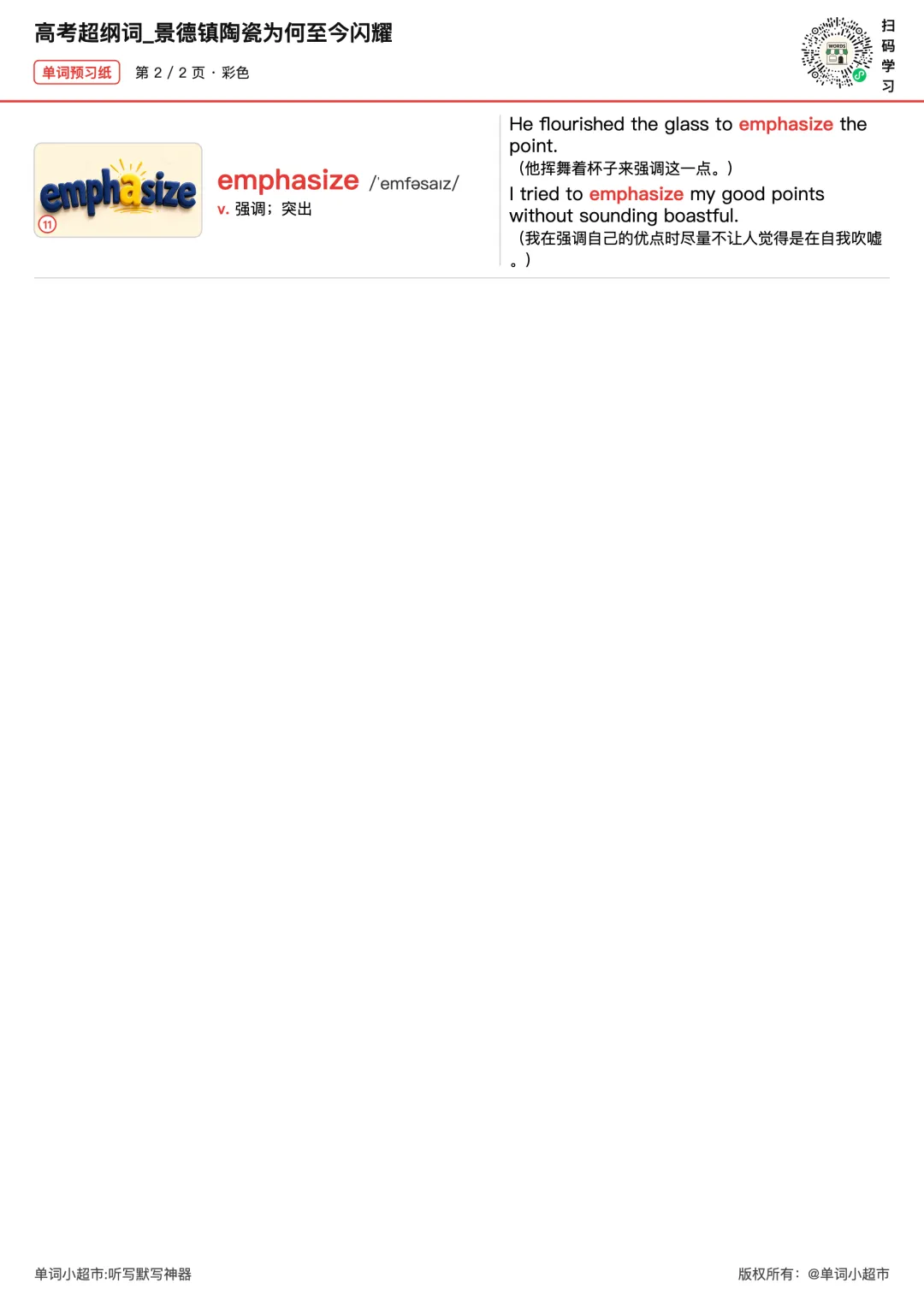
/ˈemfəsaɪz/ |
超纲词名师点评
我是许乃夫老师,前新东方功勋教师,教了二十年新概念,习惯把词放回句子里讲。这篇景德镇申遗的短文,最值得盯的是 porcelain、heritage、craft、imperial、kiln 这几个。
先看 porcelain 和 heritage。porcelain 在标题里就出现了——China's "Porcelain Capital",学生如果只背"瓷器"两个字,读到这里不会有画面感;但把它和 capital 连起来,"瓷都"这个称呼就立住了。heritage 出现在 UNESCO's World Heritage List,这是本文的核心事件。学生容易把它和 legacy、inheritance 混着记,其实这里就是"遗产",而且是带官方认证意味的世界遗产,不是家里传下来的东西。
再看 craft。这个词在文中反复出现:ancient craft、practiced the craft、the city's centuries-old craft。craft 不只是"工艺",它在这篇里是"手艺",是活人手里一代代传下来的东西。学生如果只记"船"那个义项,读到这里会绕弯。
imperial 和 kiln 放在一起看。Jingdezhen Imperial Kiln Institute,学生看到 imperial 可能只想到"帝国",但这里指的是"皇家的"——御窑,给皇帝烧瓷器的窑。kiln 这个词发音和拼写都容易让学生发怵,但它在句子里就是"窑",和 porcelain 搭配出现,理解上并不难。
最后说 claim 和 emphasize。这两个词本身不难,但 claim 在文中是"声称",emphasize 是"强调",都是引出人物观点的动词。学生读这类文章时,往往把注意力放在生词上,反而漏掉了这些"小词"在逻辑上的作用——谁在说、说了什么、为什么这么说。
老师们用这份词表时,不必让学生逐个查词典。先让他们在句子里猜,猜完再对照;学生要做的,是把词放回原文,看它在这个语境里到底承担什么意义。单词小超市里配了本文的预习单和语境跟读音频,学生可以边听边在句子里验证这些词,比孤立背词表管用得多。