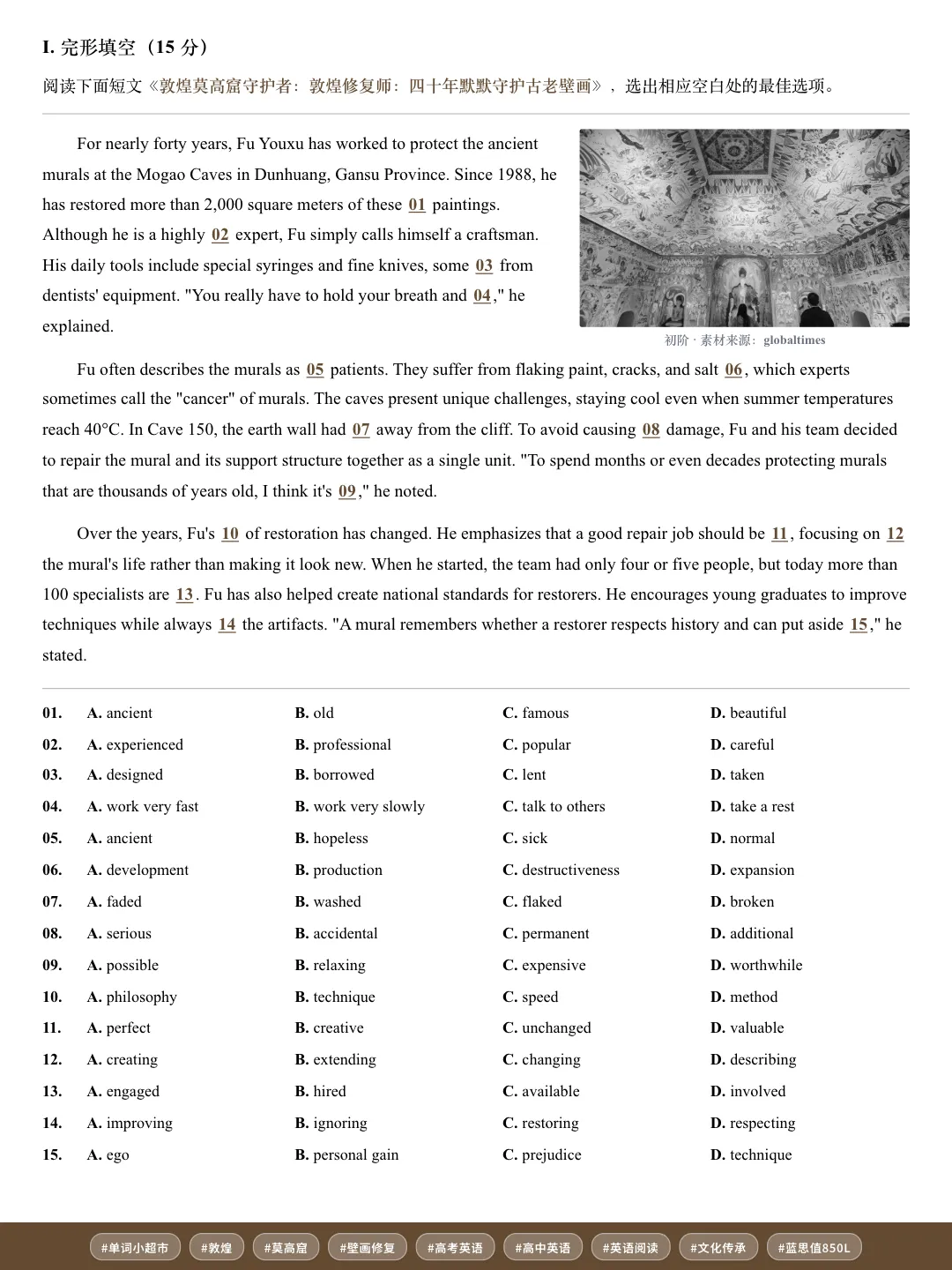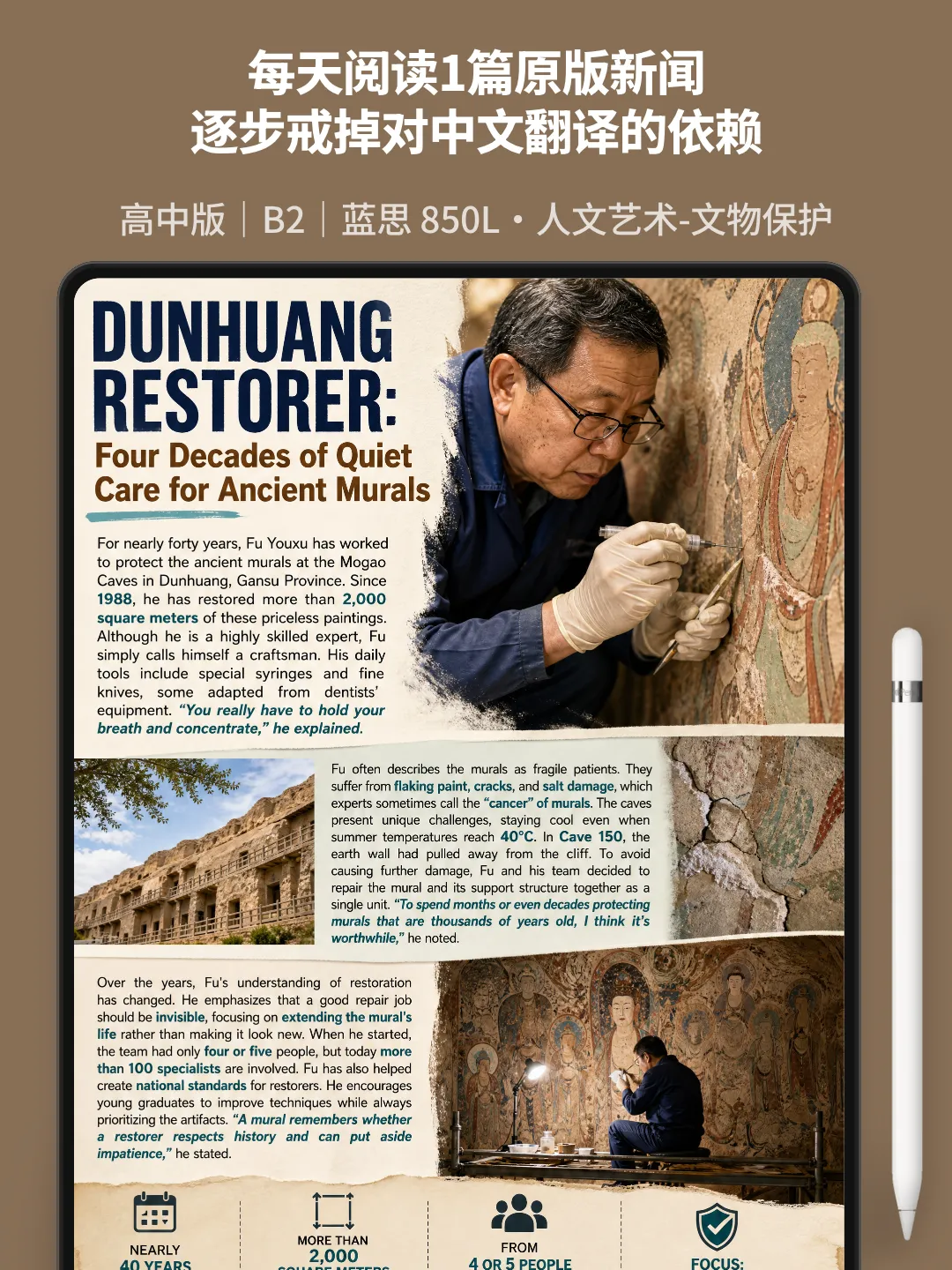

今天给大家介绍一篇高考同源阅读,讲的是敦煌莫高窟的修复师付有旭。他在甘肃敦煌守护古代壁画近四十年,用牙医设备改造的工具,把壁画当作脆弱的病人来修复。文章来自外媒对这位文物修复师的报道,属于课标“人文艺术-文物保护”主题,词数248,蓝思值850L,难度B2,偏AB。已配好阅读5题、完形15空和超纲词预习单,基础班主练阅读,提高班加一题刚好。
语篇分析
【What】 付有旭在甘肃敦煌莫高窟修复古代壁画近四十年,自1988年起修复超过2000平方米。他用特制注射器和精细刀具,把壁画比作脆弱的病人,面对剥落、开裂和盐害。在第150窟,土墙与崖体脱离,他和团队将壁画与支撑结构作为整体修复。团队从四五人发展到100多名专家,他还参与制定修复师国家标准。
【Why】 文章属于“人文艺术-文物保护”主题语境,真正要证明的是:好的修复是看不见的,重点在延长壁画寿命而非焕然一新。后文主旨和推断会踩住“壁画是脆弱的病人”这个比喻,以及“修复师是否尊重历史、能否摒弃急躁”这一生存条件——文物会记住修复者的态度。
【How】 体裁为新闻特写,段间逻辑清晰:首段引入人物与工具,第二段用比喻和具体洞窟挑战展开,第三段用But式转折呈现修复理念变化。数字(2000平方米、40°C、100多名)和人物身份(工匠、专家)容易成为细节干扰,对比处(修复前后、团队规模变化)需留意。
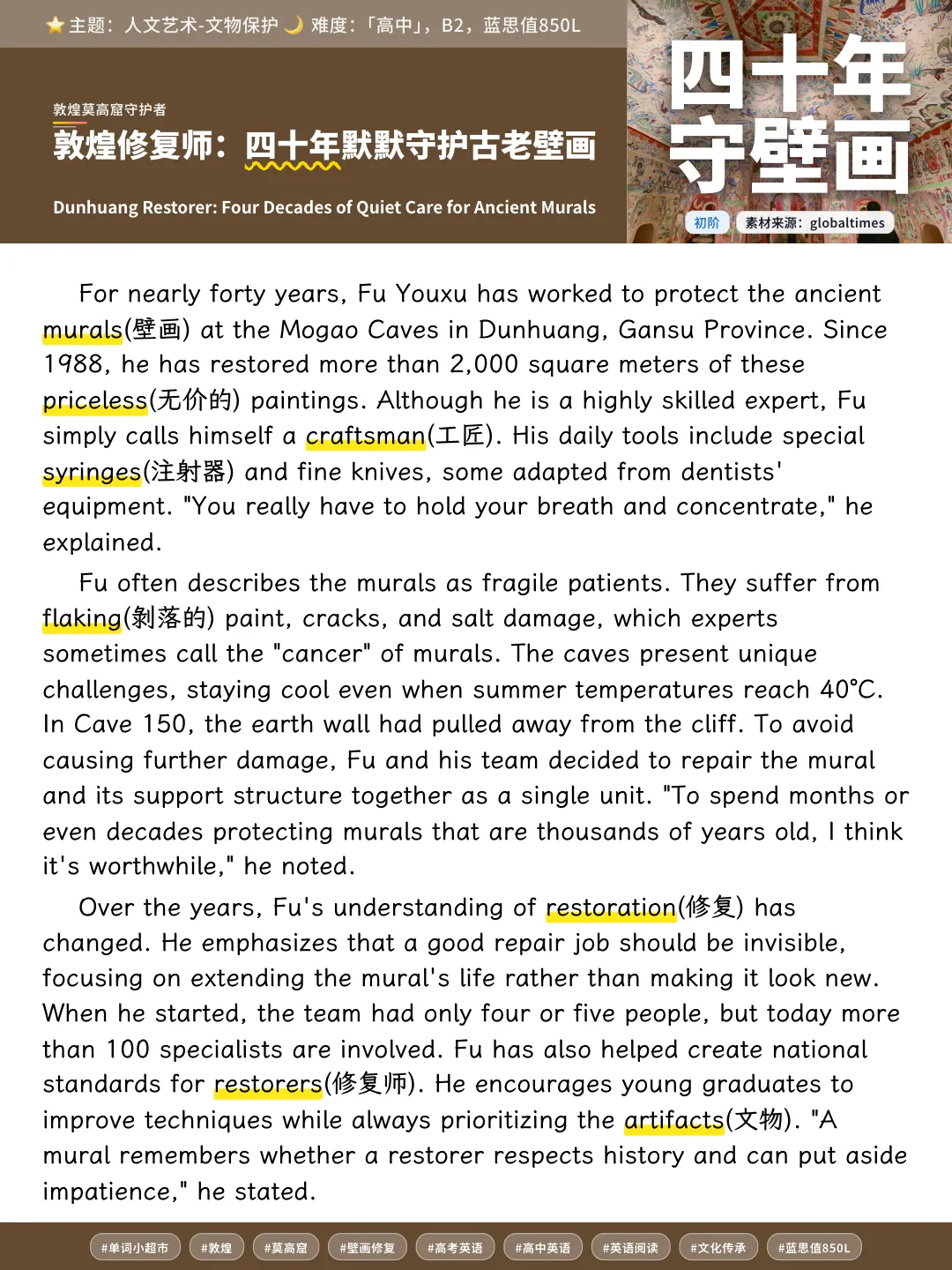
Dunhuang Restorer: Four Decades of Quiet Care for Ancient Murals
For nearly forty years, Fu Youxu has worked to protect the ancient murals(壁画) at the Mogao Caves in Dunhuang, Gansu Province. Since 1988, he has restored more than 2,000 square meters of these priceless(无价的) paintings. Although he is a highly skilled expert, Fu simply calls himself a craftsman(工匠). His daily tools include special syringes(注射器) and fine knives, some adapted from dentists' equipment. "You really have to hold your breath and concentrate," he explained.
Fu often describes the murals as fragile patients. They suffer from flaking(剥落的) paint, cracks, and salt damage, which experts sometimes call the "cancer" of murals. The caves present unique challenges, staying cool even when summer temperatures reach 40°C. In Cave 150, the earth wall had pulled away from the cliff. To avoid causing further damage, Fu and his team decided to repair the mural and its support structure together as a single unit. "To spend months or even decades protecting murals that are thousands of years old, I think it's worthwhile," he noted.
Over the years, Fu's understanding of restoration(修复) has changed. He emphasizes that a good repair job should be invisible, focusing on extending the mural's life rather than making it look new. When he started, the team had only four or five people, but today more than 100 specialists are involved. Fu has also helped create national standards for restorers(修复师). He encourages young graduates to improve techniques while always prioritizing the artifacts(文物). "A mural remembers whether a restorer respects history and can put aside impatience," he stated.
这篇语篇,可以怎么命题?
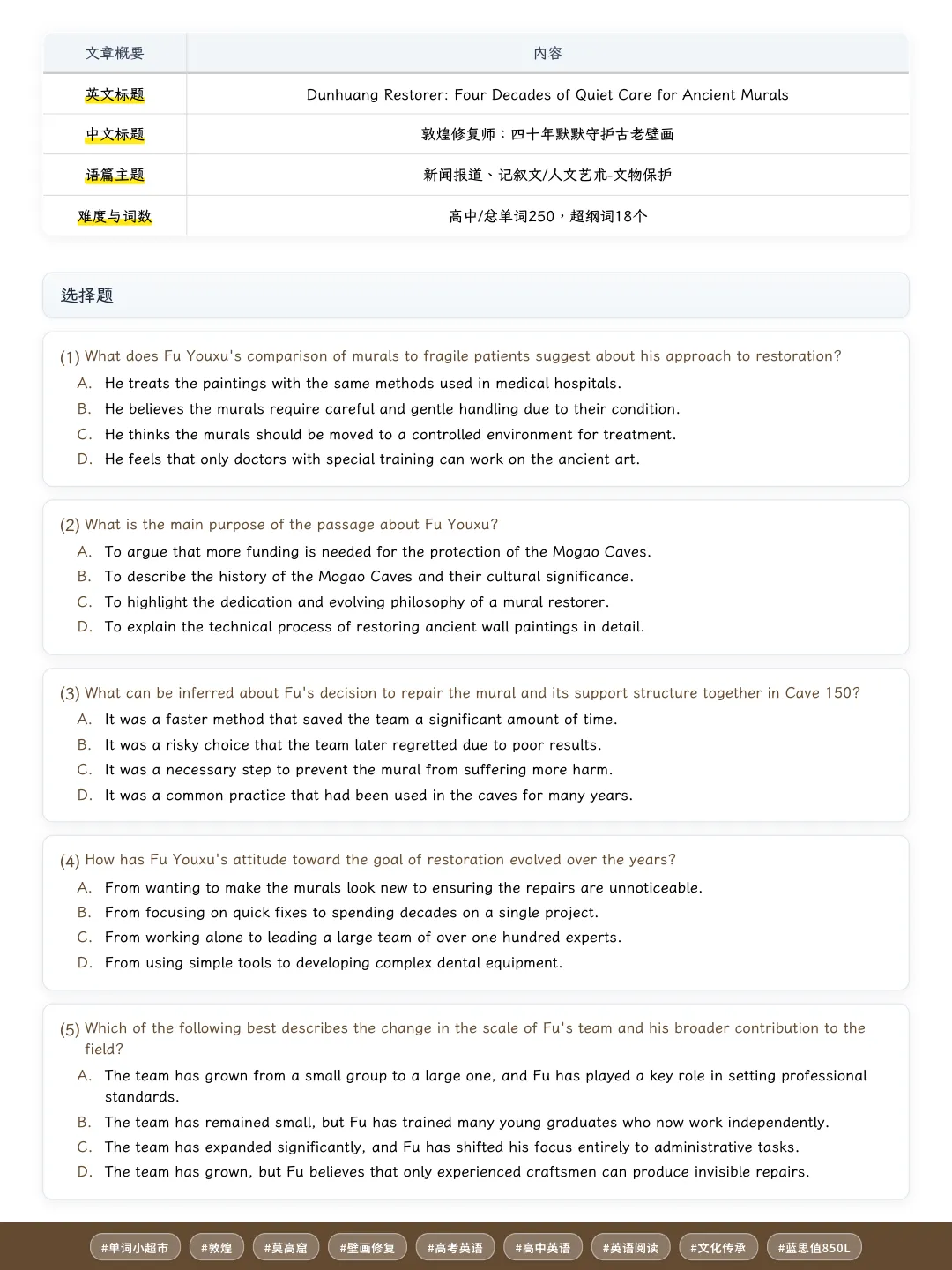
(1) What does Fu Youxu's comparison of murals to fragile patients suggest about his approach to restoration?
A. He treats the paintings with the same methods used in medical hospitals.
B. He believes the murals require careful and gentle handling due to their condition.
C. He thinks the murals should be moved to a controlled environment for treatment.
D. He feels that only doctors with special training can work on the ancient art.
(2) What is the main purpose of the passage about Fu Youxu?
A. To argue that more funding is needed for the protection of the Mogao Caves.
B. To describe the history of the Mogao Caves and their cultural significance.
C. To highlight the dedication and evolving philosophy of a mural restorer.
D. To explain the technical process of restoring ancient wall paintings in detail.
(3) What can be inferred about Fu's decision to repair the mural and its support structure together in Cave 150?
A. It was a faster method that saved the team a significant amount of time.
B. It was a risky choice that the team later regretted due to poor results.
C. It was a necessary step to prevent the mural from suffering more harm.
D. It was a common practice that had been used in the caves for many years.
(4) How has Fu Youxu's attitude toward the goal of restoration evolved over the years?
A. From wanting to make the murals look new to ensuring the repairs are unnoticeable.
B. From focusing on quick fixes to spending decades on a single project.
C. From working alone to leading a large team of over one hundred experts.
D. From using simple tools to developing complex dental equipment.
(5) Which of the following best describes the change in the scale of Fu's team and his broader contribution to the field?
A. The team has grown from a small group to a large one, and Fu has played a key role in setting professional standards.
B. The team has remained small, but Fu has trained many young graduates who now work independently.
C. The team has expanded significantly, and Fu has shifted his focus entirely to administrative tasks.
D. The team has grown, but Fu believes that only experienced craftsmen can produce invisible repairs.
这组题为什么这样设计?
这组题在技能铺排上刻意错开:主旨、推断、态度、细节与词义各占其位,不把五道题挤在同一段里刷细节。老师拿它组卷,能同时覆盖学生获取具体信息、把握人物特写主旨、由已知推未知、辨识态度演变和依托语境理解关键词这几项能力。
这组题真正要测的是学生能否在人物特写里分清主干与例证、由已知推出未言明之意、识别态度转折,并抵抗数字与身份错位的干扰。命题把细节题控制在两处,把主旨、推断和态度留给需要整合信息的题目,词义线索也藏在比喻和对比中。老师把它组进人文艺术与文物保护主题,既能测出学生信息定位是否扎实,也能暴露推断和态度判断上的能力缺口,用于分层组卷和阶段诊断都比较放心。
完型填空题目改编(15道)
For nearly forty years, Fu Youxu has worked to protect the ancient murals at the Mogao Caves in Dunhuang, Gansu Province. Since 1988, he has restored more than 2,000 square meters of these 1 paintings. Although he is a highly 2 expert, Fu simply calls himself a craftsman. His daily tools include special syringes and fine knives, some 3 from dentists' equipment. "You really have to hold your breath and 4," he explained.
Fu often describes the murals as 5 patients. They suffer from flaking paint, cracks, and salt 6, which experts sometimes call the "cancer" of murals. The caves present unique challenges, staying cool even when summer temperatures reach 40°C. In Cave 150, the earth wall had 7 away from the cliff. To avoid causing 8 damage, Fu and his team decided to repair the mural and its support structure together as a single unit. "To spend months or even decades protecting murals that are thousands of years old, I think it's 9," he noted.
Over the years, Fu's 10 of restoration has changed. He emphasizes that a good repair job should be 11, focusing on 12 the mural's life rather than making it look new. When he started, the team had only four or five people, but today more than 100 specialists are 13. Fu has also helped create national standards for restorers. He encourages young graduates to improve techniques while always 14 the artifacts. "A mural remembers whether a restorer respects history and can put aside 15," he stated.
1. A. ancient B. old C. famous D. beautiful
2. A. experienced B. professional C. popular D. careful
3. A. designed B. borrowed C. lent D. taken
4. A. work very fast B. work very slowly C. talk to others D. take a rest
5. A. ancient B. hopeless C. sick D. normal
6. A. development B. production C. destructiveness D. expansion
7. A. faded B. washed C. flaked D. broken
8. A. serious B. accidental C. permanent D. additional
9. A. possible B. relaxing C. expensive D. worthwhile
10. A. philosophy B. technique C. speed D. method
11. A. perfect B. creative C. unchanged D. valuable
12. A. creating B. extending C. changing D. describing
13. A. engaged B. hired C. available D. involved
14. A. improving B. ignoring C. restoring D. respecting
15. A. ego B. personal gain C. prejudice D. technique
本篇文章完型填空的命题特点
本篇文章完型填空的命题特点,在于以语篇约束下的信息恢复为核心,而非单句语法填空。开篇引入付有旭近四十年的守护与日常工具,空位多落在句内语块与语法约束层,同时通过同指关系与资历反差制造干扰,学生须借助全文对象与让步结构排除仅形式通顺的选项。转折段以壁画如脆弱病人的比喻推进,空位密集考查句际逻辑与近义方向,如病害并列、土墙与崖体分离的动作链、避免额外损伤的修饰关系,要求学生协调多处证据,而非只凭搭配判断。收束段呈现修复理念由技术到态度的变化,空位转向跨句复现与情感主题一致,如修复哲学、延长寿命与尊重历史、摒弃个人名利的呼应。整体设计使选项在语法上大多可成立,但唯一最佳项须同时满足对象、结果与主题评价。
本篇文章完型填空的命题特点,能有效测出学生在语篇约束下恢复信息的真实缺口:空上看选项、近义方向不核对数据、把搭配当充分条件。教师将其与同主题阅读配套印发,可让学生在阅读中先建立文物修复的语篇图式,再回到完形中检验跨句复现与情感主题一致,从而暴露并修补单句思维。
文章中文翻译
敦煌修复师:四十年默默守护古老壁画
近四十年来,付有旭一直致力于保护甘肃敦煌莫高窟的古代壁画。自1988年以来,他已修复了超过2000平方米的珍贵画作。尽管他是一位技艺高超的专家,付有旭却只称自己为工匠。他日常使用的工具包括特制注射器和精细刀具,其中一些还是从牙医设备改造而来的。“你真的必须屏住呼吸,全神贯注,”他解释道。
付有旭常把壁画比作脆弱的病人。它们饱受颜料剥落、开裂和盐害之苦,专家有时将盐害称为壁画的“癌症”。这些洞窟带来了独特的挑战,即使夏季气温达到40摄氏度,洞内依然凉爽。在第150窟,土墙已与崖体脱离。为避免造成进一步损坏,付有旭和团队决定将壁画及其支撑结构作为一个整体进行修复。“花上数月甚至数十年保护这些有着数千年历史的壁画,我认为是值得的,”他指出。
多年来,付有旭对修复的理解发生了变化。他强调,好的修复应该看不出来,重点在于延长壁画的寿命,而不是让它看起来焕然一新。他刚入行时,团队只有四五个人,而如今已有100多名专家参与其中。付有旭还协助制定了修复师的国家标准。他鼓励年轻毕业生改进技术,同时始终把文物放在首位。“壁画会记住修复师是否尊重历史,是否能摒弃急躁,”他表示。
高考超纲词
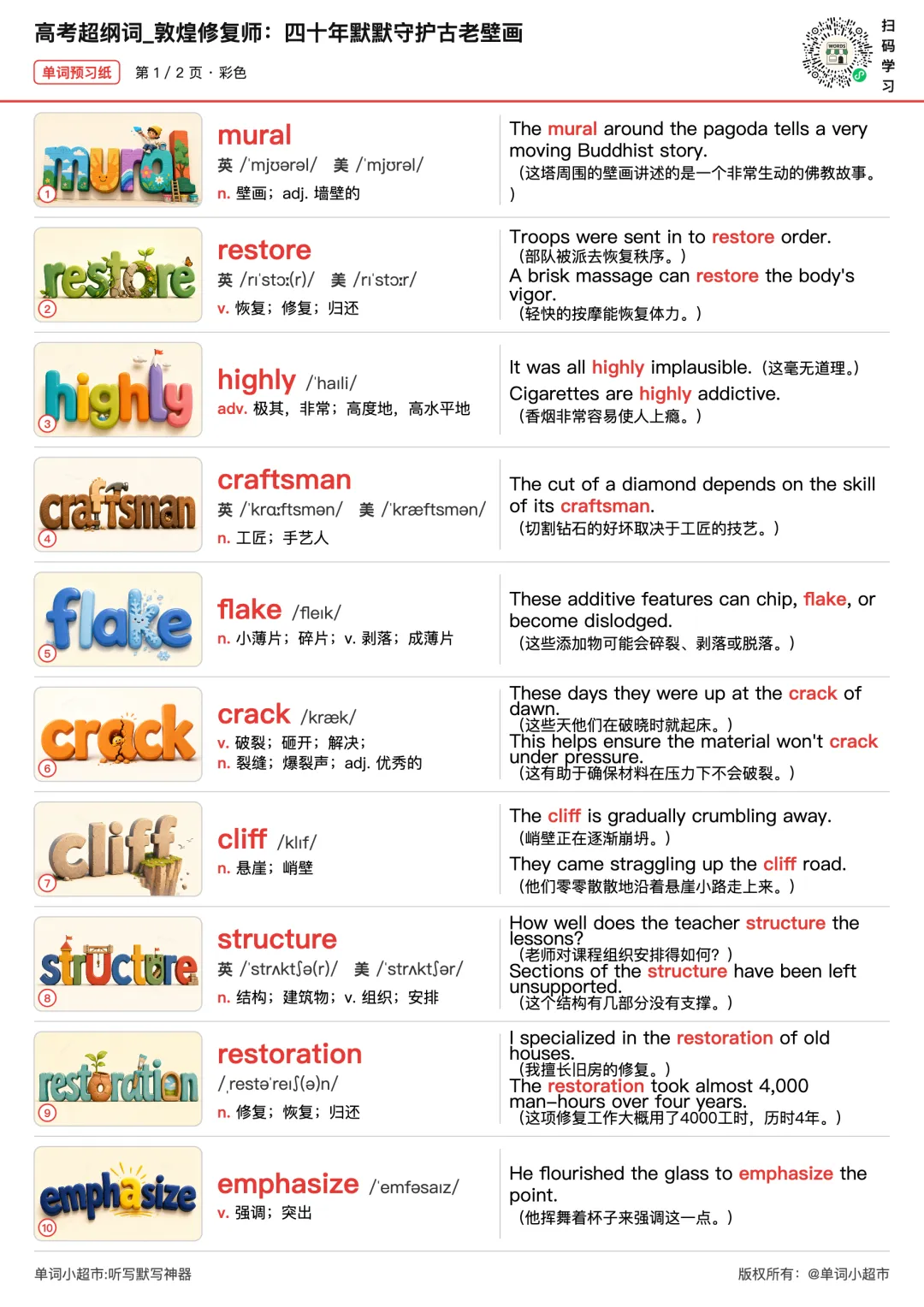
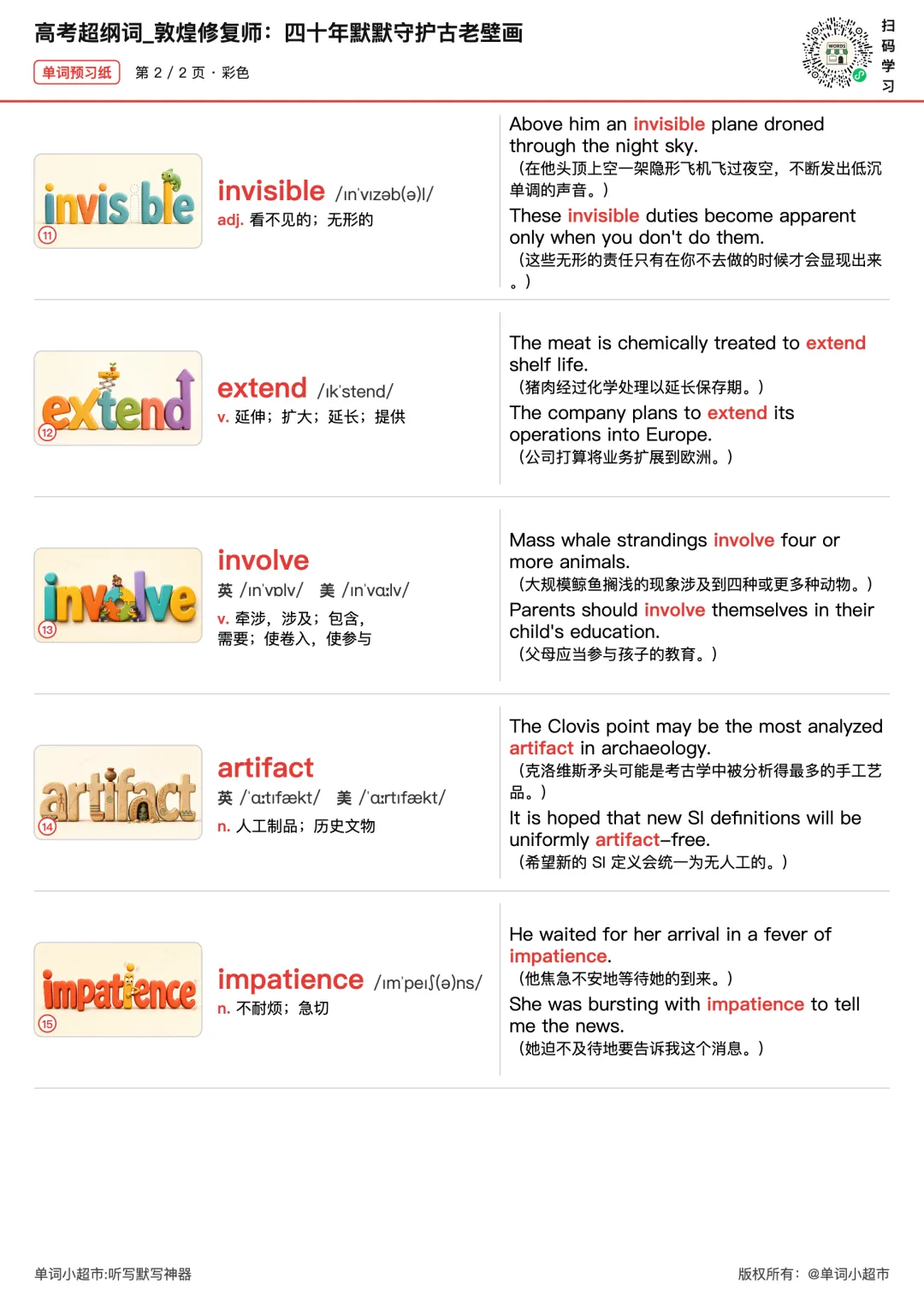
这份词表里,真正值得在课上花时间的是下面这几个:它们要么是本文信息链上的关键词,要么是学生「认识却读不准」的词。
/ˈmjʊərəl/ | ||
/rɪˈstɔː(r)/ | ||
/ˈhaɪli/ | ||
/ˈkrɑːftsmən/ | ||
/fleɪk/ | ||
/kræk/ | ||
/klɪf/ | ||
/ˈstrʌktʃə(r)/ | ||
/ˌrestəˈreɪʃ(ə)n/ | ||
/ˈemfəsaɪz/ | ||
/ɪnˈvɪzəb(ə)l/ | ||
/ɪkˈstend/ | ||
/ɪnˈvɒlv/ | ||
/ˈɑːtɪfækt/ | ||
/ɪmˈpeɪʃ(ə)ns/ |
超纲词名师点评
我是许乃夫老师,前新东方功勋教师,新概念教了二十年。这篇敦煌修复师的阅读,词表里真正值得拎出来讲的是 restoration、artifact、invisible、flake 这一组,它们串起了文章的核心信息:修复的标准是什么、修复师面对的是什么、文物意味着什么。
先看 restoration 和 restore。学生看到 restore 第一反应是「恢复」,于是 restoration 就顺理成章地理解成「恢复原样」。可文章第三段偏偏说:a good repair job should be invisible, focusing on extending the mural's life rather than making it look new。这里的 restoration 不是把壁画变新,而是延长寿命、让修复痕迹看不出来。词义没变,是语境给了它新的侧重。讲这个词,不如直接带学生读那句话,让他们自己发现「修复」和「恢复原样」之间的差距。
invisible 这个词看着简单,但它是理解全文主旨的钥匙。学生认识 visible,加个前缀 in- 就是「看不见的」,可他们不一定意识到,这个「看不见」正是修复师的标准——修得好,观众看不出修过。这就把前文 craftsman 的谦逊和后文 artifact 的尊严连起来了。一个词,撑起一段逻辑。
flake 和 crack 放在一起讲更划算。flaking paint, cracks, and salt damage,三个并列短语写的是壁画「像病人一样」的症状。flake 作动词是「剥落」,学生可能只背过名词「薄片」;crack 作名词是「裂缝」,他们可能只记过动词「破裂」。这种名词动词互相转化的词,放在句子里看词性、看搭配,比背两个释义管用得多。
artifact 是这篇文章的情感落点。He encourages young graduates to improve techniques while always prioritizing the artifacts——技术可以进步,文物始终优先。学生如果只把 artifact 记成「人工制品」,就读不出这句话的分量。
老师在课上不用把整张表扫一遍。挑 restoration、invisible、flake 这三个词,带学生回到原句里读一遍、猜一遍、验证一遍,比逐个报中文释义有效。学生自己验证的方法很简单:把词放回句子,看它前后搭配的是谁、修饰的是什么,词义自然就收窄了。
这些词的听音、配图和例句,我在单词小超市里都配好了,本篇的预习单和语境跟读音频也可以直接发给学生,让他们在句子里再走一遍。